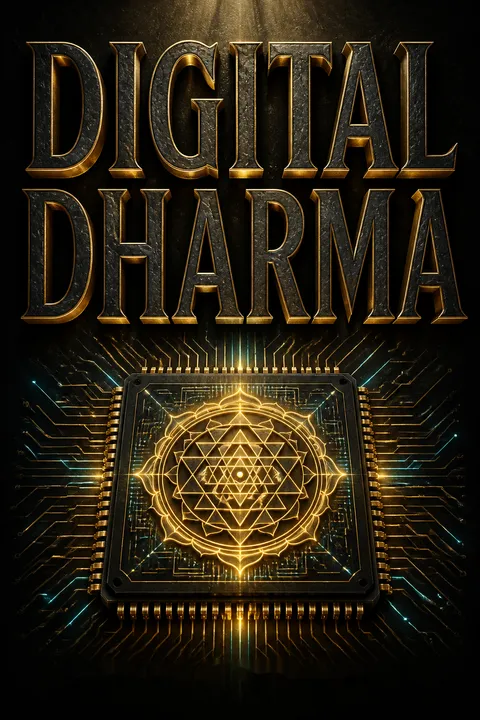


Key Takeaways
Use AI to widen reflection, not to outsource consciousness
A tool, not a sage. Chopra’s starting point is a practical surprise: AI can make spiritual and psychological ideas easier to reach, even though it is not itself conscious or wise. He describes using AI to turn an English video of himself into a Hindi-speaking version, then sees a larger possibility: chatbots can quickly summarize human teachings and help people explore personal questions. He calls the human contribution combined with machine output hybrid intelligence.
The inner work stays human. A chatbot can serve as a prompt, research assistant, or patient sounding board. It cannot live a person’s life, verify every answer, or experience the insight it describes. Its usefulness depends on what a person asks and how thoughtfully the response is considered.
The most persuasive version of this proposal treats AI as a scaffold for reflection, not as a spiritual authority. A good question can help someone name a concern, compare perspectives, or find a starting practice, much as writing can make vague thoughts visible. But fluent language creates an illusion of comprehension: a chatbot can sound compassionate without feeling concern, and confident without being correct. Sensitive disclosures also raise privacy questions, while clinical or urgent problems call for qualified human support. The tool’s value lies in helping people think more clearly, not in granting it the status of a guru.
Define your dharma by lived alignment, not wish-list happiness
A life that fits. Chopra uses dharma for the ideal life a person is meant to live, and personal dharma for the individual path toward it. Rather than equating happiness with more money, status, or pleasure, he asks readers to notice whether life expresses values such as love, creativity, service, and inner steadiness. He cites polling that finds roughly one-third of respondents in developed Western countries say they are thriving, despite material comforts and abundant entertainment.
Your story is not the path. A life story contains accidents, inherited habits, setbacks, social pressure, and choices whose consequences were hard to predict. Chopra argues that personal dharma is less about controlling every event than discovering what feels genuinely right and meaningful within lived experience. The path is personal, and its direction can change as a person grows.
This account usefully shifts the question from “What would make me happy?” to “What kind of life feels coherent with my values?” That resembles values-based approaches in contemporary psychology, where meaningful action matters even when mood is difficult. It also resists the consumer fantasy that the next achievement will settle the question of fulfillment. The limitation is that an inner sense of rightness can be mistaken for comfort, impulse, or inherited expectation. A stronger test pairs felt alignment with consequences: does this choice support one’s responsibilities and relationships, as well as one’s private sense of purpose?
Give chatbots context, and keep steering their answers
Specific questions travel further. A broad request for advice about happiness invites generic advice. Chopra shows that a more useful prompt gives the chatbot a situation, a role or perspective, and a desired format. A person might describe the pressures competing for their time and ask for a short, prioritized set of practical options. The answer can then be refined: ask for simpler wording, request that the bot ask follow-up questions, or redirect it when the response misses the point.
Conversation is adjustable. Unlike a search query, a chatbot exchange can continue through follow-up questions and saved discussion threads. Chopra recommends clear wording, relevant details, a natural conversational tone, and explicit redirection. He presents this as a way to explore concerns while they are fresh, not as a substitute for therapy or professional judgment.
Prompting is best understood as problem formulation. In research, design, and clinical interviews, the answer often improves when the question makes its assumptions and constraints explicit. The same principle applies here: context can produce advice that is more relevant, while follow-up questions expose what the first answer left out. Still, specificity does not guarantee truth. A chatbot may mirror a user’s framing, overlook crucial facts, or invent confidence. For high-stakes decisions, users should ask what information is missing, seek independent sources, and treat recommendations as hypotheses to assess rather than instructions to obey.
Notice stress early and use brief meditation to restore balance
Practice before the crisis. Chopra argues that meditation is easier to use when distraction, pressure, or an old worry first appears, rather than waiting until anxiety has become intense. He calls the intended baseline simple awareness: a calm, open, alert state that is not dominated by mental pressure. In his account, short pauses give the mind and body room to return toward balance, which he connects to homeostasis, the body’s ongoing regulation of internal conditions.
Keep the method modest. He suggests sitting quietly for about five minutes and placing attention either on the body around the heart or on the natural movement of breathing. The aim is not to force silence or eliminate every thought. AI can help someone find a mantra, reflection, or reminder, but the practice itself is the person’s work.
The early-warning approach is a practical strength: people often notice tension, distraction, or irritability before they recognize themselves as overwhelmed. Short pauses can interrupt automatic momentum and create room for a deliberate response. This fits broader mindfulness practice, which trains attention to notice experience without immediately acting on it. The book sometimes treats meditation as a broadly reliable route back to balance, but experiences vary, and meditation is not a cure-all. For some people, especially those with serious distress or trauma, particular practices can feel difficult. Flexibility and professional guidance matter when symptoms persist.
Let uncertainty loosen old routines instead of dictating retreat
Change can open options. Chopra sees resistance to change as a learned defense, shaped by past disappointments, the desire to belong, and the comfort of predictable routines. The opposite is not reckless novelty. It is a willingness to stay curious when circumstances shift and to consider whether an old response still serves. He presents uncertainty as a normal part of creating and evolving, because new ideas and paths cannot always be known in advance.
Separate fear from evidence. A person facing a career change, relationship decision, or unexpected setback can ask what the uncertainty actually signals. Is there a concrete risk to address, or is familiarity itself being mistaken for safety? The book cautions against relying on pain, shame, conformity, or inertia as the main reasons to change. A more durable choice feels connected to a valued direction.
This is a useful corrective to the assumption that certainty must come before action. In learning and creative work, tolerating an unfinished answer can make experimentation possible; premature closure can preserve a bad solution simply because it is familiar. Yet uncertainty is not inherently liberating. It can reflect genuine danger, inadequate information, or unequal power, and telling people to embrace change can ignore those constraints. The practical distinction is between accepting uncertainty as part of decision-making and romanticizing it. Gather what evidence is available, identify what remains unknown, and choose a reversible next step when possible.
Study desire's full cycle before obeying its loudest demand
Desire is not the enemy. Chopra describes the ego as the everyday self organized around “I,” its wants, fears, and need for security. He contrasts it with “It,” his term for deeper awareness and the impulse to grow beyond self-interest. His point is not to eliminate ordinary desire, which is necessary for life, but to notice how desire works: wanting, pursuing, obtaining, feeling satisfaction, and then wanting again.
Ask what fulfillment means. The cycle is natural, as with hunger, but it can become compulsive when a behavior is detached from genuine need. Emotional eating and the endless drive to win illustrate how a short-lived reward can keep a pattern going without lasting satisfaction. Chopra recommends examining impulses, noticing the joy or harm they produce, and giving greater weight to desires rooted in care, service, or creativity.
The cycle gives readers a simple way to distinguish a passing urge from a pattern that keeps demanding more. It connects naturally with behavioral science, which studies how immediate rewards can reinforce actions even when long-term outcomes are poor. The book’s distinction between ego and deeper awareness is spiritually meaningful, but readers need not accept its metaphysics to use the observation exercise. Nor should all strong desires be treated as suspect: ambition, pleasure, and self-protection can be healthy. The useful question is whether a desire serves a chosen value or has become a repetitive chase that narrows choice.
Build resilience by bending, reflecting, and seeking help when needed
Flexibility is learned. Chopra contrasts rigidity, which clings to familiar opinions and plans, with resilience, the capacity to adapt and recover. He asks readers to notice signs of rigidity: bodily tension, repeated arguments, certainty that one must be right, or an automatic refusal to reconsider. Pausing, breathing, and allowing a different response can soften those habits. He also links resilience with empathy, including the ability to treat oneself less harshly.
Old pain deserves attention. A story about a woman who suspected her husband’s infidelity shows how a wound can remain active for years even after a couple appears to reconcile. Chopra distinguishes accommodation from processing: continuing a relationship does not necessarily mean trust has returned. His advice is to meet painful memories with awareness and openness, while remaining willing to seek professional help for persistent or severe distress.
Resilience is often misunderstood as enduring more, when it can instead mean changing course, accepting support, or refusing an unsafe arrangement. The book’s emphasis on flexibility helps distinguish adaptation from stubborn self-reliance. Its betrayal story also captures how outward resolution and inner repair can diverge. However, forgiving, trusting again, or remaining in a relationship cannot be universal goals; safety and the injured person’s agency come first. Self-reflection can aid recovery, but serious trauma may require trained care. An inward practice should widen a person’s options, not pressure them to tolerate harm.
Treat negative feelings as signals, not commands or identity
Beliefs color experience. Chopra calls a deeply rooted assumption about oneself a core belief. Unlike a passing opinion, it can shape identity and interpretation, as when a person repeatedly assumes they are inadequate or that setbacks prove they are powerless. Such beliefs may be linked to childhood criticism, comparison, neglect, or other experiences, though the book stresses that people’s histories and outcomes differ.
Pause before reacting. Chopra’s practical sequence begins with noticing how one feels, rather than getting trapped in the argument inside one’s head. The next steps are to avoid treating the worst thought as fact, refrain from acting on a strong impulse, and wait for a considered response. A trusted listener can help someone express difficult feelings without merely reinforcing blame. If a pattern recurs, planning for the next instance is more useful than making a promise in the heat of the moment.
Separating a feeling from a conclusion is a powerful move. Anxiety can signal that something deserves attention, but it does not by itself prove that catastrophe is coming; anger can point to a boundary without dictating how to enforce it. This resembles cognitive approaches that examine the link between interpretation, emotion, and action. The distinction should not become emotional suppression or forced positivity. Some beliefs reflect real exclusion or mistreatment, not merely distorted thinking. The goal is to inspect a belief carefully, including the evidence outside oneself, and then choose a response that protects both clarity and agency.
Approach healing as whole-person work with many possible causes
More than one level matters. Chopra argues that healing cannot be reduced to a single cause or intervention. He points to placebo and nocebo effects, where expectations can influence reported symptoms, and to depression as a condition shaped by interacting biological, psychological, and social factors. The book challenges the idea that either medication or therapy alone explains every recovery, while also recognizing that treatment may combine different approaches.
Wholeness is a perspective. The author uses wholeness to describe the person as an integrated body, mind, and inner life. In a relationship, for example, communication matters, but shared values, trust, history, and emotional support also shape what happens. His practical question is not simply “Which technique fixes this?” but “What response helps me grow in awareness and address the situation as a whole?”
The strongest point here is methodological: complex problems rarely yield to one-factor explanations. Depression, relationships, and recovery can involve interacting circumstances, so a broad view can prevent premature certainty. Placebo and nocebo effects show that expectation can influence experience, but they do not establish that consciousness is the sole healer or that medical care is unnecessary. The book’s spiritual language can coexist with evidence-based treatment if it is treated as a meaning-making framework rather than a clinical claim. For illness or severe psychological symptoms, qualified care remains essential; holistic thinking should add context, not displace effective help.
Explore consciousness boldly, while separating spiritual vision from evidence
A question, not a verdict. The closing vision asks whether human awareness merely observes an independent universe or helps shape the reality people experience. Chopra recalls a 1930 meeting between physicist Albert Einstein and poet Rabindranath Tagore: Einstein defended a reality independent of human interpretation, while Tagore emphasized the world as it is encountered through human experience. The contrast frames the book’s proposal that consciousness may be central to reality.
AI cannot settle the debate. Chatbots can summarize perspectives on consciousness, mathematics, music, and spiritual traditions, but their responses are assembled from human-produced material. Chopra leaves the ultimate question open and invites readers to investigate through reflection and experience. His larger claim is that AI can make old spiritual ideas newly accessible, while the task of deciding what they mean remains human.
The Einstein and Tagore contrast makes a compelling way to introduce the gap between measured reality and lived experience. First-person experience is indispensable: no account of the world can replace the fact that it is experienced. But the importance of consciousness to experience does not by itself prove that consciousness creates the external universe. That is a further philosophical claim requiring arguments beyond introspection or a chatbot’s fluent summary. AI can broaden the conversation and surface competing views, but it is not independent evidence for any of them. The best invitation is curiosity paired with epistemic restraint.
Analysis
Digital Dharma is both an argument about spiritual practice and a practical demonstration of conversational AI. Its central move is to recast the chatbot from answer machine into a prompt for self-examination: ask a personally grounded question, explore the response, and use the exchange to notice one’s values, reactions, and habits. The book’s strongest advice is often the most modest: make prompts specific, redirect generic answers, meditate before stress peaks, notice the urge before acting, and seek human help when distress persists.
The broader framework gives these actions a spiritual interpretation. Chopra calls the person’s path personal dharma and places it within a vision of deeper awareness, an enduring true self, and a potentially conscious cosmos. This can make ordinary practices feel connected to purpose, but the reader should distinguish that interpretive framework from established evidence. The text sometimes moves too quickly from a psychological observation, such as expectations affecting symptoms, to a metaphysical claim that consciousness underlies creation. One does not prove the other.
The book is also more optimistic about AI than its caution warrants. A chatbot may be available at any hour and may offer patient language, but it can produce errors, reproduce bias, mirror a user’s assumptions, and encourage misplaced trust through a human-sounding voice. Its outputs should be checked, and sensitive disclosures deserve care. These limits do not erase its potential as a reflective aid. They clarify the appropriate relationship: use the machine to generate questions, organize ideas, and explore perspectives, while retaining responsibility for judgment, relationships, and care. The most transferable insight is not that AI has spiritual wisdom. It is that a well-formed question can help a person become more attentive to their own experience.
Review Summary
Digital Dharma receives mixed reactions with an overall 3.69 rating. Critics describe it as lazy, essentially reproducing ChatGPT responses verbatim with minimal original content, making it feel more like an essay than a full book. However, supporters appreciate Chopra's innovative approach to using AI as a spiritual guide and mentor for personal development. Many find it inspiring and practical, offering fresh perspectives on intentional living through technology. The consensus suggests it's most valuable for readers new to either AI or spirituality, though execution concerns dominate negative reviews.
People Also Read









Glossary
Dharma
life aligned with deeper orderIn the book, Dharma refers both to a universal order that sustains existence and to the possibility of living in alignment with one’s deeper nature. Chopra draws on Vedic and Yoga traditions, presenting Dharma as a direction built into consciousness rather than merely a set of religious rules.
personal dharma
one’s individual life pathPersonal dharma is the life a person is meant to live, understood as an evolving path rather than a fixed plan. Chopra associates it with values such as love, creativity, service, and self-awareness. Its direction is discovered through experience and reflection, not simply by pursuing conventional measures of success.
Digital Dharma
AI-assisted spiritual self-inquiryDigital Dharma is Chopra’s proposal to use conversational AI as an accessible aid to personal growth and spiritual exploration. A chatbot can summarize teachings, suggest reflective questions, and help a user examine choices. It is presented as a guide to the person’s inward work, not as a conscious spiritual authority or a replacement for human judgment.
hybrid intelligence
human and machine knowledge togetherHybrid intelligence describes the interaction between human intelligence and artificial intelligence. In the book, a chatbot’s responses draw on human-created knowledge and are shaped by a person’s questions, context, and follow-up. The result may assist reflection, but the machine itself does not thereby become conscious or possess spiritual understanding.
true self
deeper state of awarenessThe true self is Chopra’s accessible term for Atman or the higher self. It does not mean a separate inner character or a perfected social identity. It refers to awareness deeper than the everyday ego, which the book associates with qualities such as compassion, creativity, insight, and a sense of connection.
pure awareness
awareness beyond ordinary thoughtPure awareness is the book’s name for a foundational, quiet level of consciousness beneath ordinary thoughts and perceptions. Chopra describes it as a source of insight and humane impulses, and as the basis of reality in the Vedic worldview he presents. These spiritual claims are interpretive, not demonstrated by the AI examples.
simple awareness
calm, open attentionSimple awareness is Chopra’s term for a balanced mental state that is relaxed, alert, open, and not overwhelmed by pressure. He presents brief meditation as a way to return toward this state when early signs of stress appear. It is distinct from trying to stop all thoughts or force a particular experience.
Swarupa
the self’s inward pullSwarupa is a Sanskrit term Chopra interprets as the pull of the self. It describes an inward tendency toward growth, self-discovery, and higher aspirations. In his account, this impulse remains present even when distraction or habitual thinking makes it difficult to notice, like a signal obscured by interference.
Samskara
lasting mental impressionSamskara refers to an impression left by a powerful experience, particularly in the Indian account of karma discussed in the book. Chopra uses it to describe how past events can remain influential beneath conscious awareness and shape present reactions. He places this spiritual concept alongside modern discussions of lasting effects from experience.
Maya
misleading appearance of realityMaya is a term from Indian spiritual traditions that Chopra uses for the appearance of the world as fixed, separate, and fully grasped through the senses. The book connects Maya with impermanence and the limits of perception. Its claim that physical reality is ultimately an illusion is a philosophical position, not a settled scientific result.
bliss-consciousness
unconditional inner fulfillmentBliss-consciousness is Chopra’s term for a state of fulfillment rooted in pure awareness rather than dependent on external rewards. He contrasts it with the ego’s pursuit of pleasure and avoidance of pain. In the book, it represents both a spiritual possibility and a central feature of the author’s Vedic account of consciousness.
core belief
deep assumption shaping identityA core belief is a deeply embedded assumption about oneself, other people, or the world. Unlike a temporary opinion, it can strongly shape identity and interpretation, such as an enduring belief of being unworthy or powerless. Chopra argues that noticing the feelings and reactions linked to such beliefs is a first step toward changing their influence.
About the Author
Other books by Deepak Chopra






Download PDF
Download EPUB
.epub digital book format is ideal for reading ebooks on phones, tablets, and e-readers.








