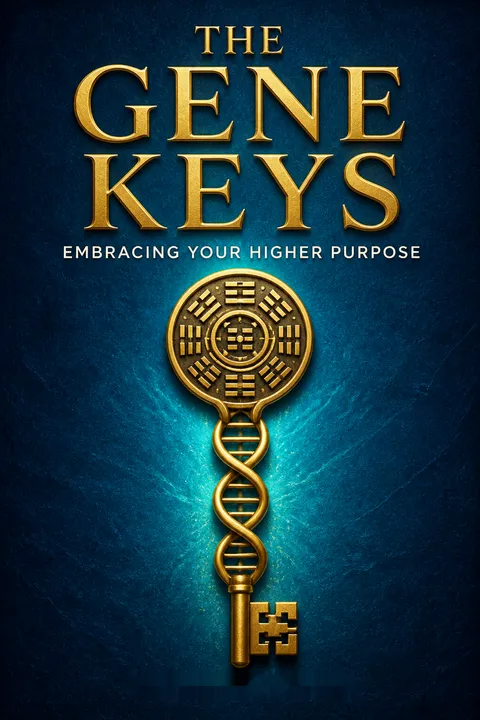


Key Takeaways
Your higher purpose is distinctive genius, not a job title or fixed destiny.
A wider definition. Rudd uses genius to mean a person living and expressing their particular gifts, not necessarily exceptional intelligence or fame. He opens with a story of lying in the cave associated with St. Benedict and experiencing a vision, presenting the book as an invitation to inner discovery rather than a conventional argument. Its central promise is that a more meaningful life can emerge from recognizing what is already distinctive in a person.
A personal map. The Gene Keys system organizes 64 archetypes, inspired by the I Ching, into a map of human patterns. A Hologenetic Profile uses birth information to identify keys connected with purpose, relationships, and prosperity. Rudd calls these patterns genetic, but their value can be approached as symbolic prompts rather than established readings of DNA.
The book's most accessible claim is not that a birth chart can reveal a biological destiny, but that people often overlook forms of ability that are not rewarded by prestige or conventional measures of intelligence. That emphasis aligns with broader work on strengths and intrinsic motivation: people tend to sustain effort when their activity fits their interests and values. The caution is important. A profile can open questions, but it should not close them by telling someone who they are or what work they must do.
Contemplate a recurring pattern before rushing to explain or repair it.
Slow the reading. Rudd distinguishes Contemplation from passive meditation and effortful concentration. It is a sustained, relaxed engagement with an idea, image, or word, allowing it to connect with lived experience rather than immediately forcing an answer. The point is not to memorize all 64 keys, but to revisit a relevant one until its pattern becomes recognizable in daily life.
Follow a pathway. The book groups personal exploration into the Golden Path: the Activation Sequence concerns gifts and purpose, the Venus Sequence concerns relationships, and the Pearl Sequence concerns prosperity through service. Readers can follow these sequences or use the book more freely, even opening it at random. Both approaches make reading an ongoing practice rather than a one-time information download.
This practice resembles reflective journaling and metacognition: noticing a thought or reaction without immediately treating it as fact can create room for a more considered response. Its strength is that it makes an abstract archetype answerable to ordinary experience. Its limit is equally clear: reflection can become rumination. A useful test is whether repeated contemplation improves a person's choices and relationships, rather than merely adding another elaborate explanation for them.
Name the Shadow, then turn its energy toward a usable Gift.
A three-level lens. In the Gene Keys vocabulary, a Shadow is a fear-shaped pattern, a Gift is the more constructive capacity hidden within that pattern, and a Siddhi is its highest spiritual expression. The book uses this progression across all 64 archetypes. For example, the first key pairs low-energy numbness with creative freshness: a period of flatness need not be treated as proof of failure, but can invite patience and renewed expression.
Accept before changing. Rudd's method is to notice a pattern without suppressing it or identifying with it. A person who recognizes habitual criticism, for instance, can ask what fear or unmet need is driving it, then practice a more discerning response. The aim is not to become perfect, but to make the pattern available for choice.
The model's memorable strength is its refusal to divide human traits into simply good and bad. Anger, doubt, or insecurity can contain information and energy, even when their habitual expression causes harm. This resembles approaches that use emotional awareness as a first step toward regulation. However, acceptance is not a substitute for treatment or safety. Persistent depression, trauma, or harmful behavior may require professional help, and calling suffering an evolutionary lesson can accidentally minimize real pain.
Treat emotions as signals to understand, not commands to obey.
Notice the reaction. The 55th Gene Key describes victimization as a habit of explaining inner states solely through outside causes: another person, money, work, or circumstance is blamed for feeling bad, while joy is postponed until life supplies the right conditions. Rudd argues that taking responsibility for one's response can loosen this loop. In practice, that means identifying the feeling, noticing the impulse to blame or escape, and pausing before acting on it.
Keep responsibility fair. The book links this inner work to a wider change in emotional awareness, but its practical point is narrower: a mood is real without being an instruction. Recognizing one's part in a conflict can restore agency. It does not mean that a person caused another's abuse, illness, or hardship, or that every external problem can be solved by changing attitude.
This is strongest when read as a distinction between experience and response, not as a claim that individuals control what happens to them. Psychological research on naming emotions suggests that putting feelings into words can help some people reduce immediate reactivity. Yet social conditions, illness, and trauma also shape emotional life. A responsible use of the book's language asks what can be chosen without implying that people are to blame for circumstances beyond their control.
Let relationships reveal inherited patterns without surrendering personal boundaries.
A relational mirror. The book treats close relationships as places where recurring fears and habits become visible. Its Venus Sequence is a guided exploration of emotional patterns, including wounds such as shame, rejection, guilt, and separation. The 59th Gene Key connects dishonesty with intimacy: concealment can preserve distance, while honest communication can make genuine closeness possible. Listening, diplomacy, and respect matter as much as emotional disclosure.
Do not romanticize pain. Rudd sometimes frames difficult relationships as opportunities to work through ancestral or collective patterns. The useful everyday version is simpler: notice what repeats, what each person contributes, and what needs to change. A relationship is not automatically destined, karmic, or healthy because it is intense. Trust and intimacy require consent, mutual accountability, and boundaries, not just a willingness to endure conflict.
The relational emphasis is a valuable corrective to self-help that treats personal growth as a solitary project. In systems thinking, recurring conflict can be understood as a loop sustained by the responses of both people, rather than as a trait belonging to only one partner. But the mirror metaphor has a danger: it can blur responsibility when power is unequal. Mutual patterns deserve examination; coercion and abuse should not be recast as lessons that a harmed person must learn.
Choose work that develops competence without spending your life-force to prove worth.
Work as expression. The 14th Gene Key contrasts compromise with competence. Rudd argues that people often drain their energy by working against their talents or accepting roles that steadily suppress their enthusiasm. Competence, in this system, combines ability with interest, flexibility, and a useful contribution. It is not simply being efficient or earning more; it is doing meaningful work in a way that can be sustained.
Protect the source. The 40th Gift, Resolve, adds the importance of boundaries, rest, and the ability to refuse demands that misuse one's energy. The 45th Gift, Synergy, extends the idea to teams: shared resources and distributed responsibility can outperform rigid competition. These ideas point toward work that supports both individual contribution and collective wellbeing, rather than treating exhaustion as evidence of commitment.
The link between autonomy, competence, and motivation is well supported across organizational psychology: people generally engage more deeply when they have meaningful choice, can build mastery, and understand whom their work serves. The book's more mystical account of prosperity is less testable, and fulfilled work does not guarantee financial security. Its practical contribution is to treat energy, boundaries, and contribution as real design constraints, not as luxuries to consider after success.
Let uncertainty and play loosen the habits that block invention.
Make room for the gap. Rudd links the 3rd Gene Key's chaos with innovation and the 24th Gene Key's repetitive thinking with invention. New ideas, in this account, become possible when familiar mental loops pause. His example is the open-ended play of children: what looks like disorder to an adult can be a way of testing possibilities without a predetermined result.
Try, observe, revise. The practical lesson is not to romanticize chaos, but to allow experiments that do not have to prove their value immediately. A person facing a stalled project might temporarily stop defending the original plan, play with alternatives, and see what new connections emerge. The book describes this as a movement beyond rigid thinking; it does not require believing that every unexpected event is a message from the universe.
Creativity research often emphasizes incubation: stepping away from a problem can help people combine ideas that focused effort keeps apart. Play also supports exploration because the cost of a failed attempt is low. The book adds a spiritual interpretation to this familiar process. That interpretation may inspire openness, but it should not replace practical evaluation. An idea still needs testing, feedback, and revision before it becomes a useful innovation.
Commit wholeheartedly to a choice, while staying honest about its costs.
Follow the cycle. The 29th Gene Key contrasts half-heartedness with commitment. Rudd suggests that repeatedly starting and quitting can keep people circling through familiar disappointments, while sustained engagement can reveal what an experience has to teach. The book also describes life as rhythms and cycles: patience means allowing a process to unfold rather than demanding immediate proof that it was the right choice.
Release without denial. The 42nd Gift, Detachment, concerns letting a cycle end without turning its conclusion into a verdict on one's worth. Together these ideas support a useful discipline: choose with care, give the choice real effort, and review it honestly as circumstances change. Commitment should not mean staying in danger or ignoring evidence. The book's cyclical language is most helpful when paired with sound judgment and self-protection.
This distinction between commitment and attachment is useful in work, relationships, and creative practice. Long-term projects often require persistence through periods when rewards are delayed, while flexibility helps people update plans when new evidence appears. The book's appeal to natural cycles can encourage patience, but its suggestion that a cycle must simply be completed can be risky if applied rigidly. Duration alone does not make a commitment wise; context and consequences matter.
Measure leadership by the agency and shared capacity it creates.
Guide, do not dominate. The 7th Gene Key contrasts division with guidance, while the 31st explores leadership as influence through language. Rudd's preferred leader listens, helps people find their own direction, and does not make followers dependent. He points to Vaclav Havel, a poet and playwright who became president during the political changes of 1989, as an example of a leader whose public identity differed from the conventional image of a power-seeker.
Build collective ability. The 45th Gift, Synergy, describes cooperation across a group rather than control from a single point. In practical terms, good leadership gives people enough information, trust, and responsibility to contribute. The aim is not to erase differences or authority, but to make authority serve the group's work rather than the leader's status.
This account connects with participatory leadership and psychological safety: teams learn and adapt more effectively when people can raise concerns and exercise judgment without fear. The Havel example also complicates the idea that leadership is merely a personality trait; political openings and institutions matter. Still, listening alone is not enough. Leaders remain accountable for decisions, resource allocation, and the unequal power that can persist even in groups that describe themselves as collaborative.
Treat the book's 2012 and 2027 dates as symbolic prompts, not evidence.
A cosmic storyline. Rudd frames the 64 keys as part of a vast movement from separation and fear toward unity, service, and freedom. He maps this story onto three proposed turning points: 1987, 2012, and 2027, and draws on traditions of world ages and planetary transformation. These dates give the book a dramatic narrative: inner change is presented as part of a collective human transition, not merely private self-improvement.
Keep the distinction clear. The book's forecast that genetic and planetary changes will culminate around these dates is a spiritual belief, not a demonstrated scientific prediction. Its more useful application is to ask what kind of society would reflect less fear, more cooperation, and greater responsibility. A hopeful future can guide present choices without being mistaken for a verified timetable.
The book's large-scale narrative gives private contemplation a social horizon, connecting personal conduct to relationships, institutions, and the environment. Such narratives can motivate collective responsibility. They also need epistemic discipline. A date-specific prophecy invites retrospective pattern-matching, while claims about mutation, planetary alignment, or species-wide awakening require evidence beyond analogy. The vision is most constructive as an ethical ideal: a prompt to build more cooperative systems, not a forecast on which to base scientific or personal decisions.
Analysis
The Gene Keys is a spiritual self-inquiry system presented through a biological and cosmic vocabulary. Its organizing rhythm is consistent: each of 64 archetypes describes a fear-driven pattern, a more constructive capacity, and an ultimate spiritual expression. The book then scales that movement from private habits to relationships, work, social organization, and a prophesied transformation of humanity. This gives the work unusual narrative force. A reader is not simply asked to improve a trait, but to see personal difficulty as one strand in a larger story of consciousness.
Its most usable contribution is psychological and interpretive. The reader is invited to notice recurring reactions, hold them with less shame, and seek the capacity concealed within them. Contemplation, emotional responsibility, honest relationships, and service recur as practical disciplines. The system can function as a structured vocabulary for reflection, especially for readers who find purely clinical or goal-oriented language too narrow.
The boundary between metaphor and science requires care. DNA does respond to environmental conditions, and epigenetics studies some changes in gene expression. That does not establish the book's claims that thoughts act as electromagnetic instructions to genes, that I Ching hexagrams correspond to genetic archetypes in a biological sense, or that collective mutation will produce a new human type. Likewise, its specific predictions about 2012 and 2027 are not validated scientific forecasts. The book is strongest when its genetics are read as an evocative model, not evidence.
This distinction does not erase the system's imaginative value. It makes the reader responsible for testing each interpretation against lived consequences. If a key increases clarity, compassion, and agency, it has practical merit. If it encourages fatalism, self-blame, or avoidance of medical and social realities, the metaphor has become a trap. The deepest lesson is therefore not that DNA secretly dictates destiny, but that a map of patterns can help people become less governed by them.
Review Summary
The Gene Keys receives mostly positive reviews, with readers praising its profound insights into human potential and spiritual growth. Many find it a transformative guide for self-discovery, combining ancient wisdom with modern concepts. Some appreciate its unique approach to personal development, while others value its poetic language and depth. Critics note its complexity and occasional repetitiveness. The book is often described as a lifelong companion for contemplation rather than a cover-to-cover read. Some readers express skepticism about its scientific claims but still find value in its perspective-shifting content.
People Also Read






Glossary
Gene Keys
64 archetypes for self-inquiryA system of 64 archetypes inspired by the I Ching and presented as a map of human consciousness. Each key describes a low-frequency pattern, a constructive capacity, and a highest spiritual expression. Rudd connects the archetypes to genetics, while readers can also use them as symbolic prompts for reflecting on behavior and purpose.
Hologenetic Profile
Personal map of Gene KeysA personalized chart calculated from birth information that assigns particular Gene Keys to themes such as purpose, relationships, and prosperity. The profile is used to focus contemplation on recurring patterns and possible strengths. The book treats it as a map of an individual's genetic and spiritual design, a claim best distinguished from established genetic testing.
Contemplation
Patient, lived reflectionThe Gene Keys' central practice: returning gently to an idea, word, or archetype and noticing how it relates to feelings, choices, and daily life. Unlike passive meditation or effortful concentration, contemplation engages thought without forcing a conclusion. It is meant to let insight develop through sustained attention rather than memorization.
Shadow
Fear-shaped patternOne of the three frequency labels used for each Gene Key. A Shadow is a habitual pattern associated with fear, such as reactivity, avoidance, or self-doubt. The book encourages readers to recognize these patterns without treating them as moral defects, then explore the capacities that may be hidden within them.
Gift
Constructive capacityThe middle frequency expression of a Gene Key. A Gift is the more creative or useful capacity associated with the same energy that appears in its Shadow form. The book presents Gifts as becoming more available through awareness, acceptance, and service, rather than through simply suppressing unwanted behavior.
Siddhi
Highest spiritual expressionThe highest of the three expressions assigned to each Gene Key. In Rudd's system, a Siddhi describes a state of spiritual realization in which ordinary separation and self-identification are transcended. The term comes from Sanskrit traditions, though the book gives the 64 Siddhis its own specific arrangement and interpretation.
Golden Path
Three personal sequencesThe integrated journey through three parts of a Hologenetic Profile. The Activation Sequence focuses on purpose and gifts, the Venus Sequence on emotional patterns and relationships, and the Pearl Sequence on prosperity and service. The book recommends moving through these sequences by contemplation, at a pace suited to the reader.
Venus Sequence
Map of relationship patternsA sequence within the Golden Path that applies Gene Keys to emotional development and intimate relationships. It is intended to help readers recognize recurring wounds and reactions, especially where inherited or early-life patterns affect connection. Its practical emphasis is on awareness and responsibility, not on treating every difficult relationship as destined.
Codon Ring
Linked Gene Key groupingA grouping of Gene Keys that Rudd associates with amino acids and recurring themes across the 64-key system. The Codon Rings are used to describe relationships among keys and to extend the framework from individual patterns to collective human dynamics. This is specialized vocabulary within the Gene Keys model, not a standard biological classification.
Synarchy
Collective self-organizationA term for an ideal form of social coordination in which people contribute according to their capacities without being governed chiefly by fear-based hierarchy. In the book, synarchy describes a collective intelligence that becomes visible as people and groups cooperate. It is presented as a spiritual and social vision rather than a tested political system.
FAQ
What is The Gene Keys: Embracing Your Higher Purpose by Richard Rudd about?
- Exploration of human evolution: The book explores humanity’s evolutionary journey through the 64 Gene Keys, archetypal codes in our DNA that guide spiritual and genetic transformation.
- Integration of science and spirituality: Richard Rudd synthesizes ancient wisdom, modern genetics, and spiritual teachings to provide a comprehensive framework for personal and planetary transformation.
- Path to higher purpose: The Gene Keys offers a contemplative approach to unlocking higher consciousness and embracing one’s unique potential and higher purpose.
Why should I read The Gene Keys: Embracing Your Higher Purpose by Richard Rudd?
- Unlock your higher purpose: The book provides a unique system to understand your genetic and spiritual blueprint, helping you transcend limiting patterns and realize your innate genius.
- Navigate profound change: It offers insights into the evolutionary shift humanity is undergoing, preparing readers to embrace the coming genetic and consciousness mutation.
- Practical contemplative guidance: Through contemplation, readers can transform their shadows into gifts and ultimately embody the siddhis, leading to personal liberation and collective harmony.
What are the 64 Gene Keys in Richard Rudd’s system and how do they function?
- Archetypal genetic codes: The 64 Gene Keys are universal archetypes encoded in human DNA, each representing a spectrum of consciousness from Shadow (limiting patterns) through Gift (higher potential) to Siddhi (divine realization).
- Spectrum of consciousness: Each Gene Key unfolds through three frequency bands—Shadow, Gift, and Siddhi—allowing individuals to understand and transform their inner challenges into higher states of being.
- Contemplative tool: The book encourages deep contemplation of these keys to activate latent genetic potentials, facilitating personal transformation and alignment with one’s higher purpose.
How does Richard Rudd’s The Gene Keys connect DNA, consciousness, and ancient wisdom?
- DNA and attitude connection: The book explains that DNA is not the sole controller of destiny; rather, a person’s attitude and environment influence gene expression, aligning with epigenetic science.
- I Ching and genetic code: The 64 Gene Keys correspond to the 64 hexagrams of the I Ching and the 64 codons in DNA, creating a symbolic and mathematical bridge between ancient wisdom and modern genetics.
- Universal archetypes: Both the I Ching and DNA reflect universal patterns and cycles of life, making the Gene Keys a genetic and spiritual codebook for understanding existence.
What are the Shadow, Gift, and Siddhi frequencies in The Gene Keys by Richard Rudd?
- Shadow frequency: Represents unconscious, fear-based patterns that limit human potential, such as victimization, dishonesty, or distraction. Shadows are the raw material for transformation.
- Gift frequency: The awakened state where one transcends shadows and expresses innate genius, creativity, and love. Gifts represent the evolutionary potential within each Gene Key.
- Siddhi frequency: The highest expression of a Gene Key, embodying divine realization and spiritual mastery. Siddhis transcend duality and manifest as states like Freedom, Transparency, or Illumination.
How does contemplation work as a method in The Gene Keys?
- Gentle, playful focus: Contemplation is a relaxed, sustained focus on the Gene Keys, distinct from meditation or concentration, allowing insights to arise naturally.
- Transformation through awareness: By contemplating the Gene Keys, readers digest their messages at physical, emotional, and mental levels, gradually transmuting Shadow patterns into Gifts and Siddhis.
- Integration into daily life: Contemplation can be practiced during routine activities, making it a continuous creative companion for personal growth and transformation.
What is the Hologenetic Profile in The Gene Keys and how is it used?
- Personal genetic blueprint: The Hologenetic Profile is a personalized map calculated from your birth data, revealing specific Gene Keys sequences that influence your purpose, relationships, and prosperity.
- Golden Path sequences: It highlights three key sequences—the Activation Sequence (genius), Venus Sequence (relationships), and Pearl Sequence (prosperity)—which form the Golden Path of contemplation.
- Guided self-discovery: By focusing on these sequences, readers embark on a tailored journey of self-awareness and transformation, unlocking their unique genetic codes and higher purpose.
What is the significance of the 55th Gene Key and the “Great Change” in Richard Rudd’s system?
- Trigger of the Great Change: The 55th Gene Key is central, representing the genetic mutation that will catalyze humanity’s shift from victim consciousness to freedom and unconditional love.
- Emotional and sexual transformation: It governs the solar plexus center, heralding the sublimation of human sexuality into higher consciousness and the emergence of a new human species, Homo sanctus.
- Evolutionary leap: The 55th Gift and Siddhi both represent Freedom, marking a pivotal evolutionary leap where collective awareness and interconnectedness become the new norm.
How does The Gene Keys describe the journey from Shadow to Siddhi?
- Facing unconscious fears: The journey begins by recognizing and accepting Shadow patterns, which are deeply embedded fears and limitations in the DNA and collective unconscious.
- Transformation through Gifts: As awareness grows, Shadows reveal their Gifts, leading to heart-opening, creative, and service-oriented states that stabilize and uplift the individual.
- Transcendence into Siddhis: The final stage is absorption and embodiment of Siddhis, rarefied states of enlightenment where duality dissolves, and the individual experiences unity, peace, and divine presence.
How does Richard Rudd’s The Gene Keys explain the role of relationships in human evolution?
- Sacred marriage ideal: The book predicts a future where relationships transcend duality, embodying the mystical union and healing the ancient split between masculine and feminine energies.
- From dependency to shared awareness: Relationships will evolve from dependency and blame to shared awareness and overflowing love, symbolized by the sacred chalice that is always full.
- Catalyst for awakening: Intimate relationships serve as the primary arena for shattering the illusion of separateness, accelerating personal and collective transformation through honesty and emotional transparency.
What are Codon Rings and Programming Partners in The Gene Keys by Richard Rudd?
- Codon Rings: These are groups of Gene Keys linked chemically and archetypally, representing major evolutionary themes and genetic families within the human genome.
- Programming Partners: Pairs of Gene Keys that mirror and reinforce each other’s themes across Shadow, Gift, and Siddhi frequencies, creating biofeedback loops that shape human behavior and evolution.
- Collective influence: Codon Rings and Programming Partners influence both individual and collective patterns, playing a key role in the evolutionary process described in the book.
What are some of the best quotes from The Gene Keys by Richard Rudd and what do they mean?
- “It is always at the very end, when we have all but given up hope of redemption that liberation comes.” This highlights the book’s theme of transformation arising from surrender and the final overcoming of victim consciousness.
- “The form is the skin, the fruit is the awareness and the seed is consciousness.” This metaphor explains the layers of human experience and the role of awareness as the key to spiritual evolution.
- “True enjoyment is rooted inside your being rather than in the external.” From the 56th Gift of Enrichment, this quote emphasizes the importance of inner fulfillment over external distractions in the path to freedom.
About the Author
Other books by Richard Rudd
Download PDF
Download EPUB
.epub digital book format is ideal for reading ebooks on phones, tablets, and e-readers.








