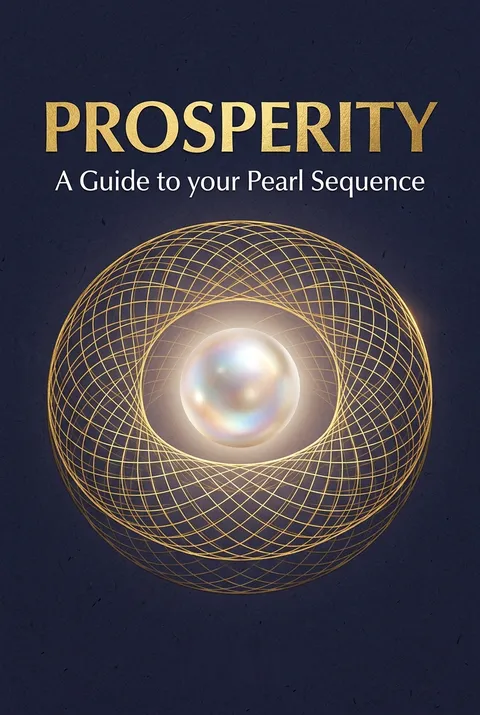


Key Takeaways
Prosperity is circulation, not a bigger pile of money
Measure what moves. The book distinguishes wealth, which it associates with accumulating money and possessions, from prosperity, which it sees as a healthy flow of resources, attention, and energy. A tree does not keep every fruit; it releases what it has produced, renewing the conditions for new growth. The practical question is not simply how much you own, but whether your money, time, and belongings support what matters or weigh you down.
Clear space for essentials. The author recommends taking inventory of what is useful, beautiful, and worth your time. Prosperity does not mean rejecting money: for someone facing material hardship, more money can bring real relief. The challenge is to seek enough for a life of purpose without turning accumulation into the purpose itself.
The distinction is useful because it separates having resources from being able to use them well. In economic terms, a stockpile is not the same as a functioning exchange: money can provide security, but its value depends on the choices and relationships it enables. The account is strongest when it treats simplicity as a personal test rather than a universal prescription. Accumulating savings can be prudent, especially under uncertainty. The point is not that reserves are harmful, but that they should serve life rather than silently become its measure.
Align purpose, relationships, and work before calling life prosperous
Prosperity is integrated. The Pearl Sequence is the book's final stage in the Golden Path, a contemplative system organized around a person's Hologenetic Profile. It brings together three strands: purpose in how one lives, love in how one relates, and prosperity in how one contributes through work. The book argues that these strands affect one another. Work can feel successful while relationships or health suffer, but that is only partial prosperity.
Follow the sequence. The Activation Sequence explores purpose, the Venus Sequence explores emotional patterns and relationships, and the Pearl Sequence turns attention to work, money, and contribution. The sequence is meant to carry inner reflection into outer life, not to provide a financial formula. Its measure of progress is greater coherence between what a person values and how that person spends time and resources.
This integrated view counters the habit of treating career, intimacy, and health as unrelated departments. A decision that improves income but erodes attention at home is not automatically a gain; its real value depends on the wider pattern. The framework also offers a useful diagnostic question: which part of life is being asked to subsidize another? Its limitation is that coherence cannot by itself remove structural constraints, such as low wages or caregiving demands. Inner alignment matters, but material conditions shape the choices available.
Make fire with your gifts instead of waiting for certainty
Initiative begins the work. The Pathway of Initiative opens the Pearl Sequence. Rudd uses fire as a symbol for the capacity to create something from the resources at hand. In a survival story, fire provides warmth and light, but making it also changes a person's sense of what is possible. The myth of Prometheus, who takes fire from the gods, conveys the risk and nerve involved in starting something new.
Take a grounded risk. The author connects initiative to using one's Gifts, the creative capacities named in the Gene Keys system. Work that draws on what a person genuinely cares about can build skill and energy, but acting on it may require leaving familiar compromises. Initiative does not guarantee success. Its first reward is acting with more conviction, while the outcome remains uncertain.
The fire image captures an important distinction between inspiration and agency. A talent becomes consequential only when it is practiced, tested, and put into a form other people can encounter. This is close to the difference between having an idea and building a craft around it. The book's encouragement to follow what one loves is compelling as a compass, but incomplete as a career plan. Risk is not distributed equally, so initiative is most useful when paired with an honest view of obligations, resources, and possible costs.
Let your deepest wound become a vocation that serves beyond you
Turn inward pain outward. In the Grail story as the book retells it, Perceval reaches a wounded king and asks how he can serve the Grail, rather than asking it to heal him. The question shifts the focus from personal rescue to the well-being of the larger world. In the Gene Keys model, the Sphere of Vocation corresponds to the Core Wound, a recurring inner vulnerability that can also become a source of insight and creative purpose.
Stop waiting to be finished. The book warns that self-examination can become postponement: a person may delay meaningful work until fear, family duties, or personal pain have disappeared. The proposed alternative is not to ignore suffering, but to let its lessons inform a useful contribution. The wound does not need to vanish before a person can act with courage.
Perceval's question offers a powerful correction to self-improvement as an endless private project. It asks whether insight can become relational, embodied in what someone makes or offers. That shift resembles the movement from reflection to practice: understanding has value when it changes conduct. Still, pain does not automatically produce wisdom, and some wounds call for care rather than conversion into a mission. The idea is most humane when service is a possibility, not an obligation imposed on people who are still healing.
Treat work as complementary roles, not a solo act
Let different strengths interlock. The book describes six Vocation line themes as functions in a shared project. One person originates and develops an idea; another connects it to an audience; others coordinate the work, communicate its value, organize its delivery, or decide where resources can do the most good. The point is not that each person must fit a fixed job description, but that successful work draws on different capacities.
Build the whole team. Rudd compares a creative project to a production: an original concept still needs collaborators who can refine it, organize it, and bring it to people. The lines are presented as parts of a larger pattern rather than a ranking of talent. Prosperity, in this account, depends on cooperation and mutual contribution, not just individual recognition or ownership.
This model makes creative work easier to understand as a system of dependencies. A strong idea can fail through poor execution, while careful coordination cannot compensate for a purpose nobody believes in. Naming distinct contributions can help a team notice neglected labor and avoid expecting one person to invent, promote, manage, and fund everything. The caution is that archetypes can become labels that box people in. Their best use is as prompts for discussing needed functions, not as fixed claims about what any individual can do.
Choose collaborators by shared purpose, not fear or greed
Culture shapes the work. In the Pearl Sequence, Culture means the social environment and alliances that support a person's vocation. The book calls a person's deeper network of compatible collaborators a fractal line. It presents this as a spiritual model of connection, not merely a list of contacts. The practical idea is that taking meaningful initiative can bring someone into contact with people whose abilities and aims complement their own.
Aim beyond the clique. Synarchy is the author's term for collective intelligence organizing itself in service of a shared purpose, rather than concentrating authority for private gain. The book contrasts this ideal with relationships organized around fear or greed, which can undermine even promising projects. It recommends looking for collaborators through shared values, clear contribution, and mutual respect, while accepting that good cooperation cannot be manufactured by enthusiasm alone.
The emphasis on the social setting of work is a strong counterweight to stories of the lone genius. Ideas travel through trust, shared effort, and practical alliances, so the quality of a working culture can determine whether talent becomes useful. The language of destiny and cosmic connection is less verifiable than the observable advice about choosing collaborators carefully. A grounded application is to ask whether a group shares its credit, handles disagreement, and treats people fairly. Those behaviors offer better evidence of alignment than a feeling of inevitability.
Add service to growth or success turns into a burden
Growth needs a purpose. The Pathway of Growth connects initiative to the effects of expanding a project. The book's central business distinction is between growth driven only by making more money and growth guided by service. It calls the first pattern potentially unsustainable: as a business expands, it may consume more resources, complicate work, and displace the reason it began.
Grow like an organism. Rudd contrasts an organism, which develops through relationships and adapts to its surroundings, with an organization that can expand through hierarchy and self-preservation. This is an ideal, not a guarantee that a small enterprise is automatically ethical. The author also points to the Ring of Prosperity, a Gene Keys grouping of Keys 16 and 45, whose Shadows are indifference and dominance, and whose Gifts are versatility and synergy. In the model, skill and coordination work best when they serve a wider good.
The distinction between growth and healthy growth is central to organizational design. Expansion can increase reach, but it also brings coordination costs and can obscure who benefits from the added value. The book's organism metaphor usefully directs attention toward relationships, purpose, and feedback rather than scale alone. Yet smallness is not inherently virtuous, and larger institutions can provide services that tiny groups cannot. The more durable question is whether an enterprise can explain its purpose, account for its costs, and share the benefits of its success.
Make your public expression unmistakably match your inner truth
Your brand is your expression. The Sphere of the Brand revisits the Life's Work from the Activation Sequence, but focuses on how a person's qualities become legible to others. Brand here is not limited to a logo or product. It includes voice, style, language, and the impression created by someone's way of working. When outward presentation conflicts with inner values, the result is confusion and strain.
Keep the message simple. The book argues that a business or creative practice communicates more than the item being sold; it also communicates the motives and character behind it. That does not mean sincerity alone makes a product useful or a business viable. It means a clear, consistent expression can help people understand what is being offered and whom it is for. The practical task is to refine communication without imitating someone else's persona.
The idea is relevant well beyond commercial branding. People infer what an organization values from repeated choices, not only from its stated mission. Consistency between claims and conduct is therefore a form of credibility. The book's language of transmitting truth is spiritual, while its practical insight is familiar to communication theory: a message is received through both content and presentation. Authenticity should not be confused with saying everything without restraint. Good expression is honest, but it is also shaped for the audience and context.
Use contemplation to recognize patterns, not chase spiritual perfection
Notice the repeating pattern. The Gene Keys describe three frequencies: Shadow, Gift, and Siddhi. In the book's vocabulary, Shadow names a constricted pattern, Gift a more creative expression of the same underlying quality, and Siddhi its highest spiritual expression. The author cautions against treating these as a ladder to climb or a demand to become flawless. They are better approached as ways of noticing how the same human capacity can appear under different conditions.
Pause before interpreting. Contemplation means staying with a phrase, memory, or recurring reaction long enough to see what it reveals. The book recommends noticing ordinary pauses, such as waiting or taking a breath, and using them to return attention to the body. This is not presented as a technique for forcing a breakthrough. It is a practice of seeing patterns more clearly and responding with less automatic resistance.
The three-part spectrum can be useful as a nonbinary vocabulary for self-observation. Instead of dividing behavior into good and bad, it invites a person to ask what a pattern looks like when fear dominates and what capacity might emerge when that fear loosens. The framework is spiritually evocative, but its labels are interpretive rather than clinical categories. A pause can help create room for choice, yet it does not resolve every emotional or practical problem. Its value lies in attention, not in promising transformation on demand.
Return to ordinary life with simpler needs and wider generosity
The Pearl is a harvest. The final Sphere represents the book's image of prosperity as a return to simplicity after a long process of reflection. Its six lines describe different relationships to resources: living simply, receiving recognition, celebrating with others, helping people in need, using power responsibly, and trusting nature's larger cycles. These are orientations, not rules about how much money someone should have or give.
Make insight ordinary. The final Pathway, called the Pathway of the Quantum, describes a hoped-for shift in awareness that cannot be predicted or proven within the book's framework. The author links it to absorption, a point at which contemplation recedes and its insights become part of everyday conduct. The practical endpoint is modest: breathe, notice what is essential, and let the way work and money are handled reflect care for others as well as oneself.
The book ends not with a demand for extraordinary achievement but with a return to daily life, where generosity and simplicity can be practiced in small decisions. That ending is valuable because spiritual language often makes ordinary responsibilities seem secondary. Here, the test is whether insight changes how resources are used and how people are treated. The quantum framing, however, should be understood as metaphysical speculation, not an established scientific account of consciousness. The ethical proposal remains meaningful without that claim.
Analysis
The Pearl Sequence is a spiritual guide to prosperity built around a counterintuitive premise: flourishing depends less on accumulating wealth than on aligning purpose, relationships, work, and generosity. Its narrative moves from initiative, through the social conditions that support growth, toward service and a final return to simplicity. The Pearl metaphor gathers these strands into a harvest, while the repeated stories of fire, the wounded Grail king, and the tree releasing fruit make abstract principles easier to remember.
The system's strongest contribution is its insistence that prosperity is relational. A vocation needs collaborators; growth needs a purpose beyond expansion; and personal fulfillment cannot be measured by income alone. Its questions about what work serves and what resources are essential can help readers examine choices that conventional success metrics leave untouched. Its useful business lens is not simply to grow, but to ask what growth consumes, whom it benefits, and whether it preserves the purpose that began the enterprise.
The book also blends levels of claim that should be kept distinct. Contemplation, attention to patterns, and aligning public expression with values are practices readers can assess in their own lives. Claims about Gene Keys as genetic codes, planetary imprinting, causal planes, or quantum changes in consciousness are part of the author's metaphysical system, not conclusions established by the scientific language he invokes. Epigenetics and thermodynamics have specific scientific meanings, and their use here often functions symbolically rather than as demonstrated evidence.
That distinction need not dismiss the book's value. Read as a contemplative map, its frameworks can prompt useful questions without being treated as biological diagnoses or predictive laws. Its most durable advice is practical and ethical: act on a meaningful capacity, build relationships that support it, prevent growth from eclipsing purpose, and let resources circulate toward what genuinely helps life flourish.
Review Summary
Prosperity receives overwhelmingly positive reviews, with readers praising its depth and transformative impact. Many find it thought-provoking and validating, appreciating its insights into personal growth and economics. Readers recommend a slow, contemplative approach to fully absorb the content. The book is part of a series, with readers eagerly anticipating the fourth installment. Some reviewers mention the book's ability to unlock mental connections and provide a foundation for understanding abundance. Overall, it's highly regarded for its profound exploration of self and prosperity.
People Also Read



Glossary
Pearl Sequence
Prosperity through serviceThe third sequence in the Gene Keys Golden Path. It applies contemplation to vocation, work, money, community, and contribution. Its central Spheres are Vocation, Culture, Brand, and the Pearl, connected through pathways of Initiative, Growth, and Service. The sequence presents prosperity as an integrated flow of resources and purpose, rather than simply the accumulation of wealth.
Hologenetic Profile
Personal Gene Keys mapA personalized chart used in the Gene Keys system. It is calculated from planetary positions associated with birth and gestation and assigns Gene Keys and lines to named Spheres. The book presents it as a contemplative guide to patterns of purpose, relationships, and prosperity, rather than merely a descriptive chart. Its meanings depend on the Gene Keys framework.
Shadow, Gift, and Siddhi
Three consciousness frequenciesThe Gene Keys system's three-part vocabulary for interpreting each Gene Key. Shadow describes its constricted or reactive expression, Gift its more creative potential, and Siddhi its highest spiritual expression. The book treats them not simply as stages to achieve, but as related possibilities within human consciousness that contemplation can help a person recognize.
Synarchy
Collective self-organizationThe book's term for collective intelligence organizing around a shared higher purpose. It contrasts synarchy with hierarchy driven by concentrated authority and self-interest. In the author's ideal, individuals and groups contribute distinct abilities while serving the health of the whole. It is proposed as a model for business, community, and governance, rather than an established description of how societies naturally function.
Fractal line
Network of compatible alliesA Gene Keys term for the group of people an individual is understood to be naturally connected with through shared purpose and complementary capacities. The book uses a cosmic origin story to explain the concept, describing people as fragments of a larger pattern. In practical terms, it points readers toward collaborators and communities that support meaningful work.
Ring of Prosperity
Two-key prosperity groupingA Codon Ring in the Gene Keys system made up of Gene Keys 16 and 45. The book associates their Shadows, Indifference and Dominance, with harmful patterns in collective economic life, and their Gifts, Versatility and Synergy, with more constructive collaboration. It is a symbolic framework within the Gene Keys, not a scientifically validated account of economic behavior.
Syntropy
Self-organizing movement toward wholenessThe book's name for a proposed principle in which complex systems organize toward greater integration and serve a larger whole. Rudd contrasts it with entropy, the tendency toward disorder described in thermodynamics. In the Pearl Sequence, syntropy also carries an ethical meaning: generosity and service allow resources and relationships to support collective flourishing. This extension is philosophical and spiritual, not a standard scientific law.
Individuation
Inner and outer integrationA state in which different areas of life, including relationships, health, work, finances, and spirituality, are brought into greater harmony. In the Golden Path, individuation is the hoped-for result of integrating its sequences, not a claim that every conflict disappears. The individuated person is described as more internally coherent while remaining engaged with community and ordinary life.
Synthinking
Intuitive, integrative thinkingThe book's term for a mode of understanding that combines heart, mind, and body rather than relying only on step-by-step logic. It is used to describe grasping patterns across different fields and holding multiple perspectives without reducing them to one narrow explanation. The author presents it as a way of engaging archetypal and spiritual insight, not as a formal scientific method.
About the Author
Other books by Richard Rudd
Download PDF
Download EPUB
.epub digital book format is ideal for reading ebooks on phones, tablets, and e-readers.








