

Plot Summary
The Miserable Ninth Hole
At thirty-six, Adam Seaver1 is so furious with his golf that, after a string of bad shots, he whiffs twice and hacks his ball into the woods. A stranger3 appears beside the muddy lie and insists Adam1 can become a master, then sends him to an abandoned road. For days Adam1 hesitates. His younger brother Ethan6 asks to play together, and Adam1 cannot bear the thought of being watched in another humiliating round.
He follows the stranger’s3 directions and finds a weathered shack fitted with an indoor practice range. There, Leela,2 a young golfer who seems to have expected him, switches on a projected fairway. Adam1 strikes one clean shot; then Leela’s2 ball appears to fly into the distant cup, although the target is only an image.
Adam’s first encounter with Leela is staged as a rescue from humiliation, but the stranger does not offer comfort or a technical fix. He redirects Adam toward a place where his usual measures of competence no longer apply. The shack turns golf into a threshold: its familiar equipment offers a foothold, while the apparently impossible shot destabilizes Adam’s certainty about what is real. His decision to come is driven by shame as much as hope, especially his wish to keep that shame from his brother. The fable begins, then, with a familiar defense of the ego and an invitation to risk looking foolish again.
The Putt Before Contact
At their next meeting, Leela2 has Adam1 put on his golf shoes and cap before she projects a putting green. She asks him to give the ball and then the cup his full attention. As he stops rehearsing his grip and mechanics, both seem to swell into his view, and the line between them becomes unmistakable.
Leela2 switches off the image before he can stroke the putt, yet tells him it has already gone in because his attention has brought the shot together. Adam1 flings his putter down and tries to leave, anger rising from years of held frustration. Instead of punishing his outburst, Leela2 lets him feel its force. When it passes, his body is weak and his mind quieter, and he accepts that something in him has shifted.
The lesson makes attention an event rather than an instruction: Adam’s perception changes before his score or technique can verify anything. Leela’s interruption frustrates his demand for proof, exposing how strongly he equates action with control. His anger is not treated as a moral failure; it is evidence of pressure that has been accumulating beneath the golfer’s practiced self-command. By waiting through the outburst, Leela lets Adam experience emotion as something that can move through him rather than dictate the next act. The scene introduces the book’s central tension between deliberate skill and the urge to force an outcome.
Wind Against Effort
After a near collision on the road leaves Adam1 startled by how sharply he seems to perceive the other driver, he returns to Leela’s2 shack. She projects a rugged links course and sends him into a gale that blows his ball off the tee. Adam1 hacks through repeated rounds as wind and rain worsen; his score deteriorates, and frustration drains his strength.
When the storm suddenly stills, he barely lifts the club. Its weight carries the swing, and the ball sails cleanly past the hazards. Leela2 points out that Adam1 had been crowding the shot with ego, anxious instructions, and fear of failure. Exhaustion silenced those demands. He leaves understanding that his best movement arrived when he stopped trying to manufacture it.
The gale gives Adam a physical version of the inner noise he has not yet learned to quiet. Its conditions cannot be negotiated away, so every attempt to dominate the shot becomes more visibly futile. The breakthrough comes not through superior force but when fatigue interrupts his effort to control each part of the swing. The lesson is not that preparation or practice is useless. Rather, the body can organize familiar skill more freely when the conscious mind stops issuing contradictory commands. Adam’s near collision and sharpened perception foreshadow this wider loosening of control, though he has not yet learned how to enter that state deliberately.
Pebble Beach in the Now
In the days after the storm lesson, Adam1 notices his shoulders relaxing and finds himself less combative with ordinary frustrations. At the shack, Leela2 sets aside most of his clubs and projects Pebble Beach, then places a red-light device beside the ball.
Adam1 must strike at the instant it lights, a task that first makes him miss entirely. As they play, though, his shots begin finding greens and birdies, even while the artificial signal keeps him reaching for the present instead of predicting it.
At the seventh tee, a green clings to a cliff above the ocean. Adam1 quiets himself and swings. Leela2 has secretly turned off the light, so this one belongs entirely to him; the ball stops inches from the cup. He feels the shot as a moment fully inhabited.
The red light turns presence into a practical problem: Adam cannot succeed by calculating when the future moment will arrive. His early misses expose the limits of anticipation, while the sequence of better shots gradually moves his attention from command toward readiness. The cliffside shot matters because Leela removes the device that had kept him fixated on timing. Adam must act from the capacities the earlier lessons have been cultivating. This is not simply a reward for relaxation; he still faces a dangerous, demanding shot. The distinction is that commitment no longer requires certainty about the result.
Parker's Unseen Green
When Adam1 sees his usually combative colleague Doris5 soften after he looks past her anger to the younger selves hidden beneath it, he begins to suspect that attention can change how people meet one another. Leela2 takes him to a public course, where he caddies for Parker,4 a cheerful blind golfer. Parker4 reads shots through sound and feel, and Leela2 helps line him up without taking over his game.
Adam1 watches Parker4 play confidently, then lets Leela2 cover his own eyes. At first, his imagined swings are tangled in frustration, embarrassment, and self-doubt. When he recognizes those feelings as a recurring cycle, he stops chasing them. He swings by touch, and the final shot reaches the hole. Leela2 then reveals that this last ball was real.
Parker challenges Adam’s assumption that good play depends on visual control. His ease on the course comes not from pretending blindness is irrelevant but from developing other forms of information and trust. Adam’s own blind exercise makes the psychological obstacle unmistakable: without sight, he cannot disguise his dependence on a mental script. The rotating emotions he discovers are not new problems created by the exercise; they are patterns he has carried into every round. Doris’s brief change at work extends the lesson beyond sport. Attention alters relationship, allowing Adam to encounter people as more than the behavior that frustrates him.
The Eighteen-Inch Test
After Parker’s4 lesson, Adam1 becomes aware of a soothing presence that seems to approach when he is still and retreats when he tries to possess it. Leela2 describes his experience as contact with what is present, not a visitor he can control. To test his attachment to outcomes, she places him on the eighteenth green of a major tournament, where a leader8 has missed two short putts and faces an eighteen-inch putt for the win.
Adam1 feels the player’s8 panic from within and initially wants to rescue him by sheer desire. Instead, he lets go of the need to guarantee victory and offers the man8 a way to face uncertainty. The player’s8 aim settles; the ball drops into the cup. Adam1 understands that passion and detachment can work together.
The tournament scene enlarges a private putting lesson into an ethical one. Adam cannot take the player’s skill away from him or supply a guaranteed result; his useful contribution is to loosen the grip of catastrophic expectation. The stranger presence he has felt beforehand prepares him to understand that attention may connect him to something larger than his own anxious perspective. Yet the sequence does not simply praise passivity. The player still has to make the putt, and Adam’s intervention matters because it restores his capacity to act. Detachment here means relinquishing ownership of the outcome without withdrawing from the effort.
The Witness in Adam
The next morning Adam1 wakes with the sensation that he is watching himself from above. For several days this silent observer follows him through work without distressing him, then gradually merges with his ordinary awareness.
Leela2 identifies the witness as a deeper self that had never truly left him. When she says she has not been teaching Adam1 so much as helping him recognize what is already his, he fears she may disappear. She does, briefly, leaving him to visit the driving range alone.
There he strikes several balls that land in virtually the same place. When Leela2 returns, she helps him notice a tremor passing through his body into the ground. Adam1 feels that each shot alters the world, and the ball becomes a record of more than its flight.
The observer episode gives literal form to the book’s distinction between the self caught in experience and the self capable of witnessing it. Adam does not become detached by escaping ordinary life; he still drives to work and faces its distractions, but they no longer command his entire attention. Leela’s claim that he already possesses mastery risks sounding like a denial of his practical failures. The range scene supplies a more grounded counterweight: Adam’s shots remain ordinary in distance, yet he attends to their effects beyond the scorecard. His fear of losing Leela also reveals how quickly spiritual discovery can become another possession to defend.
The Ball's Infinite Dimples
Convinced he has become a prodigy, Adam1 spends weeks playing brilliant rounds and hiding his new game from people who knew his old one. On the day before Thanksgiving, his shots collapse at the very ninth hole where his troubles began.
Leela2 appears in a gray cape and finds his ball beneath fallen leaves. As Adam1 turns it in his hand, each dimple opens onto a different choice: he could have skipped the shack, met Leela,2 or never encountered her. The possibilities gather into a fog he cannot reason through.
When he finally touches the ball again with Leela,2 its surface dissolves into a vast vision of creation and disappearance. For a moment his body and thoughts fall away, leaving him with an awareness larger than any single version of his life.
Adam’s relapse is structurally necessary because his temporary brilliance has become a new identity to protect. He has replaced shame about poor play with pride in exceptional play, keeping the same dependence on external proof. Returning him to the ninth hole exposes that continuity before the final lesson can take hold. The dimples make choice tangible, but their multiplying possibilities also show why control through calculation cannot settle a life. Adam’s mystical experience does not solve each alternative or reveal a preferred timeline. Instead, it loosens his demand to possess a single, secure account of who he is.
A Different Kind of Shot
The vision ends, and Adam1 finds himself back in the summer round that began his search, with his friends waiting and Leela2 gone. He has little reason to expect a triumph. His swing is awkward, the club slips off its ideal path, and the ball travels about 150 yards, safely in bounds.
Someone laughs from the tee, but the sound no longer turns the shot into a verdict on Adam’s1 worth. He experiences the movement as life acting through him, not as a performance he must control. Adam1 picks up his bag and walks on so the next group can play. He no longer wants to become a champion; he wants to discover what it means to let the game carry him.
The final shot is deliberately modest. If Adam had returned to the course with a miraculous ace, the story might have confused spiritual freedom with supernatural performance. Instead, the ball travels a useful but unremarkable distance, and the decisive change lies in how Adam receives it. Laughter from other golfers remains part of the world; enlightenment does not require their approval or the removal of embarrassment. Adam’s movement down the fairway also restores the social, ordinary rhythm of play. He must continue among other players, with imperfect swings, but no longer treats each result as a final judgment on himself.
Epilogue
Adam1 never turns professional or wins the U.S. Open. He becomes a very good golfer and learns to meet a whiff with something closer to the pleasure he might once have reserved for a hole in one. Leela2 is no longer there to share what happened, but Adam1 carries her lessons into the rest of his life.
He understands the game as a practice in attention, trust, and release. The epilogue presents his love for Leela2 as part of that inheritance: not a possession he can recover, but a memory that continues to shape how he lives.
The epilogue refuses the conventional payoff of turning Adam’s spiritual education into a sporting career. His improvement matters, but the larger measure is his changed response to failure. By letting a poor shot coexist with joy, he makes the book’s spiritual claims visible in a small, repeatable act. Leela’s absence preserves the fable’s central ambiguity: a teacher may be loved, remembered, or understood as more than a separate person, but cannot simply be summoned as proof. Adam’s affection therefore becomes less a romance resolved than a lasting orientation toward wonder, acceptance, and play.
Analysis
The book uses a simple apprenticeship plot to make a sequence of spiritual claims testable through action. Adam’s1 failures are not merely comic obstacles on the way to a better handicap. Each one isolates a different form of self-interference: fixation on mechanics, emotional resistance, anticipation, reliance on sight, and attachment to victory. Leela’s2 lessons answer these habits by changing the conditions of play, often in ways that force Adam1 to experience rather than merely understand her point.
Golf suits this structure because it converts invisible mental states into visible consequences. A strained intention becomes a whiff or a crooked drive; a moment of composure becomes a well-struck ball. Yet the story repeatedly complicates the idea that results can measure inner worth. Adam’s1 most significant final shot is ordinary by sporting standards, while the dramatic tournament putt succeeds only after he releases the urge to control it. The book’s spiritual standard is therefore not perfection of performance but a different relationship to performance.
The progression from attention to non-doing, presence, intuition, detachment, witness consciousness, and surrender gives the seven lessons a psychological sequence. Adam1 first learns to direct attention, then to interrupt the ego’s struggle to command his body. Later he discovers that even mastery can become a new source of vanity. His relapse at the ninth hole is crucial because it shows that spiritual insight can be absorbed into the same old status-seeking machinery. The final vision does not make him immune to error; it changes the scale on which error matters.
The narrative is a fable, not a realistic account of golf instruction, and its miraculous episodes deliberately leave their mechanics unsettled. The simulator, the stranger,3 and Leela’s2 disappearances make the teacher2 seem both external and inward. That ambiguity supports the book’s central proposition: guidance may arrive as another person, but its purpose is to return the student to a capacity already present. Golf becomes the book’s compact model of living with uncertainty, committed to the next action without demanding ownership of what follows.
Review Summary
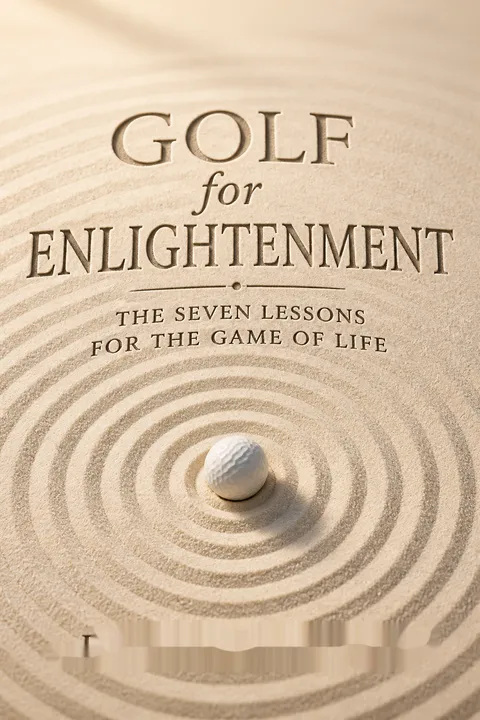
Golf for Enlightenment receives mixed reviews, with an average rating of 3.59/5. Readers appreciate Chopra's unique perspective on golf and life, finding valuable insights on mindfulness and personal growth. Some praise the book's clarity and potential to improve their golf game, while others find it too mystical or lacking in practical golf advice. Critics note Chopra's apparent inexperience with golf, but many still find the book's spiritual approach intriguing. Overall, readers consider it a thought-provoking blend of golf and Eastern philosophy, even if not always convincing.
People Also Read









Characters
Adam Seaver
The striving golferAdam is a thirty-six-year-old golfer whose ambition is knotted to embarrassment. A bad round can make him feel exposed before his friends, and his first instinct is to repair failure by trying harder. That reflex gives Leela2 a clear point of entry: Adam is skilled enough to notice when a shot feels right, but distracted by the need to prove himself. His curiosity survives his skepticism, and he is willing to return to the shack even when its lessons unsettle him. Adam’s central psychological struggle is not simply whether he can improve his swing. It is whether he can stay engaged with a challenge without making its result the measure of his identity.
Leela
The uncanny golf teacherLeela is a young golfer who appears at the hidden practice shack and guides Adam1 through lessons that blend golf instruction with spiritual inquiry. She is direct, playful, and difficult to pin down; she often answers a demand for explanation by arranging an experience instead. Rather than correcting Adam’s1 mechanics at every turn, she creates conditions that expose his habits of anticipation, anger, and control. Her confidence in him can feel exasperating because she treats capacities he doubts as already available. Leela functions as a teacher who does not make herself the source of Adam’s1 ability, challenging him to notice what he can do when he stops trying to possess the outcome.
The stranger
The roadside guideThe stranger appears among the trees after Adam’s1 disastrous round and speaks with unnerving certainty about his potential. He does not offer golf advice or explain how he knows Adam1; instead, he gives directions to the abandoned road that leads to Leela’s2 shack. His calm presence contrasts with Adam’s1 humiliation and leaves open the question of whether he is an ordinary passerby or something less easily named. For the story, he is the first interruption in Adam’s1 familiar cycle of failure and self-reproach.
Parker
The blind golferParker is a blind golfer whom Adam1 meets at a public course while serving as his caddie. Cheerful and self-reliant, he uses the sound of contact, bodily feel, and a caddie’s guidance to orient himself. He does not treat golf as pointless because he cannot see the scenery or follow the ball’s flight; the course still offers him air, movement, and a meaningful game. Parker’s ease unsettles Adam’s1 assumption that sight and control are prerequisites for good play.
Doris
The office dragonDoris is Adam’s1 abrasive colleague, quick to blame him for an error in a report. Adam1 usually avoids meeting her eyes, but one day he glimpses the more vulnerable selves beneath her hardened manner. Their exchange changes, giving Adam1 an early sign that attention can alter a relationship.
Ethan
Adam's younger brotherEthan is Adam’s1 younger brother and an invitation to play golf together. His request forces Adam1 to confront how much he fears being seen at his worst. Ethan’s brief role reveals how Adam’s1 shame shapes even his closest relationships.
The young caddie
The amused witnessA new caddie accompanies Adam1 during the humiliating round that begins the story. He finds Adam’s1 disastrous shots entertaining, though he also offers practical help and opens an umbrella when the rain starts. His presence sharpens Adam’s1 feeling of being watched.
The tournament leader
The pressured finalistAn unnamed golfer leads a major tournament before missing a short putt and facing another that could decide the win. He has the skill and commitment to reach the final green, but pressure threatens to overtake his judgment. His predicament gives Adam1 a chance to understand the difference between caring about victory and trying to control it.
Plot Devices
The vision simulator
A doorway to practiceThe simulator occupies a weathered shack at the end of an abandoned dirt road. It resembles an indoor practice range, with artificial turf, a net, lights, and projections of courses on the wall. Under Leela’s2 direction, it becomes more than a device for rehearsing shots: Adam1 experiences wind, rain, terrain, and whole stretches of golf as though he has entered them. The simulator lets the story turn each lesson into a vivid physical test, from a storm-lashed links course to Pebble Beach. Its exact capacities remain unexplained, preserving the uncertainty that surrounds Leela2 and the distinction between ordinary practice and spiritual experience.
The golf ball
A mirror of intentionThe ball begins as the object Adam1 tries to punish, steer, and judge. Leela2 repeatedly redirects his attention toward it, until it becomes a way to examine perception, touch, and the motives that precede a swing. Later, Adam’s1 balls repeatedly land together at the driving range, prompting him to notice the effect of each action beyond its score. At the final lesson, the dimples become a surface onto which Adam’s1 possible choices seem to appear, leading to an overwhelming vision of creation and loss. The ball therefore carries the story from technical focus toward its largest spiritual revelation.
The red timing light
A test of presenceLeela2 places a small device beside Adam’s1 ball during the Pebble Beach lesson and tells him to hit when its red light appears. Adam1 initially misses because he tries to anticipate the signal and then react quickly enough to catch it. Repeated attempts loosen his reliance on prediction, while the sequence of successful shots gives him room to attend to the moment at hand. At the cliffside green, Leela2 secretly turns the light off, leaving Adam1 to make a demanding shot without its cue. The device makes an abstract lesson in presence concrete by showing how anticipation can disrupt even a capable swing.
The blind-golf exercise
A lesson in touchParker’s4 round first shows Adam1 that a golfer can orient himself through sound, feel, and a trusted guide rather than sight alone. Leela2 then temporarily blocks Adam’s1 vision and asks him to make a shot without seeing the ball. His early swings become entangled with frustration and self-consciousness, revealing emotional habits that normally hide behind visual attention. Once he recognizes the repetitive cycle and stops obeying it, he makes a final shot that reaches the hole. The exercise dramatizes the book’s distinction between sensory data and the subtler bodily awareness that can help organize an action.
The silent witness
A self beyond reactionAdam’s1 sensation of watching himself from above gives form to a perspective that can observe thought and action without being consumed by them. It first appears as a double that follows him through ordinary workdays, then gradually blends with his awareness. Leela2 connects it to a deeper self that has been present all along, though Adam1 has not known how to notice it. The witness helps frame the book’s movement from controlling every result toward acting with attention while remaining less dependent on praise, fear, or disappointment. Its revelation is central to Adam’s1 spiritual education.
About the Author
Other books by Deepak Chopra





Download PDF
Download EPUB
.epub digital book format is ideal for reading ebooks on phones, tablets, and e-readers.








