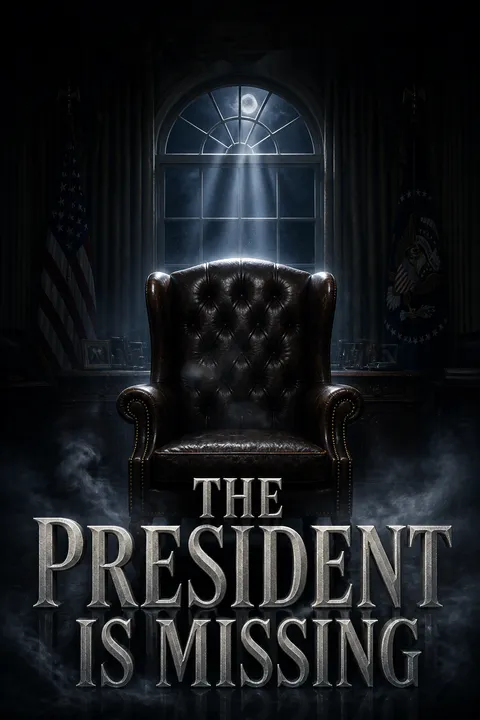


Plot Summary
A President on Trial
In the Roosevelt Room, President Jonathan Duncan rehearses for a congressional hearing with aides playing his accusers. Speaker Lester Rhodes presses him about an alleged call to cyberterrorist Suliman Cindoruk and the American operation in Algeria that stopped a militia from killing him. Duncan refuses to confirm classified actions, making his silence look like guilt.
The exercise leaves him shaken, but the danger behind those questions is not political theater: he believes the country may soon face an attack unlike any before. His chief of staff, Carolyn Brock, and childhood friend Danny Akers urge him not to testify. Duncan keeps his focus on the crisis and asks Carolyn for the latest threat briefing.
The scene turns political procedure into a suspense mechanism: Duncan's refusal to answer is legally defensible, yet publicly indistinguishable from evasion. The rehearsal also makes his isolation visible. His aides can model the hearing, but they cannot give him the freedom to explain why he acted. The contrast between a staged interrogation and a genuine national emergency establishes the novel's central bind: democratic accountability depends on information, while some security decisions cannot survive disclosure. Duncan's first instinct is to take the public risk himself, even as the people closest to him warn that candor without context will look like guilt.
Algeria's Unanswered Rescue
In private, Duncan tells Rhodes that the Algeria mission was meant to capture Cindoruk, not save him. Intelligence suggests the terrorist may be hired to launch an attack far greater than the Toronto subway sabotage, which killed seventeen people. Cindoruk may be the only person able to explain who commissioned it and how to stop it.
Duncan had ordered US operatives to intervene when a militia planned to kill him, but Cindoruk escaped and CIA officer Nathan Cromartie died. Rhodes still refuses to delay the hearings, unwilling to risk his standing with his party. Meanwhile, Duncan's immune blood disorder worsens under the strain, and his doctors warn that his platelet count is dangerously low.
The failed capture complicates the easy division between force and restraint. Duncan risks political ruin to preserve a source who is himself responsible for terror, because information may save more lives than a dead enemy can. Yet the cost is immediate and human: Cromartie is dead, and his mother is left without an explanation the president cannot safely give. Duncan's deteriorating health adds a private limit to his public authority. He can command agencies and armies, but he cannot command his own body to wait until the crisis passes.
Bach Enters Washington
A professional assassin known as Bach arrives at Reagan National under a red-haired disguise, then changes her wig, clothes, and height in a cab. She hides a rifle beneath the car's floor and checks it before moving through the city. Her employers have given her a target she considers the greatest challenge of her career.
Bach studies the National Mall, visits Ford's Theatre, and arranges a meeting through a crossword puzzle before taking position near Nationals Park. She has killed officials and commanders across several continents, and her classical-music rituals help keep her movements measured. Beneath that discipline, however, her past in war-torn Sarajevo and her hope of building a different life remain close.
Bach's introduction makes disguise a practiced form of survival, not a glamorous trick. Every costume is a temporary self, and her careful changes suggest how completely violence has displaced ordinary identity. Her attention to memorials, music, and public space complicates the image of a purely efficient killer: she notices history and beauty even while preparing to kill. The story places her private longing beside her professional precision without pretending one cancels the other. Her sequence also seeds the practical details that make later attacks credible, including her rifle, advance team, escape planning, and habit of converting public settings into cover.
Nina's Proof at Five
At five o'clock, a young woman enters the Oval Office carrying the phrase Dark Ages and a sealed envelope. She says her partner knows the other half of what Duncan needs, and insists both must remain free if the president hopes to stop the danger. Duncan lets her leave rather than detain her, accepting that he has little leverage over someone who has planned every step.
The woman, known to Duncan's daughter as Nina, says she witnessed an American missile kill relatives near a church. Minutes after she departs, Carolyn confirms that a helicopter has exploded on the helipad of a Dubai hotel Nina described. The impossible timing convinces Duncan that her warning is genuine, though not yet that she can be trusted.
Nina establishes trust as a test conducted through action rather than reassurance. She gives Duncan proof that she knows events before they occur, then makes his willingness to let her leave the measure of his character. Her reference to civilian casualties also prevents the exchange from becoming a simple contest between a state and a criminal: American power has entered her life as injury. Duncan's choice is not sentimental. He understands that detaining her might be satisfying in the short term and disastrous in the long term. The envelope, the code phrase, and the separate partner turn trust into the story's first operational tool.
The President Goes Missing
Duncan asks actress Amanda Braidwood, an old friend of his late wife Rachel, to disguise him with a red beard, glasses, and a baseball cap. Before leaving, he reassures his daughter, Lilly, at a Capitol Hill bar and sends her back to White House protection. She has delivered Nina's warning directly to him from Paris, and now understands that her father is risking himself to meet Nina's partner.
Duncan promises to return, then drives alone toward Nationals Park. His illness is worsening, but he refuses the treatment that might leave him incapacitated during the threat. Away from cameras and aides, he experiences ordinary Washington as both liberating and perilous, with no reliable way to tell who is watching.
The disguise strips Duncan of the ceremony that usually protects him and forces him to face risk as a private man. His farewell to Lilly makes the choice emotionally concrete: the stakes are not only an abstract nation but a family already altered by Rachel's death. Grief shadows his decisions without stopping them. The visit to Mandy also briefly restores a shared human world, one in which friends can tease and care for each other, before Duncan leaves it for danger. His refusal of treatment reflects both duty and a troubling belief that only he can carry the burden, a belief the coming events will test.
A Ballpark in Darkness
In the stands, Duncan meets Nina's partner, a young Ukrainian hacker who calls himself Augie. He reveals that the White House lights have been flickering because he can manipulate its systems, then warns that a destructive computer virus is imminent. As the two men leave the stadium, a coordinated blackout swallows several blocks.
A sniper shoots Nina in her van before she can collect them. Duncan drags Augie behind a police car as bullets shatter the windows and tear into the pavement. He fires Augie's hidden pistol at an attacker, then Secret Service agents reach them in the chaos. Nina is dead, and the president has no time to grieve before the surviving pair must escape the scene.
The blackout transforms an ordinary baseball game into a battlefield and makes the novel's technological threat physically legible. Duncan's disguise cannot protect him once the lights fail; survival depends on old combat training, quick judgment, and Augie's knowledge. Nina's murder is both a personal loss for her partner and a strategic blow, since the two defectors deliberately kept their information divided. The scene also refuses the comfort of a clean rescue. Duncan survives, but he is now dependent on a frightened young man whose motives remain uncertain, while the most persuasive source of proof has been silenced.
The Bridge Ambush
Secret Service agents rush Duncan and Augie away, but mercenaries attack their armored SUV on the 14th Street Bridge. Agent Davis performs an evasive turn that shields Duncan, and a collision kills Davis and Agent Ontiveros. Duncan escapes with Augie in a damaged vehicle and refuses to return to the White House.
At Carolyn's home, doctors treat Duncan's collapsing platelet count while he learns that Augie and Nina once worked for Cindoruk, then broke away. They had sent the Pentagon a brief glimpse of the virus to warn the government. Augie cannot promise he can stop it without Nina. He does know that the attack is coming on Saturday and that Cindoruk has help from someone with access inside the government.
The bridge assault makes Duncan's disappearance irreversible: two agents die because he went off the established security grid, and his survival now carries a debt to their families. His refusal to retreat to the White House is not recklessness alone; he knows the attack may be anticipated there too. Augie's grief gives their uneasy alliance a human foundation, but it does not make him reliable by default. Meanwhile, Duncan's physical collapse shows that the commander in chief is not invulnerable. He must accept medical help and trust others even as he tries to keep the circle of knowledge dangerously small.
Brandt's Dangerous Breakfast
While Duncan remains hidden, Vice President Kathy Brandt leaves the government operations center and meets Speaker Rhodes near her breakfast appointment. Rhodes says he can impeach Duncan and asks her to secure twelve votes from their party in the Senate.
In exchange, he offers her a political future by promising that his daughter will receive a Supreme Court nomination from a President Brandt. Kathy listens but does not promise to deliver the votes. Later, she publicly distances herself from Duncan without revealing what she knows about the danger.
Her conduct raises suspicion, especially because the president has not told her why he vanished. The bargain gives her a genuine temptation, but she ultimately refuses the specific role Rhodes wants her to play.
Kathy's meeting exposes the vice presidency as a position where ambition and loyalty cannot be separated cleanly. Rhodes frames a judicial appointment as a public good, but the bargain is also a route to power built on the president's removal. Kathy's hesitation matters: she is not above political calculation, yet she recognizes a boundary she will not cross. Her public distance from Duncan leaves the boundary invisible to everyone else. The episode complicates the story's suspicion of politicians by showing how a person can make a selfish-seeming choice in public while refusing a more consequential betrayal in private.
Los Angeles as Bait
Before dawn, an explosion destroys a defense contractor's plant outside Los Angeles and burns down a nearby laboratory responsible for diagnosing biological attacks. Investigators then find that hackers altered the controls at the region's largest water-treatment plant, though they catch the breach before unsafe water enters the system.
Secretary of Homeland Security Sam Haber urges Duncan to send the elite cyber-response team west. Duncan realizes that destroying the laboratory first would naturally prompt officials to inspect water systems, perhaps drawing the best specialists away from the real target.
Against the advice of Sam, Carolyn, and FBI chief Liz Greenfield, he keeps the team at the Virginia cabin. If Los Angeles is not a decoy, the choice could leave millions without water.
The Los Angeles events exploit the logic of emergency response: each sensible step can be anticipated and turned into a distraction. Duncan's decision is not a display of certainty but a choice made with the cost of error visible on both sides. Sending the team might abandon the hidden threat; keeping them might sacrifice a major city. The scene connects cyberwarfare to ordinary dependencies such as drinking water and medical testing, making infrastructure a vulnerable social contract rather than background machinery. Duncan's willingness to resist the majority also reveals the danger of leadership: when expertise disagrees, someone must still accept responsibility for the gamble.
Every Device at Risk
At a rural Virginia cabin, Duncan gathers Israeli Prime Minister Noya Baram, German Chancellor Juergen Richter, and Russian Prime Minister Ivan Volkov. Augie explains that Nina's virus has lain dormant for years inside American internet service providers, spreading to nearly every connected device.
Once activated, it will erase software and data, disabling everything from bank records and hospital systems to water plants and military networks. The attack is not ordinary ransomware; its authors do not intend to restore files for payment.
Duncan has secretly rebuilt enough military systems to retain a response capability, and he warns Volkov that any nation exploiting the crisis will face retaliation. Russia agrees to help, but Duncan still cannot know whether its offer is sincere.
Augie's explanation shifts the scale from a targeted cyberattack to a potential collapse of the infrastructure that makes daily life coordinated. The threat is terrifying precisely because the virus does not need to destroy machines physically; it attacks the records and procedures that let people use them. Duncan's concealed military preparations answer one vulnerability but expose another: deterrence can avert opportunism without restoring civilian life. Inviting Russia is both strategy and wager, since the suspected adversary may also be the most capable partner. The leaders' uneasy cooperation suggests that interdependence survives even when trust does not.
Augie Runs for the Woods
After helping the response team locate the hidden virus, Augie slips out through an open basement window. Duncan's security team finds him in the woods after Russian guards fire at him; the agents insist they meant only to warn him, but the bullet-scarred tree tells a less reassuring story. Augie admits that Nina created the virus and that he helped spread it, though each believed the other held the missing piece needed to stop it.
Nina hoped Duncan would secure amnesty so she could return to her homeland. Before they can finish, armed teams attack the cabin from the road and the lake. Duncan's nearby Viper helicopter destroys the assault vehicles, while Bach breaks into the basement and reaches the room where the experts are working.
Augie's flight shows that technical brilliance does not insulate him from guilt. He has helped create the danger and cannot bear to remain present as it unfolds. Duncan treats this fear as a problem to be managed rather than proof of treachery, but his confidence is tested by the Russian guards' gunfire. Nina's hidden bargain also comes into focus: her help was tied to a desire for home, not an abstract conversion to American ideals. The assault on the cabin collapses every layer of secrecy. The crisis is now both a race against software and a physical siege.
The Cabin Under Siege
Duncan's cybersecurity team first succeeds in a test: marking computer files inactive keeps the reconstructed virus from overwriting them. They try the tactic on the Pentagon system during the cabin assault, but Nina's full code differs from their copy.
It begins erasing files and sends an execution signal through the network. The attack appears to have started across government systems. Then the virus pauses and displays a countdown with a password field, a safeguard the team had not found.
At the same time, attackers breach the perimeter, and the Secret Service calls in Marines and the Viper helicopter. Bach slips into the basement, sees the password attempts on the screen, and realizes the people she came to kill are no longer in the room.
The failed test turns intellectual uncertainty into immediate damage: a theory that worked on a replica cannot be trusted against the real system. Nina's concealed pause mechanism offers hope, but it also imposes a deadline and removes any comfort of gradual correction. The simultaneous armed attack prevents the crisis from becoming a purely cerebral puzzle. Duncan's team must think while the cabin is under fire, and Bach enters the same space from the opposite side of the conflict. Her recognition of the password screen hints that the assassin's mission is colliding with a system she did not fully understand.
Sukhumi at the Last Second
With minutes left, Duncan gathers his national security team on a secure call and asks them to guess Nina's password. They try names, dates, political words, and places from her past, but each failure drains the countdown. Vice President Brandt finally suggests Lilly's name, which also fails. Duncan remembers that Nina wanted to go home and asks for the name of her birthplace.
Carolyn supplies the alternate spelling of Sukhumi. Augie enters it seconds before the timer expires. The password disables the virus and sends a stop command through connected systems. Devices that were offline never received the activation signal, so they remain safe as well. The country avoids the mass failure Duncan had prepared emergency orders to survive.
The solution arrives through accumulated attention rather than superior force. Duncan remembers Nina's longing for home, Carolyn recalls a spelling variation, and Augie can enter the answer in time. Their different kinds of knowledge converge at the last moment. The password's emotional logic matters: the system is stopped not by a military code or political slogan but by a place tied to a displaced person's sense of belonging. The scene also reverses the earlier problem of divided information. What once kept Nina and Augie valuable separately now becomes useful only when their fragments are shared.
The Chief of Staff's Trap
After the virus is disabled, the FBI unlocks Nina's second phone and finds her messages with an unknown White House contact. Duncan recognizes how the contact used the code word to draw Nina toward him and then let suspicion fall on Kathy. The source was Carolyn Brock, who knew the password from Monday but withheld it while positioning herself as the person who could save the country.
Her plan was to make Kathy appear disloyal, remove her from the vice presidency, and become the indispensable replacement. Duncan confronts Carolyn with the messages and footage showing Nina met her in Spain. Carolyn threatens a political scandal, but Duncan refuses to bury the deaths and the conspiracy. FBI Director Greenfield arrests her.
Carolyn's betrayal is not a sudden reversal of competence but its darkest extension. She understands access, timing, public perception, and the emotional pressure points of everyone around her. Her scheme converts a genuine national emergency into a succession contest, using Kathy as a plausible scapegoat and Duncan's trust as cover. The discovery forces Duncan to revise his judgment of the person who has helped govern beside him. His refusal to trade justice for political advantage is costly, since the scandal could damage his presidency, but he refuses to make the dead pay for the living's ambition.
The Sponsors Are Named
The investigation traces the attack to wealthy Saudi princes who wanted to weaken America enough to seize power at home. Suliman Cindoruk organized the operation for payment, while Russian intermediaries moved money and supplied mercenaries and Bach.
Cindoruk learns the virus has been disabled and tries to escape his safe house, but the guards shoot him before he gets away. Bach survives and offers investigators information about her past jobs, asking that her child be born in America and adopted by her estranged brother.
Duncan expels the Russian ambassador, orders sanctions, and promises aid to Russia's neighbors. Kathy is cleared of the treason plot, though Duncan confronts her about her political meeting with Rhodes and keeps her in office.
The revelation distinguishes the operation's motives instead of reducing every antagonist to one ideology. The Saudi princes seek regional power, Cindoruk pursues money and destruction, and Russia exploits the plot to diminish its rival. Their interests overlap without becoming identical. Bach's demand redirects the story from statecraft to inherited violence: she cannot undo her work, but she tries to give her child a different future. Kathy's survival in office is also deliberately imperfect. Duncan does not confuse her refusal to help remove him with complete political innocence, so trust returns as a negotiated responsibility rather than a reset.
A Second Chance at Dawn
On Monday, Duncan returns to Congress after Rhodes cancels the impeachment hearing and invites him to address a joint session. He explains the cyberattack, honors the two Secret Service agents who died, and describes how Nina and Augie turned against the operation they helped build.
He admits that secrecy made his disappearance look suspicious, then urges lawmakers to repair election security and rebuild trust across party lines. He does not present the crisis as proof that one leader can save the country alone. Instead, he asks Congress to treat the near-disaster as a warning about both neglected cyberdefenses and the political divisions that leave institutions brittle.
Duncan's return to the chamber answers the opening rehearsal, but not by proving that his silence was flawless. He acknowledges how his choices produced suspicion and uses the public address to restore context without claiming immunity from scrutiny. The speech turns survival into a civic obligation: defeating the malware is only temporary security if elections, infrastructure, and public trust remain vulnerable. His appeal is therefore more demanding than a victory announcement. It asks political opponents to cooperate without pretending their differences have vanished, and asks citizens to see democratic resilience as work rather than inheritance.
Epilogue
Duncan's approval rises sharply, and Congress soon passes bipartisan election reforms that begin moving voting systems toward paper ballots. Carolyn faces a major indictment, while Kathy remains vice president. Dr. Lane treats Duncan's blood disorder until his platelet count recovers, and Augie considers staying in the United States to help strengthen its cyberdefenses.
Duncan also sends help to the homeless veteran he met while in disguise. The country has escaped disaster, but the president knows its survival still depends on citizens and institutions choosing to protect the republic together.
The aftermath refuses the fantasy that one successful crisis response repairs everything. Duncan gains political room to act, but the reforms remain partial, Carolyn's prosecution carries a human cost, and cyberdefense still needs more than emergency improvisation. The veteran's treatment gives one small consequence to Duncan's anonymous night outside the White House: seeing an individual need leads to concrete help rather than a speech alone. The closing emphasis on shared responsibility also qualifies the president's heroism. He can make decisive choices, but he cannot preserve democratic life without public participation and institutional follow-through.
Analysis
The novel makes infrastructure a form of collective memory. Banks, hospitals, utilities, and government systems do not merely store information; they preserve the agreements that let strangers cooperate. The threatened virus attacks those agreements by erasing the records people use to establish identity, money, medical history, and public authority. Its true violence is social as much as technical.
Duncan's political crisis mirrors that vulnerability. He has information that could explain his choices, but releasing it could compromise the operation meant to protect the country. His silence invites suspicion, and the novel does not pretend that secrecy is harmless. It gives adversaries room to shape public perception and lets ambition flourish inside the very institutions meant to serve the public. Carolyn's manipulation is especially pointed because she understands that people can be directed through partial truths as effectively as computer systems can be directed through code.
The story's alternative to isolation is not blind trust. Duncan must rely on Augie, whose past makes him dangerous, and on allies whose motives he cannot fully verify. What makes cooperation possible is the sharing of specific knowledge: Nina's desire to return home, Carolyn's memory of a spelling, and Duncan's attention to what people have said and done. The password succeeds because technical expertise alone is insufficient. Human context supplies what the code lacks.
The novel also places limits on heroic individualism. Duncan makes the final choices, but his survival depends on agents, scientists, friends, and foreign partners. His public address therefore reframes victory as a beginning rather than proof that the system is healthy. Cyberdefense, electoral integrity, and civic trust require sustained work. The republic survives the immediate attack, but the ending leaves its deeper security in the hands of people willing to build and maintain it together.
Review Summary
The President Is Missing received mixed reviews. Many praised its fast-paced, thrilling plot and insider details of White House operations, crediting Clinton's influence. Some found it entertaining despite unrealistic elements. Critics noted formulaic writing, gender stereotypes, and preachy political messaging. Readers appreciated the short chapters and compelling action scenes. Several reviewers felt the collaboration between Patterson and Clinton was successful, though opinions varied on the balance between their contributions. Overall, it was seen as an engaging political thriller, if not groundbreaking literature.
People Also Read







Characters
Jonathan Lincoln Duncan
Widowed wartime presidentDuncan is a former Army Ranger and prisoner of war who becomes president after serving as North Carolina's governor. He is a lawyer, a baseball player at heart, and a father to Lilly. His wife Rachel's death has left him carrying grief while performing a job that offers little privacy or time to recover. Duncan believes force must be used carefully because he has experienced combat himself, yet he will accept personal and political costs when he thinks national safety demands it. His instinct to shoulder responsibility makes him courageous and also lonely. The novel tests whether he can preserve his moral judgment while relying on people he cannot fully trust.
Carolyn Brock
The indispensable operatorCarolyn is Duncan's chief of staff, a former congresswoman whose political future was damaged when a private insult about an opponent became public. She is exacting, composed, and unusually capable of managing both legislation and the daily machinery of the White House. Her loyalty to Duncan appears to combine affection, institutional commitment, and a fierce desire to prove her worth. She does not seek praise and is accustomed to making difficult choices for the administration. Beneath her discipline is the history of a career interrupted at its height, a fact that shapes how she understands ambition, recognition, and the cost of being publicly defined by a single mistake.
Augustas Koslenko
Prodigy of the underworldKnown as Augie, Augustas is a Ukrainian mathematical prodigy who grows up far from home and enters the clandestine world of cyberwarfare while still young. His intelligence is formidable, but his guarded manner and sharp humor make him difficult to read. He approaches Duncan as someone who expects the American government to use him, not trust him, and he prefers to keep information compartmentalized. His connection to Nina is both intimate and practical: each depends on the other's expertise, and each has learned to survive by withholding part of the truth. Augie's defining tension is the distance between technical brilliance and moral responsibility.
Nina Shinkuba
The fugitive coderNina is a gifted programmer from the disputed Abkhazia region, a young woman shaped by political violence and a life spent moving between identities. She is wary of governments, especially those connected to the conflicts that marked her childhood, and she guards her information carefully. Her intelligence is practical as well as abstract: she plans for surveillance, builds safeguards into her work, and understands that people can be as dangerous as machines. Her relationship with Augie rests on trust, affection, and the necessity of keeping knowledge divided. Nina's longing for home persists beneath the competence she has built to survive displacement.
Catharina Dorothea Ninkovic
The classical assassinCatharina, known in the assassin's trade as Bach, is a highly skilled sniper who moves through the world under changing names and appearances. She has trained herself to stay observant, emotionally controlled, and difficult to remember. Classical music, especially the work of Johann Sebastian Bach and his family, gives structure to a life shaped by war and violence. Her past in Sarajevo taught her to find food, shelter, and escape routes under constant threat. She treats intimacy and trust cautiously, habits formed through experiences no child should have had. Her competence is genuine, but the discipline that protects her also makes it hard to imagine a life beyond the next assignment.
Katherine Brandt
The ambitious vice presidentKathy Brandt came close to winning her party's presidential nomination before joining Duncan's ticket. She is capable, politically alert, and keenly aware that the vice presidency can make a former rival feel both powerful and peripheral. She has her own ambitions, but she also understands the institutional obligations attached to her office. Her relationship with Duncan is a careful balance of service and self-interest: she supports major decisions while remaining conscious of how every political outcome affects her future. Brandt's discipline makes her difficult to read, and her story explores what loyalty means when ambition is not itself a betrayal.
Lilly Duncan
The president's anchorLilly is Duncan and Rachel's twenty-three-year-old daughter, an independent and intelligent young woman studying in Paris. She is close to her father but no longer sheltered from the demands of his office, and she understands why people might seek her out to reach him. Rachel's death has altered their family, leaving Lilly and Duncan to find ways of supporting each other while grief remains present. Her composure does not erase her fear for her father. Their relationship gives Duncan a private emotional stake that cannot be reduced to national duty.
Lester Rhodes
The partisan SpeakerRhodes is Speaker of the House and a forceful tactician who has built his power by keeping close control of his party's members. He sees congressional oversight as both a constitutional responsibility and a political opportunity. His confidence can shade into self-interest, but he is neither careless nor unintelligent; he knows how public narratives can shape the choices available to him. His relationship with Duncan is openly adversarial, and his private calculations extend to the future of his family as well as his party. Rhodes represents a political world where trust is treated as a costly wager.
Danny Akers
The oldest friendDanny is Duncan's childhood friend, fellow Ranger, and White House counsel. They grew up in the same small North Carolina town and have shared a history that predates titles, elections, and Washington's political theater. Danny combines legal precision with an instinct for the personal truth behind Duncan's decisions. He can challenge the president without losing the intimacy that makes the challenge useful. His friendship provides Duncan with a rare place to admit fear, and Danny's steady presence reminds him that leadership need not mean emotional isolation.
Alex Trimble
The protective detail chiefAlex leads Duncan's Secret Service detail and treats protection as a disciplined, continuous responsibility. He is a former football player whose sense of service is grounded in protecting another person from danger. Duncan's willingness to travel without his detail puts Alex in an impossible position, but Alex continues to anticipate risks and respond decisively. He is not emotionally demonstrative, yet his loyalty is unmistakable in the attention he gives to the president and the agents under his command.
Amanda Braidwood
The disguising confidanteAmanda, known to her friends as Mandy, is a successful actor and Rachel's longtime friend from Harvard. Her familiarity with costumes and appearance lets her help Duncan move through Washington without looking like himself. Beneath her teasing manner is a deep tenderness toward Rachel and a concern for Duncan's life after bereavement. She knows how to offer care without demanding that he explain more than he can.
Rachel Carson Duncan
The absent moral compassRachel was Duncan's wife, Lilly's mother, and a public-interest lawyer who shared her husband's life long before he became president. She was direct, compassionate, and attentive to the people around her, even while facing serious illness. Her memories shape Duncan's understanding of love, grief, and the life he still has to live. Rachel remains present in the story through the choices and family bonds she helped form.
Elizabeth Greenfield
The principled investigatorLiz Greenfield is the acting director of the FBI, a former agent and federal prosecutor known for her careful, nonpartisan approach. She is new to the top job but willing to question Duncan when his decisions appear opaque. Her candor makes her a valuable adviser during a crisis in which secrecy is necessary and dangerous at the same time. She focuses on evidence and procedure rather than political theater.
Sam Haber
The homeland-security chiefSam leads the Department of Homeland Security and brings intelligence experience to the administration's response. Intense and methodical, he thinks in terms of infrastructure, threat mitigation, and emergency coordination. His responsibility places him near the center of the country's cyberdefenses, while Duncan's secrecy makes their working relationship unusually difficult. Sam is accustomed to trying to prepare for an opponent who cannot be seen.
Noya Baram
Israel's steadfast allyNoya is Israel's prime minister, a fearless and experienced leader who has built a personal friendship with Duncan despite disagreements over policy. She offers strategic counsel without pretending to have easy answers. Her country has strong cyberdefenses, making her help valuable, but her presence matters to Duncan for another reason: she is willing to speak candidly when he is carrying decisions alone.
Juergen Richter
Germany's wary partnerJuergen is Germany's chancellor, a tall, formal leader with a freewheeling public manner and considerable influence among European allies. Previous cyberattacks on German institutions have made him attentive to the stakes of the crisis. He wants to protect his country and its alliances, but he also understands that decisions about retaliation could draw Europe into a wider conflict.
Suliman Cindoruk
The cyberterrorist brokerCindoruk leads the Sons of Jihad, a secular nationalist organization opposed to Western influence in southeastern Europe. He is a formidable cyberterrorist who treats secrecy and misdirection as strategic weapons. Intelligence agencies have pursued him for years, but his motives are not always reducible to ideology or money. He sees technological disruption as a way for a small group to wield power once reserved for armies and governments.
Erica Beatty
The Russia intelligence expertErica is the CIA director and a career intelligence officer with deep expertise in Russia and the former Soviet sphere. She is quiet until her knowledge is needed, and her experience gives her a wary understanding of political deception. Her composure comes from years spent in dangerous work, not from indifference to its consequences.
Deborah Lane
The president's hematologistDr. Lane is Duncan's hematology specialist, a South African-born physician who treats his worsening blood disorder discreetly. She is kind but firm, unwilling to let presidential authority substitute for medical judgment. Her bluntness forces Duncan to acknowledge that his body is not another agency he can command.
David Guralnick
Mossad's intelligence chiefDavid leads Israel's Mossad and gives Duncan intelligence about the international response to the threat. He is measured, careful with conclusions, and willing to warn the president when a theory may be wrong. His professional caution complements Noya's political judgment.
Plot Devices
Dark Ages
The hidden digital doomsdayDark Ages is a stealth wiper virus designed to spread through American internet service providers and reach nearly every connected device. It can erase software and records, disabling financial systems, hospitals, utilities, communications, and military operations. Its danger lies in the fact that the code has remained dormant and difficult to detect, while its effects would reach far beyond government networks. The name first appears as a secret code phrase that convinces Duncan a visitor has access to classified information. The virus's scale then changes the story from a political crisis into a race to preserve the systems on which everyday life depends.
The Peekaboo
A warning that leaves no traceBefore the main events, a fragment of the virus briefly appears on Pentagon systems and disappears before experts can locate it. Duncan's team treats the event as evidence that someone has penetrated their defenses, but the glimpse does not reveal how extensive the infection is. The unexplained appearance prompts the creation of an emergency cyber-response team and helps make Nina's later warning credible. It also disguises the real purpose of the initial signal: the people who sent it want Duncan to understand that a threat exists before it activates.
The Sukhumi Keyword
A personal password stopperNina builds a hidden pause mechanism into the virus, giving the government a limited window to enter a keyword and halt its execution. The code is omitted from the virus replica the experts create, so their apparent solution fails when they test it on the real system. Duncan and his team must infer the password from what Nina valued and where she hoped to return. The answer is tied to her hometown, Sukhumi, and requires a spelling variation that Carolyn recognizes. This mechanism makes biography, memory, and technical procedure converge at the climax.
The President's Disguise
A breach of routine protectionDuncan leaves the White House without his usual visible security and uses a red beard, glasses, and a baseball cap to meet Nina's partner in public. The disguise allows him to reach a source who would not come to him through official channels, but it also exposes him to surveillance and attack. His disappearance creates a public mystery that feeds speculation about his health, judgment, and political future. The device therefore operates on two levels: it is a practical means of access and a political vacuum that other people are free to fill with their own stories.
Divided Knowledge
Two halves of one solutionNina and Augie deliberately keep crucial information separate. Nina knows how the virus was designed and how it might be stopped, while Augie knows how it was placed across American systems. Their arrangement protects them from being captured with all the answers in one place, but it also makes cooperation essential. After Nina is killed, Duncan must earn Augie's trust and work out what the pair had kept apart. The same principle appears within the White House, where secrecy protects the operation but leaves even senior officials uncertain about the president's actions.

Download PDF
Download EPUB
.epub digital book format is ideal for reading ebooks on phones, tablets, and e-readers.








