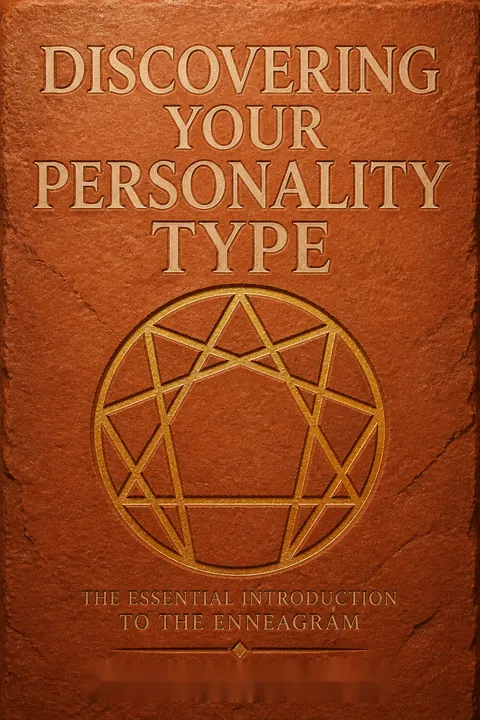


Key Takeaways
Use your type to catch your defenses, not to decorate your identity.
A map, not a box. The Enneagram describes nine recurring personality patterns, each shaped by characteristic motivations, perceptions, habits, and defenses. The authors propose that temperament and childhood experience contribute to a dominant type, which becomes a familiar way of coping with the world. But they also argue that all nine types represent potentials within each person. A type describes a habitual center of gravity, not a complete human being.
Awareness is the purpose. The practical task is to notice a pattern as it happens: the urge to correct, please, perform, withdraw, or distract. Observing that reaction without immediately judging or obeying it can create room for a more deliberate response. A test or label matters only insofar as it helps reveal the pattern.
What's valuable here is the distinction between a description and an identity. A map can make a hidden habit visible, but it can also become a new hiding place if someone treats a type as a complete explanation. This resembles the difference between using a diagnosis to guide inquiry and using it to close inquiry. The model is most useful when it generates questions about actual behavior, especially behavior that conflicts with a flattering self-image. Its spiritual language about an essential self is an interpretive claim, not something a questionnaire can establish.
Trace each type to the emotion it manages, not just its visible style.
Three emotional centers. The book groups the nine types into three Triads, or clusters organized around a dominant emotional difficulty. Types Eight, Nine, and One are associated with anger; Two, Three, and Four with shame; Five, Six, and Seven with anxiety. Every person can experience all three emotions, but each type is said to organize its defenses around one in particular.
Three ways to cope. Eights express anger, Nines push it out of awareness, and Ones try to control it. Twos seek affirmation through care, Threes through achievement, and Fours through a sense of special identity. Fives retreat into understanding, Sixes seek dependable support, and Sevens pursue options and stimulation. These are proposed patterns, not diagnoses: similar behavior can arise from different motives.
The focus on motive helps explain why a surface trait is a poor shortcut to understanding someone. Caution, for example, might reflect a search for certainty, a desire for control, or simple expertise in a risky setting. The Triads offer a compact prompt: what feeling might this behavior be managing? That question can improve self-observation without requiring certainty about the answer. The framework is strongest as a hypothesis-generating tool. If every action is interpreted as proof of a type, the model becomes unfalsifiable and less useful.
Turn perfection, caretaking, and achievement toward honesty rather than approval.
Three strategies for worth. Type One seeks to live by high standards and improve what seems wrong. Its discipline can serve fairness and quality, but suppressed irritation may turn into criticism of self and others. Growth means applying principles with flexibility and making room for play. Type Two offers warmth and practical help, but can hide personal needs and hope that generosity earns affection. Naming needs directly makes care less entangled with unspoken expectations.
Performance can obscure the person. Type Three adapts, works hard, and pursues visible success. The danger is confusing a polished image with genuine self-worth, then ignoring feelings to keep performing. Growth involves honest contact with inner experience, cooperation, and asking for help. The shared question is whether the behavior expresses a real value or tries to secure a verdict from others.
These three patterns show how socially praised strengths can carry a private cost. Conscientiousness, generosity, and ambition are valuable, yet each can become a strategy for avoiding vulnerability: the mistake, the unmet need, or the possibility of failure. This is a useful corrective to advice that simply tells people to amplify their strengths. A more discriminating question is whether a strength remains freely chosen or has become compulsory. The descriptions should not imply that all principled, helpful, or ambitious people share the same underlying fear.
Trade emotional comparison, retreat, and reassurance-seeking for contact with reality.
Three ways to seek safety. Type Four attends closely to feelings and personal identity. That sensitivity can produce creative insight, but dwelling on what is missing can intensify envy and keep old hurt active. The book points toward accepting feelings while returning attention to present life. Type Five seeks understanding and protects independence by withdrawing. Deep concentration can yield original expertise, but hoarding time, knowledge, and energy can become isolation. Growth asks for fuller participation, including contact with feelings and bodily needs.
Trust can turn outward. Type Six is responsible and loyal, alert to risks and eager for reliable support. Yet repeated doubt can make reassurance temporary, producing cycles of dependence, suspicion, or defiance. The authors emphasize building confidence in one's own judgment. Across these types, insight is not the same as resolution: feeling, thinking, and checking can each become avoidance when used automatically.
The three profiles illuminate different routes away from immediate experience. One elaborates a painful story, another retreats into analysis, and another repeatedly checks whether safety is assured. These responses may feel protective while narrowing the range of possible action. A helpful test is whether reflection produces clearer engagement or simply more reflection. At the same time, withdrawal can be a legitimate need for rest, and careful checking can be prudent. The key distinction is not the behavior alone, but its rigidity, cost, and fit with the situation.
Notice how each escape strategy protects you while shrinking your life.
Options, force, and peacekeeping. Type Seven pursues novelty and plans, bringing energy and versatility, but may scatter attention to avoid painful feelings. Its growth is to tolerate stillness, choose priorities, and stay with an experience. Type Eight values independence and acts decisively; that strength can become pressure or control when vulnerability feels dangerous. More open cooperation lets strength serve others rather than dominate them. Type Nine eases tension and helps people feel included, but can mute personal wishes until disengagement, stubbornness, or anger surfaces.
Participation restores choice. The book's advice is specific to each pattern: Sevens practice quiet and follow-through, Eights allow vulnerability and partnership, and Nines assert their needs and engage problems directly. These are not instructions to suppress enthusiasm, confidence, or accommodation. They are ways to keep those qualities from becoming automatic defenses.
These profiles challenge three attractive myths: that freedom means keeping every option open, that strength means never yielding, and that peace means avoiding disagreement. In practice, each ideal can conceal a cost. A commitment can make freedom meaningful, openness can make strength trustworthy, and respectful conflict can protect a relationship from accumulated resentment. The framework invites readers to examine what their preferred response prevents them from feeling. It should not, however, treat quietness, assertiveness, or novelty-seeking as problems by themselves; context determines whether a trait is serving the person.
Read personality as a changing range, not a fixed script.
State affects expression. The Levels of Development describe nine degrees of functioning within each type: three relatively healthy, three average, and three unhealthy. As the authors present it, movement toward unhealthy patterns involves more defensiveness and automatic behavior, while greater awareness allows more flexibility. This helps explain why two people with the same type can look very different, and why one person can act differently under pressure.
Several influences complete the picture. A wing is one of the personality types adjacent to a person's dominant type, adding a secondary influence. Directions of Integration and Disintegration describe shifts associated with greater security or stress. Instinctual Variants combine a type with a dominant focus on self-preservation, intimate intensity, or social connection. The book treats these elements as a way to enrich a portrait, not as reasons to multiply labels without limit.
A continuum is more psychologically plausible than a frozen stereotype because people vary with stress, relationships, and available support. It also creates a practical question: what is the person doing now, and how much choice remains in that response? The framework's many layers can make it nuanced, but they can also make it difficult to disprove. Almost any behavior might be explained by type, wing, instinct, or stress direction. Restraint matters: the extra categories should clarify observed patterns, not rescue a prediction whenever reality fails to match it.
Treat RHETI results as evidence to test against a lifetime of behavior.
A structured first clue. The Riso-Hudson Enneagram Type Indicator, or RHETI, presents 144 pairs of statements and asks respondents to choose the closer match. The authors instruct people to answer from the perspective of their past, especially how they were as young adults, rather than their present or ideal self. They estimate that taking and scoring it takes about 45 to 60 minutes. Its main purpose is to narrow the likely type, not to measure mental health.
Its results require interpretation. In an independent 2001 dissertation study, reported internal-consistency figures ranged from 56 to 82 percent across types, with an overall figure of 72 percent. The authors note that self-report can be distorted by blind spots, social pressure, uncertainty, or familiarity with the system. They recommend comparing test results with type descriptions, trusted observers, and honest self-observation over time.
The book is relatively careful about the difference between a questionnaire and self-knowledge. That caution is essential because personality tests can give an impression of precision even when respondents misunderstand themselves or answer strategically. One measurement distinction deserves attention: internal consistency indicates how coherently items relate within a scale, but it does not by itself show that a person's assigned type is correct. The RHETI figures are useful context, not a guarantee of classification. Treating close or conflicting scores as a reason to investigate is more defensible than forcing a single answer.
Use type differences to translate needs, not to diagnose people from afar.
Make communication less self-centered. The Enneagram can help people notice that colleagues and partners may value different things: accuracy, recognition, autonomy, closeness, predictability, or harmony. In a workplace, that awareness can change how feedback is delivered, how responsibilities are shared, and how conflict is discussed. In relationships, it can help distinguish a request for space from rejection, or a wish to help from an attempt to control.
Keep the person larger than the category. The authors also apply the model to parenting, arguing that parents influence how securely a child's personality develops rather than creating the child's type. They advise curiosity about a child's temperament instead of pressuring the child to match a parent's expectations. When considering others, the book recommends looking at whole patterns and motives rather than assigning a type from a single trait. Use categories to invite conversation, not to overrule someone's account of themselves.
The practical promise is not that a type predicts exactly what another person will do. It is that a difference in priorities becomes easier to discuss without turning it into a moral failing. That can improve negotiation: people can name what they need and ask what the other person is protecting. Yet typing others carries an asymmetry. An observer may feel insightful while the person being typed feels reduced or misread. Consent, humility, and attention to the actual relationship are safeguards against turning a tool for empathy into a system of social sorting.
Analysis
The book's central achievement is to make personality a question of motivation rather than a checklist of visible traits. A person who appears disciplined, generous, ambitious, withdrawn, or agreeable may be acting from very different concerns. By asking what the behavior is trying to secure or avoid, the Enneagram invites a more searching kind of self-observation. Its most valuable practical move is also its most paradoxical: the type is useful not because it provides a final identity, but because it can expose the habits through which identity is defended.
The system's layered structure supports that aim. Triads offer a broad emotional orientation; type descriptions specify recurrent strategies; development levels and stress patterns account for variation. Wings and instincts add detail. This gives readers a vocabulary for recognizing why people who share a broad type can differ, and why one person changes across circumstances. The danger is explanatory overreach. More categories can make the model feel increasingly precise while making it harder to test. The RHETI discussion provides an important check on that confidence. The book reports encouraging independent validation and correlations with the NEO-PI-R, while also acknowledging self-report limitations and uneven scores across types. Those findings support further study, but a correlation with established personality dimensions does not establish that nine discrete types are the best account of personality. Contemporary personality science often represents traits dimensionally, so the Enneagram may be most useful alongside, rather than instead of, such models.
The authors' claim that dominant type is largely inborn is stronger than the evidence described in this text can establish. Their parenting advice is more cautious and broadly useful: recognize differences in temperament, and do not demand that a child become a parent's preferred kind of person. Overall, the book is best read as a structured interpretive lens. Its value depends on whether it increases curiosity, accountability, and compassion, not on whether every person can be assigned a definitive number.
Review Summary
Discovering Your Personality Type is generally well-received as an introductory guide to the Enneagram. Readers appreciate its straightforward approach, comprehensive test, and clear explanations of the nine types. Many find it insightful for self-discovery and character development. Some criticize its complexity or spiritual undertones, while others praise its psychological depth. The book is often recommended as a starting point for Enneagram exploration, though some readers seek more in-depth resources after finishing it. Overall, it's considered a valuable tool for understanding oneself and others.
People Also Read








Glossary
The Enneagram
Nine-pattern personality mapA geometric symbol used in this book to organize nine personality types and their relationships. Each type represents a recurring cluster of motivations, perceptions, behaviors, and defenses. The authors present it as a map for recognizing habitual patterns and supporting personal growth, not as a complete account of an individual or a clinical diagnosis.
Riso-Hudson Enneagram Type Indicator (RHETI)
Enneagram self-report questionnaireA forced-choice questionnaire consisting of 144 pairs of statements. Respondents choose which statement better reflects their lifelong tendencies, ideally answering from their past as young adults. Its intended use is to suggest a dominant Enneagram type and a broader profile. The authors caution that results need interpretation and cannot provide complete self-knowledge or diagnose mental health.
Triads
Three emotional groupingsThe Enneagram's three groups of three types: the Instinctive Triad, the Feeling Triad, and the Thinking Triad. The book associates them respectively with anger, shame, and anxiety as organizing emotional concerns. Each type is described as managing its Triad's central emotion in a characteristic way, though all three emotions can occur in every person.
Levels of Development
Nine functioning levels per typeA framework describing nine degrees of functioning within each Enneagram type. The levels are grouped into healthy, average, and unhealthy ranges, with three levels in each range. The authors use them to explain how the same type can express more flexible or more defensive behavior, and to connect greater awareness with less automatic reactions.
Directions of Integration and Disintegration
Stress and security shiftsThe Enneagram's connecting lines are interpreted as patterns of movement between types. The Direction of Disintegration describes characteristic responses under increased stress, while the Direction of Integration describes responses associated with greater security and development. The authors treat both connected types as influences on a person's overall pattern, not as changes in dominant type.
wing
Adjacent type influenceOne of the two types positioned next to a person's dominant type on the Enneagram circle. The authors propose that a wing adds important qualities to the dominant type and that most people show a stronger influence from one adjacent type than the other. They also note that the influence can vary and that identifying a wing requires first identifying the dominant type.
Instinctual Variants
Type and instinct combinationsThe combinations formed by pairing one of the nine Enneagram types with a dominant instinct: self-preservation, sexual or intimate connection, or social connection. The authors argue that the dominant instinct shapes which needs receive priority and how a type pursues them. The resulting combinations offer a more specific portrait while leaving all three instincts present.
Functions
Type potentials within everyoneThe book's term for viewing the nine types as psychological capacities that operate in every person, not only as separate personality categories. A person's dominant type is treated as the central organizing Function, while the other eight describe additional potentials. RHETI scores are interpreted as a snapshot of how strongly those capacities are expressed at a particular time.
New York Longitudinal Study
Infant temperament researchA study by Alexander Thomas and Stella Chess, cited in the book as finding nine recurring patterns of temperament in infants. The authors present it as a parallel observation that supports the idea of early temperamental differences. The cited study did not use the Enneagram, so its reported patterns do not by themselves validate the Enneagram's nine personality types.
FAQ
What is "Discovering Your Personality Type" by Don Richard Riso and Russ Hudson about?
- Comprehensive Enneagram Introduction: The book serves as an essential introduction to the Enneagram, a system that describes nine basic personality types and their interrelationships.
- Self-Discovery Tool: It provides readers with the Riso-Hudson Enneagram Type Indicator (RHETI), a scientifically validated questionnaire to help individuals identify their dominant personality type.
- Practical Applications: The book explores how understanding your type can improve self-awareness, relationships, business effectiveness, and personal growth.
- Accessible for All Levels: Whether you’re new to the Enneagram or an advanced student, the book offers both foundational explanations and deeper insights into the system.
Why should I read "Discovering Your Personality Type" by Don Richard Riso and Russ Hudson?
- Gain Self-Understanding: The book helps you uncover your core motivations, fears, and desires, leading to greater self-acceptance and personal growth.
- Improve Relationships: By understanding your type and the types of others, you can enhance communication, empathy, and conflict resolution in personal and professional relationships.
- Scientifically Validated Tool: The included RHETI questionnaire is one of the most reliable and widely used Enneagram tests, validated by independent research.
- Broad Practical Use: The Enneagram insights are applicable in therapy, business, parenting, and cultural studies, making the book valuable across many life domains.
What are the key takeaways from "Discovering Your Personality Type" by Don Richard Riso and Russ Hudson?
- Nine Personality Types: Everyone has a dominant type, but all nine types exist within us to varying degrees, shaping our behaviors and perspectives.
- Growth Through Awareness: Recognizing your type’s patterns allows you to move beyond automatic reactions and make conscious choices for personal development.
- Dynamic System: The Enneagram includes concepts like wings, levels of development, and directions of integration/disintegration, showing how personality is fluid, not fixed.
- Practical Guidance: The book offers actionable advice for applying Enneagram insights in real-world contexts, such as business, relationships, and parenting.
How does the Riso-Hudson Enneagram Type Indicator (RHETI) work in "Discovering Your Personality Type"?
- Forced-Choice Questionnaire: The RHETI consists of 144 pairs of statements; you choose the one that best describes you, focusing on your lifelong patterns.
- Scoring and Interpretation: After completing the test, you tally your scores to identify your dominant type and possible wing, with guidance for interpreting close or ambiguous results.
- Self-Report Limitations: The book discusses the inherent challenges of self-report tests, such as self-deception and lack of self-knowledge, and suggests ways to increase accuracy.
- Validation and Reliability: The RHETI has been independently validated, with accuracy rates ranging from 56% to 82% depending on the type, making it a trusted tool for type identification.
What are the nine Enneagram personality types described in "Discovering Your Personality Type" by Don Richard Riso and Russ Hudson?
- Type One – The Reformer: Principled, purposeful, self-controlled, and perfectionistic; strives for improvement and high ethical standards.
- Type Two – The Helper: Generous, demonstrative, people-pleasing, and possessive; seeks love and connection through helping others.
- Type Three – The Achiever: Adaptable, excelling, driven, and image-conscious; values success and recognition.
- Type Four – The Individualist: Expressive, dramatic, self-absorbed, and temperamental; desires authenticity and uniqueness.
- Type Five – The Investigator: Perceptive, innovative, secretive, and isolated; pursues knowledge and independence.
- Type Six – The Loyalist: Engaging, responsible, anxious, and suspicious; seeks security and support.
- Type Seven – The Enthusiast: Spontaneous, versatile, distractible, and scattered; craves variety and excitement.
- Type Eight – The Challenger: Self-confident, decisive, willful, and confrontational; values strength and control.
- Type Nine – The Peacemaker: Receptive, reassuring, accommodating, and complacent; desires harmony and avoids conflict.
How does "Discovering Your Personality Type" by Don Richard Riso and Russ Hudson explain the structure and dynamics of the Enneagram system?
- Enneagram Symbol: The system is represented by a nine-pointed geometric figure, with each point corresponding to a personality type and connected by inner lines indicating dynamic relationships.
- Triads: The nine types are grouped into three Triads—Instinctive (8, 9, 1), Feeling (2, 3, 4), and Thinking (5, 6, 7)—each with a dominant emotional theme (anger, shame, or fear).
- Wings: Each type is influenced by one or both adjacent types, called wings, which add nuance and variation to the core type.
- Levels of Development: Each type has a continuum from healthy to unhealthy functioning, explaining differences within the same type and how people change over time.
- Directions of Integration/Disintegration: Under stress or security, each type tends to adopt traits of another type, showing the dynamic, non-static nature of personality.
What are the main concepts and terminology unique to "Discovering Your Personality Type" by Don Richard Riso and Russ Hudson?
- Wings: The adjacent types on either side of your main type, which influence your personality in unique ways.
- Levels of Development: Nine internal levels within each type, ranging from healthy to unhealthy, explaining shifts in behavior and motivation.
- Directions of Integration/Disintegration: Paths each type follows under stress (disintegration) or security (integration), adopting traits of other types.
- Instinctual Variants: Each type is further shaped by a dominant instinct—self-preservation, sexual (intimate), or social—resulting in 27 subtype combinations.
- Functions: The nine types are also seen as psychological functions or capacities present in everyone, with one being dominant.
How does "Discovering Your Personality Type" by Don Richard Riso and Russ Hudson suggest using the Enneagram for personal growth?
- Self-Observation: The book emphasizes the importance of observing your type’s patterns in real time to become less controlled by automatic reactions.
- Present-Moment Awareness: Growth comes from being present and nonjudgmentally aware of your thoughts, feelings, and behaviors.
- Moving Beyond Labels: Identifying your type is just the starting point; real transformation requires courageously observing and working with your type’s challenges.
- Integration of All Types: The ultimate goal is to develop the healthy qualities of all nine types, leading to greater freedom, compassion, and self-actualization.
How can the Enneagram, as presented in "Discovering Your Personality Type" by Don Richard Riso and Russ Hudson, be applied in relationships and business?
- Enhanced Communication: Understanding type differences improves empathy, reduces misunderstandings, and fosters more effective communication in both personal and professional settings.
- Conflict Resolution: The Enneagram helps identify sources of conflict and offers strategies for resolving them based on each type’s motivations and fears.
- Team Building and Leadership: In business, knowing team members’ types aids in assigning roles, managing diversity, and developing leadership skills.
- Relationship Compatibility: The book discusses what each type seeks in relationships and what can interfere, offering guidance for building healthier, more satisfying connections.
What are the scientific foundations and limitations of the RHETI and the Enneagram system in "Discovering Your Personality Type" by Don Richard Riso and Russ Hudson?
- Empirical Validation: The RHETI has been independently validated, showing respectable accuracy rates for a self-report personality test.
- Limitations of Self-Report: The book acknowledges that self-knowledge is required for accurate results, and factors like self-deception or social desirability can affect outcomes.
- Not a Diagnostic Tool: The RHETI is not designed to diagnose mental health conditions or measure pathology; it focuses on average human behavior.
- Ongoing Research: The authors encourage further scientific study and refinement of the Enneagram and the RHETI for greater reliability and acceptance.
What are some of the best quotes from "Discovering Your Personality Type" by Don Richard Riso and Russ Hudson, and what do they mean?
- "The Enneagram does not put you in a box—it shows you the box you are already in (but don't know it) and the way out!"
This highlights the Enneagram’s purpose: not to limit you, but to reveal unconscious patterns and offer a path to freedom. - "We study the Enneagram because it is necessary to become conscious of how our personality operates so that we can become free of it."
The Enneagram is a tool for self-liberation, not just self-description. - "The responsibility for finding out who we are always lies with us."
Self-discovery is a personal journey; no test or system can replace honest self-observation and reflection. - "The ideal is to become your best self, not to imitate the assets of another type."
Growth comes from embracing and developing your own type’s strengths, not wishing to be someone else.
How does "Discovering Your Personality Type" by Don Richard Riso and Russ Hudson address the use of the Enneagram in parenting and cultural studies?
- Parenting Guidance: The book clarifies that parents do not create a child’s type, but their approach influences the child’s health within that type; understanding both parent and
About the Author
Other books by Don Richard Riso


Download PDF
Download EPUB
.epub digital book format is ideal for reading ebooks on phones, tablets, and e-readers.








