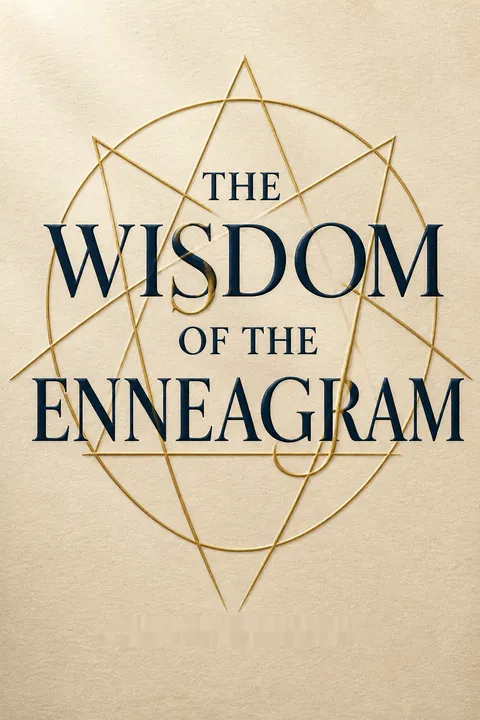


Key Takeaways
Treat your type as a coping map, not a definition of who you are
A map, not a box. The Enneagram is a model of nine personality patterns and their relationships. The book distinguishes personality, our familiar conditioned habits, from Essence, the deeper quality of being that those habits can obscure. In this view, a type describes a habitual filter, not a whole person. The authors also clarify that the modern personality system is a synthesis: the diagram has older roots, but its connection to nine personality types developed much more recently.
Recognition is only a start. A Sufi tale in the book describes a prisoner discovering that the pattern of his lock is woven into a rug. The rug offers a clue, but he still has to act to escape. Likewise, knowing a type can reveal a pattern, but insight alone does not undo it.
The distinction between a person and a pattern has a useful parallel in cognitive defusion, a practice in which people learn to notice thoughts without treating them as their identity. That shift can create room to choose a response rather than obey a reflex. The book gives this shift spiritual meaning through Essence. That metaphysical interpretation may resonate deeply, but it is not required to use the practical insight: a personality description is most useful when it makes behavior more observable, not more fixed.
Find the fear beneath each type's familiar strategy
Motives matter more than manner. The authors argue that similar behavior can serve different inner aims. They call each type's underlying threat its Basic Fear, and the compensating aim its Basic Desire. The nine patterns are: Ones pursue integrity against a fear of being defective; Twos seek love by helping; Threes seek worth through achievement; Fours seek identity through distinctiveness; Fives seek competence through knowledge; Sixes seek safety through support and certainty; Sevens pursue stimulation to escape pain; Eights seek control to prevent harm; Nines seek peace by preserving connection.
The strategy can backfire. A Six can become so preoccupied with security that worry and dependence undermine confidence. A Two may give so much to earn closeness that unspoken expectations strain the relationship. The useful question is not just what someone does, but what the behavior is trying to secure.
Motivation-focused interpretation can reveal why a surface trait is misleading: caution may reflect conscientiousness, fear, or a learned response to instability. That resembles functional approaches in psychology, which ask what a behavior accomplishes for the person. The limitation is that motives are difficult to observe directly, especially in oneself. A type description should therefore generate questions and hypotheses, not serve as proof of what another person secretly wants.
Diagnose the center of your imbalance, not just your visible behavior
Three centers, three distortions. The Triads group the types by a dominant area of struggle: Eight, Nine, and One form the Instinctive Triad, linked to resistance, control, and anger; Two, Three, and Four form the Feeling Triad, linked to self-image, shame, and identity; Five, Six, and Seven form the Thinking Triad, linked to anxiety, security, and guidance. The authors use body, heart, and head as shorthand, while emphasizing that everyone has all three capacities.
Other lenses add context. The Hornevian Groups describe social approaches: moving toward people, against them, or away from them. The Harmonic Groups describe coping when frustrated: maintaining a positive outlook, relying on competence, or reacting strongly. These classifications help distinguish, for example, a helper's outward focus from an achiever's performance focus, despite both belonging to the Feeling Triad.
Grouping patterns across multiple dimensions prevents the nine categories from becoming nine disconnected caricatures. It resembles a useful clinical habit: distinguish the problem a person faces from the strategy used to manage it. The book's head, heart, and gut language can also prompt attention to thought, emotion, and bodily response. Its analogy to brain divisions should be treated cautiously, however. A memorable metaphor is not evidence that personality neatly maps onto separate brain systems.
Trace the need your childhood strategy still tries to satisfy
Adaptations can outlive their setting. The authors propose that early unmet needs and family dynamics help shape each type's defenses. They explicitly present childhood patterns as tendencies, not as a proven cause of personality. A child who feels responsible for family order may become a One who polices mistakes. A Two may learn that attending to others is safer than expressing personal needs. A Three may discover that performance wins approval, while a Five may withdraw into private interests to avoid feeling overwhelmed.
The defense becomes a trap. The book pairs each type with a missing childhood reassurance, such as the message that a Six is safe or that a Nine's presence matters. Adults may keep seeking that reassurance indirectly, even when the old strategy now creates the very problem it was meant to prevent. Self-understanding requires compassion for the adaptation and honesty about its current cost.
This account's strength is its humane framing: a defense is not a character defect but an attempt to cope. That is compatible with developmental psychology's attention to how early relationships shape expectations and emotional habits. Yet retrospective childhood explanations can be vulnerable to confirmation bias. A compelling story about the past is not automatically a causal explanation. The practical value lies in noticing present patterns and unmet needs, whether or not a precise childhood origin can be established.
Measure growth by freedom, not by how pleasant you feel
A type has vertical range. The Levels of Development describe healthy, average, and unhealthy expressions within each of the nine types, with three levels in each range. The authors treat these levels as a measure of awareness and freedom, not simply mood. A One can be principled and discerning, or rigidly judgmental; an Eight can use strength to protect others, or to intimidate them.
States fluctuate; habits shift slowly. The book compares a person's usual center of gravity to a peg, and temporary changes in mood or stress to a flexible band around it. A difficult day may pull someone toward less healthy behavior without changing their type. A Wake-up Call signals familiar fixation, while a Red Flag indicates that patterns may be becoming seriously destructive. This framework asks readers to notice repeated motivations and consequences, rather than type themselves from one bad moment.
The distinction between a temporary state and a more persistent pattern is valuable across psychology: fatigue, threat, and context can change behavior without transforming someone's basic disposition. The book's levels make that distinction vivid and encourage early course correction. Their precision can also create a false impression of measurement. The levels are an interpretive map, not a validated clinical scale, so they work better as prompts for reflection than as scores assigned to oneself or others.
Catch the reaction before it becomes your next automatic act
Awareness interrupts the loop. The book's central practice is to observe personality in action without judgment or excuse. During a retreat, Don Riso noticed anger rising when a roommate disrupted a rare chance to rest. Instead of feeding the reaction, he watched it. The pause altered how he perceived the roommate and the room around him. The point is not that irritation must disappear, but that a noticed reaction need not dictate what happens next.
The witness creates choice. The authors call the observing capacity the Inner Observer. It can notice thoughts, feelings, bodily sensations, and surroundings without turning each passing state into an identity. Reviewing an argument afterward may teach something, but noticing the urge to attack, defend, or withdraw while it is happening can open another response. The discipline is simple and demanding: see what is happening, then refrain from acting on the first impulse.
This is a practical account of metacognition, the ability to notice mental activity while it unfolds. Mindfulness-based therapies use a similar pause to help people respond more deliberately to distress. The roommate story makes the mechanism tangible: attention shifts from the grievance to the reaction itself. Still, observation is not a substitute for setting boundaries or addressing real harm. Nonreactivity is most useful when it supports clear action, not when it becomes another way to avoid conflict.
Follow your type's growth direction without copying another type's persona
Stress and growth have patterns. The Directions of Integration and Disintegration describe ways each type may shift under strain or develop with greater awareness. In the authors' map, Ones move toward Four under stress and toward Seven in growth; Twos toward Eight and Four; Threes toward Nine and Six; Fours toward Two and One; Fives toward Seven and Eight; Sixes toward Three and Nine; Sevens toward One and Five; Eights toward Five and Two; Nines toward Six and Three.
Borrow qualities, not costumes. A stressed Five may become scattered, resembling a Seven. A growing Five, by contrast, becomes more decisive and engaged, qualities associated with a healthy Eight. This does not mean acting out another type's habits. The authors describe growth as loosening one's own defenses so useful capacities emerge naturally, not adding a second personality as a self-improvement project.
This model is memorable because it treats change as patterned rather than random, while insisting that development is not mimicry. It can help readers recognize stress behaviors that seem out of character. The caution is that directional arrows can become a self-confirming story if every action is interpreted to fit the diagram. Their strongest use is as a prompt: what capacity is missing under pressure, and what would a more flexible response look like in this actual situation?
Turn ordinary moments into practice with a repeatable sequence
Use what is happening now. The authors say the Enneagram requires daily practice, not just interesting descriptions. Their Enneagram of Letting Go is a nine-stage process: become present, recognize and name the state, sense it in the body, stay with the sensation, allow relaxation, attend to breathing, reconnect with surroundings, reframe the situation, and return to awareness. The steps are meant to be experienced, not used as a checklist for forcing a particular result.
Choose practice that fits. The book also recommends seeking truth, allowing impulses without acting them out, getting support, learning from daily life, and maintaining regular practice. A short meditation or a mindful chore can reveal the same habitual reactions as a retreat. The authors note that serious addiction and significant psychological problems may require therapy, recovery groups, or other care; the Enneagram is not a substitute.
The sequence joins attention to the body with emotional labeling and perspective-taking, a combination found in several contemporary approaches to regulating distress. Its emphasis on everyday practice avoids making transformation dependent on dramatic experiences. The stages should not be treated as a guaranteed technique, however. Bodily attention can intensify distress for some people, particularly amid trauma. A flexible pace, trusted support, and professional care matter more than completing a prescribed sequence.
Use type labels to increase compassion, never to excuse harm
A label is limited evidence. The authors warn against using type to explain a whole person or to diagnose someone else. Type does not establish a person's history, ability, integrity, or character, and every type has both strengths and liabilities. The book's QUEST sorting test is described as roughly 70 percent accurate, and its longer RHETI as about 80 percent accurate; these are the authors' reported estimates, not a guarantee of correct self-typing.
Treat the map critically. The book itself says the personality system is a modern synthesis, not an intact ancient oral tradition. It encourages readers to test descriptions against lived experience and to keep an open mind. A type can explain why a reaction feels familiar, but it cannot make that reaction harmless. The best use of the system is to recognize one's own habits and become more curious, responsible, and understanding toward others.
This restraint is essential for any popular typology. Labels can help organize self-observation, but they can also encourage confirmation bias: people notice the examples that fit and overlook those that do not. Contemporary personality research generally has stronger empirical support for dimensional trait models than for sharply bounded types. That does not make the Enneagram useless; it means its claims should be held lightly, with observed behavior and accountability taking precedence over a neat category.
Analysis
The book's deepest contribution is not simply its catalogue of nine temperaments. It links personality description to a theory of self-deception: people repeat strategies that once protected them, then mistake those strategies for identity. The model's practical sequence follows from that claim. Identify the recurring motive, notice its activation in real time, and create enough space to choose a less automatic response. Its strongest images, including the prisoner's lock pattern and the retreatant who watches irritation arise, make self-observation feel concrete rather than abstract.
The framework also benefits from two dimensions often missing in casual personality quizzes. The Triads ask where a person's central imbalance lies, while the Levels distinguish flexible strengths from increasingly constricted versions of the same type. The arrows add a proposed account of stress and development. Together, these ideas resist the simplistic claim that a type is a fixed bundle of traits.
There is a meaningful epistemic boundary. The book moves between psychological observation and spiritual claims about Essence, Divine presence, and liberation. Those claims may be compelling as religious interpretation, but they do not have the same status as observable behavioral descriptions. Likewise, the authors' accuracy estimates for their tests should not be mistaken for independent validation. Contemporary personality science generally favors dimensional models with stronger empirical foundations. The Enneagram is most defensible as a reflective vocabulary, not a diagnostic instrument or proven account of development.
That distinction does not erase its usefulness. A map can be valuable without being a literal picture of the mind. Used carefully, this one helps readers ask sharper questions: What am I protecting? What does this reaction cost? What capacity would make me freer here? Used carelessly, it becomes a flattering identity system, a way to type other people, or a spiritual shortcut around therapy and difficult realities. Its value depends less on finding the perfect label than on whether the label increases attention, humility, and responsibility.
Review Summary
The Wisdom of the Enneagram is highly regarded as a comprehensive guide to the Enneagram personality system. Readers praise its detailed explanations, practical applications, and insights into self-awareness and personal growth. Many find it helpful for understanding themselves and others better, improving relationships, and fostering spiritual development. The book is seen as accessible yet thorough, offering valuable tools for self-reflection and transformation. While some readers find certain sections too abstract or dense, most consider it an essential resource for anyone interested in the Enneagram.
People Also Read





Glossary
Enneagram
Nine-pattern personality mapA nine-point diagram used in this book to describe nine recurring personality patterns and their relationships. The authors distinguish the old history of the symbol from the modern development of the personality system. They present it as a tool for self-observation and growth, not as a religion or a complete spiritual path.
Essence
Deeper nature beyond personalityThe authors' term for a person's fundamental quality of Being, also described in spiritual language as Spirit. Essence is not another personality trait or an improved self-image. The book argues that habitual defenses obscure it, and that awareness can make personality more flexible and allow a more direct experience of this deeper nature.
Basic Fear and Basic Desire
Type-specific threat and aimBasic Fear names the central threat that a type organizes itself around, such as being unloved, unsafe, or controlled. Basic Desire names the compensating condition the type seeks to feel okay. The authors argue that these aims reflect legitimate human needs, but that rigid attempts to secure them can become self-defeating.
Triads
Three centers of imbalanceThe Triads group the nine types into instinctive, feeling, and thinking centers. Types Eight, Nine, and One are associated with control and anger; Two, Three, and Four with self-image and shame; Five, Six, and Seven with anxiety and fear. The groupings describe where each type's characteristic defenses are concentrated, not which capacity a person possesses exclusively.
Hornevian Groups
Three social approachesA grouping named for psychiatrist Karen Horney that describes how types approach other people and pursue needs. Types Three, Seven, and Eight are assertive; One, Two, and Six are compliant with internal duties or standards; Four, Five, and Nine are withdrawn. The categories describe habitual strategies, not a person's total social behavior.
Harmonic Groups
Three frustration responsesA grouping that describes how types cope when they do not get what they want. Types Two, Seven, and Nine emphasize positive outlook; One, Three, and Five rely on competence and problem-solving; Four, Six, and Eight react strongly and seek an emotional response. The groupings help explain coping style beyond a type's main motivation.
Levels of Development
Health range within each typeA nine-level scale for describing healthy, average, and unhealthy expressions within each Enneagram type. The authors use it to distinguish flexible strengths from increasingly defensive behavior and to track a person's typical center of gravity. They emphasize that mood can fluctuate quickly, while enduring changes in patterns tend to develop more slowly.
Directions of Integration and Disintegration
Growth and stress patternsThe Enneagram's connecting lines are interpreted as patterns of change. Integration describes qualities associated with a type's development, while disintegration describes behaviors that may emerge under stress. The authors caution that growth does not mean imitating another type's surface habits; it involves loosening the defenses that block healthier capacities.
Instinctual Variants
Three areas of instinctive focusThe book's three variants describe where a person's attention and concerns tend to concentrate: self-preservation, social connection, or intense one-to-one connection, called sexual in the system. Each can combine with any type, creating different expressions of its core concerns. The authors treat the variants as distinct from wings, though both add detail to a type description.
Inner Observer
Nonjudgmental witnessing awarenessThe capacity to notice thoughts, feelings, bodily sensations, and surroundings without immediately judging or identifying with them. The authors consider it essential to change because it makes automatic personality reactions visible while they are happening. It differs from an inner critic, which evaluates experience and often intensifies self-conflict.
Enneagram of Letting Go
Nine-stage awareness practiceA practice created by the authors to guide attention through a reaction: become present, recognize and name the state, sense it physically, remain with the sensation, allow relaxation, attend to breathing, reconnect with the environment, reframe the situation, and return to awareness. The stages are intended to support release, not to force a specific emotional result.
FAQ
What's The Wisdom of the Enneagram about?
- Understanding Personality Types: The book explores nine distinct personality types, each with unique traits, motivations, and challenges. It combines ancient wisdom with modern psychology to provide insights into personal growth and spiritual development.
- Psychological and Spiritual Growth: It emphasizes the importance of understanding one's personality type for personal development and spiritual growth. The authors aim to facilitate personal transformation through this understanding.
- Practical Applications: The book includes practical advice and exercises for each personality type, allowing readers to apply the concepts to their daily lives. This makes it a useful tool for self-discovery and improvement.
Why should I read The Wisdom of the Enneagram?
- Self-Discovery Tool: This book serves as a powerful tool for self-discovery, helping readers identify their personality type and understand their behaviors. Recognizing one’s type can lead to greater self-awareness and personal growth.
- Improving Relationships: Understanding the Enneagram can enhance interpersonal relationships by providing insights into how different types interact. This knowledge can foster empathy and improve communication with others.
- Holistic Approach: The authors combine psychological insights with spiritual growth, offering a holistic approach to personal development. This dual focus can help readers achieve a more balanced and fulfilling life.
What are the key takeaways of The Wisdom of the Enneagram?
- Nine Personality Types: The book categorizes human behavior into nine distinct types, each with unique characteristics and challenges. Understanding these types is crucial for personal growth.
- Levels of Development: Each type has levels of development ranging from healthy to unhealthy, illustrating how individuals can evolve or regress. This framework helps readers identify where they stand and what steps they can take to improve.
- Integration and Growth: The authors emphasize the importance of integrating the positive qualities of each type to achieve personal growth. They provide practical exercises and advice for moving toward healthier expressions of one’s personality.
What are the nine personality types in The Wisdom of the Enneagram?
- Type One: The Reformer: Principled and self-controlled, Ones strive for improvement but can be perfectionistic and critical. They seek integrity and fear being corrupt or defective.
- Type Two: The Helper: Caring and interpersonal, Twos are generous and self-sacrificing but may struggle with possessiveness and people-pleasing. They fear being unloved and seek to feel needed.
- Type Three: The Achiever: Success-oriented and adaptable, Threes are ambitious and image-conscious but can become overly competitive. They fear being worthless and seek validation through accomplishments.
- Type Four: The Individualist: Sensitive and introspective, Fours are creative but can be moody and self-absorbed. They fear having no identity and seek to express their uniqueness.
- Type Five: The Investigator: Insightful and curious, Fives are independent but may become isolated and eccentric. They fear being incompetent and seek knowledge and understanding.
- Type Six: The Loyalist: Committed and security-oriented, Sixes are reliable but can be anxious and indecisive. They fear being without support and seek security and guidance.
- Type Seven: The Enthusiast: Optimistic and spontaneous, Sevens are versatile but may struggle with impulsiveness. They fear being deprived and seek new experiences.
- Type Eight: The Challenger: Assertive and strong, Eights are protective but can be domineering. They fear being controlled and seek to assert their power.
- Type Nine: The Peacemaker: Easygoing and supportive, Nines are accepting but may be complacent and stubborn. They fear loss of connection and seek harmony and peace.
How does The Wisdom of the Enneagram define the Enneagram?
- Geometric Figure: The Enneagram is described as a nine-pointed geometric figure that maps out the nine fundamental personality types and their interrelationships. It serves as a visual representation of the types and their dynamics.
- Combination of Wisdom Traditions: The Enneagram synthesizes insights from various spiritual and psychological traditions, including Christianity, Buddhism, and modern psychology. This blend provides a holistic understanding of human nature.
- Tool for Self-Discovery: The Enneagram is presented as a tool for self-discovery and personal growth, helping individuals identify their core issues and strengths. It encourages honest self-reflection and awareness.
How can I identify my personality type using The Wisdom of the Enneagram?
- Riso-Hudson QUEST: The book includes the Riso-Hudson QUEST, a quick sorting test that helps narrow down your personality type. This test is designed to be completed in under five minutes and provides a preliminary indication of your type.
- Type Attitude Sorter (TAS): Each type chapter contains the Riso-Hudson TAS, which consists of statements that are characteristic of each type. Scoring your responses can help confirm your primary type.
- Read and Reflect: After taking the tests, read the full descriptions of the types that resonate with you. Reflect on your behaviors, motivations, and challenges to gain deeper insights into your personality.
What are the Levels of Development in The Wisdom of the Enneagram?
- Three Main Ranges: The Levels of Development are categorized into healthy, average, and unhealthy ranges, with three levels within each. This framework helps individuals understand their current state and potential for growth.
- Healthy Levels: In the healthy range, individuals exhibit positive traits and behaviors associated with their type, such as wisdom, acceptance, and self-nurturing. They are more connected to their essence and less identified with their personality.
- Average and Unhealthy Levels: The average range reflects typical behaviors and challenges, while the unhealthy range indicates dysfunction and reactive behaviors. Understanding these levels can help individuals identify when they are slipping into less healthy patterns.
How does the Enneagram help in personal relationships?
- Understanding Dynamics: The Enneagram provides insights into how different personality types interact, helping individuals understand their own and others' motivations and behaviors. This understanding can improve communication and reduce conflicts.
- Compassion and Empathy: By recognizing the strengths and weaknesses of each type, individuals can cultivate compassion for themselves and others. This can lead to more harmonious relationships and a greater sense of connection.
- Personal Growth: The Enneagram encourages individuals to work on their personal issues and growth areas, which can positively impact their relationships. As individuals become more self-aware, they can engage with others more authentically and effectively.
What role does the concept of "Essence" play in The Wisdom of the Enneagram?
- True Nature: Essence refers to the authentic self that exists beyond personality traits and defenses. It represents the core qualities of love, wisdom, and creativity inherent in every individual.
- Path to Liberation: The book emphasizes that understanding and connecting with one's Essence is key to overcoming the limitations imposed by personality types. This connection leads to personal freedom and fulfillment.
- Universal Connection: Recognizing one's Essence fosters a sense of unity with others and the world. It allows individuals to experience life more fully and authentically, transcending the ego's constraints.
What are the best quotes from The Wisdom of the Enneagram and what do they mean?
- “Whatever your age, your upbringing, or your education, what you are made of is mostly unused potential.”: This quote emphasizes that everyone has inherent potential that often goes untapped due to various life circumstances. It encourages readers to explore and realize their true capabilities.
- “The great metaphors from all spiritual traditions—grace, liberation, being born again, awakening from illusion—testify that it is possible to transcend the conditioning of my past and do a new thing.”: This highlights the possibility of personal transformation and growth, regardless of past experiences. It suggests that spiritual awakening is achievable through self-awareness and effort.
- “The curious paradox is that when I accept myself just as I am, then I can change.”: This quote underscores the importance of self-acceptance as a precursor to genuine change. It suggests that embracing one's flaws and current state is essential for growth.
How does The Wisdom of the Enneagram describe the journey of integration for each personality type?
- Pathways to Growth: Each type has specific pathways for growth that involve recognizing and integrating their strengths while addressing their weaknesses. This journey is essential for personal development.
- Emotional Awareness: The process of integration requires individuals to become aware of their emotional patterns and how these affect their behavior. This awareness is crucial for making meaningful changes.
- Connection with Essence: Ultimately, the journey of integration leads individuals to reconnect with their Essential nature, fostering a sense of inner peace and fulfillment. This connection is vital for living authentically.
How can understanding my Enneagram type help me in my personal relationships?
- Enhanced Communication: Knowing your type and the types of those around you can improve communication by fostering empathy and understanding. It allows for more effective interactions based on each person's motivations and fears.
- Conflict Resolution: The book provides insights into how different types handle conflict, enabling individuals to navigate disagreements more constructively. Understanding these dynamics can lead to healthier resolutions.
- Building Stronger Connections: By recognizing the strengths and weaknesses of each type, individuals can cultivate deeper, more meaningful relationships. This understanding promotes acceptance and appreciation of differences.
About the Author

Download PDF
Download EPUB
.epub digital book format is ideal for reading ebooks on phones, tablets, and e-readers.








