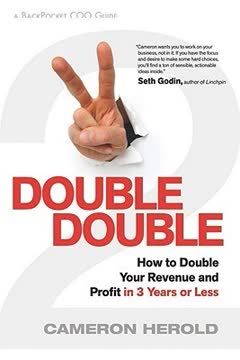
Key Takeaways
Craft a Vivid "Painted Picture" Vision
If you and your employees are not all seeing the exact same vision of what your company will look and feel like three years hence, there is no chance it will ever happen the way you see it in your mind today.
Envision the future. To achieve rapid growth, you must first develop a detailed, three-year "Painted Picture" of your company's future. This isn't a vague mission statement or a simple to-do list; it's a vivid, three-to-four-page document describing what your company will look, feel, and act like when it has doubled in size. It covers everything from customer experience and media perception to internal culture and financial health, without detailing how it will be built.
Unleash creativity. Creating this vision requires stepping away from daily operations and allowing your mind to wander freely, much like an Olympic athlete visualizes success. Turn off distractions, use pen and paper, and focus on "where" you want to be, not "how" you'll get there. Embrace outlandish ideas, as these often spark true innovation and differentiate your vision.
- Get out of your office to avoid daily distractions.
- Use mind-mapping to brainstorm without constraints.
- Cover all aspects: culture, staff, marketing, sales, IT, finance, values, work-life balance.
Align and share. Once crafted, share your Painted Picture with everyone: employees, suppliers, bankers, and even clients. This creates incredible alignment, turning everyone into allies working towards the same clear vision. At 1-800-GOT-JUNK?, a "Can You Imagine?" wall displayed employee visions, leading to unexpected successes like a Harvard Business School case study and Starbucks cup advertising, simply because the vision was openly shared.
Reverse Engineer Your Goals for Action
If you don’t know where you’re going, any road will get you there.
Work backward from the vision. Making your Painted Picture a reality demands focused action, achieved by "reverse engineering" your success. This means starting with your ultimate three-year vision and systematically working backward to define the necessary steps. Just as a custom home builder starts with the finished house design and then plans each construction phase, you must break down your long-term vision into achievable, short-term objectives.
Establish SMART goals. Begin by assessing your current strengths and weaknesses through a quick SWOT analysis, then identify key projects. For each project, set SMART goals: Shared, Measurable, Attainable, Relevant, and Time-based. These goals should align with your Painted Picture and cover critical areas like revenue, profit, customer service, and employee satisfaction.
- Shared: With coaches, mentors, team members.
- Measurable: Quantify goals (e.g., 25% annual revenue increase).
- Attainable: Ensure realism.
- Relevant: Focus on worthwhile objectives.
- Time-based: Set specific deadlines.
Define boundaries and action plans. Before diving into projects, establish clear boundaries: what you will and won't do to achieve your goals (e.g., debt limits, work hours, equity sharing). Then, create detailed action plans for each goal, outlining precise steps, responsible individuals, deadlines, costs, and involved business areas. Involve your leadership team in prioritizing projects based on potential return on investment (ROI) to ensure focus on the "critical few" rather than the "important many."
Build a World-Class "Cult-ure"
Building a great company means creating something that is slightly more than a business and slightly less than a religion.
Culture is the foundation. A world-class workplace culture is not accidental; it's a conscious, strategic decision vital for rapid growth. A strong culture acts as a "people magnet," attracting and retaining top talent while fostering an environment where employees are inspired to perform at their best. It underpins all business aspects, from productivity to customer relations, and is the living background of your Painted Picture.
Design an inspiring environment. Your physical workspace profoundly defines your culture. Eliminate private offices to foster open communication, teamwork, and faster learning. Go "a little crazy" with creative decor, branded meeting rooms, and comfortable social spaces like stocked kitchens or "Dream Rooms." These elements signal a commitment to a unique, vibrant culture, making employees feel valued and at home.
- Clean up your office regularly ("Wasteless Wednesday").
- Remove private offices; mix departments.
- Use walls for "Can You Imagine?" visions and core values.
- Provide social amenities like BBQs, free snacks, and "Nap Rooms."
Cultivate a social and entrepreneurial spirit. Beyond physical space, foster a social environment by genuinely connecting with employees, forcing them to go home, and offering generous benefits like five weeks of paid vacation (including sick days). Implement programs like "101 Dream Goals" to help employees achieve personal aspirations, building deep loyalty. Treat employees as co-owners by sharing financial statements and profit-sharing, empowering them to identify cost savings and revenue opportunities, transforming your company into a "cult-ure" of shared purpose and excitement.
Master Focused Hiring and Strategic Firing
At the end of the day you bet on people, not on strategies.
Hire for attitude, train for skills (with a twist). Great companies are built by great people. Focused hiring means proactively seeking "superstars" who raise the average skill set and positive energy of your team. Don't wait for applicants; actively poach top talent from other companies, as A-level talent attracts more A-level talent. The goal is to find individuals who are not only a cultural fit but also possess proven skills and a championship mindset.
Forecast and streamline recruiting. Plan your staffing needs at least a year in advance, mapping out every role and the precise steps in the recruiting process. For example, to hire 12 teachers, you might need 522 applications, accounting for drop-off rates at each stage: application, group interview, one-on-one, classroom test, reference checks, and CEO "sniff test." This military precision prevents scrambling and ensures you find the right people on time.
Interview for fit, fire with respect. Utilize group interviews to screen for cultural fit and leadership traits, asking questions about personal interests, stress management, and team dynamics. Follow up with in-depth one-on-one interviews to verify skills and past performance, always probing for concrete examples. Crucially, be prepared to fire "wrong people" swiftly and respectfully. Delaying a necessary termination is "stealing" from the employee's life and damages company culture, as a mentor once powerfully taught.
Optimize Communication and Meeting Rhythms
The single biggest problem in communication is the illusion that it has taken place.
Listen first, then be understood. Effective communication is the glue of any successful organization, demanding active listening and thoughtful responses. Leaders must listen twice as much as they speak, resisting the urge to interrupt or shut down ideas. Foster an open-door policy, even without physical doors, to encourage free-flowing information and feedback without fear of judgment. This builds trust and allows problems and opportunities to surface quickly.
Structure for clarity and engagement. Implement a disciplined meeting rhythm to ensure consistent communication and alignment. Every meeting needs a clear agenda, stated purpose, and defined roles (chair, timekeeper, participants, closer). Start on time, end early, and compress meeting durations to boost productivity. Engage all participants, especially introverts, by soliciting feedback from newcomers first and using techniques like adhesive notes for brainstorming.
- Daily Huddle (7 minutes): Good news, key numbers, departmental updates, missing systems/frustrations, cheer.
- Weekly Action Review (WAR - 90 minutes): What went well/didn't, where stuck, top 3 for the week, metric review, un-sticking teammates.
- Weekly Goal Setting & Review (GS&R - 30-60 minutes): One-on-one coaching, direction, development, support.
Race to the conflict, coach for growth. Address conflicts in person, not in writing, and defuse emotions by defining the problem, actively verbalizing your side ("When you... I feel... I need..."), and actively listening to the other's perspective. This nonpartisan approach builds trust and resolves issues. Furthermore, leaders must excel as coaches, adapting their style to develop employees' skills and align their efforts with the Painted Picture, understanding that "the ability to get people promoted is the best sign of a great leader."
Drive Growth with Focused Marketing and PR as Sales
Next to doing the right thing, the most important thing is to let people know you are doing the right thing.
Focus on your target market. Effective marketing isn't about reaching everyone; it's about intensely targeting those most likely to buy your product or service. Identify your ideal customer profile (e.g., specific neighborhoods, income levels, vehicle types) and concentrate all your efforts there. This hyper-focused approach, as demonstrated by College Pro Painters, allows you to dominate a niche and build a strong brand reputation, even if it means turning away customers outside your target.
Bootstrap advertising and be unconventional. Avoid expensive, risky advertising until you've exhausted free or low-cost options. Leverage bartering with media outlets for ad space, as their inventory is perishable. Negotiate aggressively for discounted "preempt-able" ads. Beyond traditional channels, embrace unconventional "guerrilla marketing" tactics to generate buzz and brand recognition.
- Barter: Trade your products/services for ad space in magazines, newspapers, TV, radio.
- Negotiate: Always haggle for lower ad prices, especially for last-minute slots.
- Corporate Clothing: Turn employees into walking billboards.
- "Parketing": Strategically park branded vehicles in high-traffic areas.
- "27 Hits": Saturate your target audience with repeated brand exposure (e.g., flyers, calls, signs).
- Handwritten Notes: Stand out with personalized thank-you notes to clients and media.
Treat PR as a sales function. Public Relations is a sales role, not a marketing or communications function. Your goal is to "sell" compelling story ideas to writers and producers, not editors, who are constantly seeking fresh content. Research who covers your industry, craft concise pitches with multiple angles, and pick up the phone to make direct contact. Build an in-house PR team of energetic, tech-savvy salespeople who love to pitch, can handle rejection, and are compensated with a mix of salary and performance-based bonuses for landing stories.
Measure and Monitor for Focused Productivity
We can’t manage what we don’t measure.
Identify critical metrics. To double your company's size, you must get more of the right things done, faster, by fewer people. This requires a relentless focus on productivity, driven by measuring key performance indicators (KPIs). Avoid measuring too much or too little; instead, identify the 10-15 most critical metrics for each business area, then narrow down to the top 5. Assign a single point accountable (SPA) for each metric, ensuring clear ownership and responsibility.
Use data for informed action. For each metric, establish a "band of acceptability" – minimum acceptable results and indicators of wild success. This allows your team to focus only on outliers (numbers too low or too high) and leverage positive trends. Implement a "5/15 reporting system" where direct reports spend 15 minutes every two weeks summarizing project status (green, yellow, red) for you to read in 5 minutes. This ensures visibility and proactive problem-solving.
- Assign SPAs: One person accountable for each key metric.
- Define Ranges: Acceptable minimums and indicators of success.
- 5/15 Reports: Concise bi-weekly updates on project status.
- Daily/Weekly Review: Regularly check dashboards for trends and deviations.
Share financial transparency. Review KPIs weekly, using a "weekly RAG" (results at a glance) to drive goal setting and planning. Crucially, share your company's income statement with all employees monthly, as part of a "Great Game of Business" program. This transparency empowers everyone to identify cost savings and revenue opportunities, fostering an entrepreneurial mindset where employees treat the company's finances as their own. Data, when shared and understood, becomes a powerful tool for collective growth and accountability.
Embrace Technology for Exponential Leverage
If the rate of change outside your business is greater than the rate of change inside your business, then you’re out of business.
Ride the technology wave. In today's rapidly evolving world, leveraging technology is not optional; it's essential for doubling your business. Stop fighting it and start embracing simple, often free or low-cost, "tech hacks" to cut costs and boost efficiency. The goal is to work smarter, not harder, by adopting tools that streamline operations and enhance connectivity.
Equip your team for modern work. Provide every employee with a laptop to enable mobility and productivity, allowing them to work from anywhere and take notes efficiently. Invest in multiple monitors for each desk to eliminate wasted time switching between applications, significantly increasing daily output. Embrace PDAs like iPhones or BlackBerries for instant access to information, but learn to manage notifications to avoid distraction.
- Laptops for all: Enhance mobility and productivity.
- Multiple monitors: Eliminate wasted time, boost efficiency.
- PDAs (iPhone/BlackBerry): Instant information access, but manage notifications.
- Simple Software: Prioritize ease of use over excessive features.
Outsource and crowdsource strategically. Don't build software in-house if off-the-shelf solutions exist. Leverage online platforms like Guru.com, eLance.com, or Outsourcing Things Done to delegate administrative, technical, or design tasks to remote workers globally at a fraction of the cost. For creative needs, use crowdsourcing sites like Crowdspring or 99designs to get multiple design options and pay only for the best. This allows you to scale operations leanly and efficiently.
Harness social media and digital tools. Utilize social media platforms like Facebook, LinkedIn, and Twitter for networking, brand building, and customer service. Encourage blogging to establish thought leadership and improve SEO. Sell products or services online to generate passive income. Most importantly, hire tech-savvy younger employees or seek their mentorship to stay current with emerging tools and shortcuts, ensuring your company remains agile and competitive.
Grow Aggressively, Even in Slow Economies
Never miss out on an opportunity like a good recession.
Refuse to participate in recessions. Stop complaining and making excuses about economic downturns. While others retreat, smart entrepreneurs see recessions as prime opportunities for aggressive growth. The media often exaggerates economic woes; your job is to stay focused on your Painted Picture and refuse to let external negativity derail your growth trajectory.
Implement counter-intuitive growth strategies. During a slowdown, defy conventional wisdom to gain a competitive edge.
- Increase expenses: Hire more salespeople when competitors are laying off, attracting top talent and generating positive buzz.
- Fire customers: Eliminate the 20% of clients who consume 80% of your time but generate minimal revenue, freeing resources for profitable relationships.
- Target cash-rich clients: Focus sales efforts on strong companies and wealthy individuals who still have money to spend.
- Eliminate competitors: Poach their best salespeople and proactively target their clients, especially when they are vulnerable.
- Steal customers (legally): Offer small discounts or bonus offers to entice competitors' clients to switch.
- Find "money under your pillow": Re-brand or re-market existing products/services, or sell a small equity stake to a key supplier or customer for cash and guaranteed business.
Stay positive, focused, and reinforce relationships. Beyond aggressive tactics, maintain a positive mindset, as like attracts like. Stay relentlessly focused on your top 3-5 daily tasks, eliminating anything that doesn't directly impact sales, profits, or costs. Use the extra time a slowdown provides to reinforce relationships with employees and top clients, building loyalty and generating referrals. Finally, watch your cash flow meticulously: increase credit lines, freeze non-essential spending, collect receivables faster, and pay bills slower to maximize liquidity.
Navigate the Entrepreneurial Roller Coaster with Awareness
First, and most importantly, realize that a start-up puts you on an emotional roller coaster unlike anything you have ever experienced.
Acknowledge the emotional ride. Entrepreneurship is an intense emotional roller coaster, characterized by rapid shifts from euphoria to despair. This isn't unique to you; it's a universal experience for founders, often magnified by stress and uncertainty. Understanding this "Transition Curve" – Uninformed Optimism, Informed Pessimism, Crisis of Meaning, and Informed Optimism – is crucial for managing your mental state and leading effectively.
Leverage each stage strategically. Each phase of the roller coaster presents unique opportunities and dangers.
- Uninformed Optimism: High energy, excitement. Do: Outward-facing activities like recruiting, guerrilla marketing, talking to media/investors. Avoid: Business planning, budgeting, major buying/hiring decisions.
- Informed Pessimism: Nervousness, slight pessimism. Do: Strategic planning, budgeting, critical hiring decisions, careful purchasing. Avoid: Media appearances, roles requiring overt excitement.
- Crisis of Meaning: Despair, paralysis, fear. Do: Reach out to support networks (friends, family, mentors), focus on small, achievable tasks (e.g., cleaning), exercise, meditate, seek professional advice. Avoid: Talking to media, making critical decisions, isolating yourself.
Build a robust support system. You cannot navigate this journey alone. Proactively build a strong network of friends, family, business advisers, and professional organizations (like EO or YPO) who understand the entrepreneurial path. Communicate your feelings openly, especially during the "Crisis of Meaning," and allow others to provide guidance and emotional support. Recognize that this roller coaster is continuous; the goal is to learn to ride it productively, waving your arms and laughing, rather than screaming in fear.
Cultivate Personal Productivity and Relentless Focus
It is not enough to be busy; so are the ants. The question is: What are we busy about?
Prioritize impactful work. True productivity isn't about being constantly busy; it's about focusing your efforts on the most important tasks to achieve significant results in less time. Multitasking is a myth that drains efficiency. Dedicate "Focus Days" each month or quarter to disconnect from distractions and concentrate solely on strategic thinking and high-impact projects, allowing for more thoughtful decisions about your business's future.
Master time management with the "Top 5" rule. Effective time management begins with clear goal setting. At the start of each day, week, or quarter, identify your top 3-6 most important tasks. Prioritize them (A1, A2, etc.) and work on them sequentially until complete. This simple method, popularized by Ivy Lee, ensures you're always tackling the most critical items, preventing distraction by less important "busy work."
- List all activities: Do a complete brain-dump.
- Prioritize (A/B, then 1-6): Focus on high-impact tasks.
- Schedule specifically: Allocate time slots in your calendar.
- Review often: Track progress daily/weekly and adjust.
- Analyze performance: Learn from what worked and what didn't.
Identify and leverage your "Unique Ability." Focus your efforts on tasks that align with your "Unique Ability" – a superior skill you love doing, that energizes you and others, and where you continuously improve. Delegate, outsource, or eliminate tasks that don't fall into this category. This strategic allocation of your time and energy ensures you're operating at your highest potential, driving company growth while finding greater personal satisfaction.
Prioritize Work-Life Balance for Sustainable Success
I’m a big believer that a focus on the 'life' part of work-life balance provides a virtuous circle in which improving your quality of life will also improve you professionally.
Integrate life, don't just balance it. Work-life balance isn't an illusion; it's a critical priority for long-term entrepreneurial success and personal well-being. Neglecting personal goals while chasing business growth leads to burnout. Instead, view improving your quality of life as a virtuous circle that directly enhances your professional productivity and enjoyment.
Schedule life first. Consciously schedule family time, personal appointments, and "play hard" activities into your calendar before booking work commitments. This ensures that important life events are protected and prioritized. For example, commit to walking your kids to school daily or pre-booking all school holidays as "off time." This deliberate scheduling reinforces your commitment to a fulfilling life outside of work.
- Work hard, play hard: Fully engage in both, without work distractions during play.
- Build a support network: Connect with others who understand and hold you accountable for balance.
- "Don't say it; do it": Act on your Bucket List items instead of just talking about them.
- Schedule family time: Block out non-negotiable time for loved ones.
- Pre-book kids' events: Plan around school holidays and activities.
Manage distractions and self-care. Implement strict boundaries around work, such as checking email only twice a day and avoiding work at night or on weekends. Exercise regularly, as physical activity clarifies the mind and reduces stress. Hire employees who actively pursue sports and hobbies, as they often bring a disciplined, team-oriented mindset to work. Regularly reflect on your accomplishments to appreciate how far you've come, rather than constantly chasing the horizon. This holistic approach ensures that as your company doubles, your personal happiness and quality of life grow alongside it.
Last updated:
Similar Books