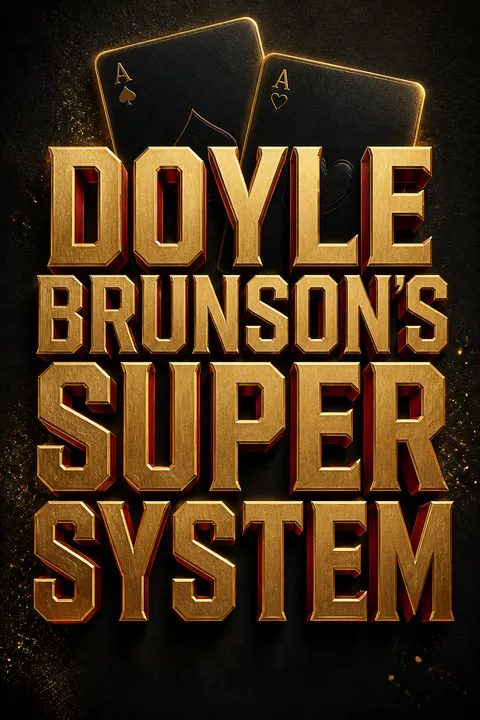


Key Takeaways
Read the player behind the bet, not just the cards
Poker is a people game. Brunson argues that strong play depends on estimating what opponents hold and why they are acting as they are. A player may be impatient for action, protecting a win, frustrated by losses, or waiting only for a premium hand. The same cards and betting situation can call for different decisions against different people. Even an opponent’s usual style can change with mood, so a player must keep observing instead of relying on a fixed label.
Watch the whole table. Brunson urges players to pay attention even when they are not in a pot. The point is not to guess perfectly, but to build a practical picture of each opponent’s habits, temperament, and likely range of hands. That picture makes later decisions less like blind guessing.
The book’s central insight resembles social inference in negotiation: an action becomes informative only when interpreted in context. A bet is not just a bet; its meaning depends on the person, the moment, and the history between players. This is more useful than treating poker as a card-ranking exercise. The limitation is that reading people can invite overconfidence. A coherent story about an opponent is not proof. The strongest version of Brunson’s advice is to use observations to update a tentative estimate, while staying ready to revise it when the evidence changes.
Treat tells as evidence, not supernatural certainty
Patterns matter more than gestures. A tell is a behavior that may reveal information about a player’s hand or state of mind. Brunson describes watching posture, betting habits, voice, and visible signs of excitement. He recalls Puggy Pearson’s habit of pushing chips in a particular way when bluffing, and a betting pattern that helped identify another player’s likely cards. A single twitch is not enough; repeated behavior tied to a known situation is more useful.
Listen, then compare. Brunson advises noticing what opponents say while separately watching what they do, since talk and play may send different signals. He also describes deliberately saying a phrase while bluffing, then using it later with a strong hand to muddy his pattern. The book speculates that intuition might involve ESP, but offers no evidence for that claim.
This section is strongest when its intuition is treated as compressed pattern recognition. People often notice regularities before they can explain them, but memory also favors dramatic examples and apparent hits. A reliable tell therefore needs repeated observation, a clear context, and a check against alternative explanations such as fatigue or nerves. Brunson’s own decoy behavior shows why tells are probabilistic rather than certain. His ESP speculation is better understood as personal belief than as a supported poker method; disciplined observation carries the practical lesson without requiring the paranormal claim.
Use aggression to collect small pots and shape big ones
Pressure has cumulative value. Brunson’s No-Limit strategy is to attack pots opponents appear unwilling to defend, then accept that some larger contests will begin with him behind. The small pots he wins help offset the cost of occasional risks, and his aggressive image can make opponents hesitate when they hold marginal hands. He calls a possible way to improve or win the hand an Out. With a draw, for example, a bet may win immediately or leave a chance to improve if called.
Change gears deliberately. Aggression does not mean betting every hand to the end. Brunson recommends shifting between loose and tight play, especially as table conditions change. He also describes pressing a winning run because opponents may become psychologically affected. The approach aims to make others uncertain, not to substitute constant action for judgment.
This is a form of strategic leverage: a player can profit from the possibility of a strong hand even when holding a weak one, because opponents must account for the full range of possibilities. The idea connects to game theory’s emphasis on keeping actions difficult to predict. Yet aggression is not inherently profitable. It works best when opponents can fold and when the bettor has enough chips to threaten meaningful consequences. Against players who call too often, the same pressure can become an expensive habit. Brunson’s own insistence on judgment is essential to the strategy.
A calling station needs value bets, not clever bluffs
Match the opponent’s level. Brunson distinguishes players who call too freely from stronger opponents who can recognize and answer a simple play. A calling station is someone who tends to check and call rather than bet, often continuing with weak hands. Bluffing this player is usually wasteful: if the opponent is likely to call, a bluff gives away money rather than exploiting a weakness. Instead, Brunson recommends playing straightforwardly and betting hands that can win at showdown.
Save complexity for equals. Against skilled players, obvious moves are easier to read, so Brunson recommends mixing up actions and using deception. In the 1977 World Championship, he watched good players repeatedly bluff a weak caller who kept looking them up. Their skill did not help because they ignored the person in front of them. The general rule is to make a play your opponent can actually respond to.
This distinction captures a broad principle of communication and competition: a sophisticated signal works only when the audience can interpret it. Against a novice, clarity and sound fundamentals can outperform elaborate strategy. Against an expert, predictability is a liability. The useful corrective is to classify behavior from evidence rather than status. A supposedly weak player may be trapping, and a strong player may be tilted or distracted. The categories should guide an initial plan, not become permanent identities. Adjustments remain valuable only when they track what the opponent actually does.
Let position and antes reshape what a hand is worth
Context changes card value. Position means acting later in a betting round, after seeing what opponents do. Brunson considers it especially powerful in No-Limit Hold’em because a player in position can respond with more information and apply pressure. He says position can sometimes matter more than the hole cards themselves. Limit games, where bet sizes are constrained, offer fewer ways to use that leverage.
The ante sets the pace. Antes and blinds are forced contributions that make waiting costly. Brunson warns that a player who waits only for excellent cards can lose chips before finding them, especially in a short-handed game. A table’s number of players also changes the odds that someone has a strong hand. He repeatedly stresses that calling a raise generally requires a stronger reason than making the raise, since the caller must account for the raiser’s represented strength.
Position is valuable because it reduces uncertainty: later action gives a player more information before committing chips. The ante, by contrast, creates a carrying cost for inaction. Together they explain why a hand cannot be judged solely by its printed rank. This is a useful decision model for any setting where timing and accumulated costs matter. Still, the claim that position can replace attention to cards is rhetorical, not literal. Position creates opportunities, but the value of those opportunities depends on opponents, stack sizes, and the betting structure.
Prefer hands that can win hidden, oversized pots
Potential matters as much as rank. Brunson particularly likes small connected cards of the same suit in No-Limit Hold’em. They may miss the flop and be discarded cheaply, but can also make a straight, flush, or concealed two-pair hand capable of winning a large pot. He recounts calling substantial raises with such cards during the 1977 World Series tournament, then winning a major pot when a strong opponent committed heavily with a vulnerable hand. The appeal is the possible payoff, not a guarantee of success.
Beware attractive trouble. Brunson warns that hands such as unsuited ace-queen or king-jack can make a pair and still be dominated by a better kicker or a stronger starting hand. He labels these trouble hands. His guidance is to avoid investing heavily with them when the situation offers little room to escape. Connected suited hands are not automatic calls either: their value depends on position, opponent stacks, and the price of entering.
The distinction here is between a hand that looks strong now and one that can produce a difficult-to-read winner later. That resembles the business idea of asymmetric payoff: limited losses in many attempts, with the possibility of a large return on a successful one. The comparison has limits. Poker hands are not investments with reliably independent outcomes, and implied payoffs can tempt players to pay too much for remote possibilities. Brunson’s useful emphasis is not simply to chase hidden hands, but to compare the entry cost with the amount that could realistically be won.
Make the flop your main decision point
Reassess when the shared cards arrive. The flop is the first three community cards in Hold’em, available to every player still in the hand. Brunson treats it as the crucial moment to decide whether to continue, because it shows how the hole cards connect with the board and what draws may be developing. A pair of aces can be vulnerable if the flop offers straight or flush possibilities; a small pair is usually worth continuing with only if it improves substantially or has a clear strategic reason to stay.
Price the draw and read the board. Brunson emphasizes making opponents pay to pursue a draw, while avoiding bets that expose a strong but vulnerable hand to cheap improvement. He warns that a set, or three of a kind, is not always safe when the board makes straights and flushes possible. He also urges players to identify the best five-card hand correctly, since a costly call can lose even when the player has a pair.
The flop functions as a decision checkpoint, much like a diagnostic test: new information should change the plan rather than merely confirm the original hope. Brunson’s insistence on reading the whole board is especially valuable because players tend to focus on their own cards and miss shared threats. Still, a single checkpoint cannot remove uncertainty. The probability of improvement, the size of the pot, and future betting all matter. A sound decision is not simply to protect a hand or chase a draw, but to compare the risk with the price and potential reward.
Protect your bankroll and attention as parts of your edge
Keep money usable. Brunson calls money committed to the pot no longer yours, a reminder not to keep calling merely because earlier bets were large. He warns against playing with money whose loss would cause distress. He recounts losing a $70,000 bankroll in Las Vegas, then rebuilding from a small stake in a low-stakes card game rather than borrowing his way back. He gives historical bankroll examples, including at least $1,000 for a $10 limit game and $2,500 for a $5 and $10 blind No-Limit game, while stressing that bigger reserves are safer.
Protect decision quality. He advises avoiding play when upset, tired, or distracted, and scheduling time away from poker. A friend once pointed out that Brunson’s play had deteriorated after a year without a break; a two-week vacation improved it. Discipline, rest, and honest review help separate poor decisions from bad luck.
This section links financial risk with cognitive capacity. A bankroll is not just money available to wager; it is protection against making decisions under desperation. Fatigue and emotional distraction also narrow attention, which is particularly costly in a game built on observing other people. Brunson’s historical bankroll figures should not be treated as current financial advice, since game conditions vary. The more durable lesson is to define a loss that can be absorbed, preserve enough capital to make choices, and stop when judgment is compromised.
Tournament chips are lives, so survive early and attack late
Tournament risk is different. In a regular game, Brunson might accept an even-money contest early because he could buy more chips afterward. In a tournament, elimination ends the opportunity. After studying Johnny Moss’s strong tournament performances, Brunson noticed that Moss often prioritized staying alive early rather than trying to build a commanding stack immediately. Brunson adopted a similar approach, avoiding large early confrontations and becoming more aggressive as the field narrowed.
Do not wait forever. Tournament antes rise, so a short stack that folds every hand can be consumed without a showdown. Brunson argues that a player who sees little chance of surviving should take a bold opportunity rather than quietly lose chips to the forced bets. He also notes that a tournament can create side games and valuable contacts, so participation may offer value beyond the prize. Skill improves a player’s chances, but does not guarantee a win.
Tournament poker changes the meaning of risk because chips cannot be replenished after elimination. This makes survival valuable, but not infinitely valuable: rising antes impose a cost on excessive caution. The underlying problem resembles managing a limited resource under a deadline. Brunson’s shift from early restraint to later aggression reflects that changing incentive. His account also usefully separates performance from outcome; a strong player can make good decisions and still lose. The practical challenge is to respond to changing stack pressure rather than apply one fixed style throughout the event.
Build a reputation that attracts action without driving people away
Trust has economic value. Brunson argues that a gambler’s word and reputation affect access to credit, games, and future opponents. His advice is to avoid borrowing where possible, borrow minimally when necessary, and repay exactly when promised. He describes refusing to ask for help after losing his bankroll, and warns that mishandling another person’s money can damage both business and play.
Compete without killing the game. Brunson also values versatility: playing other forms of poker can invite opponents into one’s preferred game and maintain a reputation for action. But he condemns humiliating a recreational player after winning from him, recalling a tournament regular who was mocked and then stopped returning. His point is commercial as well as ethical. A player may win a pot and lose the future game by treating an opponent with contempt.
Poker is not only a sequence of hands; it is also a repeated social market. Trust and reputation influence who will lend, play, and return. Brunson’s warning about humiliating a recreational opponent recognizes that a short-term victory can destroy future value for everyone at the table. This connects competitive ethics with long-term incentives: respect is not separate from strategy when relationships shape access. The tension is that reputation can be deliberately cultivated and manipulated. The most durable version rests on reliable conduct, not merely performing generosity to attract action.
Analysis
Super System is part strategy manual, part apprenticeship memoir. Its organizing idea is that No-Limit Hold’em rewards a player who can connect cards, betting patterns, position, and temperament into a single judgment. The book’s most distinctive contribution is its insistence that poker decisions are opponent-dependent. A hand does not carry a fixed instruction; it becomes meaningful against a particular player, stack, board, and moment.
Brunson writes from the authority of a successful professional, and his stories make tacit expertise visible. The tournament hand against Gary Berland, for instance, is presented not as a lucky collision but as a decision informed by remembered betting habits. That is an important account of expertise: much of skilled judgment may be rapid synthesis rather than explicit calculation. Yet anecdotes cannot establish how often a read succeeds, and memorable wins naturally receive more attention than failed reads. Readers should treat the stories as demonstrations of reasoning, not proof that every aggressive line is profitable.
The book also contains a productive tension. It champions aggression and courage, yet repeatedly insists on caution, bankroll limits, and knowing when an opponent’s hand is stronger. These are not contradictions so much as demands for calibration. Aggression is useful when it exploits fold equity, position, or a credible draw; without those conditions it can become expensive stubbornness. Likewise, confidence helps resist emotional swings, but confidence without review can protect a genuine leak.
Its advice is rooted in live high-stakes poker and reflects the games and conventions of its time. Contemporary readers can retain the durable principles while treating specific bankroll thresholds and some tactical prescriptions as context-bound. The enduring value lies in learning to observe, update, price risk, and adapt. The most dangerous misreading would be to imitate Brunson’s boldness without also copying his attention to people, situations, and the cost of being wrong.
Review Summary
Doyle Brunson's Super System is considered a classic poker text, often referred to as the "poker bible." While some readers praise its comprehensive coverage and historical significance, others note its outdated strategies. Many reviewers appreciate Brunson's conversational tone and personal anecdotes. The book is recommended for beginners and casual players seeking to improve their game, but advanced players may find more value in modern poker literature. Despite its age, the book remains a foundational text for understanding poker strategy and history.
People Also Read





Glossary
Tell
Behavior that may reveal informationA tell is an observable behavior that may offer clues about a player’s hand or emotional state. It can include betting habits, posture, voice, or a repeated way of handling chips. A tell is useful only in context and is not proof by itself, since players can conceal, change, or deliberately manipulate their behavior.
Alligator Blood
Relentless competitive resolveBrunson uses Alligator Blood for the willingness to compete intensely and pursue a win within the rules, even against friends or during a losing stretch. It includes emotional toughness and the effort to correct weaknesses rather than excuse them. It does not mean ignoring judgment or risking money without regard to the situation.
Card rush
A temporary winning runA card rush is a stretch in which a player wins several pots or receives favorable hands. Brunson argues that a rush can also affect table psychology: opponents may become cautious or make mistakes while the winner gains confidence. He recommends taking advantage of the opportunity, while distinguishing this strategic interpretation from a guarantee that favorable cards will continue.
Post Oak bluff
A small bet into a large potA Post Oak bluff is a comparatively small bet made into a much larger pot, intended to win the pot cheaply or suggest a particular kind of hand. Brunson describes such bets as potentially weak and sometimes worth calling when the opponent can be pressured later. The name refers to a betting tactic, not a general rule that small bets always signal weakness.
Out
A path to improve or winAn Out is a card or plausible route that could improve a player’s hand or help it win if the current bet does not succeed. Brunson uses the idea to distinguish a bluff with backup potential from a bet that has no reasonable continuation. An Out does not ensure victory; its value depends on the board, opponent’s likely hand, and remaining cards.
Trouble hands
Hands vulnerable to dominationBrunson’s trouble hands are selected combinations, especially certain unsuited high-card hands, that can make a pair yet remain behind a stronger hand or kicker. Their danger is that they appear playable but can lose a large pot when an opponent has a dominating combination. He recommends caution when facing raises and when a favorable-looking flop may still leave the hand second-best.
Implied odds
Potential future payoffImplied odds compare the cost of continuing with a draw against the total amount that may be won if the draw succeeds, including money opponents might contribute on later betting rounds. Brunson stresses that a call can be worthwhile even when the immediate pot is not large enough, provided a successful hand could win a much larger pot. The future payoff is uncertain and depends on opponents’ willingness and ability to pay.
Solid player
Selective entry, aggressive follow-throughBrunson distinguishes a solid player from one who is merely tight. A solid player is selective about entering pots, but tends to play actively and assertively after entering. A tight player, in his definition, remains conservative more consistently. The distinction matters because opponents may mistake careful hand selection for passivity and misjudge how strongly the player will act once committed.
FAQ
What is "Doyle Brunson's Super System" by Doyle Brunson about?
- Comprehensive Poker Strategy Guide: The book is a foundational text on poker strategy, covering both general principles and specific tactics for various poker games, with a strong focus on No Limit Hold'em.
- Insights from a Poker Legend: Written by two-time World Series of Poker champion Doyle Brunson, it shares his personal philosophy, playing style, and the psychological aspects of poker.
- Collaboration with Experts: The book includes contributions from other top professional players, offering a wide range of perspectives and advanced strategies.
- Emphasis on People and Psychology: Brunson stresses that poker is fundamentally a game of people, not just cards, and mastering the psychological battle is key to success.
Why should I read "Doyle Brunson's Super System"?
- Learn from a Master: Doyle Brunson is considered one of the greatest poker players of all time, and his advice is based on decades of high-stakes experience.
- Covers All Skill Levels: The book is suitable for both beginners seeking solid fundamentals and advanced players looking for nuanced strategies.
- Real-World Examples: Brunson shares stories and hands from his own career, illustrating how theory translates into practice.
- Timeless Poker Wisdom: Many of the concepts, such as money management, reading opponents, and adapting to different games, remain relevant in today’s poker landscape.
What are the key takeaways from "Doyle Brunson's Super System"?
- Poker is a People Game: Understanding your opponents’ psychology and tendencies is more important than just playing the cards.
- Aggression Wins: Playing aggressively, especially in No Limit Hold’em, is a hallmark of winning strategy.
- Adaptability is Crucial: The best players constantly change gears, adjust to table dynamics, and avoid predictable patterns.
- Money Management Matters: Proper bankroll management and emotional control are essential for long-term success.
- No Limit Hold’em is Complex: The game requires courage, judgment, and the ability to put opponents to tough decisions for all their chips.
What are the most important general poker strategies in "Doyle Brunson's Super System"?
- Pay Attention to Opponents: Observing and listening to other players provides valuable information about their playing styles and current moods.
- Use Aggression Wisely: Being aggressive after entering a pot is more effective than playing passively or timidly.
- Manage Your Bankroll: Only play in games where you can afford the stakes, and avoid playing with “desperation money.”
- Maintain Emotional Control: Don’t play when upset or distracted, and take regular breaks or vacations to stay sharp.
- Be Versatile: Learn to play all forms of poker profitably, not just your favorite game.
How does Doyle Brunson define and use "tells" in poker?
- Tells are Physical or Verbal Clues: Tells are involuntary actions or patterns that reveal information about a player’s hand or intentions.
- Examples of Tells: Visible neck pulse, chip handling, betting patterns, and changes in voice or demeanor can all be tells.
- Creating and Disguising Tells: Top professionals sometimes create false tells to mislead opponents or mix up their behavior to avoid being read.
- Importance of Observation: Spotting and interpreting tells requires careful observation and experience, but can provide a significant edge.
What is Doyle Brunson’s advice on money management in poker?
- Don’t Overextend Your Bankroll: Only play in games where losing won’t cause significant distress or affect your decision-making.
- Use Chips, Not Cash: Treat chips as units rather than money to avoid emotional attachment and make better decisions.
- Set Loss Limits: Be stricter with loss limits in limit games, as it’s harder to recover from big losses.
- Judgement Over Rigid Rules: While guidelines are provided, Brunson emphasizes using judgment to decide when to move up or down in stakes.
What are the key psychological qualities for success in poker according to "Doyle Brunson's Super System"?
- Courage and Aggression: Top players have the courage to make big bets and aggressive plays, even under pressure.
- Patience and Discipline: Staying alert, playing only when in the right mindset, and constantly working to eliminate leaks are crucial.
- Emotional Control: Avoid playing when emotionally compromised, and take breaks or vacations to maintain perspective.
- Confidence and Self-Examination: Regularly review your play, seek feedback, and maintain confidence even during losing streaks.
How does Doyle Brunson approach tournament play differently from cash games?
- Survival Early, Aggression Late: In tournaments, focus on surviving the early stages rather than trying to win big pots immediately.
- Adjust to Structure: As antes and blinds increase, be prepared to play more hands and take calculated risks.
- Reputation and Networking: Playing tournaments helps build a reputation and creates opportunities for profitable side games.
- Die with Courage: If short-stacked, play aggressively rather than being blinded out, as the increasing antes will otherwise erode your stack.
What are the main differences between Limit and No Limit Hold’em in "Doyle Brunson's Super System"?
- Limit is More Mechanical: Limit Hold’em requires solid, straightforward play, as it’s hard to bluff players out of pots.
- No Limit is Psychological: No Limit Hold’em is about putting opponents to tough decisions, using position, and leveraging your stack.
- Bluffing Frequency: Bluffing is much more common and effective in No Limit than in Limit games.
- Position is Critical: Position is far more important in No Limit, allowing for more strategic flexibility and pressure.
What is Doyle Brunson’s recommended strategy for playing big pairs (AA/KK) in No Limit Hold’em?
- Limp or Raise Depending on Position: Often limp in early position to induce raises, then re-raise; raise in late position if action is folded to you.
- Play Cautiously on Dangerous Flops: Be wary of coordinated boards with straight or flush possibilities, especially against multiple opponents.
- Don’t Slow Play Too Much: While some caution is advised, generally bet your strong hands to protect against draws and extract value.
- Be Ready to Commit: If a large portion of your stack is in pre-flop, be prepared to go all-in on the flop regardless of the board.
How does Doyle Brunson play small connecting cards in No Limit Hold’em?
- Favorite Hands for Big Pots: Suited small connectors (like 7-6, 8-7) are ideal for breaking opponents with big pairs if you hit the flop hard.
- Play for Multiway Pots: Enter pots cheaply, especially in early or middle position, aiming to see flops and make disguised strong hands.
- Avoid Overcommitting Pre-Flop: Don’t invest too much before the flop unless you’re on a rush or have a specific read.
- Play Aggressively When You Hit: When you connect with the board, play fast and aim to win big pots, especially against opponents with overpairs.
What are "trouble hands" in "Doyle Brunson's Super System" and how should they be played?
- Definition of Trouble Hands: Offsuit hands like AQ, KQ, QJ, AJ, KJ, QT, JT, AT, KT, and 98 are considered trouble hands in full-ring games.
- Play Cautiously: Avoid calling raises with these hands out of position, as they are easily dominated by stronger hands.
- Suited is Stronger: If these hands are suited, they gain value and can be played more aggressively, especially in position.
- Avoid Big Pots Without the Nuts: Even when you hit the flop, be wary of kicker problems or being up against stronger made hands.
What are the best quotes from "Doyle Brunson's Super System" and what do they mean?
- "Poker is a game of people. That's the most important lesson you should learn from my book." — Emphasizes that understanding opponents is more important than just playing the cards.
- "Play aggressively, it's the winning way." — Advocates for an assertive playing style as the path to long-term success.
- "If you aren't learning what you want to know just by watching and listening, create your own opportunity." — Encourages proactive observation and testing of opponents.
- "You can't play winning Poker by playing safe all the time. You must take chances ... gamble." — Highlights the necessity of risk-taking and courage in high-level poker.
- "All good Poker players have tremendous recall." — Stresses the importance of memory and learning from past hands and opponents’ tendencies.
Download PDF
Download EPUB
.epub digital book format is ideal for reading ebooks on phones, tablets, and e-readers.








