

Key Takeaways
Look for danger in successful adaptation, not only in visible breakdowns.
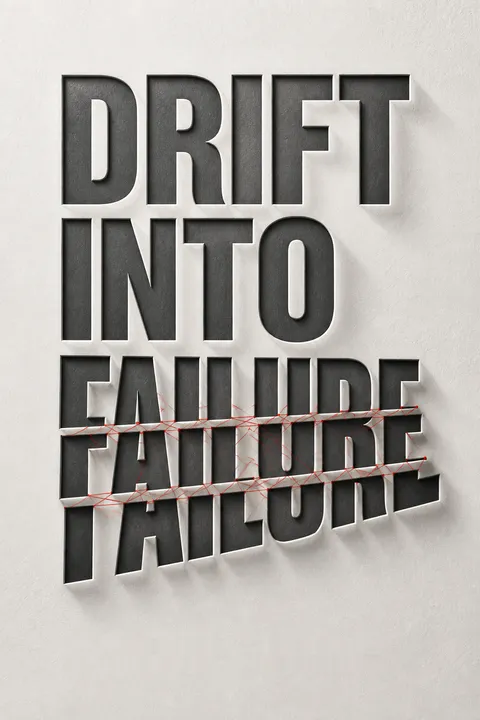
The central pattern. Drift into failure is a gradual shift in a system's routines and safety margins under pressure. Adaptations that help people meet local demands can accumulate into vulnerability, even when nobody intends harm and no single part appears defective. The same work that keeps an organization productive can also weaken its ability to absorb trouble.
A costly example. Before the Deepwater Horizon explosion, BP was 43 days behind schedule and paying $500,000 a day to lease the rig. Such pressures do not prove that one decision caused the disaster. They show how production demands shape the conditions in which many decisions are made. An organization can look successful by its usual measures while losing room to recover.
What's striking is that the book treats safety as a changing property of relationships, not a permanent feature of a well-designed machine. This resembles ecological adaptation: a strategy can help an organism or organization survive today's conditions while creating vulnerability to a different disturbance. Efficiency and safety are not automatic opposites, but efficiency that removes every buffer can make recovery harder. The challenge is measurement. Output, cost, and schedule are visible; unspent capacity and hazards that did not occur are harder to count. A sound assessment must therefore ask not only whether work succeeds, but what capacity success consumes.
Reconstruct local logic before judging decisions by their outcomes.
Decisions have a setting. The local rationality principle means that people act on the information, goals, pressures, and options available in their immediate work situation. Their choices may look irrational from outside, especially after the result is known, but the global consequences may have been invisible to them at the time. This is different from assuming that workers had complete information and simply failed to think hard enough.
The nurse's case. A nurse who gave a patient epidural medication through an intravenous line was criminally charged. The hospital had begun using larger, pharmacy-filled bags to reduce interruptions for anesthetists, and the nurse had slept only a few hours in the previous 37. The error remained serious, but its setting included fatigue, confusing equipment, and a bar-code system that staff did not use consistently. Understanding those conditions is not the same as excusing the harm.
This perspective connects with research on situated cognition: people think with the tools, routines, and cues their environment provides, not from an imaginary position of complete knowledge. It also guards against hindsight bias, the tendency to remember a chain of uncertain events as if it had always pointed toward the known ending. The practical value is diagnostic: investigators can ask what made an action workable or sensible to its actor. Context should not erase individual agency, however. It makes judgments more precise by distinguishing an understandable mistake from a reckless or deceptive act.
Follow the relationships that connect small choices across time.
A part has a history. Alaska Airlines Flight 261 crashed after the jackscrew assembly that moved the aircraft's horizontal stabilizer failed. The investigation found a broken component, but that discovery did not explain how the system came to depend on it in this condition. The original lubrication interval was 300 to 350 flight hours. Over time, industry and airline maintenance schedules stretched it to 2,550 hours. End-play checks, which measured wear, were also spaced farther apart.
Small revisions accumulated. These changes involved maintenance practices, technical guidance, regulatory approval, and design assumptions. The accident airplane's last recorded end-play check was at the maximum permitted measurement, yet it continued flying. Each schedule adjustment could make sense locally. Taken together, the adjustments left less protection against wear. A useful investigation therefore follows practices and relationships over time, rather than stopping at a list of broken parts.
The case illustrates why process tracing can reveal more than a snapshot of a failed system. In fields such as epidemiology, a harmful outcome often depends on multiple exposures whose effects accumulate across time; no single factor carries the whole explanation. The same logic applies to maintenance norms and organizational decisions. Yet historical reconstruction has a trap of its own: once an ending is known, earlier changes can look like inevitable steps toward it. A careful account should preserve the uncertainty people faced and consider paths that did not end in disaster.
Treat repeated success as weak evidence of safety, not proof.
Norms can shift quietly. Normalization of deviance is the process by which departures from an earlier safety expectation become accepted through repetition, especially when they do not produce immediate harm. Each successful use makes the next departure seem less unusual. In Diane Vaughan's study of the Challenger launch, engineers and managers repeatedly reconsidered evidence of O-ring damage in the solid rocket boosters. Earlier flights had returned safely, helping make the damage seem manageable.
The label can change. Before the Columbia disaster, recurring foam strikes had increasingly been treated as a maintenance concern rather than a threat to flight safety. That shift was compatible with established routines and successful missions, until a large piece of foam damaged the shuttle's wing. Past success mattered, but it could not guarantee safety under changed conditions. The absence of disaster is not the same as evidence that margins remain healthy.
This is a sharp account of survivorship bias: people see the many operations that ended safely, but may not see the risk accumulating beneath them. Repeated success can be evidence, yet its value depends on whether trials are comparable and independent. In complex systems, conditions change, and failures may be correlated rather than isolated. This does not mean every anomaly predicts catastrophe. It means anomalies deserve interpretation beyond whether the last operation ended well. Teams can improve judgment by examining near misses, changes in exposure, and the assumptions used to reclassify a concern as routine.
Add safeguards carefully: every layer creates new interactions.
Protection has side effects. Interactive complexity describes interactions among system parts that are unexpected, unfamiliar, or difficult for operators to see. Extra procedures, software, checks, and backup systems can block known failure paths, but each also creates new connections and new work. Reliability against a single component failure does not guarantee safety across the whole system.
The Therac-25 case. This radiation-treatment machine delivered dangerous overdoses without a broken mechanical part. If an operator changed treatment mode within eight seconds, the display appeared correct while the software retained an incompatible setting. The result was a powerful beam delivered in the wrong configuration. The failure emerged from timing and interaction between operator input and software state. The lesson is not to remove safeguards, but to test how they behave in actual work, including unusual sequences and conditions.
The example distinguishes component reliability from system safety. A backup can protect against one fault while adding complexity that creates another route to harm. Similar tradeoffs appear in cybersecurity, where additional controls can reduce one vulnerability while increasing the number of configurations that must be managed. Safety engineering still needs barriers, especially where energy or exposure can be contained. The stronger question is whether each barrier works with the others under real operating conditions. Testing isolated parts is necessary, but it cannot substitute for studying interactions among people, software, procedures, and time pressure.
Protect slack before efficiency turns a system brittle.
Margins make recovery possible. Jens Rasmussen described safety-critical work as operating within economic, workload, and safety boundaries. Pressure to reduce costs or increase output can move normal work closer to the workload and safety limits. When there is little spare time, staffing, or technical capacity, a small disruption can spread before anyone can respond.
Resilience is a capability. Resilience engineering treats resilience not as a fixed trait, but as the ability to recognize when operations approach a boundary, adjust course, and recover if control is lost. This includes noticing how adaptations change the system, not merely checking whether a component meets its specification. Efficiency can improve service, but a system optimized until nothing can pause, fail, or be repeated has little capacity to absorb surprise.
Slack is often dismissed as waste because its value appears only when something goes wrong. In operations research, spare capacity functions like an option: it preserves choices under uncertain conditions. A hospital bed, an extra maintenance window, or an unhurried handoff may seem inefficient in a normal shift and invaluable during disruption. This does not mean that larger buffers are always safer. Unused capacity can be expensive, and poorly designed slack may conceal weak processes. The relevant question is whether the system retains enough adaptable room for the disturbances it cannot reliably predict.
Give dissent real influence, not merely a seat at the table.
Diversity is more than headcount. A system needs different expertise, interpretations, and possible responses, but adding people does not guarantee that their views will matter. In a medical team, for example, a senior clinician may dominate decisions even when nurses or midwives have important observations. The distribution of decision-making power shapes whether the group can notice what one perspective misses.
Build room for challenge. High-reliability organizations use local expertise, decentralized authority, and attention to minority views. On an aircraft carrier, even a low-ranking crew member can stop a landing that appears unsafe. Rotating people across teams can also make settled practices visible again. Diversity helps only when people can speak, be heard, and influence action. Too much delay or endless debate can be costly, so its value depends on the risk and urgency of the decision.
The distinction between representation and influence is important. A committee can look diverse while its hierarchy quietly limits which evidence counts. Research on psychological safety, meaning a shared sense that speaking up will not invite humiliation or retaliation, helps explain why formal channels alone are insufficient. Still, open disagreement is not a cure-all. Some decisions require speed, and different perspectives can conflict without producing a single agreed account. The goal is not consensus at any price. It is to ensure that relevant challenges reach decision-makers before commitment becomes difficult to reverse.
Make oversight learn with the system it is meant to protect.
Protectors are part of the system. Regulators, safety departments, and quality programs do not stand outside the pressures they oversee. They can face limited staff, conflicting duties, incomplete information, and rules that lag behind changing technology. Their actions may help define which risks are investigated and which practices become accepted.
Walkerton's water system. In 2000, contaminated water sickened more than 2,300 people in Walkerton, Ontario, and seven died. Heavy rain carried bacteria toward a vulnerable well, while monitoring, testing, and public-health controls had weakened. The episode was not simply a case of one operator missing a check. The protection structure had lost feedback and oversight capacity. Effective oversight therefore needs current expertise, information from daily operations, and the ability to question practices that have become normal, not only a checklist of formal compliance.
This view avoids the easy assumption that regulators are either neutral guardians or captured villains. Their knowledge and incentives are shaped by contact with the industry, while too much distance can leave them unable to recognize weak signals. The design problem is institutional: preserve enough independence to challenge familiar practice while maintaining enough operational fluency to understand it. Rules remain useful, particularly for known hazards, but they cannot anticipate every adaptation. Oversight is strongest when it examines how standards, incentives, staffing, and actual work change together.
Judge culpability by knowledge and conduct, not catastrophe size alone.
Accountability needs context. Enron's collapse grew from a series of financial innovations and increasingly aggressive accounting practices. Mark-to-market accounting let the company record estimated future contract profits when deals were signed. As pressure to keep reporting growth rose, practices that had once seemed unusual became familiar, and internal controls and outside institutions helped sustain confidence. The resulting collapse cannot be explained by one isolated decision, though particular people could still have knowingly misled others.
More than one account matters. The book argues that investigations of complex systems should draw on authentic accounts of how work appeared to those involved, rather than claiming a complete, neutral reconstruction. This does not make every account equally credible or erase responsibility. It asks investigators to distinguish what could be known then from what became clear afterward, and to consider how punishment, policy, and public narratives affect people and future safety.
The argument bears on moral luck, the way outcomes can change judgments of decisions that looked similar beforehand. A devastating result can make an earlier choice seem obviously reckless, even when its consequences were hard to foresee. That caution should not become blanket exoneration. Evidence of deception, concealment, or deliberate disregard still matters, as do power and duty. Multiple narratives are most useful as disciplined inquiry, not as a claim that truth is impossible. They reveal different parts of a system, while evidence and ethical standards remain necessary for judging conduct.
Analysis
Dekker's central contribution is a change in the unit of explanation. A conventional investigation asks which component failed, then searches backward for a chain of causes. Drift analysis asks how ordinary work, shaped by competition, scarcity, uncertain technology, and institutional routines, changed the conditions under which the eventual failure became possible. The shift is consequential because a technically correct list of defects may describe the wreckage without explaining why those conditions were accepted beforehand.
The book is strongest when it grounds complexity in operational histories. Alaska 261 shows how maintenance intervals and oversight practices evolved through multiple organizations. Challenger and Columbia show how repeated outcomes altered interpretations of risk. These cases make a difficult claim concrete: system-level harm can emerge from locally sensible actions, and hindsight can make an uncertain path look inevitable. The concept of local rationality helps investigators examine decisions without assuming perfect information or treating every adverse outcome as proof of bad judgment.
There is a risk, however, that complexity becomes an all-purpose explanation. If every outcome is attributed to an unknowable web of interactions, the account can become hard to test and hard to use. The answer is not to return to a single root cause, but to connect systemic narratives to observable practices: how maintenance schedules changed, which warnings were reclassified, where reporting weakened, and whose expertise shaped decisions. Such evidence keeps complexity analytical rather than mystical.
The book's account of accountability also needs careful handling. Rejecting outcome-based blame does not require treating all actors as equally responsible. Intentional deception and abuse of authority differ from a reasonable decision made under severe uncertainty. A fair investigation can preserve that distinction while recognizing that organizational structures shape what people know and do. The result is a practical ethic: explain the system broadly, assess conduct contextually, and treat safety improvement as ongoing learning rather than a promise that one repair will prevent every future failure.
Review Summary
Drift into Failure receives mixed reviews, averaging 4.01/5 stars. Readers praise Dekker's exploration of complexity theory and systems thinking, finding it thought-provoking and applicable beyond industrial safety. The book challenges traditional Newtonian-Cartesian approaches to understanding failures, arguing complex systems drift gradually through small adaptations rather than single broken components. Common criticisms include repetitiveness, dense academic writing, high price for length, lack of practical guidance, and occasional editing issues. Many appreciate real-world disaster examples (Challenger, Columbia, Alaska Airlines) but desire more actionable solutions. Overall, readers recommend it for those interested in organizational safety and systems thinking despite its flaws.
People Also Read









Glossary
Drift into failure
Gradual growth of vulnerabilityA gradual process in which an organization adapts to pressures such as competition, resource scarcity, and changing technology. Small adjustments can become routine and reduce safety margins, while operations continue to appear successful. The eventual failure is not necessarily caused by one defective part or one clearly reckless decision.
Local rationality principle
Actions make situated senseThe idea that people act according to the goals, information, constraints, and options available in their immediate work setting. Their choices may look mistaken from an outside or retrospective viewpoint, but understanding the local context helps explain why an action seemed workable at the time. It does not by itself excuse harmful conduct.
Decrementalism
Risk shifts through small stepsA pattern in which small changes in practice gradually alter what an organization considers normal or acceptable. Each adjustment may seem minor and may succeed without immediate harm. Repeated success can make the next change easier to accept, allowing the cumulative effect to escape notice.
Normalization of deviance
Deviations become accepted practiceA process in which departures from an established expectation are repeatedly observed, discussed, or rationalized until they are treated as ordinary. In the Challenger case, previous flights with O-ring damage helped make the risk seem manageable. The practice's apparent success reinforced the belief that continued operation was acceptable.
Unruly technology
Technology behaves unpredictably in useTechnology whose real-world behavior does not remain as orderly or controllable as its design, testing, or formal rules suggest. Its behavior depends on the setting in which people use and maintain it. Unruliness captures the gap between engineering expectations and the changing, imperfect conditions of practice.
Structural secrecy
Work arrangements hide shared problemsA condition in which an organization's divisions, hierarchies, specialties, or locations make it difficult for people to see what is happening elsewhere. It need not involve deliberate concealment. Information can remain local, and attempts to increase formal reporting can still fail to create a shared understanding.
Practical drift
Local practice diverges from plansThe gradual divergence of local work practices from formal plans or procedures as people adapt them to the demands of actual tasks. These adaptations can be efficient and successful in routine conditions. When different groups' practices later meet under pressure, their uncoordinated changes may create confusion or risk.
Interactive complexity
Interactions produce unexpected sequencesA property of systems in which parts interact in ways that are unfamiliar, non-linear, or difficult for operators to see and understand. A system accident can emerge from these interactions even if no individual component is broken. Adding procedures, software, or backup layers can create further interactions.
Resilience engineering
Build capacity to adapt and recoverAn approach to safety that treats resilience as a capability rather than a fixed system trait. It emphasizes recognizing when operations approach unsafe limits, adapting to changing conditions, steering away from danger, and recovering if control is lost. It focuses on how the system functions under uncertainty, not only on preventing component failure.
Emergence
Whole-system behavior from interactionsA property of complex systems in which the behavior of the whole cannot be predicted or explained simply by listing the properties of its parts. The interactions among components produce higher-level patterns, including safety and accidents. Such patterns may arise from components functioning normally within their local settings.
Swiss Cheese Model
Layered defenses can align imperfectlyA safety model that depicts multiple protective layers, each with weaknesses, as defenses against hazards. An accident can occur when weaknesses across layers align and allow danger to pass through. Dekker argues that the model can help identify defenses but may also encourage investigators to search for deficient parts instead of examining how practices and relationships change over time.
Download PDF
Download EPUB
.epub digital book format is ideal for reading ebooks on phones, tablets, and e-readers.








