

Key Takeaways
Treat 'human error' as the first clue, not the final cause
A label is not an explanation. Dekker argues that “human error” is a judgment applied after an outcome, not a distinct kind of behavior that explains why an accident happened. The label often directs attention toward the worker and away from conditions that shaped the work. In 1947, researchers Paul Fitts and Richard Jones examined 460 reported experiences using aircraft controls. They found that control placement and equipment design helped explain pilots’ mistakes, pointing toward design changes rather than demands for better discipline.
Two views, two remedies. The Old View treats people as the main threat to an otherwise safe system. The New View treats their actions as clues to deeper problems in tools, tasks, and organizational conditions. An investigation should begin with the label, then keep asking what produced the behavior.
The shift resembles a move from searching for a faulty component to asking how the whole arrangement produces its outcomes. That is valuable because it turns investigation toward things an organization can redesign. Yet explaining a person’s action through its context is not the same as declaring it harmless. A strong analysis can preserve both questions: what pressures made this action understandable, and what safeguards or professional duties were still available? Holding explanation apart from exoneration helps prevent the New View from becoming a new slogan.
Rebuild the event from the operator's view, before hindsight rewrites it
Outcome knowledge distorts judgment. Hindsight bias is the tendency to see a known result as more predictable than it seemed beforehand. Outcome bias is the tendency to judge a decision more harshly because it ended badly. Both can turn a complicated, uncertain sequence into a simple story of missed clues. In one submarine collision near Hawaii, nine people died after a hurried demonstration. The commander’s superior blamed the commander, while discounting the crowded control room and inoperative sonar.
Counterfactuals explain little. Saying what someone could or should have done describes an alternative history, not why the actual choices made sense at the time. Reconstruct the cues, goals, and uncertainty as they arrived. A crew that understood cockpit smoke as an air-conditioning problem, for example, might reasonably prepare a careful diversion rather than make an emergency landing, without knowing that a fire was developing.
This approach has a close cousin in behavioral economics: people routinely mistake outcomes for evidence of decision quality. A decision made under uncertainty should be assessed using what was available then, not the information produced by the result. The practical difficulty is that a reconstruction can never perfectly recover another person’s experience, especially after death or trauma. It should therefore be presented as a disciplined, evidence-based account with acknowledged uncertainty, not as privileged access to someone else’s mind.
Make investigations traceable, timed, and aimed at changing work
Build an evidence trail. A useful investigation connects observed actions to changing process conditions, available information, and organizational pressures. Interviews can reveal how participants understood events, but memory is reconstructive, not a recording. Detailed timelines help show when tasks overlapped, which cues arrived, and how much time people had. Investigators must distinguish data that existed somewhere from data that was actually observable amid workload and interface demands.
Test every conclusion. Broad labels such as poor coordination explain little unless investigators define what they mean and show evidence for it. The book also distinguishes explanatory factors from change factors. At a mine, hand injuries were often linked to haste and poor visibility, but more than 80 percent occurred during unscheduled roadside repairs. Preventive maintenance and a larger parts supply addressed that leverage point more directly than reminders to be careful.
This method combines qualitative inquiry with the discipline of measurement: timelines make interpretations inspectable, while interviews reveal meanings that machine records cannot capture. That combination is especially useful in complex work, where the same action can serve different purposes in different moments. A timeline, however, can falsely imply that events form a tidy sequence with an obvious beginning. Investigators need to state what they include, what remains unknown, and why the proposed intervention addresses a recurring vulnerability rather than merely the last visible mistake.
Study organizational pressures, not just the person nearest failure
Local choices reflect local conditions. The local rationality principle means that people’s actions make sense to them given their goals, knowledge, and attention at that moment. The sharp end is where people directly operate a safety-critical process. The blunt end includes the organizations, policies, designs, and resources that shape their work. Focusing only on the sharp end can hide pressures created elsewhere.
Match responsibility with authority. Workers often reconcile safety with punctuality, cost, or service expectations that the organization itself sets. Dekker argues that accountability is unfair when people lack the authority or resources needed to meet the responsibility assigned to them. The wrong-runway crash described in the book illustrates this wider view: confusing airport lights, construction, and inaccurate charts formed part of the setting, even as the official account centered on the pilots’ failure to verify their location.
The distinction between sharp and blunt ends is a reminder that authority and information are distributed unevenly. Those closest to an operation often have the richest situational knowledge but the least control over staffing, equipment, or policy. Conversely, senior decision-makers can shape risk without seeing its daily effects. The framework does not mean that every organizational influence is equally causal. Investigators still need evidence showing how a policy, resource limit, or incentive altered the conditions of work, rather than treating “the system” as an all-purpose culprit.
Treat workarounds as evidence of system drift, not automatic misconduct
Small adaptations can reset the norm. Drift into failure is the gradual movement of an organization toward thinner safety margins as people adapt to constraints and repeatedly succeed. Each change can seem minor and sensible; with time, yesterday’s departure from a rule can become today’s ordinary practice. In the Los Alamos example, staff routinely moved sensitive materials without required witnesses or logs. The practice reflected the pressure to get scientific work done, not simply a few careless employees.
Success can conceal erosion. On the Space Shuttle’s external tank, workers covered damage in insulating foam to keep production moving, and defects could disappear from formal records. The absence of immediate harm reinforced the practice. Investigators should ask what makes a workaround useful, what goals it serves, and what safety margin it consumes. Repeated success is evidence that a method has worked so far, not proof that it remains safe under changing conditions.
This account connects safety to organizational learning: repeated success teaches people what the organization truly rewards, often more forcefully than written policies do. The unsettling part is that adaptation is necessary for work to function in imperfect settings, yet the same adaptation can gradually weaken safeguards. The answer is not to suppress every workaround. It is to make them discussable, test which ones improve resilience, and identify where local fixes conceal a design or resource problem that only the organization can resolve.
Design technology and procedures around real work, not idealized work
Tools change the job. New technology does not simply remove human fallibility; it changes what people must notice, remember, coordinate, and recover from. Automation can reduce some errors while creating mode confusion, hidden changes, and new monitoring burdens. In older cockpits, pilots prepared landing speeds by consulting tables, writing values down, and setting physical markers. Automated displays removed much of that active work, reducing some opportunities for mistakes while also changing how crews built and checked their understanding of speed.
Procedures assume an orderly world. Work-as-imagined is the planned sequence in manuals; work-as-done is what people actually accomplish amid interruptions, simultaneous tasks, and changing conditions. When those differ, the gap is evidence to investigate, not automatic proof of rule-breaking. Procedures can be useful resources, but people still have to judge when and how to apply them.
The cockpit example illustrates distributed cognition: remembering and deciding are supported by displays, gestures, conversation, and physical artifacts, not only by an individual mind. A redesign can remove an old hazard while weakening those supports. This is why usability should be evaluated in the actual work setting, including interruptions and team coordination. Still, local adaptation cannot substitute for basic design obligations. When a device repeatedly demands fragile workarounds, the burden should not remain on operators to compensate indefinitely.
Make accountability produce useful accounts, not silence
Punishment can hide the evidence. Forward-looking accountability asks who will address a discovered problem and how the change will be checked, rather than concentrating only on who deserves a penalty. Restorative justice aims to repair harm and relationships through dialogue, rather than treating punishment as the main response. A confidential reporting channel can also protect a reporter’s identity from supervisors while allowing safety staff to follow up. In one airline example, mechanics repeatedly received logbook violations until they helped redesign the forms; after the new logbooks appeared, violations dropped to zero.
Support the people involved. A second victim is a practitioner involved in an event that harmed or could have harmed someone and who carries personal distress or guilt. Fair accountability recognizes professional responsibility while providing support and inviting a truthful account. Explaining a failure does not mean excusing deliberate wrongdoing; it means deciding responsibility with evidence about what people could control.
Organizations need both reliable information and legitimate standards of conduct. Fear-based discipline can undermine the first without making the second clearer. The redesigned logbook shows how a response can preserve accountability while shifting attention to the conditions that generated repeated violations. Restorative approaches are not a universal replacement for sanctions, especially when conduct is intentional or malicious. Their value lies in refusing to let punishment stand in for diagnosis, repair, or a fair examination of who had the power to prevent recurrence.
Put safety expertise beside operations, and measure what workers can report
Proximity beats paperwork. Safety departments can gather intelligence, but they lose value when isolated from operational work or reduced to producing forms and monthly charts. Dekker favors a partnership: operational experts contribute knowledge of real work, while safety specialists bring investigative skills and a broader view of organizational risk. Managers should ask how work is actually done, listen without treating every deviation as a confession, and give staff the authority to raise uncomfortable concerns.
Beware incentives tied to low counts. Behavior-based programs may reward teams for having no reported injuries, making disclosure costly to coworkers. A Finnish construction and manufacturing study cited in the book found a strong negative correlation between reported incident rates and fatalities, at r = -0.82. That association does not prove that reporting prevents deaths, but it warns that fewer recorded incidents may reflect less reporting rather than safer work.
This is a problem of measurement design as much as safety culture. When rewards depend on a number, people can improve the number without improving the underlying condition, a pattern often called Goodhart’s law. The book’s example makes that risk concrete: reporting is part of the safety system, so punishing disclosure degrades the system’s sensors. Yet metrics are not useless by definition. They become more informative when paired with worker accounts, operational context, and checks on whether incentives are distorting what gets recorded.
In ultra-safe systems, examine normal work beyond incident counts
Safety is more than absence. Safety I describes safety as preventing negative events. Safety II describes it as the capacity to keep work going successfully through expected and unexpected change. In already highly reliable operations, formal incidents may reveal less about major hazards because people have learned to adapt around everyday frustrations that are not reported as incidents. Investigators should examine those routines, workarounds, and near-misses to understand how success is being achieved and where margins may be thinning.
Choose the right risk model. A chain-of-events model looks for links to interrupt; a barrier model looks for defenses to strengthen; systems approaches examine interacting constraints and goals; drift models examine gradual shifts in acceptable practice. No single model captures every kind of risk. Counting minor events as a dependable proxy for catastrophe can mislead, particularly when reporting incentives suppress the counts or when rare failures arise from different conditions.
The distinction between preventing failure and understanding success broadens safety beyond a search for defects. In complex systems, reliable performance depends on adjustment, and studying that adjustment can reveal capability as well as vulnerability. The challenge is to avoid turning resilience into another vague compliment. A useful account specifies what people adapt to, what resources enable the adaptation, and what costs or risks it creates. Different accident models serve different purposes; the key is to make the chosen model visible rather than mistake it for the system itself.
Investigate the dead with humility, because future workers inherit the same conditions
A report speaks beyond the accident. Dekker closes by asking whether investigators can reconstruct the thinking of people who died. They cannot know it with certainty, but can build careful explanations from timelines, work conditions, and established patterns of human performance. The alternative is often a report that lists what the dead failed to do, while leaving the circumstances of their work unexplored. In one runway accident, a student of Dekker’s tried to challenge that kind of account because a dead colleague had left a widow and two young children.
Ethics and prevention meet. Speaking fairly about people who cannot answer is not only an act of respect for families. It can reveal conditions that still expose living workers to similar pressures. The aim is not to invent motives, but to make claims proportionate to the evidence and preserve uncertainty where reconstruction reaches its limits.
This is an ethical argument for analytical rigor, not a request for sentimental treatment. A blame-centered report can damage families and also foreclose useful questions about design, staffing, or organizational incentives. A contextual account can protect the dignity of those involved while making prevention more concrete. The epistemic limit remains real: reconstruction is inference, not resurrection. A responsible investigation makes that limit explicit, tests competing explanations, and avoids using sympathy as a substitute for evidence.
Analysis
Dekker’s central contribution is to recast “human error” from a property of an individual into a question about how work is organized and understood. The shift matters because organizations often respond to visible actions with individual remedies, such as retraining, reprimands, or another procedure, while leaving the conditions that made those actions plausible untouched. The book offers a practical alternative: reconstruct the event as it unfolded for participants, trace behavior against time and task demands, and connect local choices to technology, management, and conflicting goals.
Its most powerful move is epistemic. Investigators do not possess a neutral view from nowhere. Their knowledge of the outcome can make past decisions look obvious, while operators had incomplete cues and competing demands. Treating the investigation as a reconstruction rather than a verdict changes its questions and its moral posture. It also improves the prospects for learning, because people are more likely to disclose the details that organizations need when they are not treated as convenient explanations.
The argument is strongest when it distinguishes explanation from intervention. Understanding why an action made sense does not establish that it was safe, justified, or beyond individual control. Nor does a systemic account require organizations to ignore deliberate misconduct or professional standards. Fair accountability needs evidence about authority, resources, expectations, and choices, not an automatic preference for either blame or absolution.
Some claims require careful interpretation. The reported inverse relationship between minor incidents and fatalities is a warning about incentives and measurement, not proof that reporting more incidents directly prevents deaths. Likewise, the New View is not a recipe that guarantees safer outcomes. Its value is as a disciplined orientation: investigate ordinary work, test assumptions about risk, keep uncertainty visible, and make changes where the evidence shows leverage. The book’s lasting challenge is to make safety learning more demanding than finding someone to blame, and more practical than merely declaring that the system is responsible.
Review Summary
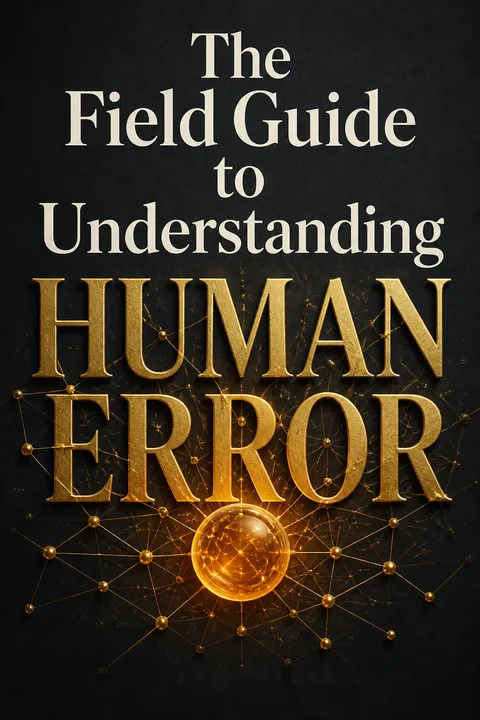
The Field Guide to Understanding 'Human Error' challenges traditional views on safety, arguing against blaming individuals for errors. Instead, it advocates examining systemic factors and organizational complexities that contribute to incidents. Dekker emphasizes the importance of understanding the context and perspectives of those involved, rather than relying on hindsight. The book offers practical advice for conducting effective investigations and improving safety culture. Readers appreciate its insights but some find it repetitive. Overall, it's considered a valuable resource for managers, safety professionals, and anyone responsible for complex systems.
People Also Read





Glossary
Old View
People as the primary hazardA way of explaining accidents that treats human mistakes as the main cause of trouble in systems assumed to be basically safe. It tends to respond with stronger rules, supervision, discipline, retraining, or automation. Dekker argues that this view can hide the organizational and technical conditions that shaped the behavior being judged.
New View
Behavior as systemic evidenceAn approach that treats behavior labeled as human error as a starting point for investigation, not a final cause. It asks how tools, tasks, resources, goals, and organizational conditions shaped what people did. Its purpose is to understand work from the participants’ perspective and identify changes that can improve the system.
Local rationality principle
Actions make sense in contextThe principle that people act according to what seems reasonable given their current knowledge, attention, goals, and circumstances. It does not say that their choices are perfect or produce good results. It asks investigators to explain why an action made sense to the person at that moment instead of judging it solely with hindsight.
Blunt end
Organizational forces shaping workThe part of a system that supports and constrains frontline activity. It includes management decisions, policies, staffing, training, regulation, equipment design, and organizational priorities. The blunt end shapes the resources available to people doing operational work, as well as the pressures and limits they face.
Hindsight bias
Known outcomes seem predictableA judgment bias in which learning the outcome of an event makes that outcome seem more likely or foreseeable than it appeared beforehand. In accident analysis, it can make investigators overestimate what operators could have predicted and reduce a complex, uncertain sequence to an apparently obvious path toward failure.
Drift into failure
Gradual erosion of safety marginsA gradual organizational movement toward reduced safety margins as people adapt work to pressures, constraints, and changing expectations. Small changes can seem reasonable and successful in isolation, allowing practice and definitions of acceptable risk to shift. The accumulated change may become visible only when an accident exposes the vulnerability.
Work-as-imagined and work-as-done
Planned work versus actual workWork-as-imagined is how designers, managers, or procedures expect a task to unfold. Work-as-done is what people actually do amid changing conditions, interruptions, competing tasks, and imperfect tools. The difference between them is not automatically misconduct; studying it can reveal both practical expertise and weaknesses in the system.
Safety I and Safety II
Safety as absence or capabilitySafety I defines safety chiefly as reducing negative outcomes such as incidents and accidents. Safety II defines it as the capacity to make work succeed under varying conditions, including disturbances that were not anticipated. The distinction shifts attention from only investigating failures toward also understanding how everyday work usually succeeds.
Second victim
Practitioner distressed after an incidentA practitioner involved in an event that harms, or could harm, another person and who experiences personal distress, guilt, or responsibility as a result. The term highlights that workers can be affected by incidents too. Support, fair treatment, and meaningful involvement in learning can aid recovery and organizational understanding.
Process-tracing methods
Reconstructing decisions over timeMethods for analyzing how people’s understanding and actions develop alongside an unfolding situation. Investigators use evidence such as timelines, interviews, process data, and communication records to examine changing cues, goals, and interpretations. The methods support plausible explanations of performance, while not claiming certainty about another person’s private thoughts.
FAQ
What's The Field Guide to Understanding Human Error about?
- Focus on Human Error: The book challenges the traditional view of human error as individual failings, suggesting they are symptoms of deeper systemic issues within organizations.
- Old View vs. New View: It contrasts the "Old View," which blames individuals, with the "New View," which sees errors as consequences of organizational factors.
- Practical Framework: Provides a framework for understanding safety science and human factors, useful for safety practitioners in various industries.
Why should I read The Field Guide to Understanding Human Error?
- Paradigm Shift: It shifts the perspective from blaming individuals to understanding systemic causes, leading to more effective safety practices.
- Applicable Across Industries: Insights are relevant in fields like aviation, healthcare, and construction, where safety is critical.
- Expert Insights: Written by Sidney Dekker, a leading authority on human error, it combines research with real-world examples.
What are the key takeaways of The Field Guide to Understanding Human Error?
- Understanding Context: Emphasizes understanding the context of errors rather than labeling them as 'human error.'
- Cognitive Fixation: Discusses how fixation on a particular way of thinking can lead to errors, highlighting the need for adaptable decision-making.
- Plan Continuation: Introduces the concept of sticking to an original plan despite changing circumstances, often due to initial cues.
What is the difference between the Old View and New View of human error in The Field Guide to Understanding Human Error?
- Old View: Focuses on human error as the primary cause of accidents, often leading to punitive measures against individuals.
- New View: Considers human error as a symptom of systemic issues, promoting a holistic approach to safety and error management.
- Implications for Safety: This shift can lead to interventions that address root causes rather than punishing individuals.
How does The Field Guide to Understanding Human Error define "human error"?
- Not Just Individual Failures: Human error is often a consequence of systemic issues rather than individual shortcomings.
- Complex Interactions: Described as interactions between individuals and their environment, influenced by culture, procedures, and technology.
- Contextual Understanding: Emphasizes the importance of context, suggesting errors often make sense within specific circumstances.
What is cognitive fixation, and how does it relate to human error in The Field Guide to Understanding Human Error?
- Definition of Cognitive Fixation: Refers to the tendency to become locked into a particular interpretation, preventing recognition of new information.
- Impact on Decision-Making: Can lead to poor decisions as individuals may ignore critical cues suggesting a need for change.
- Example in Aviation: Provides examples where pilots fixated on initial assessments, leading to catastrophic outcomes.
What are the different accident models discussed in The Field Guide to Understanding Human Error?
- Chain of Events Model: Accidents result from a linear sequence of errors, emphasizing removing weak links to prevent accidents.
- Barrier Models: Focus on defenses to prevent accidents, highlighting active and latent failures within an organization.
- Drift Model: Explains how organizations gradually shift towards riskier practices, emphasizing the need for continuous monitoring.
How does The Field Guide to Understanding Human Error suggest conducting a human error investigation?
- Gathering Human Factors Data: Emphasizes collecting comprehensive data about context, tools, and tasks involved in an incident.
- Building a Timeline: Creating a detailed timeline of events helps understand the sequence of actions and decisions.
- Contextual Analysis: Analyze data within the context, considering workload, environmental conditions, and organizational influences.
What is the significance of "drift" in safety management as discussed in The Field Guide to Understanding Human Error?
- Gradual Erosion of Safety: Drift refers to slow changes in safety practices that increase risk over time.
- Need for Vigilance: Highlights the importance of maintaining a chronic unease about safety, even in strong safety records.
- Cultural Implications: Linked to cultural factors where safety may be deprioritized in favor of production or efficiency goals.
How can organizations create a safety culture according to The Field Guide to Understanding Human Error?
- Empower Employees: View employees as valuable resources, giving them autonomy to make decisions and contribute to safety.
- Focus on Working Conditions: Improve working conditions that influence behavior, fostering a resilient safety environment.
- Encourage Open Communication: Create a culture where employees feel safe to report issues and share concerns.
What are some common misconceptions about human error that The Field Guide to Understanding Human Error addresses?
- Blaming Individuals: Misconception that human error is solely individual fault, leading to punitive measures.
- Simplicity of Solutions: Belief that quick fixes can eliminate human error, failing to address underlying complexities.
- Static Nature of Safety: Misconception that safety can be maintained through fixed rules, advocating for dynamic understanding.
How does The Field Guide to Understanding Human Error suggest organizations respond to incidents?
- Investigate Systemically: Conduct thorough investigations looking beyond individual actions to understand systemic factors.
- Learn from Near Misses: Treat near misses as learning opportunities, analyzing them for insights into potential risks.
- Foster a Just Culture: Create a culture where employees feel safe to report incidents without fear of punishment.
Download PDF
Download EPUB
.epub digital book format is ideal for reading ebooks on phones, tablets, and e-readers.








