

Plot Summary
The Page and the Captain
At thirteen, Inigo Balboa is sent from his Basque home to serve Diego Alatriste, the soldier who promised his dying father, Lope, that he would look after the boy. Years later, Alatriste emerges from prison for unpaid debts and finds Inigo waiting outside.
The captain has returned from Flanders with a wound that still troubles him, and the two set off together through Madrid. A passing carriage carries a blonde girl whose glance fixes itself in Inigo's imagination.
At the Tavern of the Turk, poet Francisco de Quevedo nearly turns a literary insult into a duel. High constable Martin Saldana interrupts the commotion, then offers Alatriste a well-paid, discreet night assignment. With debts pressing and few honest prospects, the captain accepts.
The opening makes obligation the first bond between the two protagonists: Inigo is not adopted through tenderness but entrusted by one soldier to another. Alatriste's care is practical and restrained, expressed through shelter, work, and the unspoken expectations of a veteran. His return from prison also establishes the economic trap that drives the plot. He knows paid violence is dangerous, yet poverty has made refusal a luxury. Inigo's glimpse of Angelica introduces a different kind of vulnerability. The boy's romantic imagination is already shaping his perception of a city where appearances, rank, and danger rarely align.
Masks Change the Contract
At a secluded house, Alatriste meets another hired swordsman, the Italian Gualterio Malatesta, and two masked employers. They identify their targets as English travelers, order the pair robbed of their papers, and insist that nobody be killed.
A round-headed clerk offers only partial payment, while a broad-shouldered superior makes clear that the work must be done. Then a hidden door opens and Fray Emilio Bocanegra, head of the Inquisition, enters. He overrides the original instructions: both travelers must die because they are English heretics.
The threat of the Holy Office makes refusal perilous, and the promised payment rises. Alatriste accepts, uneasy at the employers' contradictory orders and the excessive sum. Malatesta, by contrast, appears eager for the violence.
The changing instructions reveal how power hides inside procedure. The masked employers begin with the language of a controlled theft, then use religious authority to convert a political operation into murder. Alatriste is not innocent: he takes the money and agrees to the assignment. But his unease shows that he distinguishes ordinary criminal employment from a killing whose purpose and target have been deliberately obscured. Malatesta has no comparable hesitation, treating the mission as professional entertainment. Their difference is not simply good versus evil; both are swordsmen in a corrupt market. The distinction lies in whether violence remains bounded by any personal judgment.
Mercy Under Lanternlight
In a narrow lane near the English ambassador's residence, Alatriste and Malatesta wait for the travelers. Malatesta wounds the younger man, while Alatriste engages the older traveler, who proves skilled enough to resist.
With the stranger disarmed and Alatriste's sword at his throat, the captain hears him plead not for his own life but for his injured companion. The appeal stops Alatriste from delivering the final thrust. He then orders Malatesta to spare the wounded youth.
Malatesta turns on his former partner, nearly striking him, before escaping into the dark. The two Englishmen survive the attack, but Alatriste has openly defied both his employers and the Inquisitor's order. He stays long enough to make sure the travelers can move, knowing his own life is now at risk.
The decisive gesture is not a speech about honor but a choice made while a weapon is already poised to kill. The Englishman reveals his character by prioritizing his companion, and Alatriste recognizes a courage that national and religious labels cannot erase. His intervention does not cleanse the original decision to accept the job. It does, however, establish a limit he will defend even when doing so costs him protection and money. Malatesta's retreat turns their professional partnership into a personal feud. From this point, Alatriste is caught between political forces above him and a killer who knows his habits at close range.
A Prince in the Refuge
Rather than leave the wounded pair alone in the lane, Alatriste takes them to the nearby home of the Conde de Guadalmedina, a powerful courtier and an old acquaintance. The count recognizes the older traveler as George Villiers, Marquis of Buckingham, and learns that the younger is Charles, Prince of Wales.
Charles has secretly ridden to Madrid with Buckingham to meet the Infanta Maria and advance a marriage rejected by some of Spain's most influential advisers.
Guadalmedina arranges their safe transfer to the English ambassador's residence and keeps the attack from becoming public. The next morning, news of the prince's arrival spreads through Madrid. The crowd welcomes him, while Alatriste understands that the failed ambush could have triggered war between Spain and England.
The revelation changes the scale of Alatriste's danger. He thought he had been hired to kill two travelers; he has nearly killed the heir to the English throne and his closest companion. Guadalmedina's intervention shows how personal loyalties can briefly restrain the machinery of state, though he must protect the prince without exposing the secret attack. Charles's romantic mission is itself political, regardless of his intentions: a private meeting could alter an international alliance. The crowd's enthusiasm contrasts with the court's caution. Ordinary Madrileños respond to the prince as a daring visitor, while ministers see a diplomatic crisis that must be managed without admitting how close it came to catastrophe.
Angelica Learns His Name
As Madrid celebrates Charles's arrival, Inigo spots the blonde girl again near the English ambassador's house. Their brief exchange confirms that she remembers him, and he becomes still more devoted to her.
The following day, at the steps of San Felipe, she speaks with him beside her carriage and draws out details about his life, his plans, and the captain he serves. Inigo gives her more than caution would allow, thrilled that she knows his name. Her uncle, Luis de Alquezar, appears inside the carriage: a royal secretary whose displeasure sharpens when he hears Alatriste's name.
Inigo senses something unsettling in the encounter, but his longing overwhelms his judgment. Angelica's attention has made the boy feel seen, while leaving him uncertain whether she is merely curious or deliberately testing him.
Inigo's infatuation is a lesson in how desire reorganizes evidence. Angelica asks questions that should make him wary, but he experiences them as proof of intimacy because he wants to be singled out. Her ability to remember his name gives the exchange emotional force without establishing her intentions. Luis de Alquezar's hostility supplies a political shadow the boy cannot yet interpret. The scene also mirrors Alatriste's predicament: both characters are being drawn into arrangements whose full terms remain hidden. The difference is experience. Alatriste recognizes danger and still chooses among bad options; Inigo mistakes access for trust and has not yet learned to separate attention from safety.
The Gate of Lost Souls
Saldana arrests Alatriste and takes him to an isolated house, where Bocanegra and the masked clerk question him about what he has revealed. The captain refuses to expose Guadalmedina or anyone else. Though the interrogators release him, three armed men wait outside to kill him before he can return to the city.
Inigo has followed the carriage and watches the exits from hiding. When the attackers close in, he fires one pistol into a man's shoulder, then throws Alatriste his sword.
The captain kills one assailant and fights Malatesta, who escapes after a brief exchange. Recognizing a wounded attacker from Flanders, Alatriste sends Inigo to find a priest. Afterward, Inigo refuses to leave him; the captain answers by placing a finely made dagger on the boy's pillow.
The episode turns Inigo from a protected witness into an active participant. He follows because loyalty to his father's friend outweighs the danger of being caught, and his clumsy shots nevertheless change the outcome. Alatriste's response is characteristic: affection appears not as praise but as a weapon placed within reach. The captain's order to fetch a priest for a dying enemy also complicates his reputation as a hired killer. He can take lives and still recognize a former comrade in the man he has wounded. The Inquisitor's release is no pardon; the ambush outside makes clear that the powerful have simply shifted from interrogation to erasure.
Steel in the Corral
During the celebrations for the English prince, Alatriste and Inigo attend a performance at the El Principe theater. Five armed men provoke the captain in the packed audience, while officials who might normally intervene are nowhere to be seen.
Alatriste realizes the insult is a pretext for an attack and draws his sword when the men close in. Quevedo leaps into the fight beside him, but the two are badly outnumbered. From the royal box, Charles recognizes the man who spared his life and tells the Spanish king why he owes Alatriste a debt.
He and Buckingham then descend into the theater with swords drawn. Their intervention shifts the fight, and Philip orders the disturbance stopped. Alatriste is arrested with some of his attackers; Quevedo is released by the king's order.
The theater converts private violence into public spectacle. The attackers exploit a crowd trained to treat disorder as entertainment, and the absent officials suggest that this is no spontaneous quarrel. Alatriste's skill can delay defeat but cannot overcome five opponents. Quevedo's intervention is an act of friendship that puts his own body behind the words and wit he usually wields. Charles's return to the fight repays an earlier debt, but it also makes the rescue politically visible. The same public that watched a play now watches royal power interrupt a killing. Alatriste survives not because justice has become reliable, but because witnesses and obligations constrain what the court can do openly.
Olivares Names the Mask
After a night in prison, Alatriste is brought before Gaspar de Guzman, the Conde de Olivares and the king's most powerful minister. Olivares recognizes the captain's military record and questions him about the English attack.
Alatriste admits little, but Olivares summons Luis de Alquezar and makes clear that the affair involved two separate schemes: a plan to rob and frighten the travelers, and a more extreme effort to kill them. Alquezar's evasions expose his connection to the masked commission, though he avoids a full confession.
Olivares has him process overdue military pay owed to Alatriste, then gives the captain a ring and letter from Charles, promising help from English subjects. He warns Alatriste that Bocanegra remains beyond his control.
Olivares does not uncover a clean truth so much as map the competing interests around it. He knows enough to distinguish the robbery plan from the assassination, yet he treats disclosure as a tool of governance rather than a moral obligation. Alatriste's silence protects others and preserves his own code, even as it limits his ability to demand justice. The overdue pay is a modest correction for years of service, delivered through the same court machinery that withheld it. Charles's ring and letter create a counterweight to local danger, but they cannot neutralize the Inquisition. The resolution is therefore conditional: survival depends on political usefulness, private debts, and the captain's willingness to leave.
Epilogue
Inigo waits outside the palace while Alatriste remains in custody. Malatesta appears in the rain and tells the boy that the captain will be released, then asks him to carry a message: the Italian still considers their conflict unfinished.
He acknowledges that Inigo's pistol shots saved Alatriste at the Gate of Lost Souls, but warns that he may kill the boy before he grows into a threat. Malatesta walks away laughing, leaving Inigo to wait for the captain and the next turn of a feud that has not ended.
The epilogue refuses a tidy victory. Olivares's intervention may preserve Alatriste for now, but it has not dissolved the personal violence that began when he defied Malatesta. The Italian's message recognizes Inigo as more than a dependent boy: his actions have altered the balance between the two swordsmen, making him a future target as well as a witness. Yet Malatesta's warning is also theatrical, a bid to control the boy through fear. Inigo's continued waiting echoes the opening, but his position has changed. He is no longer simply the child sent to serve his father's friend; he has entered the dangerous world that shaped Alatriste.
Analysis
Captain Alatriste makes its hero a working instrument of violence who survives by preserving a small, private distinction between what he can do and what he can accept. That distinction is unstable. Alatriste takes money to attack strangers, then risks his life when one of them shows concern for another person. The novel does not present this as a conversion from evil to virtue; it presents it as the costly maintenance of judgment inside a system that rewards obedience and punishes hesitation.
The systems surrounding him are deliberately entangled. The Inquisition turns religious certainty into political force. Court officials use secrecy to pursue interests they cannot defend openly. A royal marriage is at once a young man's romantic ambition and a possible realignment of European power. Olivares, who can recognize corruption without escaping its logic, governs by bargaining with people whose motives he distrusts. In this world, moral clarity does not automatically produce justice. It may only identify the danger accurately.
Inigo's coming of age gives the story an intimate measure of that danger. He begins by seeing the captain as a substitute father and Angelica as an almost supernatural promise. The first image contains genuine affection but little knowledge; the second is desire mistaken for understanding. When Inigo follows Alatriste and fires his pistols, he moves from watching adult courage to taking responsibility for its consequences. His older narration preserves the child's wonder without pretending that wonder was wisdom.
Madrid itself sharpens the contrast. A theater audience can watch violence as spectacle, a crowd can celebrate a foreign prince, and a tavern can shelter poets who criticize the very state they inhabit. Art and public life remain vivid even as Spain's institutions decay. The novel's deepest tension is therefore not simply between honor and corruption. It is between human acts of loyalty, mercy, and courage, which are specific and costly, and the grand political machinery that converts them into leverage, rumor, or risk.
Review Summary
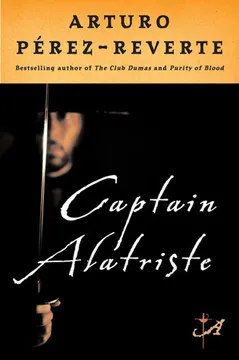
Captain Alatriste is the first book in a popular Spanish historical fiction series set in 17th century Madrid. Many readers praise Pérez-Reverte's vivid depiction of Golden Age Spain, engaging characters, and swashbuckling action. The story follows Diego Alatriste, a soldier-turned-mercenary who becomes embroiled in court intrigues. While some find the plot thin, most enjoy the atmospheric writing and historical details. Critics compare it favorably to The Three Musketeers. Overall, readers recommend it as an entertaining adventure with rich cultural insights, though a few find the pacing slow at times.
People Also Read

Characters
Diego Alatriste
The scarred hired captainA veteran of Flanders and the Mediterranean, Alatriste survives in Madrid by selling his sword to men who prefer not to risk their own skins. His title of captain comes from a day when he commanded abandoned soldiers, not from official advancement, and his present poverty sits uneasily beside decades of service. He is neither conventionally pious nor morally spotless; he has killed for money and carries the memories of particular deaths. Yet he maintains limits, especially around courage, face-to-face combat, and the treatment of the vulnerable. His care for Inigo is quiet and practical. Reading, old comrades, and a dry fatalism give him ways to endure a life that has offered little reward for loyalty.
Inigo Balboa
The captain's devoted pageThe son of Lope Balboa, a soldier who died in Flanders, Inigo enters Alatriste's household as a boy of thirteen. He is observant, eager for stories, and hungry for signs that he belongs in the adult world around him. His admiration for the captain blends filial attachment with the romance of military courage. At the same time, his imagination can make him careless: he reads Angelica's attention as a promise of intimacy before he understands the risks surrounding her family. Inigo's retrospective perspective combines youthful wonder with an older narrator's awareness of how much he failed to see. His loyalty is not passive; when danger reaches Alatriste, he is willing to act despite his fear.
Angelica de Alquezar
The blue-eyed meninaLuis de Alquezar's young niece, Angelica attends the Spanish royal household as a menina. Her beauty and composure fascinate Inigo, who interprets her brief attention through the fantasies of first love. She is intelligent enough to notice people and remember details, but the story leaves her motives difficult to read. That ambiguity matters: Inigo sees a possible angel, while her connection to a powerful court official makes her presence less innocent than he wants it to be. Angelica functions as both a person and a projection, revealing how desire can make a boy mistake being observed for being understood.
Gualterio Malatesta
The smiling Italian bladeA pockmarked Italian swordsman, Malatesta works as a professional killer and prefers surprise, misdirection, and the advantage of an unguarded back. His soft manners and private whistle make his menace more unsettling, not less. He approaches violence as craft and amusement, with little interest in the political cause behind an assignment. Alatriste's refusal to complete their first job breaks the convenience of their partnership and turns the captain into an adversary. Malatesta's patience and theatrical confidence make him dangerous beyond his fencing skill; he watches people, remembers humiliations, and treats unfinished business as a personal obligation.
Luis de Alquezar
The king's crafty secretaryA royal secretary and Angelica's uncle, Alquezar has built influence by reading the currents of court life and adapting himself to powerful patrons. His formal position gives him access to political information, while his manner suggests a man who resents being underestimated. He treats loyalty as something to display and negotiate, not as an uncomplicated virtue. The contrast between his official dignity and his calculating instincts places him at the center of Madrid's unstable alliance between churchmen, ministers, and courtiers. His family connection to Angelica also binds the boy's private fascination to the dangerous world of state politics.
Fray Emilio Bocanegra
The Inquisitor's iron willBocanegra presides over the Inquisition with an ascetic appearance and an uncompromising belief in its authority. He treats political decisions as matters of religious purity, making coercion sound like sacred duty. His influence reaches into the royal court, and even seasoned swordsmen understand that defying him can carry consequences beyond an ordinary arrest. Bocanegra's power lies not only in threats of punishment but in his conviction that he serves a higher law. That certainty leaves little room for the human hesitation that Alatriste considers part of moral judgment.
George Villiers, Marquis of Buckingham
The prince's daring favoriteBuckingham is the English king's favored courtier and Charles's closest companion on the journey to Madrid. Adventurous and ambitious, he helps turn the prince's secret visit into a dramatic attempt to advance a royal marriage. He fights capably and carries himself with the confidence of someone accustomed to influence, though the danger of the ambush briefly strips away courtly assurance. His loyalty to Charles is evident in the way he protects and tends to him. Buckingham embodies the meeting of private friendship and public ambition: he accompanies a personal romantic gesture that could reshape relations between kingdoms.
Charles Stuart
The disguised English heirThe Prince of Wales arrives in Madrid under an assumed name, hoping to meet the Infanta Maria and accelerate marriage negotiations. Young, optimistic, and drawn to chivalric gestures, he believes an audacious journey can accomplish what diplomacy has stalled. His courage is not merely ceremonial: when Alatriste faces danger later, Charles is willing to enter the fight himself. He also understands the limits of public speech and royal protocol, so gratitude must travel through discreet signs of obligation. Charles's presence turns a local act of hired violence into a matter with consequences across Europe.
Alvaro de la Marca, Conde de Guadalmedina
The captain's courtly allyA wealthy, polished courtier, Guadalmedina once served in war and has retained a genuine regard for Alatriste. Their social positions differ sharply, but old military history and mutual trust let the captain approach him when ordinary refuge is impossible. Guadalmedina understands how quickly a private incident can become a diplomatic crisis, and he is skilled at acting without making every obligation explicit. His protection of the English visitors rests on both political judgment and personal decency. He offers Alatriste help without pretending that his own influence can settle every danger.
Francisco de Quevedo
The poet with a rapierQuevedo is Madrid's celebrated satirist, a fiercely loyal friend, and a man whose sharp tongue repeatedly draws him into trouble. He can turn a tavern gathering into a near-duel, but his wit is joined to genuine courage and affection. His friendship with Alatriste is expressed through practical support as well as verbal bravado. Quevedo also gives Inigo access to a world of poetry, theater, and political criticism beyond the narrow concerns of survival. His talent for exposing hypocrisy comes with a personal cost: he is often forced to navigate exile, imprisonment, and financial uncertainty.
Gaspar de Guzman, Conde de Olivares
The king's calculating ministerOlivares is the chief minister who directs much of Philip IV's government. Intelligent, ambitious, and deeply attentive to the survival of the monarchy, he evaluates people according to what they can do for the state. His conversation with Alatriste reveals a ruler of circumstances rather than a simple villain: he recognizes the captain's reliability while remaining willing to use threats and silence. Olivares sees corruption as an instrument he may have to manage, even when it undermines the empire he hopes to strengthen. His authority can restrain some enemies, but it cannot reach every institution.
Martin Saldana
The old soldier constableSaldana is a former soldier from Flanders who now serves as Madrid's high constable. His long history with Alatriste gives their exchanges a blunt familiarity, but his office requires him to carry orders he may not endorse. He is brave, practical, and wary of knowing more than his position permits. Saldana understands that official commands can conceal private agendas, yet he also knows the risks of openly refusing them. His strained friendship with Alatriste shows how shared military experience can persist even when law and power place former comrades on opposite sides.
Caridad la Lebrijana
The tavern's generous keeperThe former actress and tavern keeper offers Alatriste and Inigo food, shelter, and a familiar gathering place. Her affection for the captain is real, though his reserve limits what she can ask from him. She brings warmth and practical generosity into a world where most favors carry a price.
Domine Perez
The tavern's gentle priestA Jesuit priest and friend of the tavern's regulars, Domine Perez tries to restrain quarrels without pretending that his companions are saints. His tolerance makes him an unusual cleric in a story where religious authority often arrives as threat. He offers counsel, companionship, and a humane counterpoint to fanaticism.
Juan Vicuna
The one-armed veteranA former sergeant who lost an arm in battle, Vicuna lives on a small pension and runs a gaming house. He joins the captain's circle at the Tavern of the Turk and remembers the discipline of soldiers who endure defeat without breaking formation. His stories help Inigo imagine the life that shaped Alatriste.
Lope Balboa
Inigo's fallen soldier fatherLope Balboa served alongside Alatriste in Flanders and died in battle. Before his death, he secured his friend's promise to care for Inigo. His military bond with Alatriste gives the boy a place in Madrid and a living connection to the father he lost.
Plot Devices
Inigo's retrospective narration
Memory with hindsightThe adult Inigo recounts events from the perspective of a boy who did not yet understand the forces around him. This frame allows the story to preserve youthful awe while admitting that first impressions were mistaken or incomplete. His descriptions of Madrid's theaters, taverns, gossip, and political ceremony make the city part of the action rather than mere background. Hindsight also creates controlled irony: the narrator can recognize danger in Angelica's attention and corruption in court behavior that the child could only admire or fear. The result is a tale shaped by memory, affection, and the knowledge of what experience eventually taught him.
Alatriste's personal code
A limit on paid violenceAlatriste earns his living as a swordsman, but he does not treat every assignment as morally interchangeable. His insistence on facing an opponent and his response to the Englishman's concern for a friend interrupt a murder that he had already accepted. The code is neither pure nor consistent enough to make him innocent; it is a narrow boundary maintained inside a corrupt profession. It gives the story its central source of action, because following that boundary makes Alatriste vulnerable to his employers, the Inquisition, and Malatesta. His choices show how a private ethic can matter even when it cannot repair the institutions surrounding it.
Masks and false names
Concealment drives the plotThe employers hide behind masks, the English travelers use common assumed names, and political actors speak through intermediaries. These disguises delay the truth about who is involved and what the assignment is meant to accomplish. They also create an imbalance of knowledge: Alatriste is expected to risk his life before he knows the identities of either his targets or his patrons. As the false names fall away, the violence acquires a larger political meaning. The device is not only a mystery mechanism; it shows how people with power can outsource danger while keeping their own names clean.
The proposed royal marriage
Romance becomes statecraftCharles's attempt to meet the Infanta Maria is driven by youthful romance, but the proposed marriage carries consequences for alliances, trade, and the balance of power in Europe. The court's hesitation and the Inquisition's opposition turn the prince's private gesture into an international flashpoint. This political framework explains why an ambush could be commissioned and why its failure alarms ministers who otherwise distrust the English alliance. The marriage also creates a pointed contrast between the crowd's delight in a gallant story and the court's calculation of diplomatic risk. Personal feeling is never separate from state interest, even when characters imagine it is.
The prince's sealed letter
A debt becomes protectionCharles gives Alatriste a ring and a sealed letter that can command assistance from English subjects. The object turns private gratitude into a portable form of political protection, giving the captain something tangible to carry beyond the immediate crisis. It cannot erase the Inquisition's power or the hostility of Alquezar and Malatesta, so its promise is real but limited. The ring also gives material shape to a theme running through the story: people with rank can make debts consequential in ways that ordinary soldiers cannot. A single act of mercy becomes a claim the captain may one day be able to invoke.
About the Author
Other books by Arturo Pérez-Reverte



Download PDF
Download EPUB
.epub digital book format is ideal for reading ebooks on phones, tablets, and e-readers.








