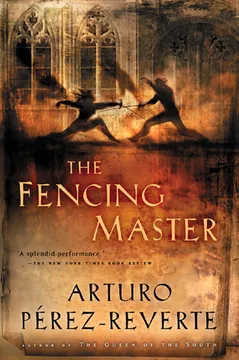


Plot Summary
Prologue
At a private supper in rainy Madrid in 1866, a wealthy, polished stranger gives the minister of the interior a sealed report naming people suspected of plotting against the queen. The stranger admits that he is selling information because he has too much to lose by refusing, then leaves without a farewell.
The minister opens the envelope and begins reading. The exchange plants a secret bargain between political power and private advantage, years before the consequences reach Jaime Astarloa, a fencing master who believes himself safely outside politics.
The opening makes political treachery feel less like a grand conspiracy than a transaction conducted over supper. The minister's willingness to weigh a man's character against his wealth establishes a world where public duty can be purchased, while the informant's self-preservation sounds almost reasonable. That ordinary calculation is the seed of the later tragedy: institutions turn private compromises into lethal liabilities, then leave other people to bear the cost. By withholding the informant's identity, the prologue also teaches the reader to treat every polished certainty as incomplete evidence.
A Knock in the Gallery
By the summer of 1868, Jaime Astarloa is a fifty-six-year-old fencing master in Madrid, earning modestly from aristocratic clients and young pupils. His closest daily ritual is crossing foils with the Marqués de los Alumbres, then sharing sherry. Jaime is writing a treatise and chasing an ideal move he calls his Grail, though age has begun to make him doubt he will find it.
He avoids the city's conspiracies, preferring books, precise lessons, and the old rules of the blade. His pupils hear him defend fencing as a serious discipline rather than a fashionable sport. As he warns them that the old code is disappearing, a knock at his door brings an unexpected visitor.
Jaime's opening conflict is not yet a mystery but a chosen form of withdrawal. His routines protect him from uncertainty, while the unfinished treatise gives his life a purpose that remains safely abstract. The political crisis outside his studio echoes the obsolescence he senses in fencing, but he treats both as spectacles rather than demands for action. The knock matters because it converts a life organized around repetition into one organized around response. His ideal of technical precision will soon be tested by a world where motives are concealed and the consequences of a single movement cannot be reversed.
Adela's Unusual Lesson
The visitor, Adela de Otero, asks Jaime to teach her his two-hundred-escudo thrust. He refuses because he has never taught a woman, and her offer of extra money only hardens his objection. When she returns, however, she questions him about complex fencing sequences and identifies alternatives he had overlooked. Jaime recognizes that her knowledge is genuine, not a social whim.
At their first lesson she declines a mask, then attacks with such speed and force that he has to stop treating her as a beginner. He disarms her only after she presses him into a fierce exchange. The bout convinces him to teach her the secret move, and her appetite for risk unsettles his confidence as much as her skill impresses him.
Adela changes Jaime's mind through competence, not seduction alone. His initial refusal protects a social boundary that he has mistaken for a professional principle; her technical command forces him to distinguish habit from judgment. The unmasked bout sharpens that challenge: she insists on being assessed as an opponent, accepting physical risk rather than the protective condescension offered to her. Jaime's admiration is therefore genuine, but it also opens a vulnerability he does not understand. Their lesson begins as an exchange of technique and quickly becomes an encounter with unequal knowledge, since she knows what she wants from him while he knows almost nothing about her.
The Master Lowers His Guard
As lessons continue, Jaime becomes eager for Adela's visits and more attentive to the person behind her controlled manner. During one bout she collides with him, and he catches her before she falls; the brief contact leaves him distracted enough for her to score twice. Later, when heat leaves her pale and unsteady, he gives her brandy and they speak more intimately.
Adela recognizes that his home preserves a lifetime of memories, and Jaime describes his years in France, his teacher Lucien de Montespan, and the married woman whose choice drove him back to Spain. He admits that loneliness has become part of his identity. Adela asks to meet his best-known client, the Marqués de los Alumbres, and Jaime agrees.
The physical stumble briefly unsettles the hierarchy between teacher and pupil: Jaime catches Adela, but she soon regains the advantage on the piste. Their talk afterward exposes what technical instruction cannot, namely the losses that have shaped each person's sense of freedom. Jaime's recollection of the woman he left behind helps explain why he guards himself through ritual and aesthetic ideals. Adela's insight gives him the intoxicating feeling of being understood, but her request to meet the marquis redirects intimacy toward a practical end. Jaime sees the request as a social courtesy. His growing attachment makes that misreading possible.
The Marquis's Hidden Trust
Jaime introduces Adela to Luis de Ayala, who is delighted by her fencing and soon begins appearing with her in public. Adela stops attending lessons, and Jaime hides his jealousy beneath professional courtesy. He once glimpses her speaking anxiously with an unidentified man, then watches her hurry away when she notices him.
Weeks later, Luis asks how Jaime met Adela and entrusts him with a sealed file, naming him the only honest person he can rely on. Jaime promises not to open it. The request lands amid mounting unrest: generals are being exiled, conspirators are mobilizing, and Madrid waits for an uprising. Jaime accepts the papers without asking what danger has made his friend seek such secrecy.
This turn converts Jaime's private emotional confusion into material responsibility. Adela's departure wounds him, but the greater danger comes from his instinct to interpret trust as a complete explanation. Luis knows Jaime's integrity and uses it as a shield for sensitive evidence; Jaime accepts the burden without curiosity because honor, for him, means keeping a promise. The unidentified man's meeting with Adela is a clue he notices but cannot place. Meanwhile, the revolution makes secrecy more valuable and more dangerous. Jaime's detachment no longer protects him from politics: another person's confidence has put political evidence in his home.
A Thrust in the Throat
In September, news arrives that Prim has landed in Cádiz and the navy has joined the revolt. While Madrid braces for a change of government, Jaime keeps to his ordinary visit to Luis's palace. A crowd and police at the gates tell him something has happened before anyone explains it. Inside, he finds Luis dead, a single clean wound through his throat made by a fencing foil.
Chief of police Jenaro Campillo questions Jaime, who conceals the sealed file and says little about Adela. Campillo reveals that the house was searched, its safe opened, but money and jewels were left behind. Jaime realizes the killers were looking for something specific. When Campillo asks about Adela, Jaime learns that she has disappeared.
The murder makes the novel's central metaphor brutally literal: a technique taught as controlled art has been used to kill. Jaime's first response is not simply grief but a failure to reconcile the wound with his knowledge of the person who received it. Campillo's questions begin an institutional investigation, yet Jaime's silence makes him an obstacle within it. His concealment is partly loyalty to Adela and partly a desire to understand before surrendering control. The untouched valuables narrow the motive toward the missing file. Political upheaval offers the killer cover, while Jaime's expertise supplies him with a frighteningly precise clue.
The Face in the River
At home, Jaime opens the file and finds official letters, detention lists, and records of men sent to prison or exile under the previous government. He cannot see why they would justify murder, so he takes the papers to Agapito Cárceles, a radical journalist who follows political affairs closely.
Cárceles spots a pattern but needs time to confirm it. A police summons interrupts their reading, and Campillo takes Jaime to identify a woman's body recovered from the river. Its face has been destroyed, but Jaime recognizes Adela's silver ring and accepts the police's identification.
Returning home, he discovers that Cárceles has taken the file, leaving only a note promising that he will explain later. Jaime now fears both that Adela is dead and that his friend's curiosity has exposed him.
Evidence arrives in fragments that resist Jaime's preferred method of understanding. The file is legible but opaque to him; the river body is recognizable only through an object; Cárceles's political insight remains unfinished. Each gap tempts Jaime to fill uncertainty with an emotionally convenient conclusion. He accepts the identification because he has no reason yet to imagine a substitute, and he interprets the missing file as a breach of trust. The sequence makes knowledge itself feel hazardous: the more each character learns, the more exposed that person becomes. Jaime's need to solve the pattern now competes with his promise to protect it.
Cárceles Under the Knife
Unable to find Cárceles, Jaime goes to the journalist's home after midnight and enters by the roof. He finds Cárceles tied to a bed and brutally tortured. The journalist manages to indicate that the papers have passed to someone else, but before he can explain, an attacker strikes Jaime from behind.
Jaime draws the blade hidden inside his walking stick and fights two men in darkness, using his fencing instincts to wound them and reach the door. The attackers escape in a waiting carriage; Cárceles later dies without recovering his reason. At the police station, Jaime finally admits that he withheld the truth because he loved Adela. Campillo warns that the killers know Jaime once held the file and may come for him next.
Jaime's code acquires bodily force here. He has spent decades treating fencing as a discipline of attention, distance, and economy; in the dark apartment, those habits keep him alive when status and careful reasoning are useless. Yet his courage does not undo the cost of his delay. Cárceles dies before he can complete the explanation, and Jaime must acknowledge that love, not abstract honor, shaped his earlier silence. Campillo sees Jaime's innocence as dangerous because it is paired with poor judgment. The scene marks a shift from a man pulled into other people's violence to one who knowingly prepares to meet it.
Adela Returns at Midnight
Rather than flee Madrid, Jaime returns home and prepares for whoever may come, setting a revolver and his sword-stick within reach. Adela arrives alone in the night, alive despite the body identified as hers. She explains that years earlier a powerful benefactor rescued her after a failed love affair, gave her a new life, and trained her in music, riding, and fencing.
When he later faced exposure for changing sides in the political conspiracy, she agreed to help him. Luis's papers could reveal his arrangement with Narváez, and the bankrupt marquis had threatened to use them for money. Adela admits she killed Luis, then explains that Lucía, her maid, was murdered and mutilated to make the police believe Adela was dead.
Adela's confession reframes the mystery as an argument about obligation. Her benefactor gave her care and agency, but also shaped her into someone capable of serving his political survival. Gratitude becomes both an authentic bond and a means of control. The murdered maid reveals how easily a person without social power can be made to disappear in the eyes of authorities. Jaime's refusal to flee places him in direct contact with the difference between loyalty and complicity: he can recognize Adela's gratitude while refusing to let it erase Luis or Lucía. The confession makes motive clearer, but it does not restore moral simplicity.
The Two-Hundred-Escudo Duel
Adela asks Jaime for the one letter missing from the file. As he searches his memory, he recalls that a page slipped beneath a sideboard when the papers spilled across his floor; he finds it there and reads it.
The letter identifies the banker Bruno Cazorla as the informant who traded intelligence on Prim for a lucrative mining concession, then returned to the conspiracy when it suited him. Adela asks Jaime to surrender the evidence. When he refuses, she tries to disarm him with intimacy, then reaches for a hatpin.
She takes Jaime's sword-stick and drives him into the fencing gallery. Armed only with a blunt practice foil, he parries her live blade, suffers a wound, and finally uses a precise counterattack that pierces her eye and kills her.
The lost letter is a material answer to the puzzle and a test of Jaime's moral limits. Its physical position beneath the furniture mirrors how political truth survives not through grand institutions but through accident and persistence. Adela's attempted seduction repeats the earlier intimacy between them, now exposed as a tactic that relies on Jaime's desire. His victory does not come from superior equipment: she holds the sharp blade, while he has only a practice foil. He survives through practiced perception and a willingness to use the opening she gives him. The climax makes his art both an ethical discipline and a lethal instrument, without allowing him the comfort of calling the result clean.
Dawn Finds the Master Standing
Morning enters the gallery through the shutters, revealing Adela's body, Jaime's bloodied clothes, and the old weapons that have defined his life. Outside, Madrid greets the revolution and the queen's departure with the noise of a city newly unbound. Jaime remains in the room, injured but upright, facing his reflection with a foil in hand.
He repeats the fencing sequences that led to his survival, examining them as parts of a move he can now see with unusual clarity. The book ends not with Cazorla's capture or a public accounting for the murders, but with Jaime returning to the work that had once seemed beyond him. The political order has changed; the old fencing master continues searching for exactness.
The ending grants Jaime survival and a new technical insight, but not conventional justice. The letter names Cazorla, yet the novel leaves his fate outside the frame; history moves on without guaranteeing that truth will be punished. Jaime's return to the mirror can be read as recovery, but it also suggests how thoroughly he converts experience into form. He has lost people and been forced into violence, then turns the movements of that night into a problem he can study. The revolution outside promises collective change, while his attention remains intensely private. His composure is not proof that the tragedy has been mastered; it is the means by which he can continue.
Analysis
The novel sets Jaime's classical fencing against a political culture in which power travels through secret letters, purchased loyalties, surveillance, and sudden violence. His belief in formal rules is not merely nostalgia: it gives him a way to judge himself when institutions appear corrupt. Yet that private code has limits. He treats discretion as honor, lets his attachment to Adela govern what he tells the police, and repeatedly mistakes self-command for understanding. His failure is not that he feels too much, but that he assumes disciplined feeling can keep him outside the consequences of other people's choices.
Adela complicates any easy opposition between honorable man and treacherous woman. Her loyalty to the benefactor who rebuilt her life is psychologically legible, even as it enables her to kill Luis and sacrifice Lucía. The story shows how gratitude can become a debt with no natural endpoint, especially when one person controls the resources that made another person's freedom possible. Lucía's substitution exposes the social conditions that make such violence easier to conceal: the poor servant can be erased so that a wealthier woman may vanish.
Fencing provides a precise model for deception but not a complete moral language. Jaime can read weight, distance, and hesitation; he cannot read Adela's purposes until the consequences are irreversible. His eventual survival depends on applying his craft under conditions that violate its ceremonial ideals. The final image, with Jaime studying the movements that saved him while the city celebrates political change, refuses a simple victory. He has acquired technical clarity, but justice for the dead remains unresolved, and his return to practice may be both resilience and retreat. The book's sharpest question is therefore not whether tradition can defeat modernity, but whether a personal code can remain honorable when its practitioner uses it to avoid seeing the world clearly.
Review Summary
The Fencing Master received mixed reviews. Many praised its evocative portrayal of 19th century Madrid and the art of fencing, as well as the complex character of Don Jaime. However, some found the plot predictable and the supporting characters one-dimensional. Readers appreciated the historical context and Pérez-Reverte's writing style, but some felt the pacing was slow. The book's exploration of honor, tradition, and societal change resonated with many, while others found the political elements tedious. Overall, it was considered an entertaining historical mystery with some flaws.
People Also Read
Characters
Jaime Astarloa
The old-school swordmasterA respected fencing master in his mid-fifties, Jaime earns a modest living teaching Madrid's gentlemen and keeps his home arranged around books, weapons, and memories. He values discipline, courtesy, and the idea that a person should answer to a private standard even when no one else is watching. That code gives him dignity, but it can also become a shelter from present obligations. Jaime is intellectually curious about fencing and strangely incurious about politics, preferring to analyze life through the measured language of attacks and parries. His reserve does not mean he feels little; rather, he has trained himself to contain desire and grief within ritual. Adela's arrival tests whether those habits reflect wisdom or fear.
Adela de Otero
The guarded pupilAdela is a striking, self-possessed woman whose unusual request brings her to Jaime's studio. She has an accomplished understanding of fencing and expects to be judged by her skill rather than by conventions about women's abilities. Her short answers, private habits, and flashes of intense feeling suggest a life shaped by experiences she does not readily disclose. She combines grace with a practical appetite for risk, and she can move between warmth and distance without explaining the change. Adela's independence is real, but it is not simple freedom: her choices are bound up with loyalties and histories that remain hidden from Jaime. Her presence forces him to reconsider his assumptions about gender, courage, and intimacy.
Luis de Ayala
The aristocratic swordsmanThe Marqués de los Alumbres is Jaime's wealthy client, daily fencing partner, and rare friend. Sociable, physically vigorous, and fond of gambling, horses, and romantic adventures, Luis lives at a pace that contrasts with Jaime's austere routines. He is a skilled swordsman who accepts defeat without resentment and enjoys the ritual of their bouts. His former political career has left him with connections he prefers to treat as a finished chapter, though his family and social position keep him near the currents of power. Beneath his flamboyance lies a man capable of judging character: he trusts Jaime because he sees a private integrity that many aristocrats lack.
Agapito Cárceles
The radical pamphleteerA former priest turned republican journalist, Cárceles survives by writing radical pieces and leaning on acquaintances. He is theatrical, argumentative, and certain that Spain needs a sweeping political rupture. His daily disputes with the monarchist Don Lucas provide the Café Progreso with a familiar spectacle, but his rhetoric also reflects genuine anger at repression and inequality. Cárceles relishes performance and often mistakes verbal certainty for practical control. Jaime values him as a companion and turns to him when political documents exceed his own understanding, believing the journalist's knowledge and declared principles make him a trustworthy guide.
Jenaro Campillo
The wary police chiefCampillo leads the police investigation into the deaths surrounding Jaime. He is observant, pragmatic, and difficult to read, using dry humor and theatrical mannerisms to keep others uncertain about his judgments. Unlike Jaime, he assumes that people conceal motives and that official procedure must begin with suspicion. He understands how easily political turmoil can obstruct ordinary justice, yet he continues to question witnesses and follow the evidence. His exchanges with Jaime expose the cost of the fencing master's secrecy: Campillo can recognize Jaime's decency while still seeing that decency as insufficient protection against professional criminals.
Lucía
Adela's quiet attendantLucía is Adela's maid, a young woman who handles practical tasks and accompanies her mistress through Madrid. She appears at the edges of Jaime's lessons and visits, helping establish the private household Adela has built. Her closeness to Adela makes her part of the world Jaime glimpses but cannot fully understand. Lucía's small role also reflects the vulnerability of servants whose lives depend on the secrets and decisions of their employers.
Lucien de Montespan
Jaime's exacting mentorA celebrated French fencing master, Montespan trains Jaime in the classical school and becomes his closest professional influence. He values control, economy, and knowledge of an opponent's habits, passing on not merely technique but a demanding standard of craft. Jaime's memories of him reveal the student's formative years in Europe and his early experience of life-and-death fencing. Montespan's approval matters deeply to Jaime, helping explain why the older man continues to measure his achievements against an inherited ideal.
Bruno Cazorla
The influential bankerCazorla manages the Bank of Italy in Madrid and occupies a position where finance, business, and political influence meet. He belongs to the city's upper circles and is connected to people who can shape both commercial fortunes and public events. His name appears among the figures whose activities make the political atmosphere difficult for Jaime to ignore. For most of the story, he remains distant from Jaime's daily world, an emblem of the power exercised by men who work through correspondence, money, and discreet arrangements.
Don Lucas Rioseco
The stubborn monarchistA widowed gentleman of declining means, Don Lucas clings to careful dress, Catholic belief, and royal loyalty. His daily arguments with Cárceles turn political disagreement into a ritual, though his fear of upheaval is sincere. He is proud, easily offended, and deeply invested in the language of honor. Beneath his bluster is a man trying to preserve social identity as his resources and influence disappear.
Marcelino Romero
The melancholy music teacherRomero teaches piano to young women and nurses an unrequited love that leaves him timid and melancholy. He depends on his friends for help when work dries up, including Jaime, who gives him money and blunt advice. Romero's longing is genuine, but he prefers to suffer privately rather than risk rejection through action. His contrast with Jaime highlights the difference between yearning for a life and accepting the consequences of choosing one.
Antonio Carreño
The cautious conspiratorA quiet civil servant who presents himself as a Mason and a political insider, Carreño brings rumors of conspiracies to the Café Progreso. He favors a constitutional solution and is more cautious than Cárceles, though he enjoys the importance of possessing information. His position makes him an example of the many men who follow political change while trying to protect their own place within it.
Álvaro Salanova
Jaime's gifted young pupilA talented adolescent from a good family, Salanova is one of Jaime's most promising students. His speed and ambition impress the master, but his youthful impatience sometimes makes him careless. Through him, Jaime sees a generation whose interests may soon pull it away from the exacting discipline of classical fencing.
Ramón María Narváez
The hard-handed ministerA powerful conservative leader and former president of the Council of Ministers, Narváez shapes the earlier political world reflected in the secret papers. He is associated with firm government and a willingness to suppress conspiracies. Though absent from Jaime's daily life, his correspondence helps explain how official power and private advantage became intertwined.
Juan Prim
The exiled revolutionary generalPrim is the military and political figure around whom the opposition's plans gather. Exiled and repeatedly rumored to be preparing a return, he becomes a focus of hope for revolutionaries and suspicion for monarchists. Jaime does not share the café's passion for Prim's cause, but the general's movement determines the unstable political weather around him.
Joaquín Vallespín Andreu
The former interior ministerVallespín, Luis de Ayala's uncle, served as minister of the interior and maintained close political ties to Narváez. His official correspondence forms part of the papers at the center of the mystery. In life, he represented the established order that Jaime usually prefers to ignore.
Plot Devices
The sealed political file
A secret that changes handsLuis entrusts Jaime with a sealed bundle of official letters and records, asking him not to read it. The papers document surveillance, arrests, deportations, and a covert arrangement involving political intelligence and a mining concession. Their value is not immediately obvious to Jaime, which forces him to seek Cárceles's interpretation. A missing letter contains the clearest evidence and remains hidden beneath Jaime's furniture after he opens the folder. The file gives the murder plot a material center: characters risk their lives not for an abstract cause but for the control of specific evidence that could expose a powerful political broker.
The two-hundred-escudo thrust
A lesson becomes a weaponJaime's celebrated secret attack uses a sequence of feints to provoke an opponent into committing to a defense, then exploits the hesitation created by that reaction. He teaches the move to Adela after recognizing her expertise. The technique connects instruction to plot: Adela's lessons give her access to Jaime's world and to Luis, while the specific method later becomes a clue to how Luis was killed. In the final fight, Jaime's mastery of fencing principles matters even when he lacks a sharp blade. The move's deeper function is to show that technical knowledge has no fixed moral character; intention determines whether it is craft, deception, or survival.
The false identification
A body hides an escapeAfter Adela disappears, police find a mutilated woman's body in the river and identify it through a silver ring Jaime recognizes. The apparent confirmation that Adela is dead persuades both Jaime and the authorities to treat the mystery as a murder with a missing suspect. Later, Adela reveals that the victim was Lucía, her maid, whose resemblance made her a substitute. The device turns the limits of visual identification into a plot mechanism: a ring can support a conclusion, but it cannot establish the identity of a destroyed face. It also exposes the unequal value society assigns to a servant's life.
The sword-stick
A hidden blade keeps Jaime aliveJaime carries a walking stick that conceals a narrow sword, an extension of his professional world into ordinary streets. He takes it to Cárceles's home and draws it when the journalist's attackers turn on him in the dark. Later, he prepares it again while waiting at home for danger to arrive. The device makes the novel's distinction between formal fencing and practical violence concrete: Jaime's elegance does not protect him, but his concealed weapon and trained reflexes do. It also reveals that his commitment to the blade is not merely nostalgic. In extremity, he trusts the instrument whose rules he has spent a lifetime learning.
The fencing vocabulary
Technique organizes the mysteryThe novel's chapter headings and Jaime's own habits use fencing terms to shape the reader's understanding of political and emotional events. Feints, parries, distance, and attacks on the blade describe both physical maneuvers and acts of concealment. Jaime mentally reconstructs motives as if analyzing an opponent's movements, which helps him impose order on events but also makes him vulnerable when he mistakes a pattern for the whole truth. The structure offers a useful lens rather than a simple code: political actors do deceive, but human obligations and grief cannot be reduced to technique. The vocabulary links the story's craftsmanship to its violence.
About the Author
Other books by Arturo Pérez-Reverte
Download PDF
Download EPUB
.epub digital book format is ideal for reading ebooks on phones, tablets, and e-readers.








