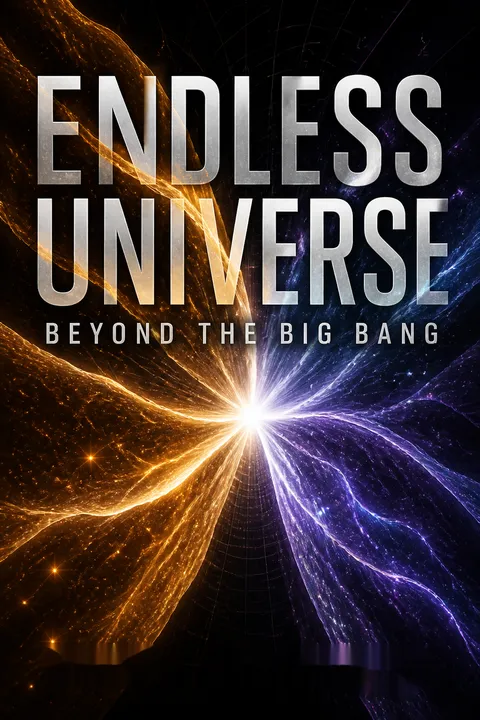


Key Takeaways
Treat the Big Bang as a measured transition, not a proven beginning.
A precision triumph. In 2003, the WMAP satellite revealed a detailed map of ancient light from the early universe. Cosmologists celebrated because its pattern matched predictions of the leading inflationary model. The authors, both contributors to that model, shared the excitement. But the map showed what the universe was like about 380,000 years after the Big Bang, not what caused the Big Bang or whether time began there.
A question reopens. Steinhardt and Turok had been led toward an alternative by a 1999 lecture on M theory. They wondered whether the Big Bang might be a collision between two worlds, with a history before it. Their book follows that proposal while stressing that cosmology reconstructs the past indirectly, from light and physical laws, rather than by replaying cosmic beginnings in a laboratory.
What's striking is the distinction between a theory's successful predictions and the larger story attached to them. A map can strongly support a model of the early universe without proving that the model's account of origins is complete. This is a familiar challenge in historical sciences, where unique past events must be inferred from surviving traces. The authors' caution is useful, though it should not obscure the force of WMAP's agreement with inflation. Uncertainty at the edge of a theory does not make its well-tested middle equally uncertain.
Separate the measured cosmic middle from the guessed beginning.
A well-charted era. The book calls the period from roughly one second after the Big Bang to today Act Two. Evidence supports its broad sequence: the universe expanded and cooled, light elements formed in its first minutes, atoms appeared around 380,000 years later, and gravity gathered matter into galaxies and stars. The cosmic microwave background preserves a picture of the young universe, while the abundances of hydrogen, helium, and other light elements help test conditions earlier than that image can show.
A boundary of knowledge. The standard equations work remarkably well for this long history, but extrapolating them before the first second leads to a singularity, where quantities become infinite and the equations fail. That mathematical failure does not, by itself, prove that time began. It marks the point where a more complete account of gravity is needed.
The distinction between observed trace and extrapolated account is a powerful way to read cosmology. Different instruments and methods constrain different periods, so confidence should be attached to particular claims, not to a single all-or-nothing narrative. This resembles the logic of geology, where present formations provide strong evidence about past processes but not necessarily every detail of the planet's formation. A caveat matters: the fact that equations fail at a singularity does not establish that a bounce occurred. It leaves the question open, rather than answering it in either direction.
Treat matching cosmic maps as evidence, not a verdict between histories.
Shared successes. Inflation describes a brief period of extremely rapid expansion that smooths and flattens the universe. Quantum fluctuations during that period can seed the density variations that later grow into galaxies. The cyclic proposal offers a different route: a long, gentle contraction before a collision can generate similar variations. Both accounts aim to explain why the early universe was almost uniform, why space is nearly flat, and why small irregularities existed to form structure.
Same snapshot, different past. At the time of the book's 2007 publication, observations including WMAP's temperature map fit both models. The authors emphasize that agreement with existing data does not decide between histories that produce similar observable patterns. Their disagreement concerns mechanisms, the Big Bang's status, and the universe's future, not the well-established expansion and cooling of the observable cosmos.
This is a textbook case of underdetermination: distinct causal stories can account for the same evidence available so far. The useful response is not to treat the models as equally established, but to identify observations on which they make different predictions. That turns philosophical disagreement into a research program. The cyclic model's ability to match the map is intellectually important, yet matching a successful model's predictions is only one test. A competitor also needs a coherent mathematical foundation, independent predictions, and evidence that discriminates in its favor.
In the cyclic model, dark energy prepares the next Big Bang.
More than acceleration. In the conventional picture, dark energy explains why cosmic expansion is speeding up today. In the cyclic model, a related energy also helps set up the next cycle. As it dominates, it stretches the universe, spreading matter thinly and smoothing large-scale irregularities. The proposal then assumes that this energy slowly changes, ending accelerated expansion and allowing a very gentle contraction.
A cosmic reset. In this account, the familiar three dimensions continue expanding while an extra dimension contracts. A high-pressure phase is supposed to keep the universe smooth and flat as the branes approach. Their collision releases energy as hot matter and radiation, producing a new expanding era. The cycle takes about a trillion years. Crucially, dark energy must be able to decay in the required way. The book presents this as a central assumption, not an observed property of dark energy.
The model's appeal lies in turning a cosmic ingredient that seems disconnected from the past into part of a repeating mechanism. In systems thinking, a component is especially explanatory when it both responds to the system's state and helps regulate what happens next. Here, accelerated expansion clears and smooths the stage, while the proposed change in dark energy permits a new act. The key uncertainty is physical, not rhetorical: observations establish acceleration, but they do not establish that dark energy decays or reverses its effect. The model's unifying story remains a hypothesis until that mechanism is grounded.
Branes recast creation as a collision across an extra dimension.
Worlds with a gap. In the M theory picture described in the book, our familiar three-dimensional world lies on a brane, a membrane-like object. A second brane sits beyond a tiny extra dimension. Ordinary matter and light are confined to their own branes, while gravity can cross the gap. This offers a striking geometric interpretation of the Big Bang: instead of space and time appearing from a singular point, two branes collide and release hot matter and radiation.
A scientific gamble. The idea took shape after the authors heard Burt Ovrut explain a version of string theory with separated worlds. But M theory was incomplete, and a realistic calculation of the collision was difficult. The authors report promising work suggesting that the transition might be mathematically describable, while acknowledging that the collision is a major unresolved test for the cyclic picture.
The brane idea earns its place because it changes the question from how something came from nothing to what physical process could connect a prior state to the hot expansion we observe. That is a productive shift: it makes the proposed beginning describable in principle and ties cosmology to a broader theory of matter and gravity. Yet conceptual vividness can outrun mathematical control. A membrane collision is an image, not evidence that such objects exist. Its scientific value depends on deriving the collision from a consistent theory and extracting predictions that cannot be adjusted after the fact.
A repeating universe must dilute entropy, not erase it.
The old obstacle. Earlier oscillating-universe models faced a thermodynamic problem. Stars and other processes create entropy, or disorder. If all three dimensions contracted at each crunch, that entropy would become increasingly concentrated. Physicist Richard Tolman argued that each cycle would then last longer than the one before, making an endless sequence difficult to sustain.
A different geometry. The cyclic model in this book contracts only the extra dimension. The branes, and the entropy distributed across them, remain expanded. Dark-energy-driven expansion spreads matter and radiation so thinly that old entropy does not become concentrated at the next collision. The authors also propose that gravity supplies energy to the branes' motion, compensating for energy converted into new radiation. Their account does not claim that entropy disappears or that conservation of energy is broken. It proposes a different way to manage entropy density and energy across cycles.
The important distinction is between total entropy and entropy per volume. A system can gain total disorder while its contents become more diffuse if its volume grows sufficiently. That makes the proposed answer to Tolman's objection conceptually different from denying thermodynamics. Still, the details matter: gravitational energy is subtle, and describing gravity as a continuing energy source is not a substitute for a complete accounting. The model's solution is promising only if the proposed geometry and dynamics actually yield repeatable conditions without hiding an inconsistency in the transition.
Demand a gravitational-wave fingerprint before choosing cosmic origin stories.
A discriminating signal. Inflation and the cyclic model can produce similar patterns in the cosmic microwave background, but they predict different gravitational waves. Inflation's rapid expansion can stretch tiny quantum disturbances into waves with a nearly scale-invariant range of strengths. In the cyclic account, the waves are expected to be much weaker overall and stronger at shorter wavelengths, rather than scale-invariant.
A test, not a promise. The book describes how gravitational waves could leave a distinctive polarization pattern in ancient light. In particular, a twisting pattern called B-mode polarization would signal gravitational waves. WMAP had not found such a signal in the results discussed by the authors, which narrowed the range of inflationary models but did not rule out inflation. The book presents future polarization measurements as a possible way to distinguish the proposals, not as a settled result.
This is the strongest kind of scientific disagreement: the rivals share established observations but expose different signatures to measurement. Polarization is valuable because it encodes more than brightness; it can preserve information about the physical process that disturbed the early plasma. The caution is that a missing signal has meaning only relative to an instrument's sensitivity and a model's quantitative prediction. A nondetection can exclude some versions without eliminating a whole family. The book's account is historically situated, so its forecasts and limits should be read as the state of the debate in 2007.
The multiverse trades a unique explanation for an observer-selection story.
A landscape of possibilities. The book describes eternal inflation as a process in which some regions keep expanding rapidly while other regions become pocket universes. If string theory's many possible arrangements of extra dimensions correspond to different physical properties, those pockets could have different laws and energy densities. The authors argue that this picture risks making the observed universe one rare outcome among an uncountable range of possibilities.
Selection instead of mechanism. The anthropic principle, in its controversial use here, explains certain observed properties by saying that observers can arise only in universes compatible with life. For instance, a very large dark-energy density might prevent galaxies from forming, so observers would find themselves only where it is smaller. The authors question whether this is sufficiently predictive when the other universes and their probabilities cannot be independently checked.
Observer selection is not automatically empty reasoning. In many sciences, selection effects help explain why a sample contains the cases it does, provided the sampling process can be specified and tested. The harder problem here is the proposed ensemble: if other pockets cannot be observed and the relative probabilities are undefined, the explanation can accommodate a wide range of outcomes. The authors' demand for testability is strongest when aimed at that gap. Their contrast should not imply that every multiverse argument is identical or that selection effects have no legitimate scientific use.
A trillion-year cycle could make a tiny vacuum energy understandable.
A vast mismatch. The cosmological constant is the energy associated with empty space. The book notes that a straightforward estimate from known quantum physics produces a value about 10^120 times larger than the one inferred from observations. The inflationary picture does not, in the authors' account, explain why the measured value is so small.
Time as a mechanism. Near the book's end, the authors outline a possible relaxation process: a quantum field could lower vacuum energy through increasingly slow jumps. In an ordinary one-time universe, this could take so long that galaxies disappear before the value becomes small. A cyclic universe continually makes new matter and radiation, so the process might have time to reach a small positive value while galaxies form in later cycles. This is a proposed solution, not an established explanation.
The proposal uses cosmic duration as a physical resource. Rather than selecting a rare universe with just the right vacuum energy, it imagines a mechanism that gradually changes the value while cycles replenish structure. That is an appealing shift from explanation by observer location to explanation by dynamical history. But extra time alone cannot solve a numerical mismatch. The relaxation mechanism must arise from defensible physics, and its predictions must fit the observed value without delicate adjustment. The book is careful to present this as a late, tentative possibility, not a result secured by the cyclic model.
Analysis
Endless Universe is both a popular account of cosmology and a record of a live scientific dispute. Its structure moves from the observationally secure expansion and cooling of the universe, through the authors' work on inflation, string theory, and branes, to a cyclic alternative that interprets the Big Bang as a recurring transition. The personal narrative matters: the 1999 conversation after Burt Ovrut's lecture and the Finland brainstorming make theory-building feel contingent, collaborative, and vulnerable to failure rather than inevitable.
The book's strongest intellectual move is separating the success of the hot Big Bang account from the stronger claim that the Big Bang began time. A singularity marks a breakdown in the equations used to describe it. Treating that breakdown as proof of creation exceeds the mathematics. The same discipline should apply to the cyclic proposal: a brane collision is not established merely because it avoids a singular beginning or supplies an elegant story.
The authors present inflation's patchwork of ingredients and its multiverse implications as reasons to pursue alternatives. Their critique is stimulating, but advocacy shapes the balance. Inflation's fit to multiple observations is substantial, while the cyclic model's core transition and dark-energy behavior remain assumptions requiring deeper derivation. Parsimony is a useful guide to theory choice, not an empirical test by itself. A framework with fewer ingredients can still be wrong, and a complicated framework can sometimes be unified by discoveries not yet made.
The book's lasting value is therefore methodological as much as cosmological. It asks readers to distinguish observation from extrapolation, elegance from evidence, and a model's ability to fit known data from its ability to make risky, discriminating predictions. Its 2007 discussion of proposed tests should be read in that historical context. The central question remains scientifically productive even if its preferred alternative is provisional: what evidence could tell us whether the Big Bang was a beginning, a bounce, or one episode in a longer history?
Review Summary
Endless Universe presents an alternative cosmological theory to the inflationary Big Bang model. The authors argue for a cyclic universe model, which they claim resolves issues with inflation theory. Readers found the book challenging but informative, praising its clear explanations of complex concepts. Some criticized the authors' defensive tone and lack of discussion on the cyclic model's flaws. While the theory remains controversial, many readers appreciated the fresh perspective on cosmology and the authors' passion for their ideas.
People Also Read



Glossary
Dark energy
Energy driving accelerated expansionThe name for the component of the universe whose gravitational effect is associated with the observed acceleration of cosmic expansion. Unlike dark matter, it is described as smooth rather than clustered. In the cyclic model, dark energy also plays a proposed role in diluting and smoothing the universe before a new cycle.
FAQ
What's Endless Universe: Beyond the Big Bang about?
- Exploration of Theories: The book explores cosmological theories, focusing on the hot big bang model and the emerging cyclic model proposed by the authors.
- Cyclic Universe Concept: It introduces the idea of a universe undergoing repeating cycles, where each cycle starts with a big bang that is not the beginning of time or space.
- Scientific Debate: The narrative details the authors' scientific journey, challenging established views and contributing to the ongoing debate in cosmology.
Why should I read Endless Universe: Beyond the Big Bang?
- Insight into Cosmology: It offers a comprehensive overview of modern cosmology, making complex ideas accessible to those interested in the universe's origins and future.
- Personal Narratives: Includes personal stories from the authors, illustrating the process of scientific discovery and collaboration.
- Current Relevance: Discussions on dark matter, dark energy, and the cyclic model are highly relevant to ongoing research in physics and cosmology.
What are the key takeaways of Endless Universe: Beyond the Big Bang?
- Cyclic Model vs. Inflation: The book contrasts the cyclic model with the inflationary model, highlighting their different implications for the universe's history and future.
- Importance of Dark Energy: Emphasizes dark energy's role in shaping the universe and its connection to the cyclic model, suggesting a more integrated view of cosmic evolution.
- Scientific Methodology: Illustrates how scientific theories evolve through debate, experimentation, and integration of new ideas, showcasing the dynamic nature of scientific inquiry.
What are the best quotes from Endless Universe: Beyond the Big Bang and what do they mean?
- Douglas Adams Quote: Reflects the ongoing mystery of the universe and the ever-evolving nature of scientific understanding.
- Big Bang Description: Encapsulates the authors' argument for the cyclic model, suggesting the universe's history extends beyond the big bang.
- Ideas as Central Characters: Emphasizes the importance of ideas in scientific discourse, highlighting their role in discovery and understanding in cosmology.
What is the cyclic model presented in Endless Universe: Beyond the Big Bang?
- Repeating Cycles: Posits that the universe undergoes infinite cycles of expansion and contraction, with each cycle beginning with a big bang.
- Influence of Previous Cycles: Events from previous cycles influence the structure and evolution of the universe in subsequent cycles, suggesting continuity.
- Integration of Dark Energy: Incorporates dark energy as a fundamental component driving the cycles, contrasting with the inflationary model.
How does Endless Universe: Beyond the Big Bang explain dark matter and dark energy?
- Dark Matter's Role: Described as an invisible component interacting gravitationally, crucial for galaxy formation and large-scale structures.
- Dark Energy's Influence: Presented as a repulsive force accelerating the universe's expansion, dominating its energy content in the current epoch.
- Connection to Cyclic Model: Understanding dark energy is essential for the cyclic model, as it regulates transitions between expansion and contraction phases.
What are the main criticisms of the inflationary model discussed in Endless Universe: Beyond the Big Bang?
- Contrived Nature: The inflationary model appears contrived, requiring multiple components awkwardly adjusted to fit observations.
- Lack of Explanation: Does not adequately explain how or why the big bang occurred, leaving significant gaps in understanding.
- Fine-Tuning Issues: Relies on fine-tuning of initial conditions, raising questions about its robustness and applicability.
How do the authors describe their personal journey in cosmology in Endless Universe: Beyond the Big Bang?
- Collaborative Efforts: Highlights the collaborative nature of scientific research, detailing work with colleagues to develop and refine ideas.
- Intellectual Challenges: Shares challenges faced while developing the cyclic model and how perspectives evolved through debate and experimentation.
- Passion for Discovery: Conveys their passion for understanding the universe, illustrating the excitement and uncertainty in scientific exploration.
What is the significance of the WMAP findings in the context of Endless Universe: Beyond the Big Bang?
- Precision Measurements: WMAP provided precise measurements of cosmic microwave background radiation, confirming key predictions of the inflationary model.
- Challenge to Theories: While supporting inflation, the findings also opened the door for alternative models, like the cyclic model, to explain observations.
- Foundation for Research: WMAP results serve as a foundation for ongoing research, prompting further investigations into dark energy and the universe's structure.
How does Endless Universe: Beyond the Big Bang address the future of cosmological research?
- Ongoing Debate: Emphasizes the ongoing debate between inflationary and cyclic models, with future observations expected to play a crucial role.
- Technological Advancements: Highlights the importance of advancements in observational astronomy for more precise measurements and tests of theories.
- Interdisciplinary Collaboration: Advocates for collaboration between particle physicists and cosmologists, suggesting insights from both fields are essential.
What is the inflationary model discussed in Endless Universe: Beyond the Big Bang?
- Rapid Expansion: Posits a brief period of rapid expansion after the big bang, smoothing out irregularities and leading to a uniform universe.
- Quantum Fluctuations: During inflation, quantum fluctuations create density variations that seed galaxy formation.
- Challenges: Faces challenges like explaining the source of inflationary energy and implications of eternal inflation, leading to a multiverse scenario.
How does the cyclic model differ from the inflationary model in Endless Universe: Beyond the Big Bang?
- Regular Cycles vs. Singular Event: Cyclic model proposes infinite cycles, while inflationary suggests a one-time event followed by steady expansion.
- Role of Dark Energy: In the cyclic model, dark energy is a stabilizing force; in the inflationary model, it accelerates expansion.
- Predictability: Cyclic model is seen as more predictable, suggesting consistent properties across cycles, unlike the multiverse scenario of inflation.
Download PDF
Download EPUB
.epub digital book format is ideal for reading ebooks on phones, tablets, and e-readers.








