

Key Takeaways
Build boundaries that filter what enters without shutting out intimacy
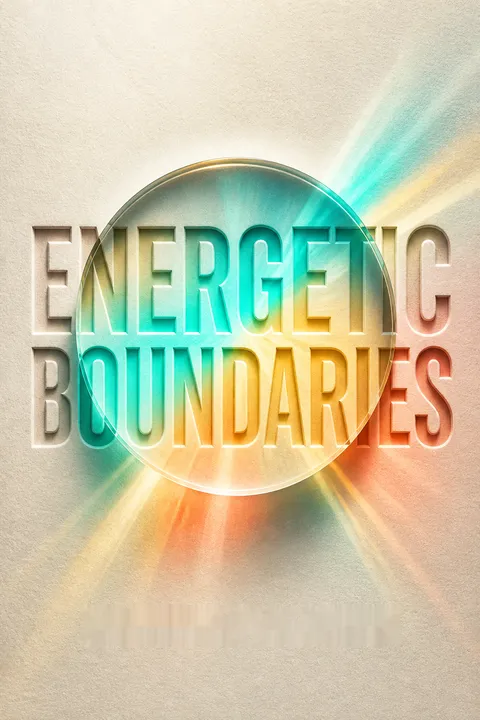
Boundaries are selective, not sealed. Dale’s central idea is that healthy boundaries protect a person’s sense of self while allowing supportive people, opportunities, and information in. In her spiritual model, they also communicate what treatment is acceptable and help draw in what a person needs. Their purpose is not to wall off the world, but to distinguish care from intrusion and connection from self-abandonment.
The image has practical value. A person overwhelmed by everyone else’s moods, or repeatedly agreeing to unwanted favors, may need clearer limits, more time to decide, or support in saying no. Dale presents these experiences as signs of damaged energetic borders. Readers can use the image as a prompt to notice where they feel depleted, pressured, or unable to choose.
The framework makes an abstract interpersonal problem easy to picture: a boundary can be too closed, too open, or selectively responsive. That resembles the psychological idea of differentiation, the capacity to stay connected to others without losing one’s own judgment. The metaphor can help readers name patterns before they have language for them. Its literal energetic explanation is a different matter. The book’s account of invisible fields directing opportunities or other people’s treatment is not established by the anecdotes it offers. The useful test is behavioral: does a boundary help someone communicate, choose, and stay safe?
Check whether your boundaries are armored, porous, or full of openings
Four areas need attention. Dale groups boundaries into four domains: physical, for safety and material needs; emotional, for feelings and beliefs; relational, for connection and love; and spiritual, for purpose and a sense of belonging to something larger. She associates them with red, orange, green, and white. Her model also describes three common distortions: rigid borders that shut out support, permeable ones that let others overwhelm or use you, and gaps that allow energy or attention to leak away.
The pattern may vary by context. Someone may be confident with friends but unable to refuse a manager, or physically safe while emotionally confused by a partner. Dale therefore advises looking at where the difficulty occurs, rather than assuming one global defect. A practical version is to ask: what is getting in, what is being kept out, and what do I need to communicate?
The four-part map is memorable because it prevents every problem from being reduced to assertiveness. Money stress, emotional confusion, unsafe touch, and spiritual shame call for different questions and often different forms of help. The red, orange, green, and white coding is best treated as a mnemonic, not a diagnostic instrument. Modern clinical practice likewise distinguishes bodily safety, emotion regulation, interpersonal functioning, and values or meaning, but does not infer these from aura colors. The distinction between rigid and porous limits is especially useful: people may need flexibility, not simply stronger defenses.
Name the pattern before you blame yourself for repeating it
Repetition has several forms. Dale calls seven recurring difficulties energetic syndromes. Paper Doll describes repeating the same damaging relationship or behavior. Vampire refers to feeling drained by others. Mule means taking on work and responsibility that belongs to other people. Healer combines giving help with absorbing the person’s distress. Psychic-Sensitive describes being flooded by perceived information or others’ needs. No-Boundary means having trouble filtering inputs and impulses. Environ describes extreme sensitivity to surroundings.
Use labels as prompts, not verdicts. A person can recognize more than one pattern, and the same behavior can have different causes. For example, exhaustion after a difficult meeting might reflect overwork, conflict, poor sleep, or a health condition, not an invisible energy transfer. The value of the labels is that they direct attention toward recurring situations and choices that can be examined.
The taxonomy can turn a vague complaint into a more precise question: is the core problem repetition, over-responsibility, or difficulty filtering other people’s demands? Naming patterns often reduces shame and helps people track triggers. Yet labels can become sticky. A framework that explains nearly any symptom risks seeming more certain than it is, especially when it includes supernatural or environmental claims that are hard to test. The strongest use is observational: record who was present, what happened, what the person did next, and whether the pattern repeats. That keeps the category open to revision.
Care for people without becoming their unpaid emotional infrastructure
Support is not substitution. Dale distinguishes a Mule, who takes on another person’s tasks or distress, from a Healer, who both offers help and absorbs the other person’s problems. The shared trap is confusing compassion with responsibility for someone else’s choices. In one client story, a woman continually accommodated her angry husband, then privately soothed herself with food. When she stopped automatically yielding, he eventually disclosed a painful history and sought help. The account illustrates a changed interaction, not a promise that every difficult person will respond well.
Bound the helping role. Ask what assistance was actually requested, what belongs to the other person, and what can be offered without harming health, time, or finances. In caregiving work, Dale recommends clear session expectations, breaks, and deliberate separation between the client’s feelings and the caregiver’s own.
This distinction speaks to a real tension in caregiving: empathy can promote connection, while chronic overfunctioning can deprive both parties of agency. In family systems, one person’s rescuing may stabilize a pattern that keeps another from facing consequences. The book’s language of absorbing energy can be translated into familiar processes such as emotional contagion, blurred roles, and burnout. But setting limits is not a method for reforming an abuser, and the client story should not be read as evidence that firm boundaries make an unsafe partner change. In harmful relationships, practical safety and professional support take priority.
Treat emotions as signals, then check whose feelings they are
Feelings carry information. Dale groups emotions into five broad signals: sadness points toward a loss of connection; anger suggests a boundary may have been crossed; fear signals possible danger; disgust flags something that feels harmful or unsuitable; and joy indicates an experience worth welcoming. Her advice is to pause long enough to identify the feeling and consider what action it calls for, rather than freezing, fighting, or fleeing automatically.
Separate feeling from belief. A person who feels angry after a family member excludes a partner might state the need for respect or make a different plan. The feeling is real, but the interpretation attached to it may need examination. Dale also asks readers to distinguish their own emotions from those they take on from others, especially in close relationships.
This approach aligns with emotion-focused and mindfulness practices: noticing a feeling can create a pause between impulse and action. The signal model is useful as a first approximation, particularly when someone has learned to dismiss anger or fear. It should not be treated as a rigid decoder. Anger can arise from threat, injustice, pain, or frustration, and fear can be disproportionate to present danger or accurately detect it. Context matters. Asking what a feeling is responding to, and what evidence supports the interpretation, preserves the emotion’s value without granting it unquestioned authority.
Trace a boundary reflex to the survival decision that once helped
Old strategies can outlive danger. Dale’s named exercise, Uncovering Your Storyline, asks readers to connect a current pattern with the circumstances in which it formed. Its focus is not only the event, but also the person’s interpretation of it, the protective response adopted at the time, and the need that went unmet. A client injured in a car crash later experienced neck spasms when planning something for herself or refusing a favor. Dale linked the pattern to guilt and self-denial; the client’s symptoms reportedly changed after addressing that guilt.
Treat the story as a hypothesis. The reflection can reveal useful links between past experience and present behavior. It does not establish that a physical symptom was caused by an energetic injury. A therapist can help explore painful memories safely, and medical evaluation remains important for persistent or severe symptoms.
The method’s strongest insight is temporal: a response that once reduced risk can become costly when the situation changes. Trauma-informed therapy similarly explores learned protective behaviors while avoiding blame for having developed them. The exercise also emphasizes the need beneath the behavior, which can guide a concrete repair, such as protection, rest, or support. Its limits matter. Memory is reconstructive, and a compelling personal narrative is not proof of causation. In particular, attributing pain or illness to a specific emotional or spiritual injury can delay appropriate care. Reflection works best alongside, not instead of, clinical assessment.
Set intentions, ask for support, and make boundaries concrete
Change begins with a clear aim. Dale’s intention practice asks readers to release shame and blame, recognize what an old pattern once protected, choose a healthier direction, seek support, and commit to that direction. She also presents Spirit-to-Spirit, a brief visualization in which a person recognizes their own dignity, acknowledges the other person’s humanity, and asks for spiritual guidance. Both exercises are framed as ways to prepare for a different response.
Pair reflection with action. A boundary might mean telling a coworker which tasks can be completed, scheduling a recovery break after caregiving, or asking a trusted person for help. The book also suggests color, sound, shapes, stones, and prayer. These may serve as personal rituals or reminders, but the text’s claims that they alter illness, energy fields, or outside events are not demonstrated by the stories it reports.
Ritual can help translate an abstract intention into a repeatable cue. A stone or phrase may remind someone to pause, while a written plan can specify what to say and whom to contact. That practical mechanism is distinct from the book’s claim that objects transmit intention into the body or change molecular structures. The distinction protects the reader from confusing meaning with evidence. The most reliable version of the exercise combines reflection with observable behavior: make a request, decline a task, seek help, or document a pattern. For trauma, mental illness, or medical concerns, qualified care is essential.
Stop treating money as proof of worth, love, or spiritual favor
Money carries several meanings. Dale links it to physical security, emotional satisfaction, power and care in relationships, and the resources needed to pursue purpose. She argues that family experiences can make money feel unsafe or shameful. Simon, a client who earned a reasonable income yet accumulated debt, associated money with abandonment and abuse after growing up around instability. Dale interpreted this as a conflict between wanting security and fearing it.
Pair insight with financial practice. The book recommends examining inherited beliefs, tracking where money goes, using cash to make spending tangible, and seeking practical support when needed. Its broader point is that a person may need both emotional reflection and concrete financial decisions. A spiritual interpretation cannot replace budgeting, fair pay, debt advice, or a financial professional.
The strongest contribution here is the idea that financial behavior has emotional and relational histories, not just arithmetic. Shame can make people avoid bills, while family roles can normalize rescuing others or surrendering control. Those patterns are worth examining alongside income, expenses, debt terms, and structural constraints. The book sometimes implies that inner energetic alignment draws prosperity, a claim its anecdotes cannot establish. That framing can unintentionally suggest poverty reflects personal failure. A more balanced reading treats beliefs as one influence among many, including wages, caregiving burdens, discrimination, health, and access to resources.
Give children clear limits, then teach them to build their own
Limits can make exploration safer. Dale opens her parenting discussion with a playground study in which children reportedly stayed near the center when the schoolyard fence was removed, then played more freely when it returned. The point is that security can support exploration rather than restrict it. Parents provide boundaries through care and example, while gradually helping children recognize their feelings, needs, and choices.
Adapt support to the child. Dale describes five spiritual personality groupings and suggests that children may differ in their need for structure, reassurance, or help separating their feelings from others’. These categories reflect her own spiritual model, not established child-development diagnoses. Her most grounded advice is to listen, model limits, and seek therapeutic help for serious or persistent difficulties. She also applies the idea of parenting to adults’ younger, wounded selves.
The fence story captures a useful developmental principle: predictable limits can create a secure base from which children explore. Contemporary child development likewise emphasizes both warmth and structure, rather than treating autonomy and protection as opposites. The book’s personality categories may prompt parents to notice individual differences, but should not be used to explain autism, ADHD, illness, or unusual behavior as energy problems. Such labels can mislead and delay assessment. Children benefit most when spiritual or imaginative practices remain optional supports, while their emotional, educational, medical, and safety needs receive evidence-based attention.
Analysis
Energetic Boundaries is a spiritually framed self-help guide that translates a broad problem, feeling invaded or depleted by other people, into an organized map of four domains and seven recurring patterns. Its structure moves from diagnosis to repair, then applies the model to health, work, money, relationships, and parenting. The central metaphor is unusually versatile: boundaries both protect and permit connection. The book repeatedly returns to a practical moral distinction, caring for others does not require surrendering one’s own needs.
Its most durable value lies in the behavioral questions beneath the metaphysics. Which responsibilities are yours? Can you identify your emotion before acting? Are you repeating a familiar relationship? What would a safer limit look like? These questions overlap with established ideas in trauma-informed therapy, emotion regulation, and family systems. The author’s client stories make the patterns vivid, but they remain anecdotes and cannot establish that energetic fields caused or cured illness, debt, or relationship outcomes.
That distinction is crucial because the book blends measurable phenomena, such as the body’s electromagnetic activity, with claims about telepathy, entities, inherited energy cords, and objects changing health. Evidence for the former does not validate the latter. Likewise, reports of cancer or psychiatric conditions resolving after spiritual exercises should not be interpreted as reliable treatment guidance. The text itself sometimes recommends therapy or medical support, and that caution deserves emphasis.
Read as a literal diagnostic system, the model can overreach and risk blaming people for circumstances shaped by illness, abuse, poverty, or institutions. Read as a set of metaphors and reflective exercises, it can help identify overgiving, emotional confusion, and rigid avoidance. The most responsible adaptation preserves the invitation to notice patterns while grounding change in communication, practical support, professional care, and observable choices.
Review Summary
Reviews for Energetic Boundaries are mixed, averaging 4.01 out of 5. Many readers, particularly empaths and those interested in metaphysical topics, found the content insightful and practical, praising Dale's accessible writing style and useful exercises. Critics felt the book was too rooted in New Age concepts, such as crystal therapy and communicating with spirits, making it difficult to accept. Some noted repetitiveness and structural issues. Overall, open-minded readers with an existing interest in energy work benefited most, while skeptics struggled with the pseudoscientific elements.
People Also Read







Glossary
Energetic boundaries
Protective spiritual bordersDale’s term for invisible fields that, in her spiritual model, surround a person and regulate protection, filtering, and attraction. She treats them as both boundaries between self and others and channels through which people communicate needs and receive support. The model can also be read metaphorically as a way to discuss personal limits.
Paper Doll Syndrome
Repeating harmful patternsA pattern in which someone repeatedly encounters similar difficulties, such as unhealthy partners, job problems, compulsions, or financial setbacks. Dale attributes this repetition to damaged or misdirected energetic boundaries that keep inviting familiar outcomes and resisting healthier alternatives. The term is a spiritual interpretation, not a clinical diagnosis.
Vampire Syndrome
Feeling drained by othersDale’s label for a pattern in which a person feels depleted after interacting with particular people or situations and believes others are taking their life energy. She links it to beliefs about being responsible for supplying others. In everyday terms, the pattern may also describe exhaustion, overgiving, or relationships with poor reciprocity.
Mule Syndrome
Carrying others’ responsibilitiesA pattern in which someone assumes other people’s practical, emotional, or mental work, often from a belief that every problem must be handled by them. Dale associates it with anxiety, exhaustion, and resentment. The term highlights over-responsibility and unequal labor rather than offering a psychological diagnosis.
Healer’s Syndrome
Helping while absorbing distressDale’s term for a helper who gives care and attention while also taking on the other person’s problems, emotions, or illnesses. She distinguishes this from the Mule pattern by emphasizing the two-way exchange: the helper gives support and receives distress. The concept describes a risk of blurred roles and caregiver burnout.
Psychic-Sensitive Syndrome
Overwhelmed by perceived informationA pattern Dale assigns to people who feel flooded by intuitive impressions, others’ emotions, perceived spiritual presences, or information they believe they receive at a distance. She argues that weak spiritual boundaries make this input difficult to filter. The label is not a substitute for evaluating sleep problems, anxiety, or unusual perceptions clinically.
No-Boundary Syndrome
Difficulty filtering impulsesDale’s label for a pattern of being overwhelmed by external input and internal impulses while struggling to identify one’s own feelings, needs, or priorities. She associates it with frenetic behavior, exhaustion, and compulsions. The term should not be used to diagnose ADHD, autism, or other conditions.
Environ Syndrome
Sensitivity to surroundingsA pattern Dale describes as unusually strong sensitivity to environmental conditions, objects, places, natural events, or perceived residual emotions. In her model, permeable boundaries let these influences affect a person’s health and mood. The term is spiritual vocabulary, not a medical explanation for allergies, toxic exposure, or illness.
Uncovering Your Storyline
Tracing a pattern’s originsA guided reflection designed to connect a present difficulty with earlier events, the interpretation formed at the time, the protective response that followed, and the need that went unmet. Dale uses this process to help readers reconsider old survival strategies. It is best used carefully, especially when memories are distressing, and can be supported by a qualified therapist.
Spirit-to-Spirit
A spiritual connection exerciseA visualization in which a person recognizes their own spiritual worth, acknowledges the other person’s spiritual dignity, and asks the Divine for guidance or protection. Dale presents it as a way to disengage unhealthy connections while preserving compassion. It can also function as a brief reflective ritual before or after a difficult interaction.
healing stream of grace
Divine support and loveDale’s name for an imagined flow of unconditional divine love that can replace harmful spiritual connections and support healing. Her exercises ask readers to visualize this stream cleansing or restoring a boundary. The term belongs to the book’s spiritual practice and is not a scientifically established treatment or measurable energy.
About the Author

Download PDF
Download EPUB
.epub digital book format is ideal for reading ebooks on phones, tablets, and e-readers.








