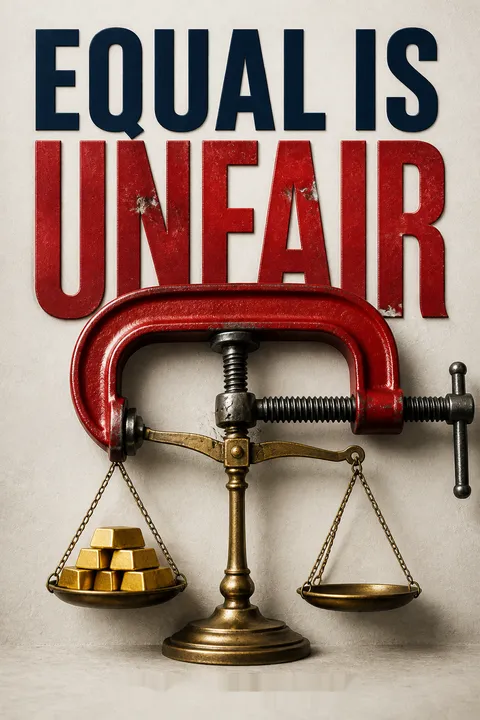


Key Takeaways
Treat unequal outcomes as a clue to investigate, not proof of injustice.
Difference is not deprivation. The book’s central claim is that income inequality alone does not show that anyone has been robbed, exploited, or made poorer. Wealth can grow: if everyone’s income rises but high earners’ incomes rise faster, inequality increases even as everyone becomes better off. The authors argue that public debate often mistakes a gap between people for evidence of harm to one of them.
Ask what caused the gap. Their preferred question is whether people gained wealth through productive work and voluntary exchange, or through force, fraud, or political favors. They see the American Dream as freedom to pursue a better life, not a promise that people will reach equal outcomes. The book therefore redirects concern from income ratios toward the conditions that let people create value and keep what they earn.
The distinction between relative position and material well-being is essential: a rising gap does not by itself establish falling living standards. But relative inequality can still matter when it shapes access to education, health, political influence, or social trust. Those effects require evidence rather than assumption, just as the authors insist. The strongest version of their argument is not that inequality never matters, but that inequality is an incomplete diagnosis. A useful test is to examine both absolute outcomes and the institutions that determine who can participate, bargain, and influence public decisions.
Follow wealth back to its creation before asking how it should be divided.
Question the pie metaphor. The authors challenge two assumptions they say distort inequality debates. The fixed pie assumption treats wealth as a limited stock, so one person’s gain must be another person’s loss. The group pie assumption treats wealth as something society creates collectively and then distributes. Against both, the book argues that wealth is produced by particular people, often working together, and can expand through innovation and trade.
Exchange can benefit both sides. The authors use J. K. Rowling’s books to illustrate the point: readers willingly paid for stories they valued, while Rowling and her publishers valued the payments. Her fortune grew, but the transaction did not require her readers to become poorer in the meaningful sense. The book argues that policy should examine how wealth was made, not infer wrongdoing from the size of someone’s fortune.
The creation-versus-division distinction corrects a common analytical shortcut: a snapshot of who owns what cannot explain how those assets came into being. Yet voluntary exchange is not a complete test of fairness. Bargaining power, information gaps, external costs, and limited alternatives can affect whether a transaction benefits both sides in practice. The authors’ framework is most useful when it prompts a second question: what rules shaped the exchange? A growing economy can create new value while still producing preventable harms or unequal access to the means of production.
Read inequality statistics as measurement choices, not unfiltered facts.
One number hides many decisions. The book argues that income and wealth trends depend on what researchers count: wages or all compensation, pre-tax or post-tax income, individual or household resources, and whether benefits such as health insurance and government transfers are included. Inflation measures, household size, immigration, and tax-law changes can also alter the picture. Different choices can make middle-income growth appear weak or substantial.
The estimates diverge sharply. For 2007, the book reports median income estimates of $30,000 using the approach associated with Thomas Piketty, $52,650 from the Current Population Survey, and $77,200 from a Congressional Budget Office measure. These figures are not interchangeable, but their spread shows why a headline about stagnation needs a definition and method. The authors argue that broader measures of consumption and living standards show progress, while acknowledging that exact gains remain disputed.
This is a valuable lesson in measurement: economic statistics are constructed, not simply found, and a precise-looking chart can conceal consequential choices. The same warning applies to the authors’ preferred evidence. Disagreement among measures does not establish that the most optimistic reading is correct, nor does it make distribution irrelevant. Researchers can reduce confusion by publishing results across several reasonable definitions and explaining who is omitted. Measurement uncertainty should lower confidence in sweeping claims on either side, not become a license to select only the figures that support a favored story.
Defend equal legal rights, not identical starting conditions.
Two kinds of equality. The authors define political equality as equal rights under law, including the freedom to think, work, trade, and own property. They distinguish this from economic equality, which concerns similarity in income or wealth. In their account, America’s opportunity came from limiting rulers’ ability to grant privileges or block people from pursuing their goals, not from guaranteeing that everyone began with the same resources.
Cuba is the contrast. The book describes post-revolutionary Cuba as a society that pursued economic leveling while concentrating political power. The state seized businesses, controlled work and trade, and rationed goods. Ordinary people depended on officials for access to many opportunities, while political insiders enjoyed advantages. The authors acknowledge that the United States has often failed to uphold equal rights, especially through slavery, but argue that rights rather than equal outcomes remain the proper ideal.
Equal rights are a powerful safeguard against hereditary status and arbitrary rule, and the Cuban example makes the cost of concentrated state power vivid. Yet formal rights do not automatically give people comparable practical chances. Disability, discrimination, poor schools, and family hardship can make a legal freedom difficult to use. The useful distinction is between equalizing outcomes and ensuring meaningful access to basic institutions. The authors are right that rights should not depend on wealth; a further question is which public arrangements make those rights usable without granting officials broad power to dictate people’s lives.
Protect innovators because ideas, capital, and trade lift living standards.
Progress begins with knowledge. The authors argue that human prosperity is not mainly a matter of adding more labor to existing methods. It comes from discovering new ideas, tools, products, and ways to organize work. Steve Wozniak designed an early personal computer; Steve Jobs helped turn it into a product ordinary customers could use. Investors supplied capital, managers coordinated people and resources, and workers carried out the plans. The book presents progress as a chain of contributions, not a solitary act.
The gains spread widely. The authors cite U.S. life expectancy rising from roughly 35 to nearly 80 over two centuries, and spending on basic necessities falling from more than half of disposable income in 1929 to about one-third in 2011. They argue that freedom of thought, contract, and property gives innovators room to try ideas and a reason to take risks.
The account captures an important feature of modern economies: innovations depend on networks of knowledge, finance, organization, and skilled work. It also explains why a successful creator’s influence can extend far beyond personal consumption. However, tracing a product’s benefits to a few celebrated individuals can obscure the contributions of institutions, public research, and less visible workers. The book does acknowledge cooperation, but its emphasis on individual creators can overstate how separable their roles are. A strong account of innovation should recognize both individual initiative and the shared infrastructure that makes it productive.
Remove career roadblocks instead of dictating wages and business outcomes.
Opportunity needs open doors. The book argues that people need routes into work and entrepreneurship, especially when they lack credentials or experience. It criticizes minimum-wage rules for potentially pricing inexperienced workers out of jobs, and occupational licensing for blocking people from offering services. One example is hairbraiding in Mississippi, where the authors report that aspiring practitioners once faced hundreds of required class hours. They also criticize limits on sidewalk businesses and rules that let existing firms object to new competitors.
Rules can protect incumbents. The authors point to taxi medallions that limited entry before services such as Uber challenged the system. They also argue that regulations can burden small firms more than established companies with lawyers and compliance staff. Their policy conclusion is to reduce barriers to work and innovation, rather than mandate particular wages or outcomes. The book’s examples make the distributional point concrete: restrictions can fall hardest on people with the fewest alternatives.
The central insight is that a policy intended to help workers can also limit entry, hiring, or competition. That is a serious question for regulators to test, particularly when rules protect established providers. But the effects of minimum wages and licensing vary by policy design and local conditions; the book’s broad claims do not settle every empirical dispute. Labor standards can also address safety, bargaining imbalances, and low pay. A sound assessment compares actual costs and benefits, including who bears them, rather than assuming either that regulation protects everyone or that removing it automatically expands opportunity.
Separate fortunes earned in markets from fortunes built through political favors.
Merit and privilege differ. The authors use the terms Money-Makers for people who build wealth through production and exchange, and Money-Appropriators for those who gain by shifting wealth through political power or other coercion. Their example is the steamboat monopoly Robert Fulton secured from New York, which Cornelius Vanderbilt challenged. In 1824, the Supreme Court struck down the monopoly; the book reports that fares from New York City to Albany fell from seven dollars to three.
Cronyism distorts the test. Subsidies, bailouts, tariffs, and government-granted monopolies can enrich firms by limiting rivals or making the public bear losses. The authors distinguish such favors from lobbying to defend against regulation, though they acknowledge that the line can blur. Their point is not that every wealthy person is productive, but that wealth alone cannot tell whether a person created value or captured a political advantage.
This distinction improves on class labels by asking how wealth was obtained, rather than treating everyone with a high income as interchangeable. It also identifies a genuine institutional risk: firms may seek political protection when government controls market access. The difficult boundary is that markets depend on public rules, and disputes over regulation are not always reducible to self-defense or rent-seeking. The book’s standard is clarifying, but applying it requires evidence about effects, beneficiaries, and alternatives. Transparency, competition, and accountability help make that examination more concrete than judging by either wealth or rhetoric.
Treat responsibility as agency, not a verdict on hardship.
Agency is not blame. The authors argue that responsibility means asking what a person can do next, rather than declaring that every hardship is the person’s fault. They tell the story of Jeremiah, who grew up amid abuse, housing insecurity, and foster care, yet worked hard in school and entry-level jobs before becoming a teacher. His story is offered as evidence that severe obstacles do not erase a person’s capacity to act.
Support can change incentives. The book also argues that welfare benefits can shrink as earnings rise, making some low-paid jobs financially unattractive. It cites studies and interviews describing single parents who faced new transport, childcare, and health costs when leaving assistance. The authors conclude that aid should not trap people outside work. Their larger claim is that poverty is ultimately a production problem, not merely a question of how existing wealth is distributed.
The distinction between explaining a person’s circumstances and denying their agency is humane and practical. Jeremiah’s story counters fatalism without pretending his childhood was ordinary. Still, one exceptional life cannot establish how typical upward movement is, and agency is shaped by health, care responsibilities, discrimination, and local job availability. Benefit cliffs are a real design problem, but assistance can also stabilize families and make work possible. Effective policy should preserve incentives while reducing obstacles, and should not turn personal responsibility into a substitute for examining institutions.
Luck shapes the starting hand, but choices shape its return.
Separate origins from actions. The authors reject the idea that people must deserve their intelligence, upbringing, or birth circumstances before they can deserve the results of their choices. They define earning more narrowly: a person uses abilities and resources through voluntary action to create value. Luck matters, but does not make effort or judgment irrelevant.
What happens to luck? In a study described by Jim Collins and Morten Hansen, highly successful companies and comparison companies experienced similar amounts of good and bad luck. The authors summarize the distinction as the return on luck: how effectively people recognize and act on circumstances they did not control. This does not mean everyone has equal chances, or that every result is deserved. It means that outside conditions alone cannot explain achievement, and that judging a person requires attention to both circumstance and conduct.
This account avoids two unhelpful extremes: treating success as pure destiny and treating every outcome as a transparent measure of merit. The idea of converting opportunity into results connects well with research on resilience and skill development, where context matters but does not dictate every response. The book risks understating how deeply early health, family resources, and social networks shape later choices. A careful judgment can recognize agency without pretending that people chose their starting conditions. That distinction supports praise for effort while leaving room to improve the conditions in which effort can pay off.
Test equality policies by the powers they give government.
Means matter, not just aims. The authors argue that equalizing income requires government to tax, regulate, or otherwise override choices about work, pay, property, and exchange. They challenge the idea of social justice associated with John Rawls’s difference principle, under which unequal rewards are acceptable only when they benefit the least advantaged. In the authors’ view, this makes individual achievement conditional on a collective judgment about its social value.
Inspect the actual proposal. The book presents the Khmer Rouge as an extreme attempt to eliminate private property and individual difference, ending in mass violence and deprivation. That history illustrates what the authors see as the danger of treating equality as an overriding goal, but it is not evidence that every redistributive policy leads to totalitarianism. Their practical test is to ask whether a proposal protects equal rights or grants officials new power to dictate outcomes.
The focus on means is a useful discipline: admirable goals do not guarantee that a policy works or that its authority will remain limited. Yet the book’s move from contemporary egalitarian arguments to Cambodia’s radical regime is a warning by analogy, not a demonstrated causal path. Democratic taxation and social insurance can operate under constitutional limits, even if their costs and effects remain contested. The sharper debate is therefore about which powers are justified, what safeguards constrain them, and whether a policy expands people’s real choices or substitutes official judgment for their own.
Analysis
Equal Is Unfair is a polemical defense of individual liberty, private property, and market exchange, organized as a rebuttal to the claim that income inequality is itself a central social wrong. Its most useful contribution is conceptual: it separates unequal outcomes from deprivation, opportunity from mobility statistics, legal equality from equal starting conditions, and productive wealth from political rent-seeking. Those distinctions help readers ask better questions than whether a ratio has risen. The historical and personal examples, from Cuba and East Germany to Vanderbilt, Wozniak, and Jeremiah, give the argument a memorable narrative structure.
The book is strongest when it asks readers to trace causal mechanisms and examine policy side effects. Its treatment of data measurement and political favoritism encourages skepticism toward simple stories. Yet that skepticism is applied unevenly. The authors scrutinize egalitarian evidence in detail while often presenting contested claims about regulation, welfare incentives, and market outcomes with greater confidence than their own methodological warnings would warrant. A statistic showing rising consumption does not settle whether wages, security, or access to opportunity are adequate. Nor does a voluntary transaction alone resolve questions about bargaining power or external harms. The philosophical disagreement is deeper than a dispute over tax rates. The authors treat individual rights and earned property as the primary standard of justice; egalitarian theories give greater weight to the distribution of life chances and benefits. The book rightly asks what coercive authority a redistributive program requires. Its critics can reasonably ask whether formal rights suffice when people lack the resources to exercise them. A reader need not accept either side’s total framework to retain the book’s strongest test: identify the mechanism, the beneficiaries, the costs, and the alternatives. Inequality is neither a verdict nor a nonissue. It is a prompt to investigate how wealth is created, how political power shapes access, and whether institutions leave people genuinely free to build a life.
Review Summary
Equal is Unfair receives mixed reviews, with an overall positive reception. Many readers praise its defense of capitalism and individualism, finding it thought-provoking and well-argued. Critics argue it oversimplifies complex issues and attacks straw men. Supporters appreciate its challenge to conventional wisdom on income inequality, while detractors find it dismissive of valid concerns. The book's stance against welfare and regulations is controversial. Some readers, even those disagreeing with its conclusions, found value in considering its arguments. Overall, it's seen as a passionate defense of free-market principles and individualism.
People Also Read







Glossary
Inequality Narrative
Inequality explains declining opportunityThe authors’ label for the argument that rising economic inequality causes declining mobility, weak growth, and unfairness, and that government should reduce the gap through taxes, regulation, and social programs. They argue that this account misreads history and living-standard data, and directs attention away from government-granted privilege and barriers to production.
political equality
Equal rights under lawThe book’s term for the principle that government should recognize the same rights for every individual, including the rights to think, work, trade, and own property. The authors distinguish it from equal income or wealth, arguing that equal legal standing allows people to pursue different goals and achieve different economic results.
fixed pie assumption
Wealth is treated as finiteThe assumption that a society has a fixed quantity of wealth, so a larger share for one person necessarily leaves less for everyone else. The authors argue that wealth can be created and expanded through production, innovation, and trade, meaning that rising inequality does not by itself show that one group has taken wealth from another.
group pie assumption
Wealth belongs to societyThe assumption that wealth is created by society as a whole and should therefore be divided according to a collective standard of fairness. The authors counter that wealth consists of values produced by particular people, often cooperating, and that government redistribution first requires taking property from those who hold it.
Pyramid of Ability
Ability raises others’ productivityA framework used in the book to describe how highly capable innovators can increase the productivity and living standards of many people with less specialized ability. New ideas, tools, and organizations make others more productive, while market exchange allows people at different skill levels to benefit from one another’s work.
Money-Makers
Creators of market valueThe authors’ term for people who build wealth by discovering, producing, organizing, and selling things others choose to buy. They contrast Money-Makers with people who gain wealth through government favors or coercion. The distinction concerns how a fortune was obtained, not simply how large it is.
Money-Appropriators
Capturers of others’ wealthThe authors’ term for people who acquire wealth by shifting existing resources to themselves through political privilege, coercion, or other nonproductive means. Examples include businesses that benefit from subsidies or protected monopolies. The concept is intended to distinguish political capture from wealth created through voluntary exchange.
difference principle
Inequality must help the least advantagedJohn Rawls’s principle, as presented in the book, that unequal distributions of social goods are justified only when they benefit the least advantaged members of society. The authors criticize it for making individual rewards conditional on a collective assessment of their social effects, rather than treating earned property as an individual right.
return on luck
Results gained from chanceA concept discussed through Jim Collins and Morten Hansen’s study of highly successful companies. It describes how well people or organizations recognize and use circumstances they did not control. The authors use it to argue that luck affects outcomes but does not by itself explain differences in achievement.
Tall Poppy Syndrome
Resentment of exceptional successA metaphor for the impulse to cut down people who stand out through ambition, ability, or achievement. The authors apply it to hostility toward successful creators and to arguments that seek to reduce exceptional fortunes even when doing so does not directly improve others’ lives.
Download PDF
Download EPUB
.epub digital book format is ideal for reading ebooks on phones, tablets, and e-readers.








