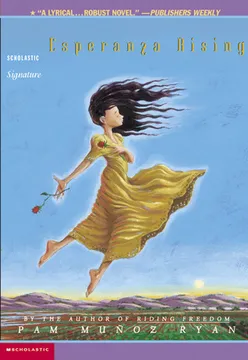


Plot Summary
The Harvest Turns to Grief
When Esperanza is six, her father, Sixto Ortega, teaches her to lie still on the ground until she can feel the valley’s pulse. Six years later, she is El Rancho de las Rosas’s cherished only child, helping begin the grape harvest before her thirteenth birthday. Her father is late returning from the range.
A ranch worker brings home his silver belt buckle, and that night Alfonso and Miguel arrive with Sixto’s body. Bandits have ambushed and killed him while he repaired a fence. Esperanza wakes on her birthday to the song she had expected to hear from her father, then realizes it was only a dream. The missing man who should have led her through another harvest has left her and her mother alone.
The opening joins Esperanza’s earliest security to the land itself: her father teaches her that belonging requires attention and patience. His murder then turns that lesson into a test. The ranch has seemed permanent because its harvests recur and its workers know its rhythms, but violence reveals how quickly private safety can be taken away. Esperanza’s birthday sharpens the loss by placing a child’s expected celebration beside an adult political reality. The dream-song shows grief already altering memory: the mind briefly restores what the world has removed, then makes the return to absence more painful.
Luis Claims the House
During the mourning, Esperanza and her mother, Ramona, accept condolences and finally open the birthday presents Sixto will never see her use. Then her uncles Luis and Marco begin occupying the ranch house and handling the estate.
The lawyer explains that Ramona inherits the house and grape income, but Luis receives the land because he held the loan. He offers to buy the house cheaply, then proposes marriage when Ramona refuses. His aim is not companionship: her standing in the community could help his political ambitions.
Ramona rejects him, and Luis warns that he controls the property beneath their home. Esperanza sees him wearing Sixto’s belt buckle and sitting at his desk. The inheritance has made the family’s grief a source of leverage for the man who wants power.
Luis’s takeover works through respectable forms: legal inheritance, banking authority, and a marriage proposal. That makes his coercion more unsettling than an open assault, because each step can be presented as ordinary business while reducing Ramona’s choices. Esperanza notices the invasion first through concrete objects, her father’s chair and buckle, before she can fully understand the law behind it. The contrast exposes how property and gender shape power in this community. Ramona’s refusal is an act of self-definition, but it cannot by itself restore safety; the family’s home is now vulnerable to someone who can make threats sound administrative.
Ashes Become an Exit
A fire destroys the family home and the vines that supported its income. Esperanza and Ramona escape with Abuelita, who is injured, while Miguel carries the grandmother out of the burning house. Luis returns to offer rebuilding if Ramona will marry him, adding that the workers will lose their jobs if she refuses.
To protect them, Ramona appears to accept his proposal. In private, she decides to flee to California with Hortensia and Alfonso, who already intend to join Alfonso’s brother there.
Abuelita goes to a convent to recover and arranges travel papers through her sisters. The family keeps its plan secret from Luis, who believes he has secured Ramona’s agreement. Esperanza leaves behind her home, friends, and school, carrying only a few belongings and her father’s doll.
The fire completes the destruction Luis began with legal pressure, though the family can only infer who arranged it. Ramona’s false acceptance turns compliance into camouflage: she uses the appearance of surrender to create room for action. The choice is not an uncomplicated escape, since it requires separation from Abuelita and from the life Esperanza understands. For the girl, leaving means relinquishing not only possessions but the social identity that made her feel entitled to comfort. The move toward California begins before she is ready to accept it. Survival here depends on coordinated trust among people whose old household roles are already changing.
Under the Guavas
Alfonso and Miguel hide Ramona, Esperanza, and Hortensia in a compartment beneath a wagon’s load of guavas, then take them by back roads toward Zacatecas. From there, the family boards a crowded, uncomfortable train instead of the fine cars Esperanza remembers.
She refuses to let a poor child touch her porcelain doll, and Ramona makes a yarn doll for the girl instead. Later, a traveling egg seller named Carmen shares what little she has and accepts lace doilies in return. Her generosity unsettles Esperanza’s assumptions about wealth and need.
At the border, Ramona presents their papers with practiced confidence, and officials admit them to the United States. Alfonso and Miguel nearly miss the train while fetching water for a secret package, leaving Esperanza frightened until they climb aboard.
The journey reverses Esperanza’s former position without making her instantly generous. Her protectiveness toward the doll shows how grief and class privilege can reinforce one another: the object carries her father’s love, yet she treats the child’s poverty as a reason to withhold it. Ramona’s handmade toy and Carmen’s exchange offer alternative models of value, based on care and reciprocity rather than status. The border scene adds another pressure: the family’s passage depends on papers and a mother able to perform certainty before an official. Their survival is not a solitary triumph but a chain of labor, secrecy, and mutual reliance.
Learning the Camp's Rules
In California, Alfonso’s brother Juan brings the travelers to a company farm camp in Arvin, where the family shares a cramped cabin with his relatives. Esperanza resents the crowded room, communal toilets, and the work assigned to her: caring for babies and sweeping the camp platform. She cannot manage laundry or a broom, and Marta, a sharp-tongued young worker, mocks her as a pampered outsider.
Miguel quietly teaches her to sweep rather than leave her humiliated. He and Alfonso also plant cuttings rescued from Sixto’s burned rose garden beside the cabin. Esperanza begins learning chores from Isabel, Juan’s young daughter, and starts to see that the people who once worked for her family are now the people keeping her family afloat.
The camp makes class visible through the body. Esperanza’s ignorance is not a personal defect so much as the consequence of a life organized to keep labor out of her sight. Once she must do that labor herself, embarrassment becomes a route to knowledge, especially when Miguel teaches without cruelty. The roses offer a counterweight to her lost estate: continuity can travel as roots and cuttings, but only because Alfonso and Miguel carried it. Her dependence on former servants unsettles the old hierarchy more effectively than a lecture could. The cabin’s cramped conditions force intimacy before Esperanza has learned how to welcome it.
Dust Settles in Mama's Lungs
As Esperanza adjusts to camp life, Marta argues that farmworkers should strike for better wages and housing. At a Saturday dance, Marta uses kittens to dramatize how powerless workers are, but many families fear losing their jobs and cabins.
When the planned strike approaches, a massive dust storm sweeps across the valley instead. The workers shelter wherever they can; the cotton fields are buried, while the higher grape crop survives. The camp returns to harvesting grapes, but Ramona develops a persistent cough after breathing the dust.
She grows pale and weak, then collapses with a fever. A visiting doctor diagnoses Valley Fever, an infection caused by dust spores, and warns that recovery could take months. Esperanza’s new home has given the family work, but its air has placed her mother in danger.
The dust storm does more than interrupt a labor action: it exposes how environmental risk and economic insecurity converge on workers with little control over either. The growers’ schedule continues because grapes survive, while the people who harvest them carry the storm into their lungs. Ramona’s illness also reverses the family’s recent emotional arrangement. She has been the one making hard choices and reassuring Esperanza; now her daughter must learn to act without that protection. The strike debate refuses a simple moral division between courage and fear. Workers can recognize exploitation and still fear losing the cabin, wages, and food that make resistance possible.
The Daughter Takes Charge
Ramona’s Valley Fever worsens, and pneumonia forces her into a county hospital. Esperanza visits when allowed, cares for Juan and Josefina’s babies, cooks, washes, and takes seasonal work to keep the household going.
She saves small sums in money orders, hoping to bring Abuelita from Mexico once her ankle heals. While cutting potato eyes in the cold, Esperanza hears that striking workers may be threatened with eviction or deportation. Her work is no longer merely a punishment for privilege; it is the means by which she might reunite her family.
She crochets Abuelita’s unfinished zigzag blanket beside Ramona’s bed, adding her own hair to its stitches. When the doctor bars visitors because Ramona has pneumonia, Esperanza leaves with no certainty that her mother will recover.
Care becomes Esperanza’s first sustained form of agency. She cannot command Ramona’s recovery or change the wages that govern the camp, but she can learn tasks, earn money, and remain beside her mother. The blanket turns this practical labor into a way of holding family bonds across distance: Abuelita’s promise is unfinished, and Esperanza takes responsibility for carrying it forward. Her maturity is not presented as a sudden loss of childhood. She still wants reassurance and fears another separation, but she acts while afraid. The hospital’s restrictions intensify that tension by making love present as work performed outside the room, rather than as constant physical closeness.
Marta Hides Among Crates
As the asparagus season begins, Esperanza meets Marta and Marta’s mother, Ada, at a makeshift strike camp. Marta explains that workers are organizing across the county, though Esperanza cannot risk joining while Ramona is ill and their savings are needed.
At the packing shed, strikers shout at the workers who cross their line, and unsafe objects appear in produce crates. Then immigration officials and police arrive, seize strikers, and tear up one woman’s citizenship papers. Esperanza finds Marta hiding behind stacked crates.
Remembering that Marta is a citizen and does not deserve separation from her mother, Esperanza gives her an apron and asparagus to help her pass as a worker. The next day, she visits the abandoned strike camp and sees the discarded remains of the piñata she had given hungry children.
Esperanza’s decision to help Marta does not erase their antagonism or require her to endorse every tactic of the strike. It marks a more difficult ethical distinction: she can disagree with someone and still refuse to help an unjust system separate her from family. The deportation sweep makes citizenship frighteningly fragile, even for people born in the United States. Esperanza recognizes the vulnerability because her own family’s migration depended on documents and concealment. The abandoned camp and broken piñata leave the action unresolved in public terms. Workers have been removed, not heard, yet Esperanza has chosen a form of solidarity that reaches one person in immediate danger.
Miguel Leaves the Valley
Miguel finally gets work in a railroad machine shop, where his skill with engines brings him closer to the future he had imagined. When workers from Oklahoma arrive willing to accept less pay, the railroad replaces him with men who have little mechanical experience and offers him ditch-digging instead.
Esperanza, furious at the discrimination, accuses him of accepting a second-class position. Miguel argues that the newcomers also need to feed their families and that he still believes he can advance.
Their argument cuts into their old closeness: Esperanza calls him a peasant, and Miguel tells her she still thinks of herself as a queen. He leaves the next morning to seek railroad work in northern California. Esperanza feels responsible for driving him away, but cannot bring herself to admit what she said.
This conflict exposes two different survival strategies. Esperanza has learned to identify injustice and now wants Miguel to confront it directly; Miguel understands that refusing bad work may mean losing the only income available. Neither position is simply cowardice or wisdom. Their argument is sharpened by their history of unequal status, which makes each hear an old insult inside the new one. Esperanza’s anger at discrimination is genuine, but it also conceals grief and fear she cannot control. Miguel’s departure turns their disagreement into a new separation, leaving Esperanza to confront the consequences of speaking from pain rather than listening to the constraints he faces.
A Doll Changes Hands
Isabel earns the best marks in her class but is passed over for Queen of the May, a choice that follows the camp’s experience of racial preference. Esperanza comforts her by giving her the porcelain doll her father once gave her, choosing to let the cherished object belong to someone who will play with it.
Soon afterward, the doctor says Ramona can leave the hospital, though she must continue resting. Esperanza welcomes her mother home and admits that Miguel has gone. She also shows Ramona the money orders she has saved for Abuelita.
The valise is empty. The family suspects Miguel took them before leaving, and Esperanza is hurt by the apparent theft, even as Ramona allows that he may have needed the money to travel. Her mother is home, but the grandmother is still far away.
The doll’s transfer measures a change in Esperanza’s relationship to loss. She does not forget that it came from her father; she stops treating memory as something that must remain untouched in storage. Giving it to Isabel also answers, in a small domestic gesture, the school’s refusal to recognize the child’s achievement. The homecoming should bring uncomplicated relief, but the empty valise restores uncertainty just as Ramona returns. Esperanza has become capable of earning and saving, yet she cannot control how others use what she has gathered. Her response to Miguel’s absence is complicated by love, anger, and the knowledge that need can push people toward choices that wound one another.
Abuelita Arrives at Last
During the summer harvest, Alfonso brings Esperanza and Hortensia to the Bakersfield bus station, where Miguel has arrived from Los Angeles. He has not returned the missing money orders, but he has brought Abuelita, who has traveled from Mexico under his care.
Esperanza embraces her grandmother, then leads her to Ramona, resting beneath the trees. Ramona recognizes her mother, and Abuelita’s arrival brings her back into the family’s daily life. Esperanza shows them the immense zigzag blanket she has continued crocheting through the months of illness and separation.
Abuelita explains that Luis kept watch on the convent, while Miguel used secret notes and help from Señor Rodríguez to arrange her journey. The missing money has not been restored, but Miguel’s return reveals that he had used his time away to bring the person they most needed.
The reunion resolves more than geographic distance. Ramona’s illness has left her emotionally withdrawn, and Abuelita’s presence restores a relationship that neither medicine nor Esperanza’s labor could substitute for. Miguel’s arrival also complicates the meaning of his earlier departure and the missing money: the act that looked like abandonment was part of an effort to reunite the family. The blanket gives this revelation a material form. Its length records months of work, fear, and hope, while its uneven colors show that continuity does not require life to return to its former shape. Care here moves in several directions at once, across generations and across old class divisions.
The Earth Beats Again
Near her birthday, Esperanza asks Miguel to accompany her to the foothills before dawn. She lies on the ground as Sixto once taught her and waits until she can feel the earth’s pulse. This time, Miguel lies beside her and shares the sensation.
Esperanza understands that losing the ranch did not erase her father, and that her future can include work, English lessons, and a home of her own. On her birthday, the family gathers beneath the trees for breakfast, with roses from the rescued cuttings and familiar foods made from what they can afford.
Abuelita teaches Isabel to crochet the zigzag pattern. When Isabel’s first rows come out crooked, Esperanza gently unravels them and encourages her to begin again. The old lesson now comes from the girl who once needed to hear it.
The ending returns to the opening image but changes its emotional conditions. Esperanza does not recover the ranch or the child’s protected future; she discovers that connection can survive relocation and grief without depending on restored wealth. The heartbeat is shared with Miguel, making the inherited lesson a bond between peers as well as between father and daughter. Her new hopes are modest and self-authored: learning English, supporting family, and securing a small home. Teaching Isabel to start again completes the transfer of Abuelita’s craft. Esperanza is no longer only the recipient of care; she can now pass on a practice that makes setbacks workable.
Analysis
Esperanza Rising makes loss concrete through the things that once seemed permanent: the ranch, the harvest, a father’s presence, and the assumption that wealth will protect a family. Esperanza’s displacement is not only a change of location. It dismantles the social arrangements that kept labor invisible to her, then requires her to learn the work on which her survival depends. That education does not excuse prejudice or make poverty virtuous. The camp’s crowded housing, dangerous dust, unequal schooling, and threatened deportations are presented as material pressures that shape what people can risk.
The book resists turning its characters into simple moral examples. Marta’s organizing answers genuine exploitation, while Josefina and Alfonso fear losing the limited security their jobs provide. Miguel hopes to rise through skill and persistence; Esperanza increasingly wants him to confront the barriers directly. Their disagreements arise from different strategies for surviving a system that offers workers little control. Esperanza’s growth comes partly from learning to see those strategies without confusing caution with indifference or protest with an easy solution.
Family care is the novel’s counterforce to dispossession, but it is practical rather than abstract. People hide travelers, share food, teach chores, save wages, carry roses, and finish a blanket. These acts do not undo structural injustice; they make survival and reunion possible within it. The recurring images of harvest and crochet likewise refuse a straight-line model of progress. Life rises and falls, crops return, and people must begin again with whatever remains. By the ending, Esperanza has not regained her former rank. She has gained a wider account of wealth, one measured in work, memory, chosen responsibility, and relationships that can cross the divisions she once took for granted.
Review Summary
Esperanza Rising receives mostly positive reviews, praised for its portrayal of Mexican immigrant experiences during the Great Depression. Readers appreciate the character development, historical context, and themes of resilience and hope. Some criticize the simplistic good-versus-evil portrayal and lack of deeper character development. The book is noted for its educational value, emotional impact, and ability to spark discussions on immigration, racism, and social issues. Many readers, including teachers and students, find it engaging and inspiring.
People Also Read










Characters
Esperanza Ortega
Displaced ranch heiressEsperanza begins as the protected only child of a prosperous ranching family, accustomed to being served and certain that her home will always be hers. Her love for her father and the land gives her a deep emotional anchor, while her early assumptions about class limit what she can see in the people around her. Grief and migration confront her with work she has never done and social barriers she has never had to name. She is proud, quick to feel shame, and capable of fierce tenderness. Her growth is not a simple rejection of her past: she must learn how to carry its memories without treating privilege as her identity.
Ramona Ortega
Mother turned providerRamona is Esperanza’s elegant, thoughtful mother, whose poise conceals a strong capacity for practical decision-making. She is devoted to her daughter and refuses to treat an advantageous marriage as a substitute for freedom. When their circumstances collapse, she adapts without pretending that hardship is easy, and she asks Esperanza to make choices rather than simply obey. Her affection is expressed through handmade gifts, patient instruction, and the effort to preserve family dignity. Ramona’s gentleness is not passivity; she can read danger, plan discreetly, and act decisively when the family’s safety depends on it.
Miguel
Mechanic across the divideMiguel is the son of Hortensia and Alfonso, a gifted mechanic raised alongside Esperanza but separated from her by class. He is practical, patient, and ambitious, especially about finding work that recognizes his skill with machines. His closeness with Esperanza is shaped by both childhood affection and the knowledge that their society assigns them different places. He tends to keep hope alive through persistence rather than protest, even when that choice frustrates people who want him to challenge injustice more openly. His loyalty to family and his belief in possibility coexist with a clear-eyed understanding of how little opportunity is offered to Mexican workers.
Abuelita
Keeper of zigzag wisdomEsperanza’s grandmother is observant, unconventional, and affectionate, with a habit of turning ordinary objects into lessons. She teaches Esperanza to crochet a zigzag pattern of mountains and valleys, connecting skill with the willingness to begin again. Her stories of migration give her advice particular weight: she knows that a new home may be harder than promised and still hold possibility. Abuelita is both a source of warmth and a practical presence, offering money, connections, and judgment when the family needs them. Her love does not shield Esperanza from difficulty; it equips her with images and practices for enduring it.
Sixto Ortega
Father of the valleySixto is Esperanza’s loving father and the owner of El Rancho de las Rosas. He respects the land, works closely with Alfonso, and treats the ranch’s harvest as a shared accomplishment. He gives Esperanza an intimate way to understand the valley, teaching her to listen to the earth rather than regard it as property alone. His care reaches beyond his daughter to Miguel and the workers who depend on the ranch. Though present mainly through Esperanza’s memories, his influence shapes her understanding of family, place, and what it means to keep faith through change.
Hortensia
Steadfast household anchorHortensia is Alfonso’s wife and Miguel’s mother, a longtime caretaker of Esperanza and Ramona. Her kindness is practical: she cooks, teaches, comforts, and notices when someone is frightened before they can say so. She treats family bonds as more important than the status divisions that separate the ranch household. In California, she helps the women adapt to labor and crowded living without demanding that they hide their grief. Her calm does not mean she is untouched by danger; it is a form of steadiness that lets others keep moving.
Alfonso
Landwise family protectorAlfonso is Hortensia’s husband, Miguel’s father, and the trusted foreman of Sixto’s workers. His friendship with Sixto rests on shared labor and respect for the land, not merely employment. He is resourceful in a crisis, attentive to the family’s safety, and willing to plan a difficult journey when remaining in Mexico becomes dangerous. In California, his experience helps the family secure work and shelter. Alfonso’s loyalty is active rather than sentimental: he builds, transports, negotiates, and protects.
Tío Luis
Ambitious political uncleLuis is Sixto’s older stepbrother, a banker who understands how financial authority can become social power. He presents self-interest as reasonable management and treats Ramona’s reputation as a tool for his political ambitions. His polished manner makes his threats more effective, because he can turn coercion into something that resembles a business arrangement. Luis is driven less by affection for the family than by control of land, influence, and public standing.
Tío Marco
Compliant local officialMarco, Luis’s younger brother and the town mayor, tends to follow Luis’s lead. His office gives the brothers local influence, but he is less forceful and less calculating than his older sibling. He helps make their power feel institutional, not merely personal.
Marta
Young labor agitatorMarta is a sharp, outspoken young worker whose family moves from farm to farm in search of employment. She sees low wages, poor housing, and divided camps as conditions workers can challenge together. Her urgency makes her confrontational, especially toward people she assumes have never known hardship. She is not simply a foil for Esperanza: she has her own family responsibilities and faces risks that make her political commitment costly. Her presence forces Esperanza to consider the difference between disagreeing with a tactic and accepting the injustice it opposes.
Isabel
Hopeful camp companionIsabel is Juan and Josefina’s young daughter, curious about Esperanza’s former life and eager to learn. She is observant, capable, and more accustomed than Esperanza to the practical work of camp life. Her delight in small possibilities, especially school and the prospect of recognition, gives Esperanza a companion as well as a quiet measure of her own changing values. Isabel’s questions help make the class difference between the girls visible without turning their friendship into a simple lesson.
Señor Rodríguez
Trusted neighboring rancherMarisol’s father and a neighboring rancher, Señor Rodríguez has known Sixto for years and understands the danger Luis poses. He offers discreet help when the family cannot safely rely on public institutions. His involvement in their plans reflects an old friendship expressed through practical risks, not grand gestures.
Josefina
Practical camp matriarchJosefina is Juan’s wife and the mother of Isabel, Lupe, and Pepe. She helps Ramona and Esperanza navigate work, childcare, and the camp’s shared routines. Her caution about striking comes from responsibility for a family, not indifference to unfairness. Josefina offers Esperanza dependable instruction and a model of how survival often depends on cooperation.
Juan
Railroad camp hostJuan is Alfonso’s brother, a farmworker who has established a home for his family in California. He helps bring the newcomers to Arvin and makes space for them in the camp. His household gives the displaced family a first foothold in a place where shelter and a job are closely linked.
Carmen
Generous traveling vendorCarmen is a widowed mother who travels by train selling eggs to support her children. She meets Ramona and Esperanza during their journey and shares what she can despite her limited means. Her generosity makes Esperanza reconsider the assumption that wealth determines who has something to give.
Ada
Marta's protective motherAda is Marta’s mother and fellow farmworker. She accompanies her daughter through the uncertainty of organizing and displacement, and she responds to Esperanza with warmth despite their families’ opposing circumstances. Her bond with Marta makes the personal stakes of deportation unmistakable.
Marisol
Friend left behindMarisol is Esperanza’s closest friend in Mexico and the daughter of a neighboring rancher. Their friendship belongs to the life Esperanza loses when she leaves for California. Although Marisol is not present during most of the journey, Esperanza’s memories of her help convey the cost of departure.
The camp doctor
Valley Fever physicianThe visiting doctor treats farmworkers who have limited access to medical care. He explains Ramona’s illness and the danger posed by the valley’s dust, while offering realistic rather than easy reassurance. His visits give the family information but cannot remove the uncertainty of recovery.
Plot Devices
The Earth's Heartbeat
A measure of belongingSixto teaches Esperanza to lie quietly on the ground until she can feel the valley’s pulse. The experience first belongs to her childhood security, when the land, her father, and her own body seem joined. Later, the image returns when she is disoriented by migration and grief, then again when she can share the practice with Miguel. It does not restore the ranch or erase loss. Instead, it lets Esperanza carry a relationship to place that is not dependent on ownership. The motif turns listening into a form of attention and makes the ending answer the opening through a changed understanding of home.
The Zigzag Blanket
A pattern for enduranceAbuelita teaches Esperanza to crochet rows that rise and fall like mountains and valleys. She also weaves strands of hair into the work, making the blanket a tangible expression of family care. Esperanza carries the unfinished piece from Mexico and continues it while Ramona is ill. Its repeated pattern gives her a task when she cannot control what is happening around her, while its gradual growth measures time and effort. The blanket connects generations without promising a life free of hardship. Its meaning comes from the hands that keep working on it and from the shared knowledge passed along with the stitches.
The Harvest Calendar
Time measured by cropsThe novel tracks Esperanza’s changing life through the fruits and vegetables that ripen across the year. Grapes, potatoes, asparagus, and peaches determine when work is available, what tasks the family performs, and how much time passes while Ramona recovers. This structure keeps the story grounded in agricultural labor rather than treating the fields as scenery. The harvest cycle also contrasts with Esperanza’s earlier belief that her life would follow a predictable path. Crops return, but the family does not return to its old circumstances. Seasonal repetition becomes a way to register change without relying only on calendar dates.
The Rose Cuttings
Memory carried through rootsAfter the ranch burns, Alfonso and Miguel salvage living roots from Sixto’s rose garden and transport cuttings to California. They plant them beside the camp cabin, preserving a link to Esperanza’s father and the home she has lost. The roses do not recreate the estate; their new setting makes clear that memory must adapt to survive. Esperanza’s attention to the cuttings reflects her gradual shift from longing for restoration toward recognizing what can be carried forward. The plants also provide a concrete proof of Alfonso and Miguel’s care, connecting their labor in Mexico to the work of building a life in California.
The Guava Wagon
A disguise for escapeAlfonso and Miguel construct a hidden compartment in a fruit wagon and cover it with guavas, allowing Ramona, Esperanza, and Hortensia to travel without attracting the attention of Luis’s watchers or roadside bandits. The fruit serves both as concealment and as a sensory reminder of the abundance the family has left behind. The cramped space makes the escape physically frightening, while Hortensia’s remembered story helps Esperanza steady herself. The wagon turns the family’s plan into a shared feat of practical ingenuity: Alfonso and Miguel guide it, the women endure its confinement, and Señor Rodríguez helps them continue toward the train.
About the Author
Other books by Pam Muñoz Ryan



Download PDF
Download EPUB
.epub digital book format is ideal for reading ebooks on phones, tablets, and e-readers.








