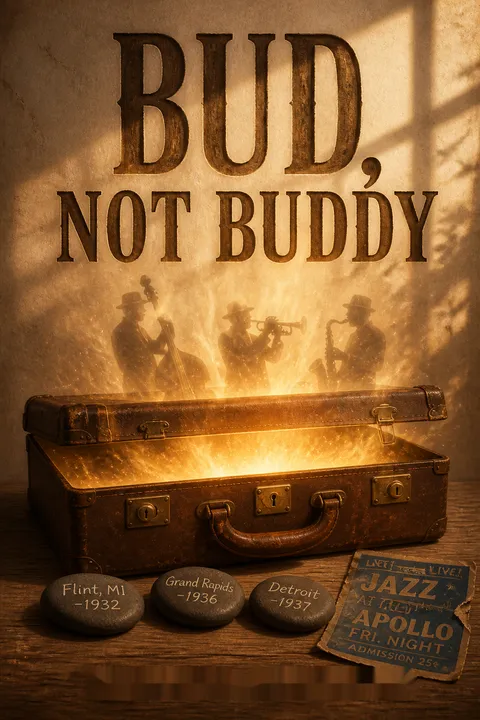


Plot Summary
Five Flyers, One Father
Ten-year-old Bud Caldwell1 has already learned that foster homes can end without warning. At the Home in Depression-era Flint, a caseworker sends him and six-year-old Jerry to separate placements. Bud1 steadies Jerry, then packs his few possessions, including five old band flyers and a photograph of his mother, Angela.2 The newest flyer advertises Herman E.
Calloway,3 a bandleader3 whose name and image Bud1 has privately linked to the father he never knew. Angela2 died when Bud1 was six, leaving him no explanation, only these keepsakes and a set of strange marked stones. As another placement begins, the suitcase becomes Bud's1 portable record of his mother2 and the first clue pointing him toward a family he hopes still exists.
The opening makes displacement routine, which is precisely what gives the separation its force. Bud can console Jerry because he has learned the language adults expect from children in care, but his careful humor does not erase the cost of being moved again. The suitcase is more than a container: it is a small, self-managed archive in a world where adults control his addresses and decisions. The flyers offer a story where official records have failed him. Bud's certainty about Calloway is not evidence yet; it is an imaginative structure built from grief, resemblance, and the few objects his mother preserved.
The Shed and the Hornets
At the Amos9 home, twelve-year-old Todd8 wakes Bud1 by jabbing a pencil into his nose. Bud1 strikes back, and Todd8 quickly stages the encounter so his mother9 sees him as the victim. Mrs. Amos9 believes her son,8 calls Bud1 dangerous, and prepares to return him to the Home.
She also confiscates his suitcase, breaking the promise that she would leave it alone, then orders him to apologize and sleep in the family shed. Todd8 frightens him with tales of monsters, and Bud1 finds dried fish heads nailed around the doorknob. Alone in the dark, he mistakes a hornets' nest for a sleeping bat and attacks it, bringing a swarm down on himself before he can escape.
The Amoses turn care into a conditional bargain: Bud is expected to be grateful, while Todd's version of events receives automatic authority. That imbalance explains why Bud fights, but it also shows how little power he has to make adults believe him. His rules and lies are practical defenses, not evidence that he feels secure. In the shed, his imagination magnifies danger because he has been placed in a genuinely unsafe situation. The hornets are not a supernatural threat, yet the real harm comes from adults who lock him away and leave him to face it alone.
Escape Through the Window
Bud1 bursts through the shed window, still stung and bleeding from the fish-head bite. Anger sends him back into the Amos9 house, where he finds his suitcase and takes the shotgun from the kitchen. He imagines using it against Todd,8 then recognizes how easily the weapon could turn his plan into a catastrophe.
Instead, he hides it outside and uses warm water to make Todd8 wet his bed, a small retaliation that lets Bud1 leave without firing a shot. He slips away before dawn and heads for the library, hoping Miss Hill will help. Bars block the windows, and the librarian tells him Miss Hill has married and moved to Chicago. With no safe adult to turn to, Bud1 sleeps beneath a tree.
This escape marks a change from enduring other people's decisions to making choices, even when his options are narrow. Bud's revenge fantasy matters less than his decision to put the shotgun beyond reach. He is capable of seeing the danger in his own anger, a form of judgment that the adults around him have not shown. His failed search for Miss Hill makes the library's security bars an especially sharp contrast: a place of knowledge cannot automatically become a refuge. Bud survives through improvisation, but the episode makes clear that self-reliance is being demanded of a child who should not have to manage this much risk.
The Library Cannot Help
Bud1 reaches a mission after sleeping outside, but its breakfast line has closed. A large man and his family pretend Bud1 belongs with them, protecting him from the attendant's strap and sharing their meal, including brown sugar for his oatmeal. Later, Bud1 enters the library hoping to find Miss Hill. Instead, a librarian explains that she has moved to Chicago, too far for him to walk.
Bud1 has lost both a potential helper and his simplest path out of trouble. He retreats beneath the library's Christmas trees, where his suitcase and his mother's photograph2 remain within reach. The kindness of the family at breakfast keeps him fed, but it cannot replace the adult he had hoped would know what to do.
The mission scene gives Bud a brief experience of protection without requiring him to earn it. The family uses an ordinary fiction, pretending he is their child, to shield him from institutional punishment, then quietly shares scarce food. The library offers a different kind of care, but information cannot solve the practical problem of a homeless boy in danger. These scenes distinguish compassion from systems: individual strangers can intervene, yet Bud remains responsible for finding his next meal and a place to sleep. The contrast deepens his isolation without making him cynical; he continues to trust that a person may help, even when institutions fail.
Deza at Thread Creek
Bud's1 friend Bugs6 finds him under the tree and proposes riding a freight train west to find work picking fruit. They travel to a Hooverville near Flint, where residents feed them in exchange for washing dishes. Bud1 meets Deza Malone,7 a girl waiting with her mother for her father to return from looking for work. As they clean up, Deza7 challenges Bud's1 insistence that losing his family does not hurt.
He tells her how much his mother2 loved him, then shares a first kiss with her by Thread Creek. Before bed, he checks the stones and flyers in his suitcase. Deza's7 loyalty to her parents and the keepsakes in Bud's1 bag turn his attention back toward the possibility that his own relatives may be closer than California.
Deza offers Bud a rare kind of intimacy: she notices the grief concealed by his practiced claims that everything is fine. Her own family is separated by poverty, but she still acts as though waiting and caring for one another matter. The difference unsettles Bud because his survival rules treat attachment as something to hide. Their brief kiss is less a romantic promise than a moment in which he is seen without having to perform toughness. The Hooverville's shared food and work also complicate the idea of home. People without secure shelter create temporary obligations to one another, and Bud begins to recognize belonging as something made through care.
Hooperville Misses the Train
Before dawn, men in the Hooverville warn that the freight is leaving early. Bud1 runs toward it with Bugs,6 but turns back when he realizes the blue Calloway flyer has fallen from his suitcase. He gets it back and reaches the tracks too late to join Bugs,6 who climbs aboard and throws Bud's suitcase back when Bud1 cannot keep pace.
The police then dismantle the Hooverville, burning its shacks and destroying its cooking pots. Bud1 cannot find Deza7 in the confusion. Back in the woods, the flyer returns to his hand after nearly blowing away, and he compares Calloway's3 name with his own. Instead of heading west, he decides to seek the bandleader3 in Grand Rapids and begins walking.
The failed train departure closes one route while sharpening another. Bud loses Bugs, the first boy he has called a brother, and the destruction of the Hooverville erases the fragile community that had sheltered them. Yet the returned flyer gives him a reason to interpret chance as direction. That belief is not simply childish credulity. Bud has too little reliable information, so he turns patterns in his mother's objects into a usable map. His decision to walk toward Grand Rapids replaces the escape plan with a search for kin, though he is still acting on a guess rather than a confirmed family history.
Lefty's Midnight Detour
The long walk exhausts Bud,1 and a passing driver, Lefty Lewis,5 stops outside Owosso with food and a bottle of pop. Bud1 fears the box of human blood in the car means Lefty5 is a vampire, then discovers it is hospital blood being delivered to Flint. To avoid being returned to the Home, Bud1 claims he ran away from Grand Rapids and names Herman E.
Calloway3 as his father. Lefty5 recognizes the name and takes him in, though Bud's1 story is still untested. At the Sleets' home, Bud1 sleeps safely and receives clean clothes and breakfast. Lefty5 arranges a telegram for Calloway3 and explains that he is taking Bud1 to Grand Rapids, giving the boy a ride toward the destination he had been walking to reach.
Lefty's intervention begins in a comic misunderstanding, but its deeper function is to interrupt Bud's isolation without demanding immediate confession. Bud lies because he expects adults to return him to unsafe places; his invented Grand Rapids home is both a shield and a way to continue toward Calloway. Lefty answers fear with practical help, food, shelter, and transportation, rather than punishment. The Sleets' breakfast gives Bud a glimpse of household warmth that is not organized around silence or suspicion. Still, safety does not instantly make him truthful. His journey is carried forward by a fragile arrangement between what he needs to conceal and where he hopes to belong.
Calloway's Closed Door
In Grand Rapids, Bud1 enters the Log Cabin and finds Calloway3 rehearsing with his band. The bandleader3 denies being Bud's1 father and treats him as a disruptive stranger. James Jimmy Wesley11 and singer Grace Thomas4 listen more carefully, notice Bud's1 swollen face and infected hand, and take him to the Sweet Pea for a meal.
There, surrounded by the musicians' teasing and Miss Thomas's4 warmth, Bud1 finally breaks down in tears. She comforts him, and the adults agree he may stay at Grand Calloway Station while they check what happened in Flint. Bud1 takes on chores, receives a recorder from Steady Eddie,12 and is welcomed into the band's playful circle with a new stage name. For the first time, shelter comes with people who expect him to remain.
Calloway's rejection initially repeats a familiar injury: Bud arrives seeking family and is treated as a problem to be managed. The musicians respond differently because they attend to his body and behavior, not merely his claim. Miss Thomas recognizes that his stoicism has limits, and the meal creates enough safety for grief to surface. His tears are not a collapse of strength but evidence that his defenses can loosen when someone reliably stays beside him. The recorder and nickname turn welcome into practice: Bud is not only given a bed, he is invited to learn and contribute. This emerging community gives him a form of belonging before anyone knows the full truth.
The Stones Tell the Truth
As Bud1 travels with the band, he sees Calloway3 collect rocks and mark each one with a place and date. During a trip to Mecosta, Calloway3 asks Bud1 to pick up one such stone. Bud1 recognizes the writing because he has carried similar stones from his mother2 for years. Calloway3 finds Bud's stones among his belongings and accuses him of taking them from the house.
Bud1 insists Angela Caldwell2 gave them to him. When he supplies her full name, James Wesley11 understands that Angela2 was Calloway's daughter.2 The clues Bud1 had read as proof that Calloway3 was his father instead reveal a different connection: the stern bandleader3 is his grandfather. Calloway3 retreats in shock, and Bud's1 search reaches a truth neither boy nor old man was ready to face.
The stones transform an argument about property into a recognition scene. Calloway has treated his collection as private evidence of a past he cannot discuss, while Bud has carried matching objects without knowing their origin. Their shared markings make family history tangible before either character can articulate it. The discovery also revises Bud's self-authored story without making his hope foolish: he was wrong about the exact relationship, but right that the objects connected him to Calloway. Calloway's anger and retreat reveal how grief can masquerade as control. The same keepsakes that preserved Angela for Bud have also preserved her absence for her father.
Momma's Room Opens
Calloway3 shuts himself away after learning Angela's2 name. Miss Thomas4 explains that he pushed his daughter2 toward an education and a future he chose for her; Angela2 eventually left, and he never knew she had a son. The stones were Calloway's3 way of remembering her, just as Bud's flyers and stones kept his mother2 close. Miss Thomas4 gives Bud1 a framed portrait of Angela,2 and the band gives him a repaired alto saxophone.
Bud1 places Angela's2 childhood photograph among the horse pictures in her old bedroom, returns Calloway's flyers and most of the stones, and keeps only the Flint stone. He no longer needs to carry every object as proof. In the room that once frightened him, Bud1 begins practicing, ready to build a life with the musicians.
The ending does not erase the years of separation or turn Calloway's grief into an easy reconciliation. Instead, it gives both generations a clearer account of what they have been carrying. Calloway's ambition came from a desire to protect Angela in a racist world, but his certainty about what she needed helped drive her away. Bud's decision to return most keepsakes shows a different relationship to memory: he can release the objects without surrendering the love they represented. The saxophone offers a future that is neither inherited automatically nor imposed by an adult. Bud can learn it through effort, within a community that has made room for him.
Analysis
Bud, Not Buddy locates its coming-of-age story in the practical emergencies of the Great Depression: a missed meal, a locked shed, a dangerous road, a child without an adult who can reliably claim responsibility for him. Bud's1 humor and invented rules should not be mistaken for carefree resilience. They are cognitive tools developed under pressure, ways of converting uncertainty into decisions he can control. The novel's comic voice lets readers experience his ingenuity while keeping the material risks visible.
Family appears first as a question Bud1 tries to answer with incomplete evidence. He reads flyers, names, and stones as a map toward a father, then discovers that the truth is more complicated than his theory. This correction does not invalidate his instincts. His objects really do connect him to Calloway,3 but through a relationship shaped by the very separation Bud1 hoped to undo. The revelation asks how a family story can be recovered when adults have failed to tell it, and how inherited grief can distort a person's ability to welcome new kin.
The novel also distinguishes provision from care. The Amoses9 provide a bed but expose Bud1 to violence; strangers at the mission offer a meal without demanding that he prove he deserves it; the band gradually offers both shelter and a role. Belonging emerges through repeated actions: noticing an injury, sharing food, teaching an instrument, making room at a table. Calloway's3 ambition for Angela2 shows that love can become coercive when protection is confused with control. Bud's1 emerging life with the musicians offers a more reciprocal model. He is not simply rescued or returned to a family past. He is invited to practice, work, remember, and choose what to carry forward.
Review Summary
Bud, Not Buddy is a heartwarming, humorous, and poignant story set during the Great Depression. Readers praise Curtis's authentic portrayal of 10-year-old Bud's voice and his journey to find family. The book skillfully balances humor with serious themes like racism and poverty. Many found it engaging and emotional, appreciating the historical context and Bud's determination. While some felt the plot was predictable, most readers, both children and adults, thoroughly enjoyed the book, highlighting its memorable characters and valuable life lessons.
People Also Read







Characters
Bud Caldwell
Resourceful young survivorBud is a ten-year-old Black boy in Depression-era Flint, shaped by his mother's2 death and repeated moves through foster care. He copes by observing adults closely, inventing rules, and using humor or deception when honesty could put him at risk. His toughness is real, but it often hides hunger, fear, and a longing to be chosen rather than temporarily housed. The suitcase of his mother's belongings gives him continuity when the adults around him keep changing. Bud is curious about books, stories, and music, and his imagination can turn frightening circumstances into manageable problems. His search for Herman E. Calloway3 begins as a child's theory, but it also reflects his determination to make a family history from the fragments he has.
Angela Janet Caldwell
Absent, vivid motherAngela is Bud's mother1, known through his memories, the objects she left, and stories others tell about her. Bud1 remembers her as loving and energetic, a woman who made time to read to him and gave meaning to his name. Her keepsakes are not neatly explained, which leaves Bud1 to interpret them through a child's logic and longing. Other people remember Angela as talented and strong-willed, with ambitions of her own. Her life exposes the pressure placed on Black women to prepare for a hostile world while also resisting the expectations imposed by those who love them. Even in her absence, Angela shapes Bud's1 ideas about care, identity, and what family should mean.
Herman E. Calloway
Guarded bandleaderCalloway leads a working band and protects his authority through strict rules, sharp judgments, and a formidable public manner. His musicians know him as demanding and often difficult, but they also recognize the discipline and musical standards behind his control. He has built a career in a period when Black performers face segregation and restricted opportunities, relying on adaptability and persistence. Bud1 approaches him with a confident family theory, which Calloway resists rather than welcomes. His guardedness suggests a man who has learned to turn vulnerability into command. Music is both his livelihood and his deepest means of connection, though his personal history has left him less able to speak openly than to perform.
Grace Thomas
Singer and steady shelterGrace Thomas is the band's singer, a warm and perceptive presence who recognizes distress that others overlook. She pays attention to Bud's1 injuries, asks about his circumstances, and offers comfort without demanding that he immediately explain himself. Her affection is expressed through practical care, food, touch, and a willingness to challenge Calloway3 when his severity harms someone. Grace understands that people can be difficult because they are hurting, but she does not confuse understanding with excusing their behavior. Her music gives the band another center of gravity, one built on expressive range rather than authority. She helps make Grand Calloway Station feel like a place where a child can be welcomed and still expected to grow.
Lefty Lewis
Quick-witted rescuerLefty Lewis is a redcap and family man who encounters Bud1 walking alone in the night. He uses humor to put the frightened boy at ease, but he is also alert to the dangers Black travelers face on Michigan roads. His job and connections place him near railroad workers and the organizing struggles of the period. Lefty offers food, shelter, and transportation without pretending that the world is safe. His teasing manner is a form of social ease, not indifference; he can joke with Bud1 while taking his welfare seriously. He is one of the adults whose kindness is both immediate and concrete.
Bugs
Restless boyhood allyBugs is Bud's1 friend from the Home, a boy who knows the dangers of being without family and still dreams of making a life on the road. He offers Bud1 the companionship of a peer rather than the supervision of an adult, and their improvised bond gives Bud1 a brief sense of having a brother. Bugs is practical about train travel and the search for work, but his plans also carry the urgency of a child who sees few choices at home. Their friendship is marked by loyalty, shared jokes, and the limits imposed by circumstance.
Deza Malone
Honest young confidanteDeza is a girl Bud1 meets in the Hooverville outside Flint, where she waits with her mother for her father to return from seeking work. She is direct without being cruel, and she sees through Bud's1 insistence that losing his family does not hurt. Her tenderness is grounded in her own understanding of separation and loyalty. Deza gives Bud1 a first kiss, but her larger importance lies in making him speak honestly about his mother2. She represents a kind of companionship in which vulnerability is not treated as weakness.
Todd Amos
Protected foster bullyTodd is the twelve-year-old son8 of Bud's1 foster parents. Accustomed to his mother's9 unquestioning defense, he uses his size and position in the household to torment Bud1, then presents himself as the injured party. His behavior shows the power children can wield when adults reward cruelty or refuse to investigate it. Todd's asthma and dependence on his mother9 do not excuse his choices, but they help explain the theatrical way he seeks protection. He is the immediate source of Bud's1 crisis at the Amos9 home.
Mrs. Amos
Punitive foster motherMrs. Amos treats fostering as a test of Bud's1 gratitude and accepts Todd's8 account without examining what happened. Her respectability and elaborate moral language conceal a readiness to punish a child entrusted to her care. She interprets Bud's1 resistance as proof that he is unworthy of help, and her decisions leave him frightened and isolated. Mrs. Amos represents the difference between offering a home in name and providing genuine safety.
Mr. Amos
Quiet household enforcerMr. Amos carries Bud's suitcase, escorts him to the shed, and follows his wife's9 orders. He is less openly cruel than she is, but he does not intervene when the child is placed in danger. His silence makes him part of the household's failure to protect Bud1.
James Jimmy Wesley
Band elder and mediatorJimmy Wesley is the band's older horn player and a trusted friend of Calloway3. He mediates between the band's stern leader and Bud1, listening to the boy's account and helping the musicians respond with care. Jimmy has enough experience to recognize when a joke should stop and when a child needs food more than interrogation. His humor and patience give him a steadying role in the ensemble.
Steady Eddie Patrick
Patient musical mentorSteady Eddie is the band's saxophonist, known for his relaxed manner and skill as a performer. He is among the first musicians to take Bud's1 interest in music seriously, introducing him to instruments and the work required to play them. Eddie balances teasing with encouragement, making room for Bud1 to be inexperienced without making him feel foolish. His mentorship gives the boy a practical path into the band's world.
Douglas the Thug Tennant
Teasing band drummerDouglas Tennant, called the Thug, plays drums and needles Bud1 with exaggerated jokes. His teasing can be sharp, but it belongs to a band culture in which musicians spar with one another and watch out for the youngest member. He brings energy and comic bravado to the group.
Roy Dirty Deed Breed
Pragmatic band pianistRoy Breed is the band's pianist, a white musician whose playing earns him a place in Calloway's3 ensemble. He understands that his race can help the band secure work in venues that might reject Black musicians. His practical loyalty reflects how performers adapt to segregation without mistaking adaptation for fairness.
Chug Doo-Doo Bug Cross
Good-humored trombonistChug Cross plays trombone and joins the band's joking exchanges, helping create a lively welcome for Bud1. He is part of the ensemble's affectionate, irreverent culture, where teasing accompanies shared labor and music.
Plot Devices
Bud's Rules and Things
A child's survival manualBud1 has collected personal rules based on what he has observed about adults, danger, lying, and staying safe. He uses them to interpret confusing situations and decide when to speak, hide, or act. The rules are funny because they turn hard-won caution into a child's practical wisdom, but their existence also reveals how little dependable protection Bud1 has had. As he meets people who help without exploiting him, the rules remain useful while gradually becoming less necessary as his only guide.
The Suitcase and Flyers
Portable clues to familyBud1 keeps his mother's2 picture, several band flyers, a blanket, and other treasured objects in a suitcase he guards closely. The blue flyer featuring Herman E. Calloway3 gives his search a destination, while the objects provide a tangible link to the life he shared with Angela2. The suitcase repeatedly exposes Bud1 to risk when adults inspect or take it, but it also lets him preserve a history that no institution has recorded for him. Its importance shifts as Bud1 discovers that memory does not depend on carrying every object forever.
The Marked Stones
A hidden family recordBud's1 stones carry names of places and dates that he cannot decipher. They appear at first to be private keepsakes from his mother2, but later prove connected to Calloway's3 own collection. The repeated markings provide physical evidence where memory and verbal testimony are incomplete. Their meaning changes the family relationship at the center of Bud's1 search and gives Calloway3 a way to understand what happened to someone he lost. This device makes the past readable through objects rather than exposition alone.
Music and the Band
A community built by soundThe band offers Bud1 a world of rehearsals, performances, jokes, work, and shared travel. Music is not merely a theme or backdrop: Bud1 hears the musicians play, receives a recorder, and is encouraged to practice. The ensemble makes belonging something active, tied to learning and contribution rather than a claim of blood alone. Its members also navigate the restrictions placed on Black performers during the Depression, finding ways to secure work while insisting on their musical standards. The band gives Bud1 a possible future he can build for himself.
FAQ
Synopsis & Basic Details
What is Bud, Not Buddy about?
- A Young Boy's Quest: Ten-year-old Bud Caldwell, an orphan in Depression-era Flint, Michigan, embarks on a determined journey to find his biological father, armed only with a tattered suitcase of clues and his self-made "Rules and Things". His quest is driven by a deep longing for family and belonging after the death of his mother.
- Survival in Hard Times: The story chronicles Bud's escape from a cruel foster home and his encounters with various individuals and communities, including a Hooverville shantytown and a kind-hearted Pullman porter, all while navigating the harsh realities of poverty, racism, and transience during the Great Depression.
- The Power of Hope: Bud's journey is a testament to resilience, imagination, and the enduring human need for connection. He follows a series of flyers advertising a jazz band, believing its leader, Herman E. Calloway, to be his father, leading him to Grand Rapids and an unexpected discovery of family.
Why should I read Bud, Not Buddy?
- Heartwarming Resilience: Readers should experience Bud's remarkable resilience and unwavering optimism in the face of profound hardship, offering a powerful message about hope and perseverance. His unique narrative voice, filled with humor and wisdom beyond his years, makes his journey deeply engaging and inspiring.
- Historical Immersion: The novel provides a vivid, accessible, and often poignant glimpse into the realities of the Great Depression, particularly for African Americans, through the eyes of a child. It educates readers about Hoovervilles, labor movements, and the challenges of the era without being didactic.
- Universal Themes: Beyond its historical setting, the book explores universal themes of family, identity, loss, and the search for belonging. It celebrates the idea that family can be found in unexpected places and that love and community are essential for healing and growth, making it a timeless and emotionally resonant read.
What is the background of Bud, Not Buddy?
- Great Depression Setting: The story is set in 1936, during the height of the Great Depression, a period of immense economic hardship in the United States. This historical context explains the widespread poverty, the existence of Hoovervilles (shantytowns), and the struggles faced by many, especially African Americans, in finding work and stable homes.
- Author's Family Inspiration: Christopher Paul Curtis drew heavily from his own family history, basing the characters of Herman E. Calloway and Lefty Lewis loosely on his grandfathers. This personal connection imbues the narrative with authenticity and a deep understanding of the experiences of Black men and women during this challenging era, as detailed in the Afterword.
- Cultural Significance: The novel highlights the vibrant African American culture of the time, particularly through the jazz band, "Herman E. Calloway and the Dusky Devastators of the Depression." It showcases the resilience, creativity, and community spirit that thrived despite systemic racism and economic oppression, offering a nuanced portrayal of Black life in the 1930s.
What are the most memorable quotes in Bud, Not Buddy?
- "It's Bud, not Buddy, ma'am.": This iconic line, repeated throughout the novel, immediately establishes Bud's fierce assertion of his identity and autonomy. It underscores his need for respect and control in a world where he often feels powerless, setting the stage for his journey of self-discovery and the importance of his chosen name.
- "When one door closes, don't worry, because another door opens.": This advice from Bud's mother, initially misunderstood as literal, becomes a profound thematic motif representing resilience and hope. It guides Bud through every setback, transforming each closed door (foster homes, missed trains) into an opportunity for a new beginning and a step closer to his true family.
- "There comes a time when you're doing something and you realize it just doesn't make any sense to keep on doing it, you ain't being a quitter, it's just that the good Lord has seen fit to give you the sense to know, you understand, enough is enough.": Spoken by both Bud (after his fight with Todd) and Herman E. Calloway (about his boxing career), this parallel thought subtly foreshadows their familial connection. It highlights a shared philosophy of knowing when to pivot, emphasizing wisdom over stubbornness and marking a pivotal moment in their respective journeys.
What writing style, narrative choices, and literary techniques does Christopher Paul Curtis use?
- First-Person Child Narrator: The story is told from Bud's perspective, using a distinct, colloquial, and often humorous voice that captures the innocence and wisdom of a ten-year-old. This narrative choice allows readers to experience the harsh realities of the Depression through a lens of resilience and imagination, making complex themes accessible and emotionally resonant.
- "Rules and Things" as a Structural Device: Bud's self-created "Rules and Things for Having a Funner Life and Making a Better Liar Out of Yourself" serve as both a coping mechanism and a unique literary device. These numbered rules provide comic relief, foreshadow events, and offer insight into Bud's psychological state and his understanding of the adult world, structuring his observations and decisions.
- Vivid Sensory Details and Metaphorical Language: Curtis employs rich sensory descriptions, particularly of smells (the library, the Sweet Pea restaurant) and sounds (Miss Thomas's humming, the band's music), to immerse the reader in Bud's world. He also uses imaginative metaphors, such as the "mighty maple" idea for Bud's growing conviction about his father, to convey complex emotions and abstract concepts in a child-friendly manner.
Hidden Details & Subtle Connections
What are some minor details that add significant meaning?
- The Smell of the Library: Bud describes the library's unique scent as a blend of "leather on all the old books," "cloth that covered the brand-new books," and "soft, powdery, drowsy smell" of pages, which he calls a "hypnotizing smell." This detail symbolizes the library as a sanctuary and a source of escape, knowledge, and comfort, a place where time seems to slow down and worries fade, contrasting sharply with the chaotic world outside.
- Lefty Lewis's "Red Pop": The red pop offered by Lefty Lewis is more than just a drink; it becomes a symbol of unexpected kindness and a moment of pure, unadulterated joy for Bud. Its "reddest red in the world" appearance, shining through the taillights, highlights the vividness of this small pleasure amidst Bud's hunger and fear, marking a turning point in his trust of adults.
- Calloway's Band Names: The various names of Herman E. Calloway's band on the flyers—"Dusky Devastators of the Depression," "Nubian Knights of the New Deal," "Terminally Unhappy Blues Band," "Gifted Gents of Gospel"—subtly reflect the band's versatility, the historical context, and Calloway's evolving identity or aspirations. They hint at the different facets of his musical journey and the challenges faced by Black musicians during the era.
What are some subtle foreshadowing and callbacks?
- Momma's "Another Door Opens": Bud's mother's repeated saying, "when one door closes, don't worry, because another door opens," is a constant callback that subtly foreshadows Bud's entire journey. Each setback, from leaving the Home to missing the train, is framed as a closed door leading to a new, often better, opportunity, culminating in his acceptance into the Calloway family.
- Calloway's "Enough is Enough" Philosophy: Herman E. Calloway's story about quitting boxing because "it just doesn't make any sense to keep on doing it... enough is enough" directly mirrors Bud's own thought process when he gives up fighting Todd Amos. This shared philosophy, expressed in almost identical words, is a powerful, subtle hint at their biological connection long before the truth is revealed.
- The Inscribed Rocks: The rocks Bud carries, inscribed with dates and locations, are initially just sentimental objects from his mother. The later revelation that Herman E. Calloway collects similar rocks, each marking a performance location and date for his daughter, serves as the ultimate, undeniable piece of foreshadowing, directly leading to the discovery of their familial bond.
What are some unexpected character connections?
- Lefty Lewis's Labor Activism: Lefty Lewis, initially appearing as a kind stranger, is revealed to be a labor organizer for the Pullman porters, distributing flyers for a union meeting. This connects Bud's personal quest for belonging to the broader struggle for dignity and rights for African American workers during the Depression, showing how individual lives are intertwined with larger social movements.
- The Band as a Chosen Family: While Bud is searching for his biological father, the band members (Steady Eddie, Mr. Jimmy, Thug, Dirty Deed, Doo-Doo Bug) quickly form an unexpected surrogate family. Their teasing, mentorship, and genuine care for Bud, culminating in the gift of a saxophone and a new nickname, highlight the theme that family extends beyond blood ties and can be found in community.
- Miss Thomas's Maternal Role: Miss Thomas, the band's vocalist, immediately steps into a nurturing, maternal role for Bud, offering comfort and emotional support that Herman E. Calloway cannot. Her intuitive understanding of Bud's needs and her ability to soothe him with her humming establish her as a crucial emotional anchor, bridging the gap between Bud's past loss and his future family.
Who are the most significant supporting characters?
- Lefty Lewis: The Compassionate Bridge: Lefty Lewis is pivotal as the first adult who genuinely helps Bud without ulterior motives, providing safe passage and a temporary home. His role as a labor organizer also subtly introduces Bud to the concept of collective action and dignity, broadening Bud's understanding of the world beyond his personal struggles and directly connecting him to Herman E. Calloway.
- Miss Thomas: The Emotional Healer: Miss Thomas serves as the emotional heart of the Calloway household and the band. Her immediate warmth, empathy, and ability to recognize Bud's deep-seated pain (leading to his first tears in years) are crucial for Bud's psychological healing. She acts as a mediator between Bud and the gruff Herman, advocating for Bud and helping to uncover the truth about his mother.
- Steady Eddie: The Mentor and Gifter of Legacy: Steady Eddie, the saxophonist, becomes Bud's primary mentor within the band, offering encouragement, a new nickname ("Sleepy LaBone"), and the gift of a saxophone. He represents the passing of a musical legacy and a new path for Bud, symbolizing acceptance and the opportunity for Bud to find his own voice and place within the family.
Psychological, Emotional, & Relational Analysis
What are some unspoken motivations of the characters?
- Herman E. Calloway's Gruff Exterior: Calloway's initial harshness and suspicion towards Bud are an unspoken defense mechanism, motivated by profound, unaddressed grief over his daughter, Angela. He has built emotional walls to protect himself from further pain, making him resistant to new attachments and unknowingly pushing away the very connection he unknowingly longs for.
- Bud's Constant Lying: Bud's "Rules and Things for Having a Funner Life and Making a Better Liar Out of Yourself" reveal an unspoken motivation for self-preservation and control. His lies are not malicious but a sophisticated coping strategy developed to navigate unpredictable and often hostile adult environments, allowing him to manipulate situations to his advantage and protect his vulnerable self.
- Miss Thomas's Immediate Nurturing: Miss Thomas's instant, deep compassion for Bud, evident in her gentle touch and comforting words, stems from her unspoken understanding of loss and her own maternal instincts. Her immediate recognition of Bud's emotional needs suggests she may have experienced similar pain or longed for a child, making her a natural source of healing and acceptance for Bud.
What psychological complexities do the characters exhibit?
- Bud's Emotional Suppression and Resilience: Bud exhibits a complex psychological state of suppressed grief and forced maturity. His repeated assertion that "my eyes don't cry no more" highlights his coping mechanism of emotional detachment, yet his vivid imagination and "Rules" demonstrate a deep internal life and remarkable resilience. His eventual breakdown at the Sweet Pea signifies a crucial release of pent-up emotion, a step towards genuine healing.
- Herman E. Calloway's Grief and Control: Herman E. Calloway is a psychologically complex character, driven by unacknowledged grief and a need for control. His meticulous collection of rocks, each a memorial to his daughter, reveals a deep, hidden sorrow beneath his gruff exterior. His inability to express emotion openly and his strictness are manifestations of his pain, making him initially blind to the familial connection right in front of him.
- The Amoses' Projection and Prejudice: The Amos family, particularly Mrs. Amos, displays psychological complexities rooted in prejudice and a need to maintain social standing. Their quickness to believe Todd's lies and their harsh treatment of Bud reflect their own insecurities and a desire to project their perceived failures onto an vulnerable outsider, highlighting the psychological toll of societal biases during the Depression.
What are the major emotional turning points?
- Bud's First Tears at the Sweet Pea: The most significant emotional turning point for Bud occurs at the Sweet Pea restaurant when, overwhelmed by the band's music and Miss Thomas's kindness, he cries for the first time in years. This moment, described as a "rusty old valve squeaked open," signifies the breaking of his emotional dam, allowing him to process years of suppressed grief and truly begin to heal.
- Herman E. Calloway's Breakdown: Herman E. Calloway's emotional collapse upon realizing Bud is his grandson, triggered by the inscribed rocks and Angela's name, is a profound turning point for him. His "bawling his eyes out" in his daughter's room reveals the depth of his long-held grief and regret, shattering his gruff facade and opening the door for a genuine connection with Bud.
- Deza Malone's Insight into Family: Bud's conversation with Deza Malone in Hooverville, where she tells him, "I guess you sort of carry your family around inside of you," is an emotional turning point that shifts Bud's understanding of family. This insight helps him realize that his mother's love and presence are internal, not just external, preparing him for the complex reality of finding his grandfather.
How do relationship dynamics evolve?
- Bud and Herman E. Calloway: From Antagonism to Acceptance: Their relationship evolves from initial suspicion and outright denial to a grudging, then deeply emotional, acceptance. Calloway's gruffness slowly gives way to a recognition of shared traits and, finally, overwhelming grief and love upon learning Bud is his grandson. Bud, in turn, moves from seeking a heroic father figure to accepting a flawed but loving grandfather.
- Bud and the Band: From Strangers to Surrogate Family: The band members initially view Bud with curiosity, but their interactions quickly foster a sense of belonging. They transition from being "Dusky Devastators" to a supportive, teasing, and mentoring "family," culminating in their gift of a saxophone and a new name, "Sleepy LaBone," solidifying Bud's place within their community.
- Bud and Miss Thomas: A Maternal Bond Forms: Miss Thomas's relationship with Bud develops rapidly into a strong maternal bond. She immediately offers him the comfort and emotional security he has lacked, becoming a surrogate mother figure. Her intuitive understanding and gentle guidance help Bud navigate his complex emotions and bridge the gap between him and his grandfather, demonstrating the power of chosen family.
Interpretation & Debate
Which parts of the story remain ambiguous or open-ended?
- The Exact Circumstances of Angela's Departure: While Miss Thomas explains that Angela left due to Herman E. Calloway's overbearing nature and desire for her to attend college, the full emotional depth and specific events leading to her running off with a drummer remain somewhat ambiguous. This leaves room for readers to ponder the complexities of family conflict and the sacrifices made for personal freedom during that era.
- The Future of Hooverville Residents: The story concludes with Hooverville being violently dismantled by the police, leaving the fate of characters like Deza Malone and Bugs uncertain. This open-ended element reflects the harsh realities and transient nature of life during the Great Depression, prompting readers to consider the broader societal impact and the countless untold stories of those displaced.
- The Long-Term Impact of Bud's Trauma: While Bud experiences significant healing and finds a new family, the novel leaves open the long-term psychological impact of his early trauma, including his emotional suppression and the "Rules and Things". Readers might debate how these coping mechanisms will evolve as he grows older and whether he will fully shed the need for such defenses in his new, stable environment.
What are some debatable, controversial scenes or moments in Bud, Not Buddy?
- Bud's Revenge on Todd Amos: Bud's decision to pour warm water on Todd's hand to make him wet the bed is a debatable moment. While presented as a harmless, satisfying act of "sweet revenge" for the bullying and injustice he suffered, some might view it as perpetuating a cycle of mischief or question its moral implications, especially given Bud's otherwise principled nature.
- The Amoses' Treatment of Bud: The Amoses' cruelty, particularly Mrs. Amos's immediate belief in her son's lies and her racist remarks ("those members of our race who do not want to be uplifted"), is a controversial depiction of foster care. It sparks debate about the systemic failures and racial prejudices prevalent during the Depression, highlighting the vulnerability of Black children in such systems and challenging readers to confront uncomfortable truths.
- The Police Raid on Hooverville: The violent destruction of Hooverville by the police, including shooting holes in pots and pans and burning shacks, is a stark and controversial scene. It directly confronts the harsh realities of state power and the suppression of the poor and marginalized during the Depression, prompting discussions about social justice, property rights, and the government's role in times of crisis.
Bud, Not Buddy Ending Explained: How It Ends & What It Means
- A New Identity and Voice: The ending sees Bud fully embraced by Herman E. Calloway's band, receiving a new nickname, "Sleepy LaBone," and a saxophone. This signifies his acceptance into a chosen family and the discovery of his own voice and potential. The saxophone, initially a symbol of his mother's legacy, becomes his instrument for self-expression and a tangible link to his future in music, moving beyond his past burdens.
- The Culmination of "Doors Opening": Bud's mother's mantra, "when one door closes, another door opens," reaches its powerful culmination. His journey, marked by numerous closed doors (the Home, the Amoses, Hooverville, the missed train), finally leads him to the open door of Grand Calloway Station and a loving family. The final squeaks and squawks of his saxophone are interpreted as "the squeaks and squawks of one door closing and another one opening," symbolizing a hopeful new beginning.
- Healing and Legacy: The ending represents a profound healing for both Bud and Herman E. Calloway. Bud finds the family he desperately sought, and Calloway begins to process his long-suppressed grief over his daughter, Angela. By placing his mother's picture among her childhood horse images and keeping only the Flint rock, Bud acknowledges his internal connection to his mother while embracing his new life and the legacy of music and family.

Download PDF
Download EPUB
.epub digital book format is ideal for reading ebooks on phones, tablets, and e-readers.








