

Key Takeaways
Read opponents as ranges, then use math to test the story
Poker needs both lenses. Hardin describes a game that shifted from emphasis on intuition and live tells toward mathematical analysis, accelerated by online play, tracking tools, and the ability to play far more hands. His point is not to replace reading opponents with arithmetic. A complete decision uses both: estimate what hands an opponent could hold, then evaluate the choice against that range.
Profiles inform estimates. A NIT tends to play very tightly, a TAG combines selective hands with aggression, and a LAG applies pressure with a wider range. Loose-passive callers resist folding, while reckless maniacs bet and raise without consistent control. These labels are starting hypotheses, not proof of a particular hand. A range is the set of plausible hands an opponent may hold, given their actions and tendencies.
What's useful here is the shift from mind-reading to probabilistic reasoning. A player does not need to guess one exact holding; the task is to maintain several plausible explanations and update them as evidence arrives. That resembles Bayesian inference, where new observations change the relative plausibility of competing hypotheses. The player categories make this concrete, especially the contrast between a tight opponent whose raises carry information and a caller whose range stays wide. Their weakness is that labels can become stereotypes. A sound read depends on observed behavior in context, not a neat category or a live-table impression.
Call only when equity earns the price or future value fills the gap
Equity is your share. In poker, equity estimates a player's long-run share of the pot if the hand reaches showdown, accounting for the chance of winning or tying against an opponent's hand or range. It changes as community cards appear. For instance, pocket Queens have about 55% equity against Ace-King before the flop, but a particular flop can sharply change that balance.
Compare price with chance. Pot odds measure the immediate price of calling. If the pot is $20, an opponent bets $10, and calling costs $10, the caller risks $10 to contest $40, so the break-even equity is 25%. In an all-in or river decision, compare equity with that threshold. Earlier in a hand, future betting can change the practical value of the call.
The key discipline is to separate the quality of a decision from the card that arrives. That is the same distinction used in decision theory between a choice's expected payoff and its realized outcome. The 25% threshold is powerful because it turns a vague feeling of being priced in into a testable question. Still, equity is not automatically money in hand: before the river, players may face more bets, fold, or fail to realize all their theoretical share. The clean comparison works best when no further decisions remain, and requires more judgment when play continues.
Treat implied odds as a forecast, not permission to chase
Future chips matter conditionally. Implied odds estimate how much more a player expects to win on later betting streets after completing a draw. They can justify a call that is too expensive by immediate pot odds alone, but only if the opponent is likely to pay after the draw arrives. Against an aggressive bettor or a calling station, further action may produce value. Position helps because acting last makes it easier to choose whether to bet when the draw completes.
Some draws pay poorly. Short stacks limit what can be won later. Tight opponents may stop betting or fold when an obvious flush card arrives. Being out of position can leave the bettor in control of whether more money enters. The book's practical test is to assess stack depth, opponent tendencies, position, number of players, and how visible the draw will be.
Implied odds are a useful correction to purely immediate accounting because poker decisions unfold over time. The concept also exposes a common forecasting error: imagining an opponent will pay a full stack simply because that stack exists. Future money is conditional on the opponent's hand, behavior, and response to the board. This makes implied odds closer to a scenario estimate than a fixed quantity. The framework is strongest when it asks what the opponent will actually do after the draw completes, rather than treating deep stacks as automatic permission to continue.
Count clean outs, then use the Rule of 2 and 4 carefully
An out must really help. Outs are unseen cards that improve a drawing hand. A flush draw usually has nine, an open-ended straight draw eight, a gut-shot straight draw four, and two overcards six. But some apparent outs are dirty: they complete a better hand for an opponent, or leave the player behind. On a board where a heart completes both a straight and a possible flush, those heart cards may not be reliable outs.
Estimate quickly. The Rule of 2 and 4 turns outs into a rough equity estimate: multiply by two when paying to see one card, and by four on the flop when all-in means seeing both turn and river. Nine clean outs suggest about 18% to see the flush on one card, or roughly 36% across two. The shortcut grows less accurate with many outs, so discount uncertain cards first.
The shortcut is valuable because it converts a calculation into a usable table-side estimate, while the instruction to discount outs guards against false precision. In practical reasoning, the hard part is often not arithmetic but defining the relevant evidence correctly. A card that improves a hand is not necessarily a card that wins. The rule also compresses dependencies between turn and river into an approximation, so it is best used to distinguish clearly good prices from clearly bad ones, not to settle close decisions with false confidence.
Let effective stacks and SPR set commitment, not your cards alone
The smallest stack limits the contest. Effective stack size is the amount two opponents can actually win from one another, determined by the shorter relevant stack. Stack-to-Pot Ratio, or SPR, is the effective stack divided by the pot. A $20 effective stack against an $18 pot gives an SPR near 1.1; a $175 stack gives an SPR near 9.7.
Depth changes the decision. A low SPR generally leaves fewer chips behind relative to the pot and makes committing with a medium-strength hand more plausible. A high SPR leaves more money at risk, so a marginal pair is less comfortable, while hands that can make very strong holdings may gain value. The book's examples emphasize that SPR is a guide, not a verdict: ranges, board texture, and action still determine whether a hand is strong enough.
SPR acts like a scale that puts a hand's strength in financial context. A pair can be a reasonable commitment when little remains to risk and a dangerous one when many more chips are available to lose. This is a compact way to prevent players from treating the same hand as equally valuable at every stack depth. Its usefulness depends on resisting mechanical rules, however. A low ratio does not make a weak hand strong, and a high ratio does not justify folding automatically; the ratio frames the decision rather than making it.
Judge preflop all-ins against ranges, and remember extra callers dilute equity
A shove is not a hand. Before calling a preflop all-in, estimate the opponent's jamming range, calculate the pot odds, and assess your hand's equity against that range. A short-stacked LAG may shove a broad set of pairs and high cards, making pocket Jacks a profitable call at a price that requires 40% equity. A short-stacked NIT may shove only very strong hands, making a smaller pair a clear fold at the same price.
More players change the math. Equity usually falls as additional opponents enter, even for pocket Aces, because every extra hand has a chance to win. Multiway pots can also create side pots when some players are all-in and others have chips left. A call, a re-raise, or a deliberate flat-call can therefore have different strategic effects, depending on which opponents may continue and how much they can contribute.
This section's central habit is to evaluate a hand against a distribution, not against the most vivid possibility. It is a practical defense against both fear, which imagines only the opponent's strongest holding, and optimism, which imagines only bluffs. Multiway equity also illustrates why a premium starting hand is not invulnerable. The exact range remains an estimate, though, and a small error near the break-even threshold can change the decision. Range analysis is most useful when its assumptions are stated rather than silently treated as facts.
Set-mine only when a hit can return far more than your call
Sets arrive infrequently. Set-mining means calling before the flop with a pocket pair mainly to make three of a kind. A pocket pair flops a set or better about 11.76% of the time, roughly once in 8.5 attempts. If a player calls 3 big blinds, the book estimates that winning about 24 big blinds when a set arrives is needed just to break even before rake.
Use a cushion, not a guarantee. Hardin offers a 15-to-1 guideline: for every big blind invested, look for the possibility of winning roughly 15. A 3-big-blind call therefore calls for a potential return around 45 big blinds. This is an implied-odds heuristic, not a promise. Check whether effective stacks allow that return, whether an opponent is likely to hold a strong hand, and whether that opponent will pay off a set.
The arithmetic makes an emotionally attractive play easier to audit. Pocket pairs look simple, and the rare set can produce a memorable pot, but the repeated misses are part of the price. The 15-to-1 rule is useful as a safety margin over bare break-even odds, yet it cannot capture every relevant condition. A player can have deep stacks and still fail to get paid, or face a board where a set is vulnerable. The heuristic should therefore prompt a payoff forecast, not substitute for one.
Make steals and bluffs pass a break-even test before firing
Risk sets the required success rate. A blind steal risking 2 big blinds to win the 1.5 big blinds in the blinds needs to work about 57% of the time to break even. Risking 3 big blinds raises that threshold to about 67%. A pure bluff risking $50 to win a $100 pot needs the opponent to fold about one-third of the time. Larger bets require more folds to break even.
Read the response, too. A 3-bet bluff with a typical 3-big-blind open and 9-big-blind re-raise needs folds about two-thirds of the time before postflop costs are considered. Hero calls work by the same price logic: calling a river bet is profitable when the hand beats a bluff often enough to exceed the pot-odds threshold. These percentages say how often a play must work, not whether a particular opponent will cooperate.
Break-even arithmetic gives aggression a budget. It shows why small bets can succeed less often and still be profitable, while a large bluff needs more fold equity. The distinction between threshold and prediction is essential: knowing that a bluff needs one-third folds does not establish that the opponent folds one-third of the time. That forecast requires information about the range, board, and player. The same discipline tempers hero calls, where a compelling story about a possible bluff is not evidence that the bluff frequency clears the price.
Value-bet against opponents' draws; semi-bluff when fold equity joins them
Board texture guides sizing. A wet board has many possible straight or flush draws; a dry board has few. With a strong made hand on a wet board, bet enough to charge opponents for continuing with draws, while considering how much they will actually call. On a dry board, protection matters less, so a smaller bet or a check may keep weaker hands involved or invite a bluff.
A draw can attack. A semi-bluff is a bet or raise with a drawing hand that can still improve if called. It has two routes to success: the opponent folds, or the draw completes. An all-in semi-bluff becomes attractive when the draw has substantial equity and the opponent can fold. Against a calling station, fold equity is low, so the same shove may lose much of its appeal.
This is a useful reversal of perspective: betting is not only a way to build a pot, it sets the price an opponent must pay to continue. On a wet board, the bettor tries to make a draw's call unattractive; with a strong draw, the semi-bluffer can put pressure on made hands while retaining a chance to improve. The interaction between hand equity and fold equity is the important insight. A nominally powerful draw is not automatically a good shove if the opponent rarely folds or the draw's outs are compromised.
Review decisions by expected value, and use combinations to audit ranges
Results are not verdicts. Expected value, or EV, estimates the average gain or loss from a play over repeated situations. If a player goes all-in with pocket Aces against a weaker pair and loses one hand, the result does not by itself make the decision wrong. An EV calculation weighs each possible outcome by its probability and payoff, including both wins and losses.
Count the hands, not just the stories. Combinatorics means counting the specific card combinations that fit a range. A pocket pair has six combinations; an unpaired hand has 16, of which four are suited. Visible cards remove possible combinations. If an Ace is in a player's hand or on the board, fewer combinations of pocket Aces remain for the opponent. This helps assess whether a value hand or bluff is plausible, especially during off-table review.
EV and combinations turn post-session review into a form of model checking. EV asks whether the decision was sound given the assumptions; combinatorics asks whether the assumed range contains the number of hands the story implies. Together they can expose intuitive overcounting, such as imagining many bluffs when only a few plausible combinations exist. Their precision is conditional, not absolute. A spreadsheet can calculate an answer perfectly from a mistaken range, so the most valuable review records both the arithmetic and the assumptions feeding it.
Analysis
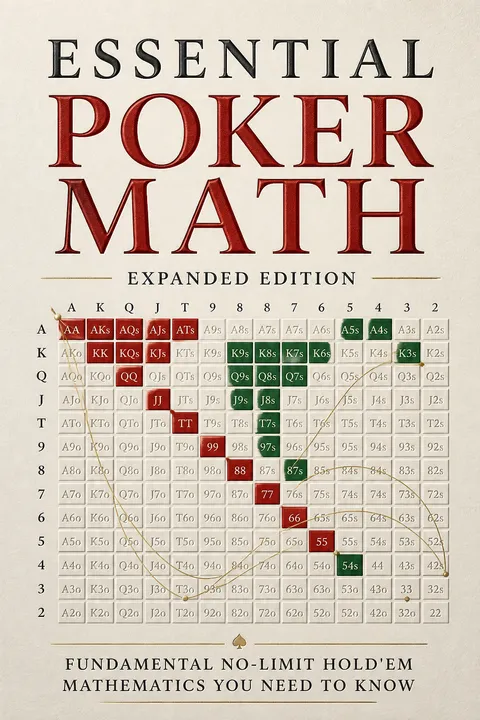
Essential Poker Math is a practical decision manual, not a complete theory of no-limit Hold'em. Its through-line is a sequence of increasingly specific questions: What range does the opponent represent? What is the price of continuing? How often does the hand win? Can future action compensate for an immediate shortfall? What does the stack depth permit? The book's strength is making these questions operational with mental arithmetic, then linking them to examples a reader can revisit away from the table.
Its most durable contribution is not a single formula but a habit of separating three things beginners often collapse: the hand they hold, the hand their opponent might hold, and the money required to continue. Equity and pot odds translate that separation into a threshold. Implied odds, fold equity, and combinatorics then add context that a one-line calculation cannot capture. This layered structure also explains the book's accessibility: basic arithmetic is sufficient to begin, while precise range analysis can deepen with study.
The method has boundaries. Equity greater than pot odds is a clean test when no further betting remains, but on earlier streets a player may not realize all of that equity. The implied-odds discussion acknowledges future action, although estimating that future is inherently uncertain. Likewise, the 15-to-1 set-mining rule is a useful heuristic rather than a universal law, and player labels are coarse summaries of behavior. A disciplined player treats both as provisional models and updates them with evidence.
The book also addresses the emotional trap of short-term results. A correct call can lose, and a poor call can win; neither isolated outcome settles the quality of the decision. That lesson is most persuasive when supported by hand histories and explicit assumptions, not merely by reassurance. Its ideal reader is a beginner or low-stakes player who wants a reliable framework for common decisions, not advanced equilibrium strategy. The practical payoff is a shift from asking whether a move felt brave or unlucky to asking what its inputs imply over many repetitions.
Review Summary
Essential Poker Math receives high praise from readers for its clear explanations of poker mathematics and strategies. Many reviewers appreciate the book's step-by-step approach, making complex concepts accessible to beginners. Readers highlight the coverage of pot odds, equity, and implied odds as particularly useful. While some find the content basic, most agree it's an excellent introduction to poker math. The book is often recommended for aspiring players looking to improve their game. Some readers note the included video course as a valuable bonus. Overall, reviewers consider it a fundamental read for poker players of various skill levels.
People Also Read







Glossary
Equity
Expected share of the potEquity is a player's expected share of a pot if the hand reaches showdown, based on the chance of winning or tying against an opponent's hand or estimated range. It can be expressed as a percentage or a dollar amount. Equity changes as community cards are revealed, and it describes a long-run expectation rather than guaranteeing the outcome of one hand.
Pot Odds
Immediate price of a callPot odds compare the money already available to the amount a player must call. They can be expressed as a reward-to-risk ratio or as the call amount divided by the pot after the call. The resulting percentage is the minimum equity needed to break even when no further betting or other effects change the decision.
Implied Odds
Expected future winningsImplied odds estimate the additional money a player may win on later betting streets after completing a draw. They can make a call worthwhile even when immediate pot odds are insufficient, but only if the opponent is likely to contribute more chips. Stack depth, position, opponent tendencies, and how obvious the draw is all affect the estimate.
Outs
Cards that improve a drawOuts are unseen cards that can improve a drawing hand on a future street. A conventional flush draw has nine potential outs, while an open-ended straight draw usually has eight. Some apparent outs are dirty because they may complete an opponent's stronger hand or fail to produce a winning hand, so estimates should account for them.
Rule of 2 and 4
Quick equity estimateThe Rule of 2 and 4 estimates the chance of completing a draw from its number of outs. Multiply outs by two when estimating the chance of seeing one card, and by four on the flop when an all-in lets the player see both turn and river. It is a fast approximation, not an exact probability calculation.
Expected Value (EV)
Average long-run resultExpected value estimates the average amount won or lost by making a particular play over repeated instances of the same situation. It combines the probability and payoff of each possible outcome. A positive EV play is profitable in expectation, while a negative EV play loses in expectation, regardless of whether the play wins or loses once.
Effective stack sizes
Chips two players can contestEffective stack size is the amount two opponents can win from or lose to one another in a hand, limited by the smaller relevant stack. A player with 400 big blinds cannot win 400 from an opponent who has only 80. Effective stacks shape risk, possible payoffs, and how a hand should be played.
Stack-to-Pot Ratios (SPRs)
Stack depth relative to potA stack-to-pot ratio is calculated by dividing the effective stack by the current pot. A low ratio means the remaining stack is small compared with the pot; a high ratio means more chips remain relative to what is already contested. SPR helps frame commitment decisions, but does not replace analysis of ranges, board texture, and action.
Fold equity
Chance opponents foldFold equity is the likelihood that an opponent will fold when facing a bet or raise. A bluff or semi-bluff can win the pot immediately if the opponent folds, in addition to any chance of winning at showdown. Fold equity depends on the opponent, the perceived ranges, the board, and the size of the wager.
Combinatorics
Counting possible hand combinationsCombinatorics is the counting of specific card combinations that make up a player's possible range. A pocket pair has six combinations, while two different ranks have 16 combinations, including four suited and 12 offsuit combinations. Known cards remove combinations from consideration, helping estimate how many value hands or bluffs an opponent can hold.
Set-mining
Calling to flop a setSet-mining is calling a preflop raise with a pocket pair primarily to make three of a kind on the flop. A pocket pair flops a set or better about 11.76% of the time. Because misses are frequent, profitable set-mining depends on sufficient effective stacks and a realistic chance of winning additional chips when the set arrives.
FAQ
What's "Essential Poker Math, Expanded Edition" about?
- Focus on Poker Math: The book is centered around teaching fundamental mathematics essential for No-Limit Hold'em poker, aimed at improving players' understanding and application of poker math.
- Target Audience: It is designed for both beginner and experienced poker players who have struggled with or neglected poker mathematics in their game.
- Comprehensive Coverage: The expanded edition offers more detailed explanations, additional examples, and new topics compared to the original edition.
- Practical Application: The book emphasizes practical math concepts that players can use daily at the poker table to outplay opponents.
Why should I read "Essential Poker Math, Expanded Edition"?
- Improve Your Game: The book provides essential mathematical tools that can significantly enhance your poker strategy and decision-making.
- Accessible Content: It breaks down complex mathematical concepts into easy-to-understand language, making it accessible even for those without a strong math background.
- Proven Success: The original edition was a best-seller, indicating its effectiveness and popularity among poker players.
- Free Resources: Purchasing the book grants access to free poker courses and resources, further aiding in your poker education.
What are the key takeaways of "Essential Poker Math, Expanded Edition"?
- Understanding Equity: Learn how to calculate and use equity to make informed decisions at the poker table.
- Pot and Implied Odds: Master the concepts of pot odds and implied odds to determine the profitability of calls and bets.
- Mathematical Strategies: Implement strategies like set-mining, blind stealing, and 3-bet bluffing using mathematical principles.
- Decision-Making Framework: Develop a structured approach to decision-making in poker, focusing on +EV (expected value) plays.
What are the best quotes from "Essential Poker Math, Expanded Edition" and what do they mean?
- "Poker is a game of long-term EV, not short-term wins and losses." This emphasizes the importance of focusing on long-term profitability rather than individual hand outcomes.
- "A complete poker player is one that can both read their opponents and use math at the poker table." Highlights the dual importance of psychological and mathematical skills in poker.
- "Understanding equity, along with pot and implied odds, lays the foundation behind making correct mathematical plays at the table." Stresses the foundational role of these concepts in successful poker strategy.
- "The best players in the world utilize a combination of reads and tells along with in-depth math and game theory-based decision making." Encourages players to integrate both intuitive and analytical approaches.
How does Alton Hardin explain the importance of math in poker?
- Evolution of Poker: Hardin explains how poker has evolved from a game of street-smarts to one deeply rooted in mathematics and game theory.
- Common Fallacy: He addresses the misconception of "playing the player, not the cards," emphasizing the importance of math in decision-making.
- Two Aspects of Poker: Hardin highlights the need to balance reading opponents with making mathematically sound decisions.
- Changing Dynamics: The book discusses how online poker and software tools have increased the focus on mathematical analysis in the game.
What is the "Rule of 2 and 4" in "Essential Poker Math, Expanded Edition"?
- Quick Equity Estimation: The Rule of 2 and 4 is a simple method to estimate your equity in a hand by counting outs and multiplying by 2 or 4.
- When to Use: Multiply outs by 2 on the flop if not all-in, by 4 if all-in, and by 2 on the turn.
- Accuracy: While not 100% accurate, it provides a close enough estimate for practical use during play.
- Practical Application: This rule helps players make quick decisions without complex calculations, enhancing in-game efficiency.
How does Alton Hardin suggest using pot odds in poker?
- Immediate Odds: Pot odds are the immediate odds offered when calling a bet, calculated as a reward-to-risk ratio.
- Decision-Making Tool: Compare pot odds to your equity to determine if a call is profitable (+EV) or not (-EV).
- Percentage Method: Hardin recommends using the percentage method for comparing pot odds to equity, as it is more intuitive.
- Practical Exercises: The book includes exercises to practice calculating pot odds quickly and accurately.
What is the significance of implied odds in "Essential Poker Math, Expanded Edition"?
- Beyond Immediate Odds: Implied odds consider potential future winnings on later streets, not just immediate pot odds.
- Good vs. Bad Implied Odds: Hardin explains how to identify situations with good implied odds, such as against aggressive opponents or in multi-way pots.
- Strategic Application: Use implied odds to justify calls with drawing hands when direct pot odds are unfavorable.
- Caveats: Be cautious of situations with bad implied odds, such as against tight opponents or in end-of-action spots.
How does Alton Hardin address pre-flop all-in situations?
- Common Scenarios: The book covers typical pre-flop all-in match-ups and their respective equities.
- Pot Odds Consideration: Emphasizes the importance of evaluating pot odds and opponent ranges before calling an all-in.
- Multi-Way Dynamics: Discusses the complexities of multi-way all-in situations and the impact on equity.
- Practical Examples: Provides practice hands to illustrate how to assess pre-flop all-in situations effectively.
What are the mathematical strategies for set-mining in "Essential Poker Math, Expanded Edition"?
- Set-Mining Odds: The odds of flopping a set are 11.76% or 7.5:1, meaning you need to win enough when you hit to cover the times you miss.
- 15-to-1 Rule: Hardin suggests a 15-to-1 rule for profitable set-mining, requiring a return of 15 times the initial investment.
- Factors to Consider: Evaluate effective stack sizes, opponent hand strength, and implied odds before set-mining.
- Practice Hands: The book includes examples to help players understand when set-mining is profitable.
How does Alton Hardin explain the concept of Expected Value (EV) in poker?
- Long-Term Focus: EV is the expected long-term average of winnings or losses from a specific play.
- +EV vs. -EV: A +EV play is profitable in the long run, while a -EV play is not.
- Decision-Making: Use EV to guide decisions at the table, aiming to make as many +EV plays as possible.
- Off-Table Analysis: Perform EV calculations off the table to evaluate past plays and improve future decision-making.
How can combinatorics be used in poker according to "Essential Poker Math, Expanded Edition"?
- Hand Combinations: Combinatorics helps estimate the likelihood of specific hands by calculating possible combinations.
- Pre-Flop and Post-Flop: Use combinatorics to assess opponent ranges and potential made hands both pre-flop and post-flop.
- Blockers and Card Removal: Understand how visible cards reduce the number of possible combinations in an opponent's range.
- Balanced Ranges: Develop balanced ranges by using combinatorics to create a mix of value and bluff hands.
Download PDF
Download EPUB
.epub digital book format is ideal for reading ebooks on phones, tablets, and e-readers.








