

Key Takeaways
Treat every growth rate as temporary until the system's limits are visible
Growth has different gears. Linear growth adds the same amount in each interval. Exponential growth adds the same percentage, so each increase builds on a larger base. A bacterial culture can double rapidly under ideal laboratory conditions, but real organisms eventually run into limits of nutrients, space, or energy. Many processes therefore follow logistic growth, a bounded S-shaped trajectory: a slow beginning, a steep rise, and a taper as a limit approaches.
The curve depends on the process. These patterns describe organisms, machines, populations, and markets, but they do not make those systems interchangeable. Growth rates also change during a trajectory. A percentage that sounds modest can produce huge absolute additions when applied repeatedly, while a large early rate may fade once constraints take hold.
What's useful here is the distinction between a growth rate and a growth path. A single rate invites extrapolation; a trajectory asks what is changing underneath it. The same mathematical form can describe very different mechanisms, from cell division to product adoption, so the curve is a map of observed change rather than an explanation of its cause. The book's emphasis on constraints helps prevent the familiar mistake of treating a temporary acceleration as a permanent feature of the world.
Use growth curves to test a forecast, not certify it
A close fit is not foresight. The book demonstrates this with Mozart's catalogue of compositions. Several different curves fit the known record with an R-squared near 0.99, yet they predict sharply different totals for a hypothetical later life. The fit describes the past data, not Mozart's unrealized creative capacity.
The same problem reaches public policy. Early US air travel data suggested much more future growth than actually occurred. Forecasts based on early wind turbine capacity gains likewise implied machines far larger than those built. A logistic curve can indicate that a process may be approaching saturation, but a new technology, a changed market, or a revised definition can shift the apparent ceiling. The book treats curves as disciplined descriptions, not guarantees.
The Mozart example exposes a broader problem in quantitative prediction: a model can be statistically impressive while answering the wrong question. Cumulative output is not the same as creative potential, just as an early adoption rate is not proof of eventual market dominance. Good forecasting therefore needs more than curve fitting. It needs a plausible account of the mechanism, the system boundary, and what could alter either one. The warning is especially valuable because precision in a graph can look like certainty even when the underlying assumptions remain fragile.
A relay of technologies can look limitless while each successor plateaus
Progress often changes engines. The maximum power of stationary prime movers climbed across successive technologies: steam engines gave way to water turbines, then steam turbines. Each technology had its own bounded growth, but their overlapping advances formed a much steeper long-term trend, gaining nearly seven orders of magnitude over roughly three centuries.
Records are not everyday performance. This relay can make history look like one continuous acceleration, even when practical capabilities settle down. Container ships move at speeds comparable to nineteenth-century clippers, and a modern Boeing 787 cruises more slowly than the first generation of commercial jetliners. The record-setting edge of a technology may keep advancing even as the ordinary system that moves most people or goods changes little.
The relay model clarifies why technological history can seem exponential without obeying a universal law of acceleration. New designs reset a performance ceiling, but each reset depends on fresh materials, infrastructure, investment, and a viable use. This separates frontier achievement from broad social change. It also cautions against treating the fastest machine as a proxy for the speed of civilization: a record is evidence of possibility, not evidence that the whole system has changed at the same rate.
Judge biological progress against constraints, not record-breaking outliers
Living growth has ceilings. Plant and animal growth depends on energy, nutrients, water, temperature, and competition. A widely used metabolic theory proposes that many biological rates scale with body mass to roughly the three-quarter power, but studies cited in the book find substantial departures across species and habitats. The relationship is a useful broad pattern, not a universal rule.
Crop gains are impressive but bounded. Semidwarf wheat, improved rice, hybrid corn, fertilizer, irrigation, and mechanization raised yields dramatically. Global wheat yields rose from about 1.17 tonnes per hectare in the early 1960s to 3.15 tonnes in the early 2010s. Yet many regions now show slower gains or plateaus. Exceptional contest yields do not mean national harvests can keep rising at the same pace.
What's striking is how the book holds two truths together: biological systems share useful regularities, yet local conditions can defeat neat universal laws. That distinction matters for agriculture, where a record plot under ideal care is not a forecast for a whole region. Yield improvements depend on both biological potential and the inputs that help realize it. Treating either genetics or technology as a magic lever obscures the ecological conditions that set the working limits.
Separate digital speed from the physical systems that make it possible
Fast diffusion has foundations. A popular comparison claims that phone, radio, television, the Internet, and an app each reached 50 million users in progressively less time. The book challenges the comparison: a communications network requires decades of generation, transmission, devices, and maintenance, while an app spreads over infrastructure already built for it.
The platform predates the product. Electricity networks began expanding in the late nineteenth century. They were followed by wired communications, computers, mobile phones, and dense cellular networks. Software can spread quickly because these physical systems are already in place. The same principle applies to new services that depend on roads, power grids, factories, or global shipping. Diffusion speed alone does not reveal the total effort behind adoption.
This distinction is a useful corrective to stories that confuse a frictionless user experience with frictionless production. Digital products can appear to arrive from nowhere because their enabling systems are mostly out of sight. That hidden foundation includes extraction, manufacturing, energy, and maintenance. The comparison also shows why adoption statistics need consistent units: counting devices, users, and software accounts as though they were equivalent can create a dramatic but misleading narrative.
Urban growth concentrates opportunity and resource demand in the same place
Cities amplify both gains and needs. Dense urban areas allow firms, workers, customers, and ideas to interact more easily. At the same time, cities require dependable flows of food, fuels, electricity, water, and materials from far beyond their borders. Their apparent compactness can conceal a large, global supply system.
The scale is already immense. In 2015, about 54 percent of the world's population lived in urban areas. China's urban population grew from roughly 190 million in 1980 to about 800 million in 2017. The resulting construction and infrastructure demand has been enormous. Dense cities can make public transit and shared services practical, but crowding, pollution, housing costs, and resource use remain substantial challenges.
The urban story resists easy slogans. Concentration can make some services more efficient, yet it also creates dense demand that must be met reliably every day. A city can look self-contained while depending on distant farms, power stations, mines, and ports. This makes urban planning inseparable from regional and global resource planning. The book's view is strongest when it treats cities not as isolated places but as hubs in a wider material metabolism.
GDP counts market output, not the full cost or quality of growth
The measure has blind spots. Gross domestic product totals the market value of final goods and services produced in a country. It does not fully count unpaid household work, informal economic activity, environmental damage, or improvements in product quality. Estimates of the shadow economy vary widely, illustrating how much the accounting boundary matters.
A concrete omission is unpaid labor. Britain's Office for National Statistics estimated unpaid work at about one trillion pounds in 2014, compared with official GDP of about 1.8 trillion pounds. GDP remains useful for tracking market activity, but it cannot stand in for well-being or sustainability. Proposed alternatives add different factors, yet none provides a universally accepted replacement.
The key issue is not that GDP is useless, but that it is often asked to serve as a moral scorecard. A market measure can track monetized production while missing whether that production repairs damage, improves lives, or simply transfers costs elsewhere. Alternative indexes face their own weighting problems, so the practical lesson is to use multiple indicators and name what each leaves out. Measurement choices quietly shape what institutions notice and reward.
Track absolute material flows, not just efficiency per product
Efficiency can hide expansion. Cars illustrate the difference between doing more with less material per unit and reducing total material use. Engine power per unit of mass improved sharply, but vehicles also became heavier and more powerful, while sales grew enormously. Relative dematerialization did not produce absolute dematerialization.
Small devices still have large footprints. In 2015, global sales of phones, laptops, and tablets together embodied roughly one exajoule of energy in their production, by the book's estimates. Cars embodied more in total, but their longer lives narrowed the comparison when annualized. Short-lived electronics require frequent replacement. A product's size is therefore a poor guide to its total energy and material cost.
This is a strong systems-level distinction: intensity measures can improve while total throughput rises. The pattern appears in the book across vehicles, electronics, housing, and infrastructure. Efficiency matters, but it does not automatically settle whether society is using less overall. That question requires accounting for volume, lifespan, replacement, and the full supply chain. The analysis also avoids the opposite mistake of dismissing efficiency gains, which can reduce burdens even when they do not eliminate them.
Read Japan's retreat as a transition, not a single forecastable collapse
The reversal was dramatic. Japan's Nikkei 225 peaked at about 38,916 in December 1989 after rising nearly sixfold during the decade. It then fell for years. The country's population peaked at about 128 million in 2008 and was declining by 2017. Economic stagnation and demographic aging now reinforce each other.
Yet decline is not disappearance. Japan remains a major economy with extensive infrastructure, skilled industries, and a high standard of living. Its experience shows how growth can give way to prolonged stagnation, demographic contraction, or adaptation, rather than one sudden end. The precise path depends on policy, labor, migration, productivity, and the cost of maintaining systems built for a larger population.
Japan is valuable as a case study because it makes post-growth conditions tangible without reducing them to catastrophe. A society can lose economic momentum and population while retaining substantial capability and social order. At the same time, aging changes the economics of infrastructure, care, and work. The case should not be universalized: other countries have different fertility patterns, migration options, and institutions. Its clearest lesson is that plateau and decline create new management problems, not merely smaller numbers.
Make future growth answer to the biosphere's limits, not economic habit
Growth runs on physical inputs. Modern agriculture depends on fossil energy, machinery, irrigation, and synthetic fertilizer. During the twentieth century, anthropogenic energy inputs to farming grew nearly 130-fold, while the global population grew about 3.7-fold and harvested area by roughly 40 percent. Synthetic nitrogen now supports a substantial share of food production.
The central tension is planetary. Economic activity draws on finite materials and energy while imposing pollution, habitat loss, soil erosion, and climate change. The book argues that long-run material growth cannot continue indefinitely on a finite planet. It does not offer a precise sustainable population or a complete policy blueprint, but it insists that preserving the biosphere must become a condition of future prosperity.
The book's closing argument is strongest as a constraint on decision-making, not as a precise forecast. The physical dependence of economies on energy, food, and materials is clear, while the exact thresholds for safe planetary use remain uncertain. That uncertainty can support caution rather than complacency: delayed action risks making later choices harsher. The unresolved challenge is institutional. Economic systems reward near-term output, while ecological damage is dispersed across places and generations, making compatibility something that must be deliberately governed.
Analysis
The book's central achievement is to make growth comparable across domains without pretending that bacteria, turbines, cities, and economies share one cause. Its recurring analytic move is to ask what is growing, how it is measured, over what interval, and under what constraints. That discipline changes the reader's interpretation of familiar curves: exponential acceleration is a temporary phase, logistic saturation is common but not mechanically predictable, and apparent hyperbolic progress can arise when one bounded technology hands off to another.
The strongest tension is between description and prediction. The author assembles an unusually broad quantitative record, then repeatedly shows that an excellent retrospective fit can fail when definitions, technologies, institutions, or resource ceilings change. This is not a weakness to smooth away. It is the book's core epistemic lesson: fit is evidence about shape, not proof of mechanism. The Mozart projections, turbine capacities, and energy forecasts make that distinction concrete.
The book also challenges economic abstraction by returning growth to its physical substrate. GDP, productivity, and digital services depend on energy, food, materials, and infrastructure, even when those inputs become less visible. Relative efficiency gains can coexist with rising total throughput, and cities can concentrate both productive opportunities and ecological demands. These connections are persuasive because they bind technical history to everyday conditions rather than treating innovation as immaterial.
A limitation follows from the book's scale. It demonstrates the incompatibility of indefinite material expansion with a finite biosphere, but it does not derive an operational transition plan or a defensible numerical ceiling for population and consumption. The evidence supports prudence more firmly than any single policy prescription. Its enduring value is therefore a method and a warning: measure real trajectories, distinguish rates from totals, inspect physical dependencies, and treat continued growth as a proposition that must be justified, not an assumption that nature will accommodate.
Review Summary
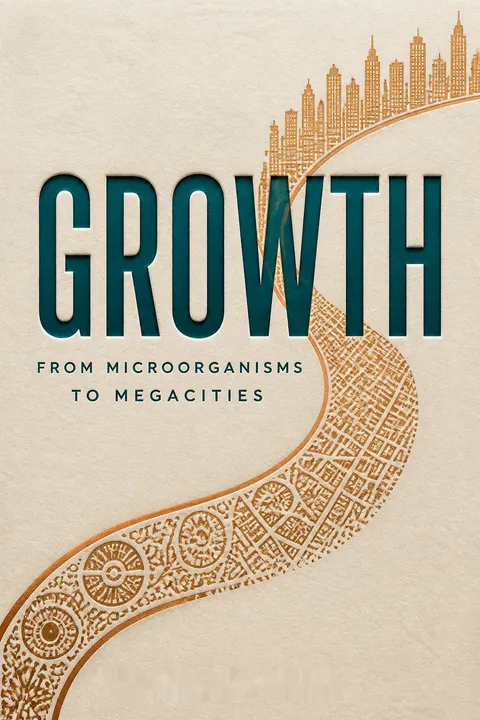
Growth presents an encyclopedic survey of growth patterns across nature and civilization. While praised for its comprehensive data and analysis, many reviewers found it overly dense and technical. Smil's main argument is that all growth inevitably reaches limits, challenging notions of infinite economic expansion. The book covers microorganisms to megacities, examining mathematical growth models and their applications. Some appreciated Smil's rigorous approach and broad synthesis, while others felt it could have been more concise and reader-friendly. The final chapter on limits to growth was highlighted as particularly insightful.
People Also Read










Glossary
Linear growth
Constant absolute additionsA pattern in which a quantity increases by the same absolute amount during each equal time interval. The increase does not depend on the quantity already accumulated. A steadily advancing distance or a crop adding a similar yield each year can approximate linear growth. Its percentage rate declines as the total becomes larger.
Exponential growth
Constant percentage increasesA pattern in which a quantity grows by the same percentage during each equal time interval. Because each increase is applied to a larger base, absolute additions become progressively larger. Exponential growth produces rapid acceleration, but in physical systems it can only persist temporarily before resources, space, costs, or other constraints alter the trajectory.
Logistic growth
Bounded S-shaped growthA finite growth pattern commonly represented by an S-shaped curve. Growth begins slowly, accelerates, reaches its fastest rate near an inflection point, and then slows as the quantity approaches an upper limit. In the classic symmetric form, that inflection point occurs halfway to the limit. The limit itself can change as conditions change.
Hyperbolic growth
Finite-time mathematical divergenceA mathematical trajectory in which a quantity approaches infinity within a finite time interval. This differs from exponential growth, which approaches infinity only as time itself becomes infinite. Hyperbolic trends can describe temporary historical patterns or the combined effects of successive technologies, but real systems cannot reach infinite size or speed.
Carrying capacity
An environment's supportable limitThe maximum population or quantity that a defined environment can sustain under specified conditions. In logistic models it represents the upper limit toward which growth slows. It is not necessarily fixed: technology, resource access, and environmental change can raise or lower the supportable level, making it unreliable as a timeless forecast.
Moore's law
Chip components roughly doubleThe observed historical trend that the number of components on an integrated circuit roughly doubled every two years over several decades. It describes a sustained pattern in semiconductor production, not a universal law governing all technologies. Applying its pace to unrelated fields can generate implausible predictions because each technology faces different constraints.
Moore's curse
Misapplied chip-like expectationsThe book's label for the mistake of assuming that advances outside computing will follow the unusually rapid improvement associated with semiconductor components. Chip progress can make rapid, sustained gains seem normal in every field. In practice, other technologies depend on different materials, infrastructures, costs, and physical limits.
Demographic transition
Shift to lower birth and death ratesA population process in which high birth and death rates give way to lower rates. Death rates generally fall first, creating a period of faster population growth while births remain high. Fertility later declines, slowing growth and potentially leading to population stability or decline. The timing and speed vary across countries.
Population momentum
Growth from a young age structureThe continued growth of a population after fertility falls, caused by a large share of people entering or remaining in childbearing ages. Even when the average number of children per woman reaches replacement level, births can remain numerous because the population contains many potential parents. Momentum fades only as the age structure changes.
Total factor productivity
Output beyond measured inputsThe portion of economic output growth not explained by measured changes in labor and capital. It is commonly associated with technology, knowledge, and more efficient organization, but it is a residual rather than a direct measure of any single cause. Its value depends on the quality of the input and output measurements.
Yield gap
Potential minus actual crop yieldThe difference between a crop's estimated yield potential and its actual yield in a particular place. Potential is estimated from crop genetics and local conditions such as climate, soil, and water availability. The gap indicates room for improvement through better inputs or practices, but does not mean every region can attain record yields.
Relative dematerialization
Less material per unitA decline in the energy or material required for each unit of output or performance. It can result from lighter materials, more efficient designs, or improved production. It does not guarantee lower total use: if the number, size, or replacement rate of products rises, aggregate material and energy demand can still increase.
About the Author
Other books by Vaclav Smil








Download PDF
Download EPUB
.epub digital book format is ideal for reading ebooks on phones, tablets, and e-readers.








