

Key Takeaways
Treat manufacturing as the foundation beneath modern services, not a relic
Objects sustain modern life. Digital networks, hospitals, farms, transport, and homes all depend on physical equipment, materials, and machines. Even a service-heavy economy must make or obtain the goods that let its services function. Smil argues that there has been no overall disappearance of material demand: efficiency gains per item have been outweighed by population growth and rising consumption.
Innovation has a factory address. Manufacturing has historically been a major place where scientific knowledge becomes usable products, from electric motors and fertilizers to computers. The book cites estimates that manufacturing supports substantial activity in connected sectors and accounts for roughly two-thirds of research and development. Its importance, Smil argues, cannot be read from its share of gross domestic product alone.
What's striking is the distinction between a service economy and a self-sufficient one. Software, logistics, and finance may dominate the visible transaction, while their material foundations remain elsewhere in the supply chain. That makes manufacturing a systems question, not merely a sectoral one. The argument is strongest when it identifies dependencies and innovation links. It is weaker if interpreted as a claim that every domestic factory is socially beneficial: production also consumes resources, and some services create considerable value without requiring a large industrial base.
Judge industrial strength by capabilities, not manufacturing's shrinking GDP share
The category is blurry. Modern factories often depend on design, software, research, logistics, and after-sales support. When a manufacturer outsources those functions, official statistics may classify them as services, even though they remain part of the production process. The measurement problem grows when goods cross borders as components before final assembly.
An iPhone shows the distortion. Smil describes a 2009 estimate in which Chinese assembly added less than 4% of the phone's manufacturing cost, while the finished export was recorded at about $2 billion. Most component value came from other countries, including the United States. This example does not make trade statistics useless. It shows why a country-of-origin label and a manufacturing GDP figure can obscure where expertise, suppliers, and value actually reside.
This is a measurement problem with policy consequences. A country can appear to retain a high-value design business even as it loses the production routines that reveal defects, train suppliers, and improve manufacturability. Conversely, counting every task inside a manufacturing firm as industrial output can exaggerate the sector's footprint. A better assessment tracks capabilities and relationships across the value chain, alongside conventional output and employment figures. Such accounting is harder, but less likely to confuse a corporate headquarters with an industrial ecosystem.
America's industrial ascent came from combining inventions with systems that scaled them
Scale required a system. After the Civil War, the United States combined abundant energy, expanding transport, technical invention, and large markets. Between 1865 and 1900, primary energy use multiplied nearly twelvefold. Steel output surged, and standardized, interchangeable parts let factories make complex goods in greater quantities. The American system of manufacturing used specialized machines and consistent components so products could be assembled without custom fitting each part.
Electricity changed the factory. Edison did not merely develop a useful light bulb. His commercial system required generators, wiring, meters, and compatible equipment. Electric motors later let factories arrange machines around production needs instead of belts and shafts driven by a central engine. The broader lesson is that an invention becomes transformative when the surrounding infrastructure, suppliers, and production methods make it reliable and affordable at scale.
The history here resembles the development of a technological platform: the invention matters, but so do standards, complementary tools, infrastructure, and the market that rewards adoption. That perspective helps explain why importing a finished product is not equivalent to possessing the capacity to make it. At the same time, this account should not turn industrial growth into a frictionless triumph. The same expansion brought monopoly power, dangerous work, and environmental damage. Productive capacity creates possibilities, not automatic public benefit.
Make goods cheaply at scale, but count the human costs of efficiency
Ford reorganized production. The Model T succeeded through a combination of a simple, durable design, standardized parts, and increasingly coordinated factory operations. Between 1909 and 1926, the labor needed to build a car fell from more than 400 hours to about 50. Its price dropped from roughly $850 to as low as $265, bringing automobile ownership within reach of far more households.
Efficiency changed the job. Frederick Winslow Taylor studied work operations and sought to make tasks more predictable and productive. Assembly-line work could be exhausting and repetitive, but standardized production also gave many workers, including immigrants with limited formal training, access to factory wages. Ford sharply raised pay and shortened the workday in 1914. This history is not a simple celebration of productivity: affordable goods and higher output came with control over workers' pace and tasks.
The tension is still central to automation debates: productivity can lower prices and expand access, but the gains do not distribute themselves. Ford's case shows that labor conditions depend on bargaining power and management choices, not just on the machine. It also cautions against treating repetitive work as either wholly degrading or automatically dignified because it pays. The relevant question is who captures productivity gains, who bears the physical and psychological costs, and whether workers can move into more skilled roles.
Wartime output showed America's mobilizing power, not a magic innovation engine
Mobilization was extraordinary. During World War II, government agencies, private firms, and workers redirected factories toward military production. Between 1939 and 1944, aircraft output increased about twenty-eightfold, while shipbuilding grew more than seventeenfold. New factories, resource extraction, transport, housing, and labor recruitment all had to expand before the products could roll out. Women entered factory jobs in large numbers, and Black workers migrated to industrial cities in the North and West.
War mostly scaled existing designs. Many famous wartime vehicles and aircraft had been conceived before the conflict. The overriding priorities were speed and volume, sometimes at the expense of quality and efficiency. Smil argues that productivity growth during the war and immediate reconversion was slower than in the 1930s. The postwar boom also rested on earlier advances, alongside measures such as the GI Bill, which helped veterans pay for education and housing.
The episode is a strong case study in state capacity: coordinated purchasing, investment, and production can rapidly redirect an economy. It also separates invention from deployment. Crisis can create urgency and funding, but it does not guarantee good designs, high productivity, or smooth conversion back to civilian work. The social legacy is similarly mixed. Expanded employment and education opened doors, while migration and wartime work did not erase discrimination or make the new opportunities permanent for everyone.
Cheap energy and captive markets let complacency masquerade as industrial strength
The boom concealed weaknesses. From 1948 to 1973, American manufacturing expanded alongside rising incomes and mass ownership of cars, appliances, and larger homes. US producers often faced little serious foreign competition at first. In automobiles, however, companies could sell oversized, fuel-hungry vehicles despite poor reliability and weak design. By 1973, the average fuel economy of US cars had fallen to about 13.4 miles per gallon, below the 1936 level cited in the book.
The shocks exposed the mismatch. Oil-price increases in the 1970s made efficiency suddenly valuable, while Japanese makers were offering smaller, more reliable cars. Imports passed 20% of US vehicle sales in 1979. The story of General Motors captures the reversal: its market share peaked above 50% in 1962, then fell as its products and practices lost ground. A protected or booming home market can reward output while postponing the hard work of competing on quality.
A long run of success can weaken the feedback that makes firms learn. When customers have few alternatives and energy is cheap, poor design may remain profitable for years. The same pattern appears in organizations beyond manufacturing: stable demand can turn yesterday's strength into today's blind spot. Yet the comparison with Japanese firms should not become a morality tale about national character. Their advantage reflected concrete production practices and market choices, and the book also notes that Toyota itself later suffered quality problems.
Offshoring can erase the production knowledge needed for the next invention
Job loss was not just a recession blip. US manufacturing employment fell from nearly 17.2 million in 2000 to about 11.5 million in 2010. Smil disputes the claim that productivity alone explains the decline, citing research that challenges official output and productivity estimates. In one estimate he reports, trade with China was associated with 2.4 million US jobs lost between 2001 and 2008, including direct and indirect effects. The precise causes vary by industry, but the scale of the change was substantial.
Production builds know-how. Manufacturing teaches firms how materials, components, equipment, and designs behave in actual use. Smil uses consumer electronics to illustrate the risk: after production of ordinary products moved abroad, the United States also lost capacity in areas such as displays and batteries. The iPhone's low-cost assembly in China is not the same as China creating all of its value, but it does show how production and employment can shift far from the company that owns the product.
The deeper issue is cumulative learning. Production experience generates tacit knowledge, the practical understanding that is difficult to capture in plans or patents. Losing a factory can therefore weaken a network of suppliers and engineers, not just a payroll. Still, offshoring is not identical to national decline: firms may gain access to markets, specialized suppliers, or lower costs, and workers can move into other fields. The consequential question is whether the transition creates comparable opportunities and preserves the capabilities needed for future products.
Raise exports: America's weak selling effort mattered more than import volume
Selling abroad was the weak link. Smil argues that the United States' trade problem was not simply an unusually high appetite for imported goods. In 2009, manufactured imports per person were about $4,600 in the United States, compared with roughly $9,600 in Germany. But US manufactured exports per person were only about $2,400, against Germany's $11,200. Export intensity means the share of a country's manufactured output that it sells abroad; by this measure, the United States was exporting less than half the global average.
Germany offered a contrast. Its specialized midsize manufacturers, skilled training system, and focus on exports helped firms dominate narrow global markets. Smil sees export growth as more realistic than blanket protectionism, while recognizing that competitors do not face identical rules or costs. The book's figures suggest that matching even the global average export intensity could have added hundreds of billions of dollars in annual US sales.
This reframes the trade debate from imports as a moral failing to exports as an organizational challenge. A firm that sells internationally must meet demanding standards, learn from customers, and build distribution networks. Export success is therefore not produced by currency changes alone. Germany's model also depends on institutions, training, and patient ownership that cannot be copied with a slogan. The book's trade argument is persuasive as a diagnosis of weak export participation, though trade deficits by themselves do not prove that a nation is becoming poorer.
Rebuild industrial capabilities while planning for factories that need fewer workers
A renaissance needs foundations. Smil reviews proposals to improve manufacturing through research investment, export support, vocational training, better infrastructure, and less burdensome costs for firms. These are connected problems: advanced equipment requires skilled operators, supplier networks, dependable transport and energy, and sustained research. The book compares US training with Germany's apprenticeship-based system, where companies, unions, and government help prepare workers for technical jobs.
More output may mean fewer jobs. Robots can perform tasks with speed, precision, and consistency, and computational manufacturing uses software to coordinate design and production. Additive manufacturing, often called 3D printing, builds an object layer by layer rather than cutting it from a larger piece. These methods can make production more flexible, but they also limit how many workers a returning factory employs. Smil's central forecast is cautious: renewed production is possible, but a broad return to past employment levels is unlikely.
The useful policy distinction is between rebuilding capacity and promising a particular number of jobs. Industrial capability can matter for innovation, resilience, and exports even when automation keeps payrolls lean. But that does not remove the distributional problem: displaced workers need credible routes into new roles, and communities need more than a factory announcement. A serious renewal strategy therefore has to measure training, domestic supplier depth, and innovation alongside output. Otherwise, a country may restore production statistics without restoring broad economic security.
Analysis
Smil's history is best read as an argument about capability, not nostalgia. The United States did not rise because it simply made more objects. It linked inventions to energy systems, skilled and semi-skilled labor, standardized components, production equipment, infrastructure, and a market large enough to reward scale. Its later retreat likewise cannot be understood through a single statistic. GDP share, output, productivity, jobs, export performance, and domestic supplier depth measure different things, and each can tell a different story.
The book is particularly strong when it shows how industrial competence accumulates through practice. The iPhone example complicates the idea that final assembly equals the whole product, while also raising a more important question: who retains the capability to scale and improve the next generation? This is a question of resilience and option value. A domestic production network may be costly in ordinary times, yet valuable when supply chains are disrupted or a new technology needs rapid commercialization.
The argument also needs limits. Manufacturing is not inherently superior to services, and trade deficits are not automatic evidence of national impoverishment. Nor can factory employment return to its historical peak if technology allows much higher output with fewer workers. Smil sometimes treats broad trade balances as a stronger verdict on economic health than they can bear, and his account gives less weight to the consumer gains, specialized expertise, and new firms that global exchange can support.
The most defensible conclusion is therefore neither autarky nor indifference. A country should not attempt to make every product, but it should know which capabilities are strategically and economically consequential, and avoid losing them by default. Industrial policy is most credible when it names those capabilities, invests in people and shared infrastructure, and accepts that output growth will not automatically restore secure employment. The book's enduring contribution is to make the production system visible beneath the consumer goods and services that usually command attention.
Review Summary
Made in the USA receives mixed reviews, with an average rating of 3.75/5. Readers appreciate Smil's detailed analysis of American manufacturing's history and decline, praising his thorough research and insightful arguments. However, some find the writing style dry and difficult to follow, with an abundance of statistics. Critics note the book's pessimistic outlook but acknowledge its importance in understanding the manufacturing sector's role in the US economy. Many readers recommend it for those interested in economic history and policy, despite its challenging content.
People Also Read









Glossary
American system of manufacturing
Standardized, machine-based productionA production approach using specialized machines and standardized, interchangeable parts to make goods in large quantities. Parts are made consistently so that workers can assemble them without individually fitting each component. First used extensively in American armories, the approach spread to industries including sewing machines, farm equipment, and automobiles.
total factor productivity
Output beyond measured inputsA measure of how efficiently an economy or industry turns labor, capital, and other measured inputs into output. Growth in total factor productivity captures improvements not explained simply by adding more workers or equipment. Smil links much of this remaining growth to technical and organizational change, while cautioning that those influences interact.
Fordism
Mass production and consumptionA manufacturing and economic arrangement associated with Ford's production methods: standardized products, assembly-line work, large output, and lower unit costs. In the book's discussion, the model also connects factory wages with the mass consumption of factory-made goods. It spread beyond Ford and continued to shape production systems, including later approaches that presented themselves as alternatives.
advanced technology products
Census-defined high-tech goodsA US Census Bureau category covering products from industries such as information and communications, electronics, aerospace, advanced materials, biotechnology, medical equipment, and pharmaceuticals. Smil uses the category to challenge the belief that American technical invention guarantees commercial strength: the United States moved from a small surplus to a substantial trade deficit in these products.
export intensity
Exports relative to manufacturing salesThe proportion of a country's manufactured output that is exported. Smil uses this measure to compare how strongly national manufacturers sell into foreign markets. In his account, the United States had notably low export intensity compared with Germany and other major producers, suggesting that weak export performance contributed to trade deficits.
Mittelstand
German midsize industrial firmsGermany's numerous midsize manufacturing companies, often family-owned and based outside major cities. In Smil's account, many specialize in highly technical products and hold strong positions in narrow global markets. Their long-term ownership, skilled workforce, and export orientation contrast with firms more focused on short-term financial returns.
computational manufacturing
Software-coordinated productionA digitally organized way of making products in which computing links design, prototyping, and production. Smil presents it as a possible major shift in manufacturing, with software and automated equipment coordinating operations that once required separate manual or mechanical steps. It can make production more flexible while reducing the need for large workforces.
additive manufacturing
Layer-by-layer productionA process that creates an object by depositing and solidifying successive layers of material, rather than removing material through cutting or other machining. Three-dimensional printing is a prominent form. The book describes its early use in prototyping and specialized products, and considers its potential to change production costs, location, and employment.
FAQ
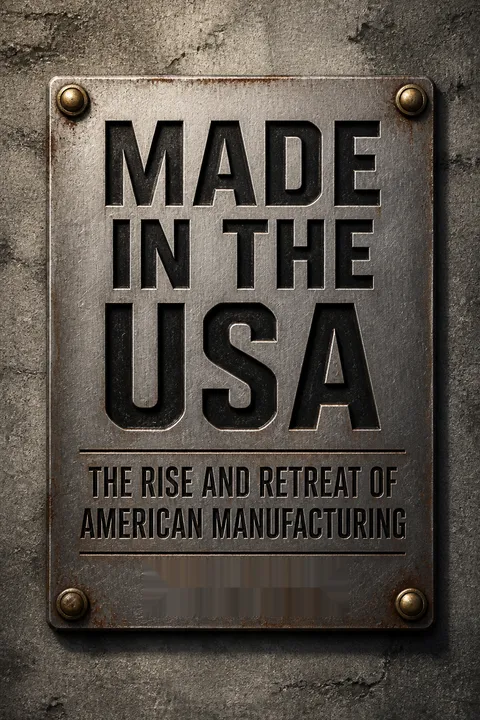
1. What is "Made in the USA: The Rise and Retreat of American Manufacturing" by Vaclav Smil about?
- Comprehensive historical overview: The book traces the development, achievements, and decline of American manufacturing from the post-Civil War era through the 21st century.
- Interdisciplinary analysis: Smil combines technical, economic, and social perspectives to explain how manufacturing shaped the US’s economic and strategic power.
- Focus on rise and retreat: It details the sector’s rapid growth, global dominance, and the complex factors behind its recent decline, including globalization and policy choices.
- No simple solutions: Smil avoids forecasts or prescriptions, instead offering a nuanced, evidence-based exploration of manufacturing’s past, present, and possible futures.
2. Why should I read "Made in the USA: The Rise and Retreat of American Manufacturing" by Vaclav Smil?
- In-depth, nuanced analysis: The book goes beyond surface-level explanations, exploring the technological, economic, and political forces behind American manufacturing’s evolution.
- Global perspective: Smil compares the US experience with that of Japan, Germany, and China, providing context for current trade and industrial challenges.
- Policy relevance: The book’s well-researched critiques and recommendations are valuable for policymakers, economists, and anyone interested in the future of American industry.
- Accessible and interdisciplinary: Written by a scientist, the book is approachable for general readers while offering depth for specialists.
3. What are the key takeaways from "Made in the USA" by Vaclav Smil?
- Manufacturing’s central role: Manufacturing has been the backbone of US innovation, economic growth, and national security.
- Complex causes of decline: The retreat of US manufacturing is due to a mix of globalization, policy missteps, technological change, and management failures.
- No easy renaissance: While some reshoring is happening, automation and global competition limit the potential for large-scale job recovery.
- Need for comprehensive reform: Revitalizing US manufacturing requires coordinated action in education, infrastructure, tax policy, and trade.
4. How did American manufacturing rise to global dominance according to Vaclav Smil?
- Post-Civil War transformation: The US shifted from a rural economy to the world’s leading manufacturer through mechanization and the adoption of interchangeable parts.
- Steel and infrastructure boom: Explosive growth in steel production enabled railroads, skyscrapers, and military hardware, overtaking Britain’s industrial leadership.
- Electrification and mass production: Innovations like Edison’s electric system and Ford’s assembly line revolutionized factories and made consumer goods widely accessible.
- Information age foundations: Advances in printing, telephony, and early electronics set the stage for the modern information economy.
5. What were the key achievements of American manufacturing highlighted in "Made in the USA"?
- Innovation leadership: The US pioneered electrification, mass production, and new materials, driving global productivity and economic growth.
- Wartime production: Unprecedented industrial mobilization during World War II supplied the Allies and spurred technological advances.
- Mass consumption society: Manufacturing enabled widespread prosperity, creating durable goods and supporting a broad middle class.
- Global output share: For much of the 20th century, the US accounted for about 24% of global manufacturing output.
6. Why does Vaclav Smil argue that manufacturing still matters in modern economies?
- Driver of innovation: Manufacturing remains the largest source of technical innovation, fueling growth across all sectors.
- Material foundation: Modern life depends on a vast array of manufactured goods, from infrastructure to everyday products.
- Economic multiplier: Every dollar in manufacturing generates significant additional economic activity, more than most service sectors.
- Trade and jobs impact: Manufacturing decline leads to trade deficits and job losses that services alone cannot offset.
7. What caused the decline and retreat of American manufacturing, according to Vaclav Smil?
- Global competition and offshoring: Rising competition from Japan and China led to market share losses and the relocation of production overseas.
- Policy and management failures: Short-term profit focus, underinvestment in innovation, and inadequate government support weakened competitiveness.
- Technological change: Automation and robotics reduced labor demand, while the shift to services reinforced manufacturing’s decline.
- Energy shocks and trade deficits: Oil crises and persistent trade imbalances further eroded the sector’s strength.
8. How did globalization, especially trade with China, impact US manufacturing jobs and trade deficits?
- Ballooning trade deficits: After China joined the WTO, the US trade deficit with China soared, especially in manufactured goods.
- Massive job losses: Millions of US manufacturing jobs were lost due to Chinese imports, with severe impacts in key states and regions.
- Complex interdependence: US companies benefit from low-cost Chinese manufacturing but face job losses and strategic vulnerabilities at home.
- Intellectual property and security: The shift has raised concerns about IP theft and economic security.
9. How did technological innovation in electronics, computing, and semiconductors shape US manufacturing’s evolution?
- Early US dominance: American firms invented and led in semiconductors and microprocessors, powering the computer revolution.
- Japanese competition: By the 1980s, Japan captured large shares of advanced chip markets, prompting US industry-government collaboration (SEMATECH) to regain ground.
- Software-hardware synergy: US leadership in software (Windows, Mac OS, etc.) boosted manufacturing productivity and blurred industry boundaries.
- Ongoing challenges: Despite design leadership, much chip fabrication has moved overseas, threatening future competitiveness.
10. What were the main social and economic consequences of the US manufacturing decline described by Vaclav Smil?
- Widespread job losses: Manufacturing employment dropped by millions, leading to high unemployment and underemployment in affected regions.
- Rising inequality: The loss of well-paying jobs contributed to growing income inequality and reduced social mobility.
- Urban decay: Cities like Detroit and Youngstown suffered population loss, abandoned housing, and economic distress.
- Community impacts: Deindustrialization led to social polarization and weakened the economic fabric of many communities.
11. What policy recommendations does Vaclav Smil offer for revitalizing American manufacturing?
- Tax and regulatory reform: Lowering corporate taxes and increasing R&D credits could spur investment and job creation.
- Education and workforce: Improving vocational training and STEM education is essential for supporting advanced manufacturing.
- Infrastructure and trade: Modernizing infrastructure and enforcing fair trade practices, including IP protection, are critical for competitiveness.
- Comprehensive approach needed: Success depends on coordinated reforms across multiple policy areas.
12. What are the prospects and challenges for a US manufacturing renaissance, according to "Made in the USA"?
- Limited job recovery: Automation and global supply chains mean that even with reshoring, manufacturing jobs are unlikely to return to historic levels.
- Technological transformation: Advances like 3D printing and intelligent automation will boost productivity but reduce labor demand.
- Global competition persists: Trade imbalances and foreign competition remain significant obstacles.
- Strategic commitment required: A true renaissance depends on sustained, strategic policy action and investment.
These 12 questions and answers provide a comprehensive overview of the main themes, arguments, and insights from "Made in the USA: The Rise and Retreat of American Manufacturing" by Vaclav Smil, covering the book’s historical narrative, key concepts, and policy implications.
About the Author
Other books by Vaclav Smil








Download PDF
Download EPUB
.epub digital book format is ideal for reading ebooks on phones, tablets, and e-readers.








