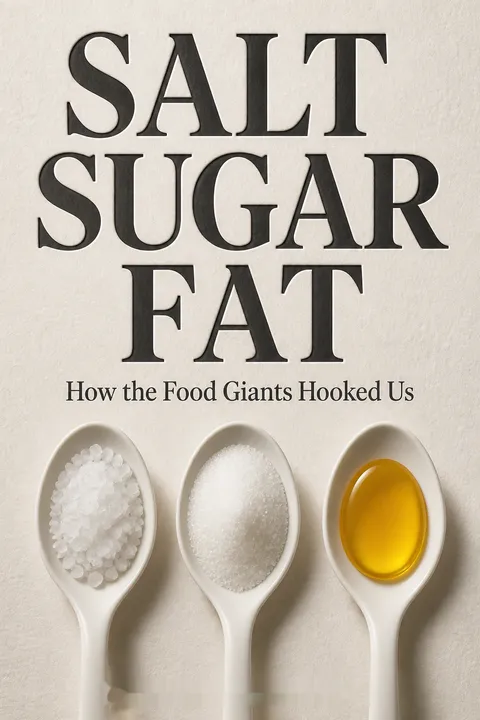


Key Takeaways
Read the supermarket as an engineered environment, not a neutral marketplace.
A revealing meeting. In 1999, executives from eleven major food companies gathered to discuss rising obesity. Kraft’s Michael Mudd urged them to study how their products encouraged overeating and to consider broad changes. General Mills chief Stephen Sanger rejected changing successful recipes because consumers wanted good taste. The meeting ended without a collective reform effort. Moss uses it to frame the book’s central argument: processed food is not simply what shoppers happen to choose. Companies deliberately combine inexpensive ingredients, product design, advertising, and retail tactics to encourage consumption.
Responsibility has layers. The book does not prove that any single snack causes a particular illness. Nutrition research often cannot isolate one food from the rest of a person’s life. Its stronger case is systemic: the food environment makes highly appealing, calorie-dense products cheap, visible, and routine. Individual choice remains real, but it operates inside that environment.
What's striking is how the meeting turns an abstract debate about personal responsibility into a question about who shapes the available choices. Behavioral science calls the influence of arrangement and defaults choice architecture: people still choose, but the surroundings make some decisions easier and more frequent. That does not make consumers powerless, or companies uniquely responsible for every health outcome. It does mean that accountability should include foreseeable effects of product design and marketing, not merely whether a customer could have said no.
Protect children's palates before commercial sweetness becomes their normal.
Sweetness begins early. Children are biologically drawn to sweet tastes, which signal energy and can soothe pain. Food companies understand this, and sweetness also helps products brown, retain moisture, and last longer. In one Monell Chemical Senses Center experiment, six-year-old Tatyana Gray preferred vanilla pudding containing 24 percent sugar. Her preferred concentration was about twice what most adults tolerated. Moss reports that Americans consumed an average of 71 pounds of caloric sweeteners annually, with added sugar averaging about 22 teaspoons a day at the time of publication.
Preference can be shaped. The term bliss point describes the sweetness level, or range, that makes a product most appealing. Researchers also found that infants do not naturally prefer salty foods, but children introduced to salty processed foods developed a stronger liking for salt. Taste preferences are not fixed at birth.
Developmental biology helps explain why children are especially receptive to intense flavors, but biology is not destiny. An inborn attraction to sweetness makes energy-rich foods appealing; it does not require breakfast cereal or drinks to reach the extreme concentrations found in some products. The important distinction is between using a child’s preferences to nourish them and using those preferences to define what food is supposed to taste like. Early exposure can establish expectations, although family meals, culture, and access to alternatives also shape those expectations.
Convenience changes the meal itself, not merely the time it takes.
A new promise. In the 1950s, General Foods executive Charles Mortimer made convenience a defining product goal. Chemist Al Clausi helped deliver it with instant pudding, Tang, and other foods that reduced preparation. The appeal was genuine: working households had less time, and manufacturers offered practical ways to ease the daily rush. But convenience also expanded what could count as breakfast, lunch, or a snack. Pop-Tarts moved from breakfast to afternoon treat, while packaged drinks and ready-made meals made eating possible almost anywhere.
Needs can be invented. The industry did not simply respond to requests for faster cooking. Its advertising and product development helped teach people to expect food that was portable, shelf-stable, and ready immediately. That shift reshaped routines and made packaged products a larger part of everyday eating.
Convenience is not a fake need. Time is scarce, paid work and caregiving compete, and preparing every meal from scratch is not a realistic standard for many households. The more revealing question is who gets to define convenient, and what costs are hidden in the answer. A product can save minutes while displacing cooking knowledge, nutrition, or shared meals. Recognizing that tradeoff avoids two easy mistakes: treating processed food as pure liberation, or blaming busy families for accepting help that was deliberately designed and marketed to them.
Treat product liking as an engineered variable, not a natural verdict.
Taste gets measured. Food scientist Howard Moskowitz helped make optimization a standard product-development tool: test many slight variations, measure consumer responses, and use statistical models to identify the most appealing formula. His work on Cherry Vanilla Dr Pepper tested 61 formulations through 3,904 tastings. The resulting analysis found that the company could use less of its flavoring while preserving consumer appeal, saving money at enormous production scale.
More than one ideal exists. Moskowitz’s earlier work on Maxwell House showed that consumers could prefer weak, medium, or strong coffee. That insight encouraged companies to create products for different taste groups instead of searching for one universal favorite. The method can recognize real diversity in preference, but it also turns liking into a measurable commercial target, optimized for sales rather than for nutrition.
Optimization is powerful because it replaces guesswork with disciplined testing. It can produce genuinely better-fitting products, as the coffee example shows. The ethical question is not whether companies should learn what people enjoy, but what objective the model rewards. If purchase intent is the main measure, health and long-term satisfaction can disappear from the calculation. A broader test would ask not only which product wins a tasting, but whether consumers can use it in a healthy pattern and still find it worth buying.
Look for fat where texture and convenience disguise its volume.
Fat works quietly. Unlike sugar’s obvious sweetness, much of fat’s appeal comes through mouthfeel: sensations such as creaminess, crunch, and smoothness. It carries other flavors, improves texture, and can help products survive storage. Research described by Moss found that people had trouble estimating fat in foods when sugar was also present, making the fat easy to overlook.
Cheese became an ingredient. Industrial processing made cheese faster and cheaper to manufacture, while food companies found ways to add it to pizzas, frozen meals, snacks, and sauces. U.S. cheese consumption rose from about 11 pounds per person in 1970 to roughly 33 pounds by 2007. Cheese is not inherently harmful, and it can be enjoyed as part of a diet. The concern is how easily it accumulates when hidden inside foods that do not seem like cheese servings.
The lesson about hidden fat extends beyond nutrition labels: people estimate what they eat using appearance, texture, and familiar categories. When a rich ingredient is blended into a meal, it is harder to notice both its amount and its contribution to the whole. Still, fat is not a single moral category. The book’s strongest point is about excess and concealment, not a case for eliminating every fatty food. Making ingredients visible can support informed choice without turning eating into a constant exercise in suspicion.
Most excess salt arrives preloaded in packaged food, not from your shaker.
The shaker was a decoy. In a 1991 Monell study of 62 adults, researchers estimated that processed foods supplied more than three-quarters of participants’ sodium. Salt added at the table supplied only 6 percent, and naturally occurring sodium a little over 10 percent. The study redirected attention from household habits to the food supply.
Salt does factory work. It enhances flavor, but it also improves texture, slows spoilage, and masks bitter or stale notes in processed foods. Manufacturers use sodium compounds as well as ordinary salt. In Moss’s account, companies struggled to reduce sodium without damaging taste, appearance, or production. A small Monell experiment also found that people who reduced salt for twelve weeks became more sensitive to it and added back only a fraction of what they had removed. That result is promising, though the experiment involved only nine adults.
This is a useful example of why individual advice can miss the source of a population problem. Removing a saltshaker does little if most sodium is built into bread, soup, meat, and prepared meals. Public health efforts are stronger when they target the dominant source rather than the most visible one. At the same time, salt reduction is technically and commercially difficult, not a matter of simply omitting an ingredient. The book shows why gradual change across many products may matter more than asking every shopper to compensate alone.
Healthier formulas need market-wide incentives, not isolated corporate virtue.
Reform carries risk. Kraft made a serious effort to address obesity, including setting limits on salt, sugar, and fat in product development. Its officials also changed some marketing practices and improved package information. Yet the company faced a basic commercial problem: if a reformulation weakened taste and sales, a rival could keep the more appealing version and take its customers.
Competition can reverse progress. Campbell’s experience with lower-sodium soups illustrates the pressure. After sales weakened, the company announced it would restore some sodium to selected soups, and investors welcomed the move. The episode echoes the 1999 executive meeting, where companies declined to reduce ingredients across the board. Voluntary reform is fragile when each company bears the cost while competitors can benefit from holding back.
This is a classic coordination problem. When every producer benefits from an industry-wide change but each fears being the first to lose customers, private incentives can block collective improvement. Common standards can reduce that disadvantage by making the competitive rules apply to all. Yet regulation needs care: taste, affordability, food safety, and product quality matter, and abrupt changes can fail. The useful aim is not to demand corporate goodness in isolation, but to design rules and incentives under which healthier products can compete without asking one company to absorb the whole risk.
Government can promote cheese and beef while warning about their excess.
Two messages collide. The U.S. Department of Agriculture issues nutrition guidance while also overseeing industry-funded campaigns to sell agricultural products. The beef checkoff, a producer levy used for marketing, generated more than $80 million a year. The USDA nutrition center had an annual budget of about $6.5 million. Dairy marketing helped expand cheese use, including as an ingredient in pizza and prepared foods, even as nutrition guidance raised concerns about saturated fat.
Promotion is public policy. The Supreme Court treated beef checkoff advertising as government speech because the agriculture secretary controlled the program. The result is a striking contradiction: public agencies can support messages encouraging consumption while separate guidance advises people to limit some of the same foods. The tension is not just about wording. Public resources and official authority help shape what people buy.
The conflict is institutional, not simply a matter of individual officials holding inconsistent opinions. Agencies often serve several constituencies, and food policy links public health to farm income, trade, and rural employment. That complexity helps explain the contradiction, but it does not make it harmless. Clear disclosure of who funds and approves promotional messages would help the public distinguish nutrition advice from commodity marketing. A policy system can acknowledge agriculture’s economic role while still making health goals legible and internally consistent.
Build shopping habits around labels, routines, and access, not health halos.
Check the whole package. Moss describes a Philadelphia parent who bought a breakfast bar because its front label suggested fruit and calcium. The product had more sugar and less fiber than Oreos. Other packaging tricks include small serving sizes that make a large bag’s total calories seem modest, and healthy-sounding ingredients that distract from the rest of the formula.
Make better choices workable. The book’s practical advice is to notice placement, read ingredient and nutrition information, plan meals, and be cautious about products marketed as healthy. It also shows the limits of individual vigilance: in Strawberry Mansion, nearby corner stores offered cheap, convenient snacks while supermarkets and fresh food were harder to reach. Better decisions depend partly on having realistic alternatives, not simply more discipline.
The health halo is a problem in information design: one favorable cue can dominate attention while less flattering details remain small or unfamiliar. A useful shopping routine is to compare the whole product, including serving size, rather than trust a single front-of-package claim. But the Philadelphia example also guards against a purely individual solution. Time, price, transport, and neighborhood retail shape what is feasible. Advice that ignores those constraints can turn structural disadvantage into a story about personal failure.
Analysis
Moss builds a reported argument from a memorable contradiction: food companies know how their products are engineered, yet the people who design and sell them often avoid eating those products themselves. The narrative moves from the 1999 executive meeting through laboratory experiments, product launches, marketing campaigns, and government policy. That progression makes the book more than a catalogue of ingredients. It shows how biology, corporate strategy, household routines, and public policy reinforce one another.
The central contribution is a shift in scale. A shopper’s decision matters, but millions of decisions are made inside an environment shaped by low-cost ingredients, sensory testing, packaging, advertising, and retail placement. The book’s strongest evidence concerns these commercial mechanisms: how companies test preferences, how convenience products enter daily routines, and how industry groups respond when salt, sugar, or fat becomes controversial. Its account of cheese is especially revealing because it tracks not just a food’s formulation, but its transformation from an occasional item into an invisible addition across many product categories.
The argument also benefits from its limits. Moss acknowledges that nutrition science often cannot establish a simple causal chain from one product to a specific disease. Some of the neuroscience and animal research he discusses is suggestive rather than conclusive, and terms such as addiction can imply more certainty than the evidence warrants. That caution strengthens the broader case: the concern is not that every processed food is dangerous or every company acts with malicious intent. It is that systems optimized for sales predictably reward easy-to-eat, inexpensive, highly appealing products, while the health costs are distributed across families and public institutions.
The book’s most practical implication is therefore institutional as well as personal. Consumers can learn to read labels and plan purchases, but durable change requires policies and market conditions that do not punish the first company to reform. A compelling food system would preserve convenience and affordability while making health less dependent on extraordinary vigilance.
Review Summary
Salt Sugar Fat exposes how food companies manipulate consumers by optimizing processed foods with addictive levels of salt, sugar, and fat. Moss's investigative journalism reveals industry tactics, government complacency, and the resulting health crisis. Readers praise the book's eye-opening information, engaging writing style, and balanced approach. Many report renewed commitment to healthier eating habits after reading. While some found it repetitive or overly detailed, most reviewers highly recommend it as an important expose of the food industry's practices and their impact on public health.
People Also Read





Glossary
bliss point
Most appealing intensityThe sweetness, saltiness, or other sensory intensity at which a food or drink is most appealing to a consumer. In practice, preferences vary among people, and the most appealing level can be a range rather than one exact point. Food companies use taste tests and analysis to find formulas likely to attract buyers.
optimization
Statistical product refinementA product-development method that tests many controlled variations in ingredients or other features, gathers consumer responses, and uses statistical models to identify promising combinations. In the book, Howard Moskowitz applies optimization to foods and drinks, translating sensory preferences into formulas that companies can manufacture and sell.
sensory-specific satiety
Flavor-driven fullnessThe tendency for a strong, distinctive flavor to become less appealing as a person eats it, contributing to a feeling of fullness. Research on military rations helped Howard Moskowitz investigate this effect. The concept helps explain why products with appealing but not overwhelming flavors can remain easy to keep eating.
mouthfeel
Food's tactile sensationThe physical sensations a food creates in the mouth, including creaminess, smoothness, dryness, gumminess, and crunch. The book describes mouthfeel as particularly important to fat’s appeal. Fat can make food feel rich or silky and can carry or modify other flavors, even when consumers do not consciously identify it as fatty.
stomach share
Share of eating occasionsA food company’s internal idea of competing for a larger portion of what people eat. The term captures an ambition broader than winning against another brand: companies may seek to displace other foods and drinks, increase consumption occasions, or get existing customers to buy more of their products.
checkoff
Producer-funded marketing programA commodity promotion program funded through required payments by producers when they sell or produce goods such as beef or milk. In the book’s account, the USDA oversees these programs and their advertising. Checkoffs promote products as a category, rather than promoting only one producer’s brand.
permission
Accepted product compromiseA food-industry term for what consumers are willing to give up in exchange for convenience, price, or another benefit. Lunchables, for example, did not need to reproduce a hot meal if children accepted a cold, assembled version. The term helps developers judge which departures from an ideal product shoppers will tolerate.
Model for Ideal Snack
Snack purchase equationA formula developed at Frito-Lay to represent factors that influence snack purchases. Taste, convenience, and usefulness increase purchase appeal, while price, health concerns, and quality problems reduce it. The model expresses how a company might weigh competing motives when assessing a snack, rather than measuring nutrition alone.
FAQ
What's Salt Sugar Fat about?
- Exploration of processed foods: Michael Moss investigates how food companies manipulate salt, sugar, and fat to create products that are highly appealing and addictive.
- Impact on health: The book examines the role of these ingredients in the obesity epidemic and related health issues like heart disease and diabetes.
- Industry practices: Moss reveals the strategies and corporate culture of food giants, showing how profit is often prioritized over public health.
Why should I read Salt Sugar Fat?
- Informed consumer choices: The book provides insights into the hidden dangers of processed foods, helping readers make healthier dietary decisions.
- Understanding marketing tactics: It uncovers how food companies exploit human psychology to create cravings, enabling readers to recognize manipulative marketing strategies.
- Public health awareness: By highlighting the connection between diet and health, the book encourages readers to consider the broader implications of their food choices.
What are the key takeaways of Salt Sugar Fat?
- Ingredients drive cravings: Salt, sugar, and fat are used to enhance flavor and create addictive products, often at the expense of health.
- Marketing over health: The food industry prioritizes profit, frequently ignoring the health consequences of their products.
- Consumer responsibility: Readers are encouraged to take responsibility for their health by being more discerning about the foods they consume.
What are the best quotes from Salt Sugar Fat and what do they mean?
- “We’re Hooked on Inexpensive Food”: Highlights the affordability of processed foods and their contribution to widespread obesity.
- “People Love Salt”: Emphasizes the addictive nature of salt in processed foods, used to enhance flavor and drive sales.
- “We don’t create demand. We excavate it.”: Reflects the food industry’s approach to marketing, exploiting existing consumer desires.
How does Michael Moss define the "bliss point" in Salt Sugar Fat?
- Optimal sweetness level: The bliss point is the precise amount of sugar that maximizes a product's appeal.
- Mathematical modeling: Food scientists use statistical methods to determine this point, engineering products to hit the sweet spot for taste.
- Consumer behavior insight: Understanding the bliss point explains why certain foods are addictive and why consumers overindulge.
What role does marketing play in the food industry according to Salt Sugar Fat?
- Psychological manipulation: Food companies use tactics to create cravings and drive sales, often prioritizing marketing over health.
- Targeting children: The industry focuses on marketing sugary products to children, shaping lifelong eating habits.
- Brand loyalty: Strategies are designed to foster brand loyalty, ensuring consumers return to their favorite products.
How do salt, sugar, and fat contribute to the obesity epidemic?
- Caloric density: These ingredients provide high calories in small servings, leading to overconsumption.
- Altered taste preferences: Their prevalence in processed foods alters taste preferences, increasing cravings for unhealthy options.
- Biological responses: They trigger biological responses in the brain that promote overeating and addiction-like behaviors.
How do food companies use salt, sugar, and fat?
- Enhancing flavor: These ingredients enhance taste, creating a sensory experience that encourages repeat purchases.
- Creating addiction: They stimulate pleasure centers in the brain, leading to addictive eating behaviors.
- Maximizing shelf life: They improve shelf life, maintaining profitability by ensuring products remain appealing.
What insights does Salt Sugar Fat provide about the relationship between food and addiction?
- Food as a reward: Processed foods activate brain reward pathways, leading to compulsive eating behaviors.
- Psychological factors: Many people eat to cope with stress, creating a cycle of dependency on unhealthy foods.
- Need for awareness: Understanding these addictive qualities can help consumers make more conscious dietary choices.
How does Salt Sugar Fat address the issue of consumer responsibility?
- Empowerment through knowledge: Moss encourages readers to educate themselves about processed food ingredients and tactics.
- Making informed choices: The book advocates for critical evaluation of food purchases, promoting healthier eating habits.
- Advocacy for change: Consumers can drive industry change by demanding healthier options and holding companies accountable.
What insights does Salt Sugar Fat provide about the food industry's relationship with government regulation?
- Lack of oversight: The book highlights insufficient regulation, especially in marketing unhealthy products to children.
- Industry influence: Food companies often influence government policies, prioritizing profit over public health.
- Need for reform: Moss calls for greater accountability and transparency, urging consumers and policymakers to advocate for healthier options.
What recommendations does Salt Sugar Fat make for consumers looking to improve their diets?
- Focus on whole foods: Prioritize whole, unprocessed foods to reduce intake of unhealthy ingredients.
- Read labels carefully: Become adept at identifying hidden sugars, fats, and sodium in food products.
- Advocate for change: Support policies promoting public health and demand healthier food options from the industry.
About the Author
Other books by Michael Moss

Download PDF
Download EPUB
.epub digital book format is ideal for reading ebooks on phones, tablets, and e-readers.








