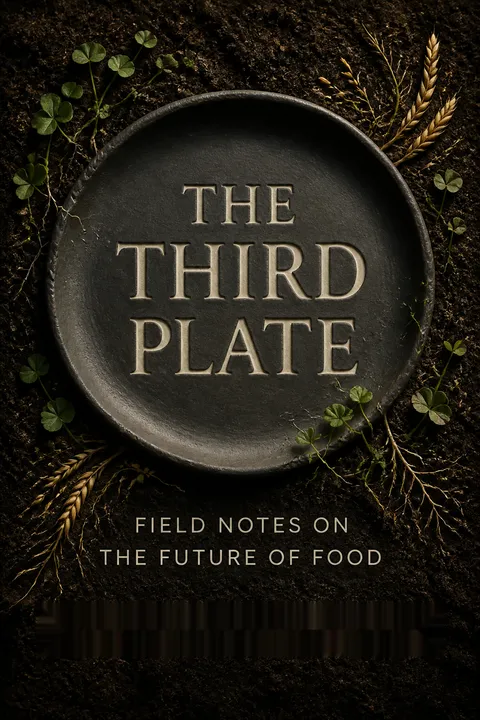


Key Takeaways
Build the meal around the land, not the diner’s inherited plate.
One cornmeal changed the question. Barber receives rare Eight Row Flint corn, a variety selected over generations for flavor. Farmer Jack Algiere plants it with beans and squash in the Three Sisters method: beans enrich the soil, corn supports climbing beans, and squash shades the ground and suppresses weeds. The harvest becomes polenta so vivid with corn flavor that Barber rethinks what good cooking depends on. The taste comes not from the chef alone, but from seed, soil, planting relationships, and place.
A new plate takes shape. Barber calls the needed shift the Third Plate: a way of cooking and eating that reflects the whole agricultural system, rather than simply swapping conventional ingredients for local or organic versions. His imagined plate puts a roasted carrot at the center, with braised secondary cuts of beef providing depth. The principle is not a particular recipe. It is letting what the landscape can sustain shape the cuisine.
The polenta story makes an ecological argument through pleasure rather than guilt. That matters: taste gives diners a direct reason to care about agricultural decisions that otherwise remain invisible. The Third Plate also reframes a meal as a design choice with consequences for what farmers plant. Its challenge is practical as well as culinary. A dish can express a whole system, but only if its ingredients are available, affordable, and welcome at the table. Deliciousness opens the door; dependable relationships across farms, kitchens, and markets keep it open.
Treat healthy soil as a living system that must be repaid.
Soil has a budget. Barber presents the Law of Return: when harvesting removes nutrients and organic matter, farming must return enough fertility to maintain the soil. The living soil community includes microbes, fungi, worms, and many other organisms. Klaas Martens rebuilds depleted fields through crop rotations, including spelt for deep roots and clover to capture nitrogen from the air. He returns plant material to the ground rather than relying on quick chemical inputs alone.
Flavor is part of the harvest. At Stone Barns, Algiere grows carrots that register 16.9 on a Brix meter, a measure of soluble sugar. Barber connects their remarkable taste with careful soil management, while noting that variety and weather also matter. The book argues that soil health supports plant vigor and flavor, not just yield. Its central warning is simple: harvesting without restoring fertility spends down the farm’s capacity to produce well.
The budget analogy clarifies why a high yield in one season can disguise declining productive capacity. It also shifts attention from input labels to the system that processes nutrients. The carrot comparison is memorable, but Brix is not a complete measure of flavor, and a single crop cannot prove that soil practice alone caused a taste difference. Barber’s stronger point is structural: repeated harvests need replenishment. Soil care is less a purity badge than maintenance of the conditions that make future harvests possible.
Read weeds and pests as clues before trying to eliminate them.
A weed can be information. Martens rejects the idea that every unwanted plant is simply an enemy. Different plants can reveal conditions in a field: he associates wild garlic with low sulfur, thistle with compacted soil, and foxtail with poor drainage. He combines such observations with soil tests instead of treating every symptom with a spray. In one depleted field, he plants mustard after a test indicates low sulfur, then follows it with nitrogen-fixing beans and emmer wheat.
The velvetleaf tells a story. A neighboring field had been dominated by tall velvetleaf. As rotations rebuild soil conditions and soybeans become vigorous, the velvetleaf weakens and whiteflies gather on it, while leaving nearby soybeans alone. Martens sees this as evidence that the field’s balance is changing. The lesson is not that pests are always beneficial, but that their presence may point to a problem in the growing conditions.
This is a model of diagnosis before intervention. It resembles troubleshooting in medicine or engineering: a visible failure can be a signal of a hidden imbalance, not the root cause itself. The method demands time and local knowledge, which large operations may not easily provide. It also requires humility about interpretation. A weed can suggest a condition, but it does not identify it with certainty. Martens’s most persuasive practice is pairing close observation with soil testing and then judging whether a change improves the field.
Restore grain’s flavor through breeding, fresh milling, and careful cooking.
Wheat is not generic. Barber notes that grain crops occupy over 80 percent of American farmland, while wheat consumption exceeds 130 pounds per person each year. Yet roller milling separates the germ and bran from the starchy endosperm, producing shelf-stable white flour while removing much of the grain’s flavor and nutrients. Freshly milled whole wheat retains more of the kernel’s oils, but those oils spoil quickly, so freshness matters. Alex Grunert’s brioche made with Martens’s freshly milled emmer develops a rich aroma and a flavor absent from ordinary whole wheat flour.
Selection shapes the loaf. Industrial wheat has often been bred for uniformity, high yield, and fast processing. The Green Revolution’s semidwarf varieties helped raise yields and avert hunger, but Barber also describes their reliance on fertilizer and irrigation. Steve Jones’s breeding work seeks flavor, disease resistance, nutrition, and useful yields together. The book’s point is not to reject modern breeding, but to broaden what breeders and buyers ask wheat to do.
The wheat story exposes how a staple can become culturally invisible precisely because it is everywhere. Milling technology, seed selection, baking standards, and consumer expectations reinforce one another, making blandness seem normal. Barber also avoids a simple anti-technology narrative: the Green Revolution saved lives, while its production model created serious ecological costs. That tension matters. Better grain is not achieved by nostalgia alone. It requires plant science and processing methods that serve qualities beyond shelf life and speed.
Build cuisine around soil-building crops and less-coveted animal cuts.
Menus shape farms. Farm-to-table cooking can still favor the ingredients diners already expect: premium steaks, lamb chops, and popular vegetables. That demand encourages farmers to produce chosen parts or crops, even when a healthier rotation requires less fashionable grains and legumes. Barber’s Third Plate reverses the familiar proportions: a carrot or parsnip becomes the centerpiece, while braised beef shank contributes flavor as a sauce. The dish is a way to make a different pattern of farming desirable.
Use more of the farm. Historic cuisines often grew from limited supplies and made grains, vegetables, and secondary cuts central. Polenta, paella, and Hoppin’ John are examples of dishes built around what local agriculture could provide. Barber argues that today’s kitchens can do the same for crops such as rye, millet, buckwheat, and beans, which may improve soil but often lack a strong market for human food. Cooking with them helps make diverse rotations economically possible.
A cuisine is more than a menu of good ingredients. It is a demand system, translating cultural preferences into planting and raising decisions. This makes cooking a form of economic coordination: a recipe can give farmers a reason to grow something the soil needs. The constraint is that diners cannot be expected to change habits on command. Familiar textures, skillful preparation, and a compelling story can help, but restaurants serve only a fraction of meals. The broader test is whether these dishes become practical beyond the special occasion.
Let ecosystems set production limits, even when wildlife takes a share.
Diversity can produce more than one crop. In Spain’s dehesa, a traditional landscape of grassland and scattered oaks, pigs forage on acorns while cattle and sheep graze other plants. Cork, grain, meat, cheese, and household gardens all belong to the same working landscape. The system persists because production adjusts to available resources, including the acorn harvest. In poor acorn years, fewer pigs are raised rather than forcing the land to support more.
A fish farm can include birds. At Veta la Palma, a managed wetland uses tides, channels, and natural food webs to raise fish. Flamingos and other birds eat some fish and shrimp, but their presence also reflects a functioning ecosystem. The operators focus on keeping production within the system’s capacity, not maximizing the number of fish. This illustrates the edge effect, the increased activity and diversity where ecosystems meet, such as land and water. Human intervention can support such a system when it works with ecological limits.
These farms challenge the assumption that every organism competing with a crop is a loss. The more useful question is whether the whole system remains productive and diverse, not whether a single output is maximized. That is a powerful shift in accounting. Yet it is not a plug-and-play formula: the dehesa depends on a particular climate, history, and culture, and Veta la Palma required extensive engineering and careful management. Their value lies less in being copied exactly than in showing that restraint and ecological function can be part of production.
Use a chef’s influence carefully: popularity can rescue food, then exhaust it.
Chefs create markets. Jean-Louis Palladin and Gilbert Le Coze helped make once-overlooked seafood desirable by buying it, cooking it well, and introducing it to diners. That influence opened opportunities for fishermen and improved standards for handling fresh fish. But popularity has a cost. Chefs also helped drive demand for bluefin tuna, especially its prized belly, as stocks declined sharply. Barber recalls serving bluefin despite knowing the conservation warnings, then trying to justify the choice because it was locally caught.
Make room for alternatives. Ángel León builds dishes around bycatch, fish parts, and unfamiliar species that might otherwise be discarded. His work shows how technique can make overlooked food delicious. But Carl Safina warns that making a new species fashionable may simply move pressure down the food web. A trophic level describes a species’ position in that web. The chef’s responsibility, then, is not only to discover delicious foods, but to consider what new demand might do to the species and fishers involved.
The bluefin episode is a useful case of good intentions colliding with market effects. A chef can use prestige to reward careful producers, but the same prestige can turn scarcity into luxury and accelerate extraction. This is a feedback loop, not a moral failure unique to restaurants. The harder question is how to promote alternatives without repeating the pattern. Seasonal limits, transparent sourcing, and dishes that celebrate abundant species may help, but the book offers no easy guarantee that popularity will remain ecologically benign.
Link seeds, mills, bakers, and diners so soil-building grains have buyers.
A farm needs neighbors. In Penn Yan, Martens and his wife build a mill and seed business that gives nearby farmers somewhere to process, store, and sell organic grains. Their work helps create a community where farmers share knowledge and diversify rotations. Barber calls midsize operations the agriculture of the middle: farms too large for farmers’ markets, yet too small to compete easily with commodity agriculture. Their survival depends on infrastructure and reliable buyers, not just sound practices.
Keep seed improvement alive. A landrace is a diverse population of crops adapted over generations through seed saving and selection. Glenn Roberts preserves and develops such crops, while breeder Steve Jones connects farmers with bakers through the Bread Lab, a public research space where wheat is tested for both field performance and baking quality. Their work shows that conservation needs use. Seeds last when farmers can grow them, mills can process them, and cooks make their harvests worth buying.
This closing argument makes durability a question of institutions and culture, not just farm technique. A seed bank preserves possibility, but a working food network turns possibility into practice. The chain is vulnerable at each link: farmers need dependable income, millers need manageable grain, and bakers need flour that works. The Bread Lab’s value is that it brings those interests into one place rather than asking each group to solve the problem alone. The book’s strongest test of sustainability is whether this cooperation becomes ordinary enough to outlast individual champions.
Analysis
The book’s narrative is a chef’s education in scale. It begins with a single startling taste, Eight Row Flint polenta, then follows flavor backward through seed, soil, farming relationships, and culture. Its recurring discovery is that the ingredient is not an isolated object. The carrot carries the condition of soil; the ham carries a grazing landscape; fish carry the history of water and fisheries. The plate becomes a compressed account of an ecosystem.
That move also revises the meaning of sustainable eating. Local, organic, and grass-fed labels can improve particular practices, but they do not necessarily change the pattern of demand. A restaurant may buy better lamb and still help preserve a meat-centered menu that asks farmers for premium cuts and little else. Barber’s most useful contribution is to show how cuisine can act as agricultural infrastructure. Recipes create markets for crops, cuts, and species that make the larger system viable. The comparison of the dehesa, Veta la Palma, Penn Yan, and the Bread Lab gives this argument range: ecological durability needs both biological relationships and social ones.
The book is strongest when it narrates observations and practical experiments. The polenta, Martens’s crop rotations, the farmers’ mill, and the restaurant’s failed attempt at natural foie gras make abstractions tangible. Its scientific claims require more caution. Soil health, flavor, mineral content, and human health are related themes, but the author sometimes moves from plausible mechanisms to broad conclusions faster than the evidence presented can carry. A Brix reading measures sweetness, not the full complexity of nutrition or taste. Likewise, the suggested connection between mineral depletion and overeating remains a hypothesis in the account, not a settled causal explanation. These limits do not weaken the central systems argument. They make its best form clearer: observe carefully, test claims, and design food culture to reward ecological complexity rather than uniform output.
Review Summary
The Third Plate receives mostly positive reviews, praised for its engaging writing style and in-depth exploration of sustainable food systems. Readers appreciate Barber's passionate approach to agriculture, cooking, and environmental stewardship. Many find the book informative and thought-provoking, offering insights into the complexities of food production and consumption. Some criticize its focus on high-end cuisine and potential elitism. Overall, reviewers commend Barber's vision for the future of food, emphasizing the interconnectedness of farming, flavor, and ecological health.
People Also Read



Glossary
Third Plate
Cuisine shaped by ecologyBarber’s term for a way of cooking and eating that reflects the agricultural system capable of producing the food. Instead of centering a large portion of premium meat with a small vegetable side, it makes grains, vegetables, overlooked cuts, and other integral farm products central to the meal.
Law of Return
Restore harvested soil fertilityThe agricultural principle that nutrients and organic matter removed from soil in a harvest must be returned if fertility is to endure. Returns can include manure, compost, plant residues, and crops that improve soil. Barber presents it as a basic condition of long-term production, not an optional technique.
landrace
Locally adapted crop diversityA crop population maintained and selected over generations in a particular environment. Unlike a uniform commercial variety, a landrace includes variation among plants. Farmers save seed and select useful traits as conditions and preferences change, preserving both local adaptation and the possibility of further improvement.
dehesa
Spanish wood-pasture systemA traditional landscape in Extremadura, Spain, combining grasslands with widely spaced oak trees and several forms of production. Iberian pigs forage on acorns, while cattle and sheep graze the pasture; grain, cork, and other products also support local livelihoods. Its ecological and cultural relationships have persisted for centuries.
edge effect
Life-rich ecosystem boundaryThe heightened biological activity and diversity found where two ecosystems meet. A shoreline is one example, as is the border between open field and forest. Barber uses the concept to explain why estuaries and other transition zones can support abundant life, while also requiring careful management.
agriculture of the middle
Midsize farms between marketsBarber’s phrase for farms too large to rely on direct farmers’ market sales, but too small to compete easily with large commodity operations. These farms cultivate substantial acreage yet often lack processing, distribution, and dependable markets for diverse crops. Their survival depends on infrastructure and buyers that reward varied production.
Bread Lab
Collaborative wheat research spaceSteve Jones’s public research center connecting wheat breeders, farmers, millers, bakers, and chefs. It tests wheat for field performance and baking qualities, while encouraging experimentation beyond the uniform varieties favored by industrial production. The goal is to help distinctive local grains find both practical uses and reliable markets.
Download PDF
Download EPUB
.epub digital book format is ideal for reading ebooks on phones, tablets, and e-readers.








