

Key Takeaways
Treat food as infrastructure: it shaped brains, civilizations, and power.
Food changed the species. Early humans ate flexibly, using tools and cooking to access more kinds of food. Cooking made many roots, grains, legumes, and meats easier to digest, while shared meals supported cooperation. The book describes a feedback loop: better ways to find and prepare food supported larger brains, which helped people obtain food more effectively.
Farming changed society. Agriculture emerged gradually in different regions about ten thousand years ago. It supported far larger populations, but planting and storing crops also created property rules, permanent settlements, and surplus that rulers could claim. The same shift that made cities possible also laid foundations for class divisions, forced labor, and conflict over land and water.
What's striking is how food links biological history to political history without treating either as destiny. Cooking is not merely a culinary invention here: it changes what bodies can use and what groups can do together. The account also complicates the familiar story of agriculture as a simple leap forward. Farming enabled population growth and cities, but its benefits and burdens were distributed unevenly. That distinction matters today: a system can produce abundance while failing the people who grow, process, or need its food.
Protect living soil before demanding another record harvest.
Soil is a living system. Plants draw nutrients from it, and those nutrients must be replenished. Farmers can help by leaving fields fallow, planting cover crops, rotating crops, or adding compost and manure. Legumes such as beans can host microbes that convert atmospheric nitrogen into a form plants can use.
The Three Sisters show the principle. In an Indigenous American system, corn supports climbing beans, beans help replenish soil nitrogen, and squash leaves shade the ground and conserve moisture. By contrast, the book traces how repeated cultivation and poor irrigation helped degrade soil in places such as Sumer, where salt buildup damaged crops. Its lesson is practical: harvests depend on ecological relationships that cannot be replaced indefinitely by extracting a few nutrients.
The soil argument is a useful corrective to the idea that land is simply a platform for crops. It resembles systems thinking in ecology: resilience often comes from interactions, diversity, and renewal, not from maximizing one output at a time. The Three Sisters make that principle concrete without romanticizing it as effortless. Such systems still require knowledge, work, and suitable conditions. The broader point is that productivity measured in a single season can hide costs that only become visible across generations.
Abundance does not end hunger when access is controlled by power.
A crop failure can become a catastrophe. During Ireland's potato famine, a blight destroyed the dominant potato crop, but dependence on one variety made the damage especially severe. Meanwhile, other food produced in Ireland continued to be exported. The crisis was not simply a shortage of calories. Landlessness, poverty, and political decisions left many people unable to obtain food.
The pattern traveled. The book describes colonial policies that redirected land and labor toward cash crops in India and elsewhere, weakening local food systems. It also recounts famines under Stalin and Mao, where government choices worsened scarcity and punished rural populations. Across these cases, food existed somewhere, but access was restricted. Production matters, yet distribution, political rights, and emergency support can decide who survives a bad harvest.
The strongest contribution here is the distinction between food availability and the ability to command food. That is a political-economic insight, not just a historical one: markets distribute according to purchasing power, while governments can either protect or undermine access. The examples also warn against treating famine as a weather event alone. Still, not every shortage has the same causes, and ecology can impose genuine limits. A sound account needs both: environmental shocks explain what is threatened, while institutions help explain who bears the loss.
Judge farming by soil, resilience, and livelihoods, not yield alone.
Machines accelerated production. Tractors, combines, and later synthetic fertilizers let fewer workers cultivate far more land. In the United States, a task that had taken a farmer and horse at least seventy-five hours in 1850 could take about fifteen hours by 1930. But higher output did not guarantee stable farm income. As farmers adopted costly equipment and planted more, supply rose, prices fell, and debt often deepened. The book calls this cycle the Agriculture Treadmill.
The Dust Bowl exposed the cost. On the Great Plains, settlers plowed up deep-rooted grasslands and planted wheat across huge areas. When unusually wet years ended and drought returned, wind lifted exposed topsoil into massive storms. The disaster was not just bad weather: production choices and public policies had removed natural protection from the soil.
Efficiency is not a neutral measure. It can mean less labor per unit of output, but it can also shift risk onto farmers, ecosystems, and workers while concentrating the gains elsewhere. The Dust Bowl is especially memorable because an apparently successful expansion became fragile when the underlying conditions changed. Yet machinery itself is not the whole problem: tools can support careful farming too. The relevant question is who controls them, what incentives guide their use, and whether costs such as erosion appear in the measures of success.
See junk food as surplus engineered into craving, not personal weakness.
Processors found a market for excess. Abundant grain, milk, and meat could be transformed into packaged products with long shelf lives, distinctive brands, and persuasive advertising. The book uses white bread, processed cheese, ketchup, and fast food to show how industrial production reshaped familiar foods and created new ones. Ultra-processed foods, or UPFs, are products extensively transformed from ingredients and often formulated with added sugars, fats, salt, and flavorings.
Marketing helped normalize them. Companies studied how to make products especially appealing, including by finding a bliss point, a carefully tuned balance of flavors that encourages consumption. The book reports that UPFs provide about sixty percent of calories in the U.S. diet. Its practical dietary advice is to favor vegetables, fruit, legumes, nuts, seeds, whole grains, and water, while limiting UPFs and sweetened drinks.
This framing moves the conversation from individual discipline to the design of the food environment. When products are engineered for convenience, intense flavor, and repeat purchase, advice to simply choose differently has limited reach. The account also connects food processing to a surplus economy: a product must be sold even when it is not needed for nourishment. At the same time, processing is not a single category of harm. Freezing or preserving food can be useful; the sharper concern is the combination of heavy formulation, aggressive promotion, and weak accountability.
Test agricultural miracles by who benefits, not harvest totals.
The Green Revolution raised yields. From the 1960s onward, high-yielding seeds, irrigation, fertilizer, and pesticides helped increase production of crops such as wheat and rice in parts of the developing world. But bigger harvests did not automatically reduce hunger. The new methods often required land, equipment, and credit that poorer farmers could not afford, while subsidies and market prices shaped who gained.
Trade rules mattered too. The book argues that U.S. food aid and exports sometimes displaced local production rather than building self-sufficiency. In Mexico, cheap subsidized U.S. corn entered after trade protections were reduced, while many small farmers lost their markets and livelihoods. These examples do not erase genuine yield gains. They show why success should also be measured by food access, farmer independence, debt, and effects on local diets.
The important analytical move is separating production from welfare. A technology can raise yields and still worsen inequality if access to land, credit, or markets is unequal. This is a broader lesson about innovation: benefits depend on institutions, not only technical performance. The critique is most persuasive when it asks who bears transition costs and who captures the surplus. It is less persuasive if it implies that increased yields have no humanitarian value. The real question is how productivity gains can serve food security without making farmers dependent or disposable.
Treat climate, animal production, and soil as one food-system problem.
Industrial farming connects multiple pressures. Large-scale animal production uses grain and soy grown in monocultures, while confined animals produce concentrated waste and often receive routine antibiotics. Feed crops, grazing, deforestation, processing, and transport all carry environmental costs. The book notes that livestock occupies a large share of ice-free land and that estimates of agriculture's share of emissions vary widely, partly because farming depends on fossil fuels.
Climate change threatens the same system. Heat, drought, floods, pests, and water scarcity can undermine harvests. The Ogallala Aquifer, which supports irrigation across the Plains, is being depleted, with most of its extracted water used for crops. The lesson is not that every farm or animal has identical impacts. It is that soil, water, energy, animal welfare, and emissions must be assessed together.
This is a strong systems argument: the same production model can affect climate while also making food production more vulnerable to climatic disruption. It resists the temptation to find one villain or one technical fix. The author appropriately notes that estimates of agriculture's climate contribution differ, which counsels against false precision. The practical implication is still clear: evaluate the whole chain, including feed, land use, water, and waste, rather than judging a product only by what happens on the farm or by its transport distance.
Restore food justice by sharing land, bargaining power, and healthy food.
Food's costs fall unevenly. The book traces how land theft, slavery, racist lending, and discriminatory farm programs shaped who could own farms and build wealth. After the Civil War, a promised land settlement for formerly enslaved people was reversed, while federal land policies primarily benefited white settlers. Black farm ownership later fell sharply, and many food workers remain poorly paid, exposed to dangerous conditions, or excluded from basic protections.
Organizing can change terms. The Coalition of Immokalee Workers pressured major food buyers to require better protections on tomato farms. Its Fair Food Program linked purchasing power to standards against abuse and unsafe work. The larger lesson is that food justice is not only about getting groceries into a neighborhood. It also concerns who owns land, who sets prices, who does the labor, and who has power to demand fair treatment.
The historical account makes inequity structural rather than incidental. Land ownership and labor protections shape who can participate in agriculture, not just who receives its products. The Fair Food example is valuable because it identifies leverage: large buyers can influence working conditions even when they do not employ farmworkers directly. A remaining challenge is that ethical purchasing programs reach only part of the workforce. Durable justice requires enforceable rights and public policy, not reliance on conscientious brands or consumers alone.
Scale out agroecology through communities and policy, not technology alone.
Agroecology works with nature. It combines ecological farming practices, such as crop rotation, cover crops, compost, and intercropping, with commitments to fair labor, local control, and food access. It is broader than a label for pesticide-free products. In Belo Horizonte, Brazil, public programs connected affordable meals, school food, local farms, and food education, helping reduce hunger while supporting family farms. In Andhra Pradesh, India, Zero Budget Natural Farming promotes soil health and lower reliance on purchased chemicals.
Change needs collective support. The book also points to community gardens, farm-to-school purchasing, and cooperatives. Individuals can support local growers or join a community-supported agriculture program, but consumer choices cannot replace changes to subsidies, labor rules, and land access. The goal is to replicate locally rooted, sustainable systems in many places, while making policy and public investment favor nourishment over extraction.
Agroecology is presented as both a farming method and a democratic project, which helps explain why technical substitutions alone are insufficient. Belo Horizonte shows how procurement, public meals, and farmer support can reinforce one another. The approach also resists the assumption that sustainability requires one universal blueprint. Its challenge is implementation: labor-intensive methods need training, infrastructure, and reliable markets, and results vary by place. Replication should therefore mean adapting principles to local conditions, not copying one model wholesale.
Analysis
The book's central argument is that modern food cannot be understood as a collection of consumer choices. It is a historical system linking land ownership, labor, public policy, ecology, trade, nutrition, and corporate power. Its narrative moves from cooking and early agriculture through empire, American industrial farming, processed food, and contemporary climate risk. That chronology gives the reader a causal map: the pursuit of reliable surplus first enabled civilization, then became a recurring incentive to extract more from soil and people than either could renew.
The most useful distinction is between output and nourishment. Higher yields, cheap calories, and year-round availability can coexist with hunger, illness, degraded soil, and precarious farm livelihoods. The book's examples, from Sumer's salinized fields to the Dust Bowl and the Irish famine, make visible how environmental shocks become social catastrophes through institutions. Its account of processed food similarly connects product formulation and marketing to the incentives created by surplus.
The analysis is strongest when it shows that technology operates inside power relations. Tractors, hybrid seeds, fertilizers, and refrigeration can increase capacity, but their benefits depend on who owns them, who assumes debt, and whose costs remain uncounted. The proposed alternative, agroecology, therefore includes land and labor justice alongside soil practices.
The argument also invites caution. The book often presents industrial agriculture through its harms and agroecology through its promise. Yet feeding large populations requires dependable production, and not every traditional practice transfers well to every climate, crop, or labor market. Yield gains have mattered, even when distribution has been unjust. The productive question is not whether technology or ecology should win, but which technologies strengthen resilience, access, and accountability. The book's lasting value is to change the scorecard: food systems should be judged not only by what they produce, but by whether people can eat well, workers can live with dignity, and the land can keep producing.
Review Summary
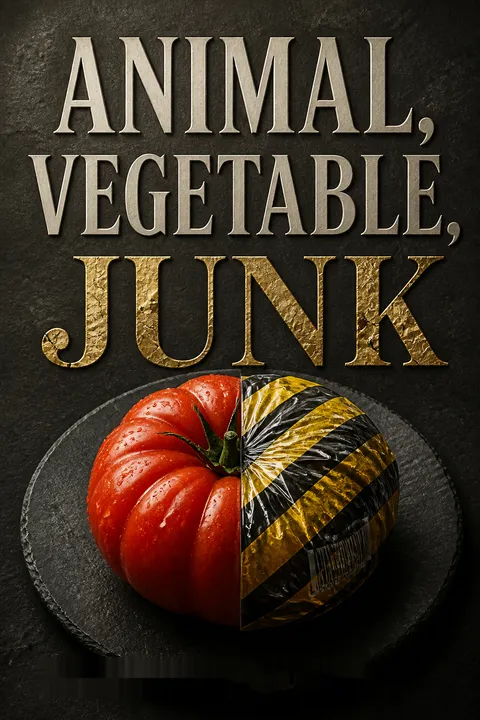
Animal, Vegetable, Junk presents a comprehensive history of agriculture and food production, critiquing modern industrial farming and processed foods. Bittman argues that our current food system prioritizes profit over health and sustainability. While some readers found the book informative and thought-provoking, others criticized it as biased and overly political. Many appreciated the historical context and calls for change, but some felt the solutions offered were inadequate. Overall, the book sparked discussions about the complex relationships between food, politics, environment, and human health.
People Also Read


Glossary
Agriculture Treadmill
Cycle of costly expansionA cycle in which farmers adopt new machinery, seeds, or chemicals to raise output, but widespread adoption increases supply and pushes prices down. Farmers then expand or borrow more to maintain income, while equipment and input companies often capture a steadier share of the gains. The term highlights how innovation can leave average farmers no better off.
agroecology
Ecological, justice-centered farmingAn approach that applies ecological principles to farming through practices such as crop rotation, cover crops, composting, intercropping, and beneficial relationships among plants and animals. In the book, agroecology also means a wider commitment to social justice, farmer control, fair labor, local food systems, and responsible stewardship of land. It is presented as broader than organic certification.
food sovereignty
Community control of foodThe principle that people and communities should have meaningful control over how food is produced and distributed. In the book, it includes access to land for those who farm, the ability of farmers to decide what they grow, and the right of communities to support food systems suited to their needs rather than being governed solely by distant markets.
ultra-processed foods (UPFs)
Heavily reformulated food productsFoods transformed well beyond basic preparation, often assembled from refined ingredients and additives rather than recognizable whole foods. The book uses the term for products engineered for shelf life, convenience, and strong consumer appeal, frequently containing combinations of refined starches, sugars, fats, salt, and flavorings. It distinguishes these products from minimally processed foods such as plain oatmeal.
Green Revolution
High-input crop intensificationThe spread, especially from the mid-twentieth century, of high-yielding crop varieties alongside irrigation, chemical fertilizers, pesticides, machinery, and credit. The approach increased yields in some regions, but the book argues that its benefits often favored wealthier farmers and input companies, while creating debt, ecological damage, and dependence on export markets.
concentrated animal feeding operation (CAFO)
Large-scale confined livestock facilityAn industrial system that raises large numbers of animals in confined spaces and relies on purchased feed, mechanized handling, and concentrated production. The book describes CAFOs as creating serious concerns involving animal welfare, waste, pollution, antibiotic use, worker safety, and nearby communities. Their scale can make meat production cheaper while shifting environmental and health costs onto others.
bliss point
Optimized flavor appealA carefully calibrated combination of ingredients, especially sugar, salt, fat, and flavorings, designed to make a product especially appealing. The book describes food companies using repeated taste tests and measurements of consumer response to refine products. The concept illustrates how product design can encourage repeated consumption, rather than simply responding to a fixed preference.
Three Sisters
Complementary Indigenous crop systemA traditional planting system that combines corn, beans, and squash. Corn provides support for climbing beans, beans host microbes that add usable nitrogen to soil, and squash leaves shade the ground and help retain moisture. The crops support one another while providing a varied food supply, offering an example of productive farming based on ecological relationships.
About the Author


Download PDF
Download EPUB
.epub digital book format is ideal for reading ebooks on phones, tablets, and e-readers.








