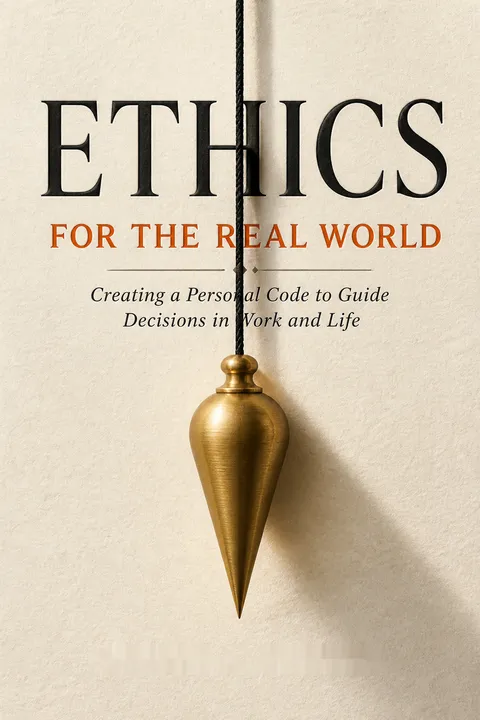


Key Takeaways
Treat small ethical shortcuts as rehearsals for larger betrayals
Compromise is ordinary. Ronald Howard’s turning point came when a defense contractor implied that the analysis of competing fighter planes should reach a predetermined answer. Howard refused the contract rather than manipulate the work. The temptation was not a villain’s grand scheme. It was a lucrative invitation to cut a corner, the same shape as the everyday lie told to avoid embarrassment or the small expense quietly charged twice.
Small lapses travel. In one study cited by the authors, college participants reported about two lies a day, while community participants reported about one. The authors argue that each tolerated exception makes the next easier to excuse. The cost is not only a damaged self-image: people who conceal a lapse must guard their story, and others lose information they need to make their own decisions.
The strongest part of this argument is its attention to accumulated habits rather than spectacular villains. A small deception can train someone to treat personal convenience as a sufficient reason to withhold information. It can also make future candor feel more expensive, since admitting one falsehood exposes the earlier one. Still, not every omission is equivalent: privacy, discretion, and protection from abuse can justify withholding information. The useful test is whether silence preserves a legitimate boundary or manipulates another person’s choices.
Do not mistake a prudential squeeze for an ethical dilemma
Separate the questions. The book distinguishes three dimensions of an action: prudential, or what serves a person’s interests; legal, or what the rules permit; and ethical, or what the person believes is right. These dimensions can point in different directions. An act may be legal and advantageous while still being wrong. The University of Colorado kept a football victory after officials mistakenly gave the team an extra down. The result stood under the sport’s rules, but the authors ask whether retaining a win earned through an error was fair to the opponent.
Most dilemmas are temptations. A manager who lies to protect a bonus usually faces a conflict between self-interest and honesty, not two equally binding ethical duties. Separating those pressures makes the real choice easier to see. The authors also distinguish negative ethics, clear prohibitions such as not stealing, from positive duties to help, whose limits are harder to define.
This separation is useful because people often use legality as a moral alibi or describe an uncomfortable trade-off as an ethical emergency. Naming the prudential incentive can expose the actual pressure: money, status, convenience, or loyalty. The distinction also helps prevent every difficult personal choice from being moralized. Yet legal institutions and personal interests can be morally relevant, not merely distractions. The framework works best as a diagnostic, a way to clarify what is at stake, rather than a claim that law and practical consequences never matter ethically.
Choose your ethical logic before outcomes tempt you to switch sides
Set the standard early. Action-based ethics judges whether the act itself follows a principle, regardless of the result. Consequence-based ethics judges an act by its expected effects, often asking whether it produces greater overall benefit. The difference matters under pressure. In Nazi Germany, Kurt Gerstein joined the SS hoping to expose atrocities, but also carried out orders involving poison gas. His aim to limit greater evil did not erase his participation in harm.
Forecasts are not facts. Google chose to offer a censored search service in China, reasoning that access to some information might be better than none. That consequentialist case depended on uncertain predictions about benefit and cost. The authors warn that people often switch ethical logics when the convenient one supports a desired choice. Phrases like “everyone does it” and “someone else would do worse” can be signs of rationalization, a justification built to soothe rather than test a decision.
The contrast makes visible a tension that everyday reasoning often hides: rules protect people from convenient exceptions, while attention to consequences can reveal harms that rigid rules overlook. Either approach can be abused. A rule can ignore a foreseeable catastrophe, and a claimed greater good can disguise private advantage. The practical value lies in making the reasoning explicit before the decision is made. For consequence-focused choices in particular, uncertainty deserves scrutiny: confidence in a good intention does not make a forecast reliable.
Write a short code for the temptations you actually face
Make principles personal. Religious teachings, family habits, professional rules, and admired role models all offer ethical touchstones, but they may conflict or leave gaps. A student named Ali Hasan, for example, valued his religious tradition while rejecting nepotism he had seen in business. Reflection helped him decide which inherited principles he wanted to make his own.
Build a usable guide. The authors recommend drafting standards, testing them, and refining them. Begin with recurring temptations such as deception, theft, and harm, then add personally relevant situations. Test each rule for reciprocity, asking whether the same standard would seem fair if applied to oneself, and universality, asking whether everyone could follow it. Keep the code focused and livable. Clear prohibitions are easier to apply than unlimited positive duties, such as an undefined promise to help everyone in need. A code should guide action, not serve as a list of ideals no one can keep.
A written code can reduce the mental bargaining that happens when a tempting opportunity arrives. It also forces abstract values into decisions about actual behavior, including uncomfortable questions about favoritism, confidentiality, and professional loyalty. The emphasis on a livable code is important: a standard that is repeatedly broken may teach its author to distrust the entire system. At the same time, a personal code is not self-validating. Reciprocity and universality help challenge self-serving rules, but communities and affected people can reveal blind spots that solitary reflection misses.
Frame the real ethical question, then create more than two options
Slow down the frame. The book’s decision process has three steps: clarify the ethical issue, generate alternatives, and evaluate them. In a clinical trial of the experimental drug TGN1412, six healthy volunteers were dosed close together and suffered severe reactions. The authors ask whether researchers had adequately considered the risks and whether they could have delayed dosing to learn from the first response.
Escape false binaries. A parent tempted to secretly read a teenager’s email might frame the choice as privacy versus safety. Neutral wording reveals a more specific question: whether to access someone else’s messages without permission. The parent can then consider alternatives such as talking with the teenager or asking to review the messages together. The book recommends generating several options before judging them, including ordinary compliance, a response modeled on a respected person, and an option that treats the other person as a loved one.
Problem framing is not a cosmetic first step. It determines which facts become visible and which choices seem possible. A binary frame often makes one value appear to require violating another, while a broader frame can uncover conversation, consent, delay, or a change in procedure. This is especially valuable in organizations, where the first version of a problem may reflect the interests of whoever has authority. More alternatives do not guarantee a sound choice, however. They matter when the evaluation still attends to power, risk, and the people who bear the consequences.
Tell the whole truth to protect relationships, not just transactions
Find the truth beneath the excuse. The book’s “whole truth” means acknowledging not only the facts but also the motives and fears driving a misleading answer. A man meeting his future mother-in-law pretended to enjoy her rhubarb pie. That small lie became a routine he maintained for decades, while she kept baking the dish for him. He could instead have thanked her for the welcome and honestly admitted he disliked rhubarb.
Candor needs care. Telling the whole truth does not mean answering every question or speaking cruelly. It means avoiding a false impression while communicating with attention to the relationship. The same logic applies to missed promises: explain the problem and renegotiate rather than quietly disappearing. Secrets deserve boundaries too. Before agreeing to keep one, clarify how long it will be kept and what circumstances could require disclosure.
The rhubarb story captures how a lie can become a maintenance obligation: the original discomfort passes, but each repetition renews it. Honest disclosure can prevent that debt and give another person a chance to respond to the real situation. The phrase “whole truth” is most useful when paired with care and relevance. Unfiltered disclosure can harm or overwhelm, and not every private thought belongs in a conversation. The challenge is to be candid about facts that materially affect another person without confusing honesty with bluntness.
Choose workplaces whose ordinary incentives do not demand self-betrayal
One conscience goes to work. The authors reject the idea that personal and business ethics belong to separate selves. Professions and organizations create distinctive pressures, so they advise examining the people in charge, everyday practices, and ethical codes before joining. The central question is how close a person is to conduct they consider wrong, and whether that proximity is acceptable.
Transparency can build trust. At start-up Outcome Software, founder Clint Korver told employees when the company was short of cash and explained how payroll would be handled if the shortage continued. Three times the company froze pay, once for four months. Only one of twelve employees left during those periods. The authors present this openness as a way to let employees make informed choices and share responsibility, rather than keeping them uninformed for the company’s convenience. When an organization’s demands conflict with personal principles, leaving may be the most honest option.
This workplace argument moves ethics beyond individual character and toward institutional design. Transparent communication gives employees more agency, while clear incentives can either reward honest reporting or make silence safer. The story also shows why trust is not simply a warm feeling: it affects whether people understand risk and choose to stay. Still, openness alone cannot repair every workplace or make unequal burdens fair. Ethical culture requires more than candor from a leader. Employees need meaningful ways to question decisions without being punished for raising problems.
Practice ethical judgment until integrity becomes your default response
Turn decisions into habits. The book treats ethical skill as something practiced, not a trait possessed only by unusually virtuous people. Rehearsing self-examination, applying a personal code, and considering alternatives can make thoughtful responses more available under pressure. Its model of a “growth choice” is to select, among acceptable options, the action that best develops character and relationships.
Courage can be practiced. During the 1937 Nanking massacre, German businessman John Rabe helped organize a safety zone that sheltered Chinese civilians and intervened against violence, despite his position as a Nazi Party leader in the city. His actions illustrate how a person can refuse the easy role assigned by an organization and act to protect others. Most people will face smaller tests, but repeated choices shape what feels possible when the stakes rise.
The book’s hopeful premise is that integrity can become more automatic through repeated practice, much as complex skills become easier with rehearsal. That view counters the idea that ethical conduct belongs only to saints or exceptional personalities. It also makes small decisions consequential because they train attention and response. Habit is not destiny, though. A person can act well in one setting and fail in another when authority, fear, or incentives change. Practice is strongest when paired with environments that make ethical action possible.
Analysis
The book’s distinctive move is to treat ethics as a decision skill rather than a sermon about admirable character. Its engineering sensibility appears in the sequence: recognize recurring temptations, separate types of problems, write a usable personal code, and rehearse a decision process. This practical structure makes philosophical distinctions more accessible. The book is especially persuasive when it shows how vague framing and self-serving language narrow a person’s choices before any explicit decision is made. Its strongest insight may be relational: deception is not merely a blemish on the deceiver’s character, it deprives another person of information and agency.
That emphasis also reveals the approach’s limits. The authors define their scope around actions involving deception, theft, and harm to other people, which makes the framework tractable but leaves some moral questions at the margins. Ecological damage, institutional injustice, and harms without an easily identifiable victim can be difficult to assess through a primarily interpersonal lens. The emphasis on personal codes can also imply that better individual reasoning is enough, when incentives, hierarchy, and retaliation may constrain what employees can safely do. The book acknowledges social pressure, yet its practical advice works best where people retain meaningful choice.
Its division between action-based and consequence-based ethics is useful as a warning against opportunistic reasoning, but real decisions often draw on both. A person may hold firm constraints while still weighing uncertain outcomes within those boundaries. Likewise, telling the truth can protect another person’s agency, but privacy, safety, and power differences can make disclosure harmful. The book’s insistence on examining motives and relationships helps with these complications, even if no checklist resolves them automatically. Its lasting contribution is less a universal code than a disciplined pause: name the pressure, identify who is affected, test the story being told, and search for a response that can be defended without hiding its costs.
Review Summary
Ethics for the Real World receives mixed reviews. Some readers find it practical and life-changing, praising its real-world examples and step-by-step approach to developing a personal ethical code. Others criticize it for lacking depth and failing to provide a comprehensive ethical system. The book is commended for its readability and down-to-earth style, making ethics accessible to a broad audience. However, some reviewers feel it oversimplifies complex ethical issues and doesn't adequately address moral trade-offs. Overall, it's seen as a good introduction to ethics for beginners but may disappoint those seeking more advanced philosophical discussions.
People Also Read







Glossary
Ethical space
People included in concernThe circle of people whose welfare and interests are considered when making an ethical decision. It may include family, coworkers, a community, or people farther away who are affected indirectly. Making the boundary explicit matters because the same action can seem acceptable when only close relationships are considered and harmful when its wider effects are included.
Action-based ethics
Judge the act itselfAn approach that evaluates whether an action follows an ethical principle, rather than whether it produces a favorable result. A person using this approach might commit to not lying even when a lie appears useful. In the book, this contrasts with consequence-based ethics, which assesses actions by their expected effects.
Consequence-based ethics
Judge expected outcomesAn approach that evaluates an action by the consequences it is expected to produce, often seeking the greatest overall benefit. Because outcomes are uncertain, the decision depends on forecasts and judgments about whose welfare counts. The authors warn that this approach can be distorted when a person overstates benefits or minimizes ethical costs to justify a preferred action.
Negative ethics
Clear prohibitionsEthical standards framed as actions that must not be done, such as lying, stealing, or harming. The book treats these as comparatively clear because a person can often determine whether a specific act violates the rule. This contrasts with positive ethics, which require beneficial action and often leave uncertain how much effort or help is enough.
Positive ethics
Duties to do goodEthical standards that require action to benefit others, such as feeding people in need or preventing harm. They can be difficult to define because they rarely specify how much help is required or where the obligation ends. The book recommends distinguishing these commitments from broader aspirations so ambitious goals do not blur clear prohibitions.
Whole truth
Facts, motives, and fearsA way of communicating that includes relevant facts while also acknowledging the speaker’s intentions, concerns, and reasons for feeling tempted to mislead. It is meant to replace false impressions with candid, relationship-aware communication. It does not require answering every question or speaking without tact; a person can decline to disclose information while being honest about that refusal.
Quality commitment
Mutual, clear agreementA commitment in which the requester and the person promising share an understanding of the task and agree on what successful delivery means. The promise must be feasible in light of the promisor’s time, skills, and resources, with expectations for timing and quality made clear. A knowingly unrealistic promise or request can create an avoidable breakdown and raise ethical concerns.
Growth choice
The most relationship-building optionAn option selected from several ethically acceptable alternatives because it offers a stronger opportunity for personal or interpersonal development. Rather than stopping at minimum compliance, a person considers which response could improve character or strengthen a relationship. The idea does not mean every dilemma has an elegant solution or that a person must choose the most demanding option.
FAQ
What's Ethics for the Real World about?
- Ethical Decision Making: The book focuses on mastering ethical distinctions to enhance clear thinking and disciplined decision-making.
- Personal Ethical Code: It guides readers in creating a personal code to navigate ethical dilemmas in both work and life.
- Real-World Applications: Authors Ronald A. Howard and Clinton D. Korver provide practical tools for making ethical decisions in everyday situations.
Why should I read Ethics for the Real World?
- Skill Development: It offers a systematic approach to developing ethical reasoning skills, enhancing personal integrity and relationships.
- Practical Framework: The book provides a structured framework for addressing ethical challenges, making complex situations easier to navigate.
- Real-Life Examples: Relatable scenarios and historical examples illustrate the consequences of ethical compromises, making lessons impactful.
What are the key takeaways of Ethics for the Real World?
- Awareness of Ethical Compromise: Readers learn to recognize common ethical temptations and their unintended consequences.
- Importance of Distinctions: The book stresses distinguishing between prudential, legal, and ethical dimensions of actions.
- Creating a Personal Code: It guides readers through drafting, testing, and refining their own ethical codes to guide behavior.
What are the best quotes from Ethics for the Real World and what do they mean?
- "Man has a natural aptitude for virtue...": Highlights the need for conscious effort and practice in developing ethical behavior.
- "The chains of habit are too weak...": Emphasizes how small ethical compromises can lead to larger issues if not addressed early.
- "The evil that is in the world...": Underscores the importance of understanding ethical principles to avoid unintentional harm.
How does Ethics for the Real World define ethical compromise?
- Common Ethical Temptations: Identifies deception, stealing, and harming as main categories leading to compromises.
- Slippery Slope: Explains how small compromises can create a pattern of unethical behavior.
- Impact on Relationships: Ethical compromises affect personal integrity and create barriers in relationships.
What is the process for creating a personal ethical code in Ethics for the Real World?
- Drafting Standards: Identify key ethical issues and outline principles regarding deception, stealing, and harming.
- Testing Standards: Evaluate standards against ethical role models and apply tests for reciprocity and universality.
- Refining the Code: Clarify degrees of separation, draw sharper lines for positive ethics, and consider a hierarchy of principles.
What are the distinctions between prudential, legal, and ethical dimensions of actions in Ethics for the Real World?
- Prudential Dimension: Relates to self-interest and practical considerations like financial gain or personal loyalty.
- Legal Dimension: Involves the law and whether an action is lawful, which may not always align with ethical considerations.
- Ethical Dimension: Focuses on what is right or wrong according to one’s beliefs, requiring deeper reflection beyond legality or practicality.
What specific methods does Ethics for the Real World recommend for ethical decision-making?
- Three-Step Process: Clarify the ethical issue, create appealing alternatives, and evaluate those alternatives.
- Testing Alternatives: Use principles of reciprocity and universalizability to ensure decisions are fair and just.
- Characterizing Consequences: For consequentialists, assess uncertainties and evaluate trade-offs for each alternative.
How does Ethics for the Real World address the concept of reciprocity?
- Reciprocity as a Test: Evaluates ethical alternatives by considering how you would want to be treated in similar situations.
- Raising the Bar: Encourages considering how loved ones should be treated, leading to more compassionate decisions.
- Transforming Relationships: Applying reciprocity can turn ethical challenges into opportunities for strengthening relationships.
What role do ethical role models play in Ethics for the Real World?
- Guidance for Behavior: Serve as benchmarks for acting in challenging situations, providing examples of integrity.
- Inspiration for Personal Codes: Help shape personal ethical codes by resonating with readers' principles.
- Testing Alternatives: Considering what a role model would do can clarify the best course of action.
How does Ethics for the Real World suggest handling secrets?
- Criteria for Accepting Secrets: Be cautious and clarify the ability to keep secrets in advance to set clear expectations.
- Time Limits on Secrets: Suggests putting time limits on secrets to avoid indefinite burdens.
- Communicating Exceptions: Emphasizes notifying others about exceptions to confidentiality for safety or legal reasons.
What role does personal growth play in Ethics for the Real World?
- Ethical Sensitivity: Personal growth is tied to developing sensitivity to recognize and navigate ethical dilemmas.
- Transforming Temptations: Encourages viewing ethical challenges as opportunities for growth, not obstacles.
- Continuous Reflection: Advocates for ongoing reflection and refinement of ethical codes for personal growth and integrity.
Download PDF
Download EPUB
.epub digital book format is ideal for reading ebooks on phones, tablets, and e-readers.








