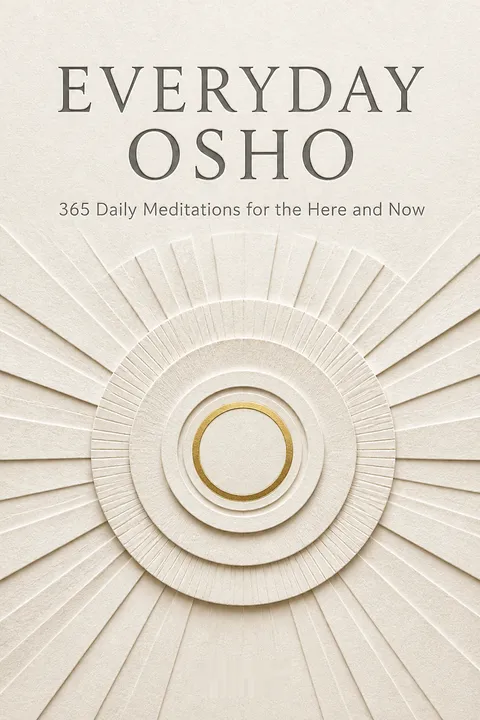


Key Takeaways
Meditation begins by noticing the mind, not decorating it
Attention, not ritual. Osho defines meditation as awareness: noticing thoughts, memories, desires, and reactions instead of being carried along by them. He distinguishes this from chanting or repeating a mantra. Such practices can calm the mind, he allows, but calm is not the same as insight. The aim is to make unconscious habits visible to attention.
Light in the house. Osho pictures awareness as a small lamp in a largely unlit mind. Practice is not about adding a grand belief; it is about letting observation reach the overlooked corners of experience. In his account, this changes the texture of ordinary life, making familiar things feel vivid and meaningful. His description is a spiritual metaphor, not a scientific measurement of conscious and unconscious thought.
The useful distinction is between a calming practice and an attentive one. Repetition, breath, or ritual may settle distraction, but they do not automatically produce curiosity about what the mind is doing. Contemporary mindfulness programs also emphasize noticing thoughts without treating them as facts, which makes this approach practical beyond religious settings. The metaphor of illumination is compelling, though the claim that awareness reveals a deeper spiritual truth cannot be verified by attention alone. Observation can clarify experience without proving a metaphysical explanation for it.
Name moods lightly, so a label does not become a command
Watch the shift. Osho argues that moods can change even when circumstances stay much the same. His exercise is to observe a mood without immediately calling it happiness or misery. He suggests assigning moods neutral labels, such as A and B, for a week. The label creates a little distance: instead of clinging to a good feeling or resisting a bad one, a person can notice each as a passing state.
A view from a hill. The image is of watching weather move through a valley. The observer sees sun, clouds, and darkness without deciding that any one condition defines the whole landscape. Osho connects misery to habitual complaint, but this should not be mistaken for saying that external hardship has no effect on well-being.
Neutral naming can interrupt the automatic loop between feeling and action. Research on affect labeling suggests that putting an emotion into words can sometimes reduce its intensity, although results depend on the person and situation. Osho's exercise is especially useful because it asks for observation before interpretation. Its limit is the claim that feelings are primarily internal. Poverty, illness, discrimination, and loss are not merely excuses for a mood. A more balanced application distinguishes the event, the feeling it evokes, and the response still available.
Let feelings move through you without letting them choose your actions
Feel without dividing. Osho sees rigid control as a source of inner conflict. One part of a person feels anger or sadness, while another insists that the feeling must not exist. He argues that acknowledging an emotion can reduce this split. A child who becomes furious, then returns to play, illustrates his ideal of fully experiencing a feeling without carrying it indefinitely.
Energy needs direction. Osho also suggests that some anger may be unused creative energy, and recommends putting energy into work or art that matters. The practical lesson is not to obey every impulse or make other people absorb it. A feeling can be noticed in the body, expressed safely, and followed by a considered choice. Awareness gives emotion room without handing it the steering wheel.
This resembles a valuable distinction in emotion regulation: suppressing a feeling is different from choosing what to do with it. Acknowledgment can reduce shame and make a response more deliberate. But emotional expression is not automatically healing, and catharsis can reinforce anger when it rehearses aggression. The section is strongest when read as permission to feel, not permission to act without restraint. Creative work may redirect energy for some people, but anger can also signal a violated boundary or an unsafe situation that needs practical attention.
Reopen your work to surprise before skill hardens into repetition
Skill can go stale. Osho observes that beginners often bring fresh attention to a task, while experts may repeat what already works. He does not reject skill; he warns against mistaking fluency for continued discovery. When familiar work loses its vitality, he advises changing the method, adding something new, or starting again as a learner.
Failure can teach. The book tells a story of Edison continuing an experiment after hundreds of unsuccessful attempts. His colleagues see wasted effort; Edison sees information about approaches that do not work. The point is to treat exploration as learning rather than judge it only by immediate success. The anecdote captures Osho's ideal of staying curious, though it should not be read as proof that expertise prevents discovery.
The advice resembles the idea of beginner's mind: deliberate attention can expose options that routine hides. It also fits creative practice, where constraints and variation help prevent work from becoming mechanical. Yet expertise is not simply the enemy of innovation. Deep knowledge often helps people recognize which experiments are promising and which repeat known failures. The strongest interpretation is not to discard mastery, but to keep testing its assumptions. Periodic novelty is useful when it renews attention rather than serving as an escape from the difficult work of refinement.
Build intimacy from openness, not possession or constant access
Love needs room. Osho describes love as fragile and vulnerable to repeated conflict, suspicion, and demands for reassurance. He pairs intimacy with inner independence: meditation develops a sense of self that can be shared, while love brings that self into relationship. In this view, closeness is not the same as constant access. Time apart can keep two people from treating each other as fixtures.
Trust without blindness. Osho strongly favors openness, even at the risk of being deceived. His larger point is that fear can close a person off from affection and friendship. Yet openness does not require accepting mistreatment. A relationship can be generous and emotionally honest while still having boundaries, mutual consent, and consequences for harmful behavior.
The emphasis on space corrects a familiar confusion: dependence is not proof of devotion. Secure relationships tend to make room for both connection and individual agency. The more provocative advice to trust despite possible deception is better treated as an ideal of noncynicism than as a rule for managing danger. Trust is valuable because it allows cooperation, but it is also calibrated through evidence and repaired through accountability. Openness becomes sustainable when it is paired with discernment, not when one person is asked to absorb repeated harm.
Treat ordinary moments as the raw material of spiritual practice
Attention changes the ordinary. Osho locates spiritual life in daily experience rather than only in temples or formal ceremonies. He recommends noticing small pleasures and sources of gratitude, from breathing to sharing food. A tea ceremony makes the point: an everyday act can become deliberate and attentive without needing an elaborate doctrine.
Look where you are. The book retells a Zen story in which a monk asks what true religion is. A master points him toward a cypress tree in the courtyard. The answer redirects attention from abstract explanation to what is present. Osho uses similar advice for sadness, noise, or stillness: notice the actual experience rather than condemn it first. The practice is not to pretend every circumstance is pleasant, but to meet it directly.
This approach turns attention into a daily resource rather than a special event. Ritual studies and mindfulness practice both show how repeated, focused actions can acquire significance without changing their practical purpose. The cypress story is memorable because it refuses to let a question about life become a substitute for living. Still, reverence for the present should not become spiritual bypassing. Not every hardship needs to be transformed into a blessing; some conditions call for grief, help, or change as well as attention.
Accept yourself without freezing yourself into an ideal or label
Drop the imaginary finish line. Osho rejects self-improvement when it means forcing oneself to resemble an ideal such as a saint or sage. He argues that ideals can turn ordinary limitations into evidence of personal failure. Acceptance, in his account, makes room for change because it stops wasting energy on self-condemnation.
Notice the inherited script. The book describes identities such as nationality, religion, and gender roles as layers of conditioning. A person may learn that certain emotions or interests are unacceptable before having the chance to discover what feels authentic. Osho urges readers to examine these assumptions rather than mistake them for the self. This is not a claim that identity or social obligations are unreal; it is an invitation to hold them less rigidly and act with greater awareness.
Self-acceptance can reduce the shame that makes change feel like self-erasure. It also invites a useful question: which parts of identity are chosen, and which were assigned before choice was possible? But rejection of ideals can go too far if it treats every aspiration as oppressive. Some standards protect other people, and some goals express deeply held values. Acceptance works best as a starting condition for honest growth, not as a shield against feedback or responsibility.
Keep meditation embodied and woven into work, love, and rest
Use the whole day. Osho warns against turning either work or spirituality into a twenty-four-hour identity. He offers a rough example of spending several hours on work, with time also reserved for relationships, meditation, music, sleep, and play. The exact schedule is less important than refusing to let a profession consume every part of life.
Return to the body. The book also treats breathing, posture, and bodily rhythm as entry points to attention. Osho recommends sensing the lower abdomen, which he calls the hara, as a way to feel more centered. These are experiential instructions, not medical claims. His broader principle is to alternate inward quiet with active participation, rather than assuming that meditation requires withdrawal from ordinary life.
The balance between inward attention and outward participation is one of the collection's most practical safeguards. Reflection can become avoidance when it is detached from work, relationships, and bodily needs. Contemporary approaches to mindfulness similarly emphasize that awareness can be practiced during ordinary activity, not only in seated sessions. The specific schedule and energy language are personal prescriptions, not universal physiology. A useful adaptation is to notice whether a practice improves daily functioning and connection, rather than judging it by how detached or unusual it feels.
Let mortality make today vivid, not frantic or postponable
Remember the limit. Osho uses the certainty of death to challenge endless postponement. In a story about three travelers visiting Rome, the traveler with the shortest stay is called fortunate because limited time makes attention urgent. The point is not that speed is wisdom, but that an imagined abundance of tomorrows can keep people from choosing what matters now.
Choose the essential. Osho asks readers to consider what would deserve attention if little time remained. Love, meditation, and meaningful contact with life rise above status and trivia in his answer. The thought of death is meant to clarify priorities, not produce panic. His spiritual claims about what follows death are separate from this practical observation: time is limited, and no one can guarantee a more convenient moment to begin.
Mortality awareness can sharpen priorities because it exposes the cost of treating every decision as reversible. The Rome story makes scarcity productive rather than merely frightening. Yet a constant focus on death can also create anxiety or push people toward impulsive choices. The value lies in using finitude as a question, not a command: which commitments deserve time, and which are inherited habits? A grounded answer can include care, work, pleasure, and rest, not only explicitly spiritual pursuits.
Test inherited rules against lived experience, then own the choice
Experience over borrowed certainty. Osho urges readers not to outsource every judgment to scripture, tradition, or an authority. He defines maturity as observing how actions affect one's own clarity and well-being, then taking responsibility for the result. His example is a person asking an ancient divination text to decide whether to marry. Even a good outcome, he argues, would not replace the growth that comes from making the decision oneself.
Use the right tool. Osho distinguishes objective inquiry from inner observation. Critical reasoning is essential when examining the external world, he says, while direct attention matters when exploring subjective experience. This distinction is useful, but it should not become a reason to dismiss evidence. Personal experience can guide a life; it cannot by itself establish universal truth or determine how another person should live.
The call to take responsibility resists both passive conformity and the comforting fiction that someone else can make a life decision harmless. It echoes a broader principle of agency: choices become meaningful when people understand their reasons and accept consequences. Osho's contrast between science and inward experience is less secure when treated as a strict divide. Self-observation can be distorted by memory, expectation, and bias. The strongest version combines first-person honesty with critical scrutiny and respect for the evidence available to others.
Analysis
Everyday Osho is less a linear argument than a year of short provocations. Its recurring method is to unsettle an automatic response: replace judgment with observation, control with receptivity, inherited identity with inquiry, and postponed life with attention to the present. Meditation is the connecting idea, but it is not presented primarily as a seated technique. It is a way of meeting emotion, work, love, solitude, and ordinary sensation without immediately turning them into a story about success or failure.
That method gives the collection its energy and its difficulty. Osho often praises spontaneity, yet also recommends exercises, schedules, and disciplined attention. He sometimes says to accept experience, while elsewhere urging readers to change whatever makes them miserable. These tensions are not organized into a single formal system. They are best read as context-dependent prompts rather than universal laws. The reader has to decide which advice fits the situation, a task consistent with the book's emphasis on personal observation, but one that can also leave important standards unclear.
The sharpest distinction is between noticing a feeling and obeying it. The collection is persuasive when it asks readers to become less reactive and more present. It is less reliable when it treats psychological suffering as mainly self-created, or makes broad claims about health, sexuality, society, and human nature without evidence. External conditions can constrain choice, and acceptance should not be confused with tolerating abuse or foregoing treatment. Likewise, spiritual experience may matter deeply to the person having it without proving claims about cosmic reality.
Read with those limits in mind, the book offers a memorable discipline of attention: keep life open enough to surprise you, and keep enough awareness to tell openness from recklessness. Its invitation is not simply to seek calm. It is to participate more fully while loosening the demand that experience obey a fixed plan.
Review Summary
Everyday Osho receives mostly positive reviews, with readers praising its wisdom, thought-provoking content, and ability to inspire daily reflection. Many appreciate the book's concise meditations and find them applicable to various life situations. Some readers use it as a daily devotional, while others prefer to browse randomly. Critics note occasional contradictions or disagreements with certain ideas. Overall, readers find the book helpful for personal growth, mindfulness, and developing a fresh perspective on life.
People Also Read






Glossary
Meditation
aware observationOsho uses meditation to mean conscious observation of inner and outer experience, rather than a particular ritual or method. Thoughts, memories, and emotions are noticed without automatically following or condemning them. In this account, practices may help settle attention, but meditation itself is a quality of awareness that can extend into ordinary activity.
Choiceless awareness
witnessing without preferenceA way of observing thoughts and feelings without selecting some for approval and others for rejection. Osho presents this nonjudgmental witnessing as central to meditation: the observer neither indulges a thought nor fights it, but notices it as it arises and passes. The term describes a practice of attention, not a claim that all thoughts are equally wise or harmless.
Satori
a glimpse of awakeningA term from Zen Buddhism that Osho uses for a sudden glimpse of illumination or expanded awareness. He distinguishes such a brief experience from a lasting transformation of one's way of being. He advises noticing the circumstances around a glimpse, rather than clinging to the experience or assuming it can be forced to recur.
Hara
lower abdominal centerA Japanese term associated with the lower abdomen, used in traditions of meditation and bodily practice. Osho treats the area below the navel as a center of grounding and energy. He suggests attending to it through breathing and bodily awareness. This is a contemplative model, not a claim that the abdomen contains a distinct anatomical energy organ.
Anand
bliss beyond oppositesA Sanskrit term for bliss, which Osho distinguishes from ordinary pleasure. Pleasure and pain are opposing experiences that change with circumstances; anand is described as a deeper state that is not defined by either opposite. The term belongs to a spiritual account of consciousness and cannot be reduced to a temporary good mood.
Monodrama
one person, many inner rolesOsho's term for the inner situation in which one person occupies multiple roles, such as the one who gives an instruction and the one who receives it. He uses the idea to describe self-observation and inner dialogue. Unlike a play with separate actors, the inner observer and the person being observed are aspects of the same individual.
Zorba the Buddha
pleasure joined with awarenessOsho's description of an ideal person who combines enjoyment of embodied, everyday life with contemplative awareness. The phrase joins the sensual vitality associated with Zorba the Greek to the stillness associated with Gautama Buddha. It summarizes a refusal to treat worldly pleasure and spiritual practice as mutually exclusive.
About the Author
Other books by Osho









Download PDF
Download EPUB
.epub digital book format is ideal for reading ebooks on phones, tablets, and e-readers.








