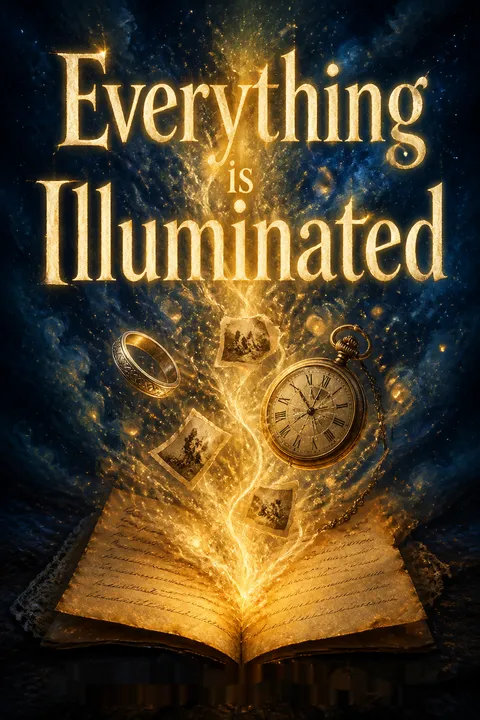


Plot Summary
Three Alexanders Set Out
Alex Perchov, a young Ukrainian who performs confidence more easily than English, is recruited by his father’s heritage-tour company to translate for Jonathan Safran Foer. Jonathan is an American Jew seeking the village where his grandfather grew up and the woman said to have saved him during the war.
Alex’s grandfather, also named Alexander, must drive them, though he claims blindness and has barely recovered from his wife’s death. He insists on bringing Sammy Davis, Junior, Junior, a disorderly dog presented as his seeing-eye companion.
Alex wants adventure, money, and eventually a life in America with his younger brother, Little Igor. His father treats the assignment as an obligation, while Grandfather treats it as an unwelcome return to a place he refuses to discuss.
The Perchov household introduces a family in which affection rarely arrives without force or evasion. Alex performs a worldly masculinity he does not possess, while his father tries to direct his future through blunt commands. Grandfather’s claimed blindness is already a form of concealment, and his grief makes the trip more than a driving job. Alex’s dream of America is not simple ambition: he imagines taking Little Igor with him, turning escape into a promise of care. The road journey begins because several people want something different from it, though none can yet say what they need.
The Photograph's Missing Name
At the train station, Alex finds Jonathan shorter and less imposing than the Americans he has imagined. Their first hours together are awkward: Alex translates around Grandfather’s irritation, while Sammy Davis, Junior, Junior torments Jonathan in the back seat.
Jonathan explains that a photograph shows his grandfather beside a family who helped him escape the Nazis. An inscription names a girl, Augustine, but offers no explanation of what she did or where she went. Jonathan hopes to find her near Trachimbrod, the vanished shtetl his grandfather came from.
Alex promises they will succeed, though the promise is meant as much to steady himself as Jonathan. As they exchange letters and pages of Jonathan’s developing book, their uneasy working relationship begins to turn into a friendship shaped by what each man cannot say plainly.
The photograph gives the journey a concrete object but not a reliable map. Its inscription seems to settle a name, yet the missing context makes the image a source of projection for both men. Jonathan imagines a debt he can repay by finding Augustine; Alex imagines the trip as proof that his ordinary life can open outward. Their initial misunderstandings are not merely comic obstacles. They expose how each man reads the other through inherited stereotypes, then revises those assumptions through practical dependence. Their letters add a second journey: Alex is learning to write himself, while Jonathan is asking him to help shape a story about family.
A Baby from the Brod
In Jonathan’s imagined history, a wagon plunges into the Brod River in 1791, and the villagers gather to argue over what happened. They find no body, only a strange scatter of belongings, until Hannah spots a newborn girl among the debris. The Well-Regarded Rabbi takes responsibility for her and asks the men of the shtetl to become her father.
The disgraced usurer Yankel is chosen, and he brings the baby home, speaking to her as if every ordinary object deserves a name. He has already lost children and a wife, and the child gives him a reason to care for someone again. When the village must choose an official name, a lottery settles on Sofiowka, but a second vote gives the community its chosen name: Trachimbrod.
The river birth makes origin itself uncertain. The villagers can record what they see, but cannot explain how a baby appears among the remains of a drowned wagon. Their argument does not solve the mystery; it creates a community around it. Yankel’s adoption is likewise an act of care mixed with private need. He gives Brod a home, but also receives a chance to imagine himself innocent again. The village’s two names show how public labels and chosen identities diverge. Trachimbrod begins not with certainty, but with a shared decision to keep living beside what cannot be known.
The Girl Behind the Bead
Brod grows into a brilliant, lonely girl whom the women distrust and the men desire. Yankel tells her that her mother died in childbirth, invents memories of a marriage that never happened, and hides the note his own wife left when she escaped with another man.
Brod becomes a reader, gardener, and maker of clothes, while studying sadness as carefully as other people study scripture. She and Yankel build a private world of tenderness, including the small abacus beads each wears to belong to the family they have made.
At the same time, Brod cannot make the outside world feel worthy of her love. She relies on the men who gather at her window, not because she loves them, but because their attention helps her endure a life she cannot honestly embrace.
Brod and Yankel sustain each other through stories that protect them and confine them. Yankel’s invented family history is an act of mercy toward a child, but it also keeps his shame and her origin beyond discussion. Brod senses the gap between the world she wants and the one available to her, then turns that gap into an intellectual discipline. Her catalogue of sadnesses is not detached cleverness; it is an attempt to make pain legible when affection cannot cure it. Their beads mark chosen kinship, but they cannot erase the difference between love and truth.
Trachimday Turns Brutal
During Trachimday in 1804, Brod serves as Float Queen while Yankel watches from home, troubled by the men’s attention to her. On her way back, the mad squire Sofiowka assaults her. She returns to find Yankel dead, still clutching a scrap of writing and his abacus bead. Shalom, a young man from Kolki who has won the golden sack, arrives at her window and refuses to leave without her.
Brod agrees to marry him only after making him deal with Sofiowka. The squire is found dead the next morning, his hands severed and his body marked by Brod’s lipstick. Shalom becomes the first person to meet her grief without pretending it is harmless, and Brod leaves the sanctuary she shared with Yankel for a marriage she chooses on her own terms.
The festival turns Trachimbrod’s communal celebration into a scene of private violence. Brod’s public role as an admired symbol cannot protect her from the men who treat her as an object. Yankel’s death removes the one person who helped her make a livable world, leaving Brod to decide what kind of protection she can accept. Her condition to Shalom is both a demand for justice and a way to regain agency after the assault. The revenge does not restore her old safety, but it prevents the village from treating what happened as another spectacle to consume.
A Hole Between Them
After Brod marries Shalom, a disk-saw blade lodges in his head at the flour mill. He survives, but the injury changes his temper, and the loving husband begins to beat her. Doctors warn that removing the blade would kill him, so Brod stays, making a small opening in the wall between their rooms through which they can speak and touch without meeting face to face.
Their final intimacy comes through that barrier, as Shalom weakens and Brod becomes pregnant with their third son. Before he dies, he tells her Yankel was not her biological father. Brod names the baby Yankel, as she named the two sons who died in the mill. The child continues the family line, carrying forward a history assembled from loss, affection, and secrets.
The blade makes the body an unreliable container for character: Shalom’s injury does not excuse his violence, but it fractures the man Brod loved from the man who harms her. The wall gives them a form of intimacy that neither marriage nor physical closeness could sustain. Their final connection depends on distance, patience, and the recognition that they cannot repair everything. Shalom’s disclosure arrives too late to give Brod a secure origin, yet it also confirms that the family she knew was real in its care, even if not in its biology. The repeated name Yankel turns grief into continuity.
The Arm That Attracted
Generations later, Jonathan’s grandfather Safran grows up with a useless right arm, the result of being born with teeth and receiving too little nourishment. Women are drawn to the limb, and Safran turns their attention into a long series of affairs with widows and young women. None matters to him as much as the Gypsy girl he meets at the theater.
For seven years they share jokes, secrets, and a private life in the forest, but Safran keeps her apart from his family and refuses to imagine a future they could choose together. When his parents arrange his marriage to Zosha, he tells the Gypsy girl he has no choice. She asks him to change his life; instead, they stop speaking and let the arranged wedding proceed.
Safran’s arm becomes both a bodily difference and a screen on which others project desire, pity, and power. His affairs let him be wanted without requiring him to be known. The Gypsy girl disrupts that arrangement because she asks for more than his body or his stories: she asks him to make a consequential choice. Safran’s claim that he has no choice protects him from the risk of choosing and from responsibility for the hurt his silence causes. His predicament echoes Brod’s distance from honest love, but the refusal here is active: he sees a possible life and turns away.
Wedding Beneath Bomblight
At his wedding reception in 1941, Safran slips away and has sex with Maya, Zosha’s younger sister. The Gypsy girl is also present, but their connection remains hidden; she passes Safran a note asking him to change, and the note is lost in the disorder. That night, German bombs explode in nearby hills. Safran’s first sexual experience with Zosha unexpectedly brings him into love with his new wife.
The blast frightens the shtetl, but its people soon retreat into memories and familiar rituals instead of preparing to flee. Safran, overwhelmed by his sudden attachment and by thoughts of the Gypsy girl, cannot make sense of what he has chosen. The mistaken bombing becomes a warning that Trachimbrod hears, remembers, and then fails to act upon.
The wedding gathers several incompatible futures into one room: Safran’s arranged domestic life, his hidden attachment, and the public performance of communal happiness. The lost note makes the Gypsy girl’s request materially present but unable to change events. The bombs transform a private sexual awakening into a historical threshold, though no one yet knows what it means. Trachimbrod’s response to danger is not simple ignorance. The residents remember the threat, but memory becomes a maze that absorbs action. Safran’s new love for Zosha similarly alters his intentions without freeing him from the choices and losses already in motion.
The Village Erased
In 1997, Alex, Jonathan, and Grandfather drive through villages whose residents deny that Trachimbrod ever existed. Alex hides their repeated failures from Jonathan, while the dog chews up documents and maps.
At last Alex approaches an elderly woman named Lista, who recognizes the photograph’s people and reveals that she is the only survivor from Trachimbrod. She is not Augustine, but she knew Safran as a boy and remembers him as her first kiss. Lista shows them boxes of salvaged possessions, photographs, and scraps from the lives destroyed around her.
She then guides them to a field where the town once stood and a monument records 1,204 murdered residents. She gives Jonathan another box, marked IN CASE, and refuses to leave the place where she has spent her life among the remnants.
The failed search makes erasure visible through ordinary refusals: people insist the town never existed, and Alex must decide whether to protect Jonathan with lies or confront the limits of their quest. Lista changes the search from a hunt for one named rescuer into an encounter with a surviving witness. Her boxes are not an answer to history but a stubborn counterweight to its disappearance. The empty field and monument make absence concrete, while Lista’s refusal to leave shows that survival can become a life organized around the dead. The trip finds no simple restoration, only a person who remembers.
Herschel in the Photograph
Back at the hotel, the three men open Lista’s IN CASE box. It contains a map, a history book, and a photograph of four people: Alex’s grandfather as a young man, Jonathan’s grandmother holding Jonathan’s father, and Herschel, Grandfather’s Jewish friend.
The image links the men’s separate searches to one shared past. Grandfather admits that Nazi soldiers once forced the people of Kolki to identify Jews. To protect his wife and infant son, he pointed out Herschel, who was taken away and killed.
Grandfather had hidden this from his family and carried the guilt into old age. Jonathan writes down the confession; Alex listens as the man who drove him through Ukraine finally explains why he feared the journey and why Augustine could never be the whole answer.
The photograph does not merely supply a missing identity. It collapses the distance between the two family histories, placing Jonathan’s grandmother and Alex’s grandfather in the same frame as the friend Grandfather betrayed. His confession resists the comforting categories of hero and villain. He acted to protect his family, but that motive cannot erase what happened to Herschel. The image also gives Alex a new way to understand his grandfather’s silences: they were not emptiness but an effort to keep shame from entering the next generation. Jonathan’s writing records the confession, yet recording it does not settle its moral weight.
Trachimbrod's Last Festival
The book returns to Trachimbrod on March 18, 1942, as residents hold the annual festival despite the war. Many young men are away fighting, but the parade proceeds and Brod’s descendants gather by the Brod River. Nazi bombing strikes the village; people flee into the water, where the crowd becomes deadly as bodies pull one another under.
Safran breaks free and survives, but his pregnant wife, Zosha, drowns. Their baby is born alive in the river, then dragged under by the cord connecting it to its mother. The Nazis gather the remaining Jews, force them to desecrate the Torah, and burn them in the synagogue. Lista survives, but Trachimbrod is destroyed. The festival that once made the town visible becomes its final public ritual.
The massacre answers the novel’s repeated question of what memory can and cannot preserve. Trachimbrod’s residents kept their festival, names, and records, but ritual could not shield them from organized violence. In the river, the community’s instinct to survive becomes a force that drowns its own members. Zosha’s death and the newborn’s brief life make the destruction intimate rather than statistical; the synagogue’s burning makes its assault communal and deliberate. Lista’s survival matters, but it does not compensate for the town’s loss. Her later archive keeps fragments, not a restored world.
Alex Breaks the Family Pattern
After returning to Odessa, Alex’s grandfather asks to borrow the money Alex has saved for a future in America, hoping to continue a search for the woman in the photograph. Alex refuses, fearing that the truth he wants will destroy his grandfather.
He later confronts his drunken, violent father and gives him the savings as payment to leave the family. Little Igor is furious and hurt, but Alex chooses his mother and brother over his own escape. Grandfather approves of Alex making his own life.
He writes Jonathan a final account of the choice, then kills himself in the bath. Alex discovers him and strikes his body in grief before telling Jonathan what happened. The story ends with Alex forced to carry both the family’s violence and its possibility of change.
Alex’s final decisions are costly precisely because they cannot be recast as uncomplicated heroism. Refusing Grandfather’s request may spare him a devastating truth, but it also protects the man from knowledge Alex believes he cannot bear. Giving his savings to his father ends one form of daily danger while closing the escape Alex had imagined for himself and Little Igor. Grandfather’s suicide leaves Alex with grief rather than a clean inheritance. Yet his choice to confront his father marks a break from the family pattern of silence and domination. He does not become free of the past; he begins by refusing to repeat it.
Analysis
Everything Is Illuminated makes the search for family history a contest between evidence and the stories people need in order to live. Jonathan begins with a photograph and a named rescuer, but the image cannot provide a complete past. Alex’s grandfather has carried a decisive wartime act in silence, while Brod and Yankel construct a loving family through inventions that obscure biological truth. In each case, concealment offers temporary shelter and creates a debt that later generations inherit.
The novel’s movement between Alex’s comic first-person account, Jonathan’s writing, and the imagined chronicle of Trachimbrod refuses a clean boundary between fact and fiction. The invented shtetl is full of records, rituals, and extravagant explanations, yet those forms cannot prevent its destruction. Conversely, Lista’s humble collection of photographs and objects preserves lives that official histories reduce to a number. The book does not suggest that imagination repairs history. It shows that imagination can give the lost a human scale, while also warning how easily it can overwrite them.
Its characters repeatedly confuse love with protection. Yankel lies to spare Brod pain; Safran claims he cannot choose; Grandfather hides his wartime responsibility; Alex invents a braver self for Little Igor. These acts are not morally identical, but each shows how care can become entangled with fear. The novel’s most difficult insight is that understanding an action does not erase its consequences. Grandfather’s confession explains why he pointed to Herschel, but explanation cannot return Herschel. Alex’s final choices do not heal his family, yet they interrupt the inheritance of violence. Illumination here is not complete knowledge. It is the moment someone stops using silence as the only protection available.
Review Summary
Everything Is Illuminated receives mixed reviews, with some praising its innovative storytelling, humor, and emotional depth, while others criticize its gimmicks and pretentiousness. Many readers appreciate the character of Alex and his unique narrative voice. The novel's structure, blending multiple storylines and narrators, is both praised and criticized. Some find the magical realism elements and Holocaust themes powerful, while others feel manipulated. Overall, the book is recognized as ambitious and polarizing, with its unconventional style either captivating or frustrating readers.
People Also Read

Characters
Alex Perchov
The self-inventing translatorAlex is a young Ukrainian translator who begins by presenting himself as worldly, sexually experienced, and destined for a richer life abroad. His comically mangled English and confidence conceal a sharp observer who notices the grief and shame others try to hide. He loves his younger brother, Little Igor, even when he treats him as an audience for an exaggerated version of himself. Writing to Jonathan gives Alex a place to revise his self-image and speak more honestly than he can at home. His central tension is between escape and responsibility: he wants to become someone new without abandoning those who depend on him.
Jonathan Safran Foer
The searching grandsonJonathan is a young American writer traveling through Ukraine to learn what happened to his grandfather’s family and the woman connected to a wartime photograph. He is observant, anxious, and careful with painful subjects, but his search begins with the hope that evidence can make an inherited story whole. Alex’s blunt questions challenge his distance from Ukraine and from his own family history. Jonathan records what he learns, yet writing does not give him control over the past. His developing bond with Alex shifts the trip from a private genealogical mission into an exchange in which each man helps the other approach what he has avoided.
Alex's grandfather, Alexander
The guarded driverKnown simply as Grandfather in Alex’s account, Alexander is an aging former guide and driver who claims blindness and lives with deep grief. He is irritable, physically imposing, and difficult for Alex to read, but his temper coexists with tenderness toward his grandson and a painful awareness of his own past. He agrees to drive Jonathan toward Trachimbrod while resisting questions about the war and about the place he once called home. His silence shapes the journey as strongly as Jonathan’s photograph does. Grandfather represents the way a family can pass on the consequences of an old choice without passing on its explanation.
Brod
The river-born thinkerBrod is a perceptive and intellectually restless girl raised in Trachimbrod by Yankel. She reads widely, makes her own clothes, and approaches sadness as something with distinctions and structures rather than a single condition. Her loneliness comes partly from being treated as an object of fascination and partly from sensing that the world cannot meet the intensity of what she feels. Brod and Yankel create a private refuge through care and shared invention, but she also develops a stubborn independence that resists the village’s expectations. Her story asks how a person can seek love without surrendering the right to define herself.
Yankel
The shamed adoptive fatherYankel is a disgraced usurer who becomes Brod’s father and devotes himself to giving her a home. His past includes public humiliation and personal loss, leaving him prone to sorrow that he tries to disguise with stories, books, and rituals of care. He tells Brod a comforting account of her origins rather than expose the uncertainty surrounding them. His tenderness is genuine, though it rests on concealment, and his fear of losing her shapes the family they make together. Through Yankel, the novel distinguishes loving someone from knowing everything about them.
Safran
The wounded loverSafran is Jonathan’s grandfather, a young man from Trachimbrod whose disabled right arm becomes a focus of other people’s desire and pity. He is clever about bodies and evasive about feelings, using numerous affairs to avoid the vulnerability of being known. His connection with the Gypsy girl is different because she recognizes the distance he keeps between desire and commitment. Safran’s family obligations and his fear of change bind him to a life he has not fully chosen. His story links personal avoidance to the historical catastrophe that overtakes the world he comes from.
Lista
The keeper of remnantsLista is an elderly woman living alone near the erased site of Trachimbrod. She has preserved photographs, household objects, and written fragments from people who no longer have descendants to claim them. Her manner is gentle but guarded, and she treats ordinary belongings as evidence that a person once occupied the world. She remembers the town not as an abstract tragedy but as a dense network of neighbors, jokes, ceremonies, and private histories. Lista’s reluctance to leave her home reflects an attachment to the dead that outsiders may mistake for passivity.
The Gypsy girl
The forbidden belovedA performer from the nearby Gypsy community, she meets Safran at the theater and becomes his closest confidante. She is imaginative, frank about desire, and unwilling to mistake secrecy for devotion. Her stories and carved messages propose a life beyond the boundaries Safran accepts, while her own history includes abuse and the threat of violence. She wants him to choose a future with her, not merely visit her in private. Her presence reveals the difference between being desired and being chosen.
Herschel
The endangered friendHerschel is a Jewish poet and the closest friend of Alex’s grandfather in Kolki. He is shy, bookish, and deeply woven into the family life of Grandfather, his wife, and their child. His poems and visits make him more than a figure in a wartime photograph. Herschel’s friendship tests the limits of loyalty when danger forces people to choose between their own safety and another person’s life.
Little Igor
The quiet younger brotherLittle Igor is Alex’s thirteen-year-old brother, quiet, curious, and more perceptive than Alex’s teasing suggests. He is often clumsy and physically hurt, but his silence lets him notice the emotional weather of the household. Alex wants him to admire and follow him, while also hoping to protect him from their father’s violence. Little Igor represents the future Alex imagines building, and the person whose needs make that future difficult to pursue alone.
Alex's father
The violent providerAlex’s father manages the heritage-tour business and expects his son to inherit its work and remain in Odessa. He presents control as practical family duty, but his drinking and violence make home an unstable place for Alex, Little Igor, and their mother. He is not portrayed as simply cruel: shame, pride, and his own family history complicate his behavior. His choices force Alex to confront whether loyalty means preserving the household as it is or protecting the people living inside it.
Alex's mother
The exhausted caregiverAlex’s mother works long hours and sees family life as a web of sacrifices that should be returned in kind. She is humble, proud of her sons, and worn down by a marriage shaped by her husband’s absence and drinking. Alex often misunderstands her appeals for help as nagging, but her labor forms the quiet structure holding the household together. She cares for her children without having the power to make their home safe by herself.
Zosha
The arranged brideZosha is the young woman chosen to marry Safran, the daughter of a prosperous Trachimbrod family. She enters marriage with little experience and hopes to please her husband, while the elaborate reception reflects her parents’ investment in family status. Zosha’s private life becomes entangled with the war approaching her town, and her relationship with Safran develops in ways neither could predict. She is not merely the occasion for his choices; she is a young person trying to build a marriage within a world already closing around her.
Augustine
The name on a photographAugustine is the name Jonathan finds written on the back of an old photograph, attached to a young woman believed to have helped his grandfather survive the war. The name gives Jonathan’s trip a destination, though the image leaves the woman’s identity and actions uncertain. Augustine functions less as a fully known person than as the question the photograph carries across generations.
Sammy Davis, Junior, Junior
The chaotic guide dogGrandfather’s excitable dog travels with the search party, despite being an unreliable seeing-eye companion. She lunges at Jonathan, chews documents, and makes every cramped car journey more difficult. Her disorderly presence punctures the solemnity of the expedition, while her attachment to the men gives the family a small, physical form of companionship.
Sofiowka
The deluded witnessSofiowka is a troubled villager whose inconsistent account of the wagon accident helps shape Trachimbrod’s founding legend. His unreliable memory and theatrical self-importance make him a source of both local amusement and unease. The village carries his name on official maps even as its residents reject that name in favor of Trachimbrod.
Plot Devices
The Wartime Photograph
A family past in one frameJonathan’s photograph, with a name written on its back, launches the search for Augustine. Its apparent clarity is misleading: the image shows people whose identities and relationships cannot be understood from the inscription alone. Later, another photograph in Lista’s box connects Jonathan’s family to Alex’s grandfather and Herschel. The device makes memory visible while showing its limits. A photograph can preserve faces and proximity, but it cannot explain what happened between the people pictured or what one of them later chose.
Lista's Boxes
An archive rescued from erasureLista keeps boxes of photographs, personal objects, and documents salvaged from Trachimbrod. Their labels turn intimate belongings into a rough catalogue of the town, while individual items prompt memories that no official record could hold. The box marked IN CASE gives Jonathan, Alex, and Grandfather access to a photograph that joins their histories. The collection cannot restore the dead or provide a complete account, but it resists the idea that a destroyed community left nothing behind.
Letters and Manuscripts
Writing as shared testimonyAlex and Jonathan exchange letters, editorial notes, and pages of Jonathan’s developing book. Alex’s distinctive English initially produces comic mistakes, but the correspondence gives him a way to revise his self-presentation and discuss his family more candidly. The manuscript also lets the two men shape a shared account of the trip, even as they disagree about what should be changed or left in. Writing becomes a relationship in action: it can preserve testimony, disguise pain, and offer a second chance to say what could not be said aloud.
The Brod River
Birth, loss, and returnThe Brod is the setting for Trachimbrod’s founding legend, its annual festival, and the later destruction of the town. It carries objects from the first wagon accident and gives Brod her name, linking private origins to communal memory. During the Nazi attack, villagers enter the same water in search of safety, but the press of bodies turns it into a place of mass death. The river’s changing role prevents it from serving as a simple symbol of renewal: what gives life in one generation can become the landscape of loss in another.
FAQ
Synopsis & Basic Details
What is Everything is Illuminated about?
- A Dual Quest for Roots: Everything is Illuminated follows Jonathan Safran Foer, a young American Jew, on his journey to Ukraine to find Augustine, the woman who saved his grandfather from the Nazis. This quest is facilitated by his eccentric Ukrainian translator, Alex, Alex's "blind" grandfather, and a "deranged" dog named Sammy Davis, Junior, Junior.
- Unearthing a Lost Shtetl: Interwoven with Jonathan's contemporary search is the fantastical, tragic history of Trachimbrod, the vanished Jewish shtetl from which his ancestors hailed. This historical narrative, penned by Alex in his unique English, chronicles generations of love, loss, and the absurdities of life in a community destined for annihilation.
- Memory, Identity, and Storytelling: The novel explores profound themes of memory, identity, and the redemptive, yet often unreliable, power of storytelling. It delves into how personal and collective histories are constructed, remembered, and sometimes invented, in the face of unspeakable trauma and the desire for connection and forgiveness.
Why should I read Everything is Illuminated?
- Unique Narrative Voice: Jonathan Safran Foer's novel offers an unparalleled reading experience through Alex's distinctive, malapropism-laden English, which infuses humor and pathos into a deeply moving story. This stylistic choice makes the narrative both accessible and profoundly original, inviting readers to engage with language in a fresh way.
- Profound Thematic Depth: Beyond its engaging plot, Everything is Illuminated delves into universal themes of generational trauma, the search for identity, the complexities of love and forgiveness, and the enduring impact of historical events like the Holocaust. It challenges readers to consider the nature of truth and the role of memory in shaping who we are.
- Emotional Resonance and Humor: Despite its tragic undertones, the book is filled with moments of unexpected humor and genuine warmth, particularly in the evolving relationship between Jonathan and Alex. It masterfully balances light and shadow, leaving a lasting emotional impression that is both heartbreaking and hopeful.
What is the background of Everything is Illuminated?
- Post-Soviet Ukrainian Setting: The contemporary narrative is set in post-Soviet Ukraine, a landscape still grappling with its complex history and the lingering shadows of World War II. This backdrop highlights the cultural clashes and misunderstandings between Jonathan's American perspective and Alex's Ukrainian reality, enriching the Everything is Illuminated themes of identity and heritage.
- Holocaust and Lost Shtetls: The historical core of the novel is rooted in the destruction of Jewish shtetls (villages) in Eastern Europe during the Holocaust. Trachimbrod, though fictionalized, represents the countless communities and lives obliterated by Nazi atrocities, emphasizing the importance of Holocaust memory and the search for lost histories.
- Author's Personal Quest: Jonathan Safran Foer drew inspiration from his own journey to Ukraine to find the woman who saved his grandfather during the war. This personal connection imbues the narrative with authenticity and a deep sense of purpose, making the Everything is Illuminated analysis resonate with real-world historical inquiry.
What are the most memorable quotes in Everything is Illuminated?
- "The beginning of the world often comes.": This recurring phrase, appearing in chapter titles and narrative reflections, encapsulates the novel's cyclical view of history, loss, and renewal. It suggests that endings are always followed by new beginnings, even in the face of profound destruction, a key Everything is Illuminated theme.
- "I am not sad. I am not sad.": Yankel's repeated mantra, particularly after his wife leaves him, reveals the profound psychological complexity of denial and the human struggle to cope with overwhelming grief. This quote highlights the internal battles of Everything is Illuminated characters against their own emotional realities.
- "Everything is illuminated by the light of the past.": While not an exact quote, the novel's title and its pervasive message emphasize how understanding history, even its darkest parts, sheds light on the present and future. This central idea drives the Everything is Illuminated explained narrative, suggesting that truth, however painful, brings clarity.
What writing style, narrative choices, and literary techniques does Jonathan Safran Foer use?
- Epistolary and Metafictional Structure: The novel employs an innovative epistolary format through Alex's letters to Jonathan, which serve as a meta-commentary on the act of writing itself. This narrative structure in Everything is Illuminated allows for self-reflection on truth, fiction, and the challenges of translation, blurring the lines between author, translator, and character.
- Magical Realism and Absurdist Humor: Foer masterfully blends the mundane with the miraculous, incorporating elements of magical realism in literature into the history of Trachimbrod. Talking animals, improbable events, and Alex's unique linguistic flourishes create a distinctive, often humorous, tone that contrasts sharply with the underlying tragedy, a hallmark of Jonathan Safran Foer's writing style.
- Interwoven Timelines and Shifting Perspectives: The narrative constantly shifts between Jonathan's contemporary quest and Alex's imaginative retelling of Trachimbrod's past, often jumping centuries within a single chapter. This nonlinear narrative technique emphasizes the interconnectedness of generations and the enduring weight of history, making the past feel vibrantly alive in the present.
Hidden Details & Subtle Connections
What are some minor details that add significant meaning?
- Sammy Davis, Junior, Junior's Name: The dog's name, chosen by Grandfather after his favorite singer, Sammy Davis, Junior, a Black Jewish convert, subtly introduces themes of identity, conversion, and unexpected connections across cultures and religions. This detail foreshadows the complex, often surprising, revelations about Jewish identity and heritage that unfold in the Everything is Illuminated analysis.
- The Dial's Evolving Face: The bronze statue in Trachimbrod, initially a symbol of strength and vigilance, is rebronzed monthly, its face modeled after the Kolker's male descendants. This detail subtly illustrates the concept of "reverse heredity" and how the past is continually reshaped by the present, a profound Everything is Illuminated symbolism of memory's malleability.
- Brod's "613 Sadnesses": Brod's meticulous cataloging of 613 unique sadnesses, mirroring the 613 commandments of the Torah, is a poignant detail that elevates her personal melancholy to a spiritual and communal level. It highlights her role as a "prodigy of sadness" and connects individual suffering to a broader Jewish tradition of law and lament, a key aspect of Brod's sadness.
What are some subtle foreshadowing and callbacks?
- Grandfather's "Anna?": Grandfather's repeated utterance of his deceased wife's name, Anna, when he wakes from sleep, subtly foreshadows his deep-seated grief and the profound impact of her loss on his mental state. This recurring detail hints at the emotional weight he carries, which is later revealed to be intertwined with his wartime trauma, a crucial element of Grandfather's guilt.
- The "I will... I will..." Resolution: The fragmented resolution found in Trachim B's wagon wreckage, "I will... I will...", is a subtle callback that echoes throughout the novel, representing the unfinished intentions and unfulfilled promises of past generations. It underscores the enduring human drive to act and create, even in the face of uncertainty and destruction, a powerful Everything is Illuminated theme.
- The "Hole" Motif: From the egg-sized hole for women to view the ark in the synagogue to the hole in the wall between Brod and the Kolker, and the ultimate "hole" of Trachimbrod's destruction, this recurring motif subtly connects physical and emotional voids. It symbolizes absence, separation, and the spaces through which intimacy and truth can sometimes emerge, a rich layer of Everything is Illuminated symbolism.
What are some unexpected character connections?
- Alex and Jonathan as Literary Collaborators: Beyond their roles as translator and author, Alex and Jonathan develop an unexpected literary partnership, with Alex actively shaping the narrative through his "corrections" and inventions. This meta-connection highlights the collaborative nature of storytelling and the blurring of authorial lines, a unique aspect of Jonathan Safran Foer's writing style within the novel.
- Grandfather and Lista's Shared Past: The revelation that Grandfather (Alex's grandfather) and Lista (the woman Jonathan seeks) both hail from Kolki and share a traumatic past, including the betrayal of Herschel, creates a deeply unexpected and painful connection. This link underscores the pervasive reach of Holocaust memory and the shared burdens of survival, impacting Grandfather's guilt.
- Safran's Dead Arm and Female Attraction: Safran's physically "dead" right arm, a result of early malnutrition, unexpectedly becomes a source of attraction for women, who are drawn to its "unknowability" and "unattainability." This paradoxical connection reveals a complex psychological dynamic where vulnerability and perceived weakness can evoke profound desire, adding depth to character development in Everything is Illuminated.
Who are the most significant supporting characters?
- Sammy Davis, Junior, Junior: The "deranged" Seeing Eye bitch serves as more than comic relief; she acts as a barometer for the emotional tension in the car and a catalyst for character interactions. Her actions, like eating Jonathan's documents or licking his cologne, often reveal unspoken anxieties or desires, adding a layer of Everything is Illuminated symbolism to the journey.
- Little Igor: Alex's younger brother, Little Igor, represents innocence, vulnerability, and the future Alex desperately wants to protect and shape. His clumsiness and quiet understanding highlight Alex's evolving sense of responsibility and his desire to break cycles of family violence, making him central to Alex Perchov's motivations.
- The Dial: The bronze statue in Trachimbrod's square, initially a monument to the Kolker, becomes a living, evolving character through its rebronzing and its "conversations" with Safran. It embodies the collective memory and changing identity of the shtetl, serving as a powerful symbol of how history is continually reinterpreted and reshaped, a key piece of Trachimbrod history.
Psychological, Emotional, & Relational Analysis
What are some unspoken motivations of the characters?
- Grandfather's Quest for Absolution: Grandfather's initial reluctance to join the trip, followed by his intense desire to find Augustine, is driven by an unspoken, profound need for absolution for his wartime actions. His feigned blindness and melancholy are outward manifestations of his internal struggle with Grandfather's guilt, seeking a form of redemption he cannot articulate.
- Alex's Pursuit of "Premiumness": Alex's constant striving for "premium" English, his fabricated stories of sexual conquests, and his desire to move to America are deeply rooted in an unspoken motivation to escape his "ordinary" life and the perceived mediocrity of his family. This reveals his deep-seated insecurities and aspirations for a more significant identity, central to Alex Perchov's motivations.
- Brod's Search for Authentic Love: Brod's "genius of sadness" and her resistance to conventional love stem from an unspoken yearning for a love that is truly honest and un-"once-removed." Her complex relationships, particularly with the Kolker, reflect her deep psychological need to find genuine connection in a world she perceives as inherently flawed and dishonest, a core aspect of Brod's sadness.
What psychological complexities do the characters exhibit?
- Grandfather's Selective Memory and Denial: Grandfather exhibits complex psychological defense mechanisms, including selective blindness and denial regarding his past. His inability to acknowledge his actions directly, instead speaking in riddles or through others, showcases the profound impact of trauma and memory in fiction on his psyche, a central aspect of Grandfather's guilt.
- Alex's Performative Identity: Alex constructs a performative identity through his exaggerated stories and linguistic inventions, a coping mechanism to navigate his difficult family dynamics and societal expectations. His internal conflict between his fabricated self and his true desires reveals the psychological complexities of self-invention and the search for authenticity, a key element of Alex Perchov's motivations.
- Safran's Paradoxical Love and Self-Loathing: Jonathan's grandfather, Safran, displays a complex mix of promiscuity and an inability to truly love, coupled with a deep, unacknowledged self-loathing. His "dead arm" becomes a physical manifestation of his emotional detachment, highlighting the psychological toll of early trauma and the difficulty of forming genuine connections, a crucial part of character development in Everything is Illuminated.
What are the major emotional turning points?
- The Shared Laughter over the Potato: The scene in the Lutsk restaurant where Jonathan, Alex, and Grandfather share violent, tearful laughter over a dropped potato marks a significant emotional turning point. It's a moment of unexpected, raw connection and release, transcending language and individual sadness, symbolizing a nascent bond and shared humanity amidst their disparate quests.
- Grandfather's Confession of Herschel's Betrayal: The climax of the novel, Grandfather's confession of betraying his best friend, Herschel, to the Nazis, is a devastating emotional turning point. This act of confession and testimony shatters Alex's idealized image of his grandfather and forces both Alex and Jonathan to confront the brutal realities of survival and the profound weight of guilt, a core Everything is Illuminated theme.
- Alex's Decision to Protect Grandfather: Alex's choice not to give Grandfather money for a futile search for Augustine, believing it would lead to his death, and his subsequent decision to care for his family after Grandfather's suicide, marks his emotional maturation. This turning point signifies his acceptance of responsibility and his shift from self-serving ambition to selfless love, defining Alex Perchov's motivations.
How do relationship dynamics evolve?
- Alex and Grandfather's Deepening Bond: Initially marked by Alex's resentment and Grandfather's gruffness, their relationship evolves from obligation to a profound, unspoken understanding. The shared journey and Grandfather's eventual confession forge a deeper, albeit painful, connection, transforming Alex's perception of his grandfather and his own family legacy, central to Everything is Illuminated characters.
- Jonathan and Alex's Friendship as a Mirror: The friendship between Jonathan and Alex develops from a transactional arrangement into a genuine, mutually transformative bond. Their epistolary exchanges and shared experiences allow them to reflect on each other's lives, acting as mirrors for their own insecurities, aspirations, and the complexities of their respective family histories, a key aspect of identity in Everything is Illuminated.
- Brod and Yankel's "Saving Lie" Love: The relationship between Brod and her adoptive father, Yankel, is built on a "great and saving lie" about her origins and his past. This dynamic, though rooted in deception, is characterized by deep affection and mutual protection, illustrating how love can manifest in complex, imperfect ways, and how fictions can be necessary for survival, a poignant love and loss theme.
Interpretation & Debate
Which parts of the story remain ambiguous or open-ended?
- Grandfather's True Blindness: The novel leaves ambiguous whether Grandfather's blindness is literal or a psychological manifestation of his inability to confront his past. Alex initially dismisses it as feigned, but later acknowledges its emotional depth ("the melancholy is what makes Grandfather unhealthful, and it is what makes him blind"). This ambiguity deepens the exploration of Grandfather's guilt and the nature of truth.
- The Identity of Augustine/Lista: While the woman they find is named Lista, the narrative consistently refers to her as "the woman we continued to think of as Augustine." This ambiguity, coupled with her denial of being Augustine, leaves open the question of whether she is the "Augustine" Jonathan's grandfather knew, or if "Augustine" is a symbolic figure, a representation of the lost savior, adding to the Everything is Illuminated ending meaning.
- The Nature of "Love" in the Novel: The book frequently questions and redefines love, presenting it as a "saving lie," a "sickness," or something "once-removed." The ambiguous nature of love, particularly in relationships like Brod and the Kolker's or Safran and the Gypsy girl's, invites readers to debate whether true, unconditional love is ever fully attainable or if it's always intertwined with pain and compromise, a central love and loss theme.
What are some debatable, controversial scenes or moments in Everything is Illuminated?
- Grandfather's Betrayal of Herschel: The scene where Grandfather identifies Herschel as a Jew to the Nazis is profoundly controversial, forcing readers to confront the impossible moral choices made during the Holocaust. This moment sparks debate about forgiveness themes, survivor's guilt, and whether such an act, born of self-preservation, can ever be truly forgiven or understood.
- Safran's Infidelity on His Wedding Day: Jonathan's grandfather, Safran, engages in sexual acts with his bride's younger sister on his wedding day, a scene that is both shocking and morally ambiguous. This moment challenges traditional notions of fidelity and love, prompting discussion about the complexities of human desire and the impact of past trauma on present actions, a key aspect of character development in Everything is Illuminated.
- The Kolker's Abuse of Brod: The depiction of the Kolker's physical and emotional abuse of Brod, stemming from his saw-blade injury, is a difficult and controversial element. It raises questions about the nature of love in the face of violence, Brod's resilience, and the novel's portrayal of suffering, inviting readers to grapple with the dark realities of human relationships and the search for meaning in pain.
Everything is Illuminated Ending Explained: How It Ends & What It Means
- Grandfather's Suicide and Alex's Inheritance: The novel culminates with Grandfather's suicide, an act of self-punishment and perhaps a final attempt at atonement for his past. His last letter to Jonathan, translated by Alex, reveals his deep remorse and his desire for Alex and Little Igor to "begin again." This ending signifies the tragic weight of Grandfather's guilt and the passing of the burden of memory to the next generation, shaping Alex Perchov's motivations.
- Alex's Choice for a New Future: Alex chooses not to give Grandfather the money for a futile search, prioritizing his family's future over a past that cannot be changed. After Grandfather's death, Alex rejects his abusive father's path and commits to caring for his mother and Little Igor, breaking the cycle of violence and self-deception. This decision represents a powerful act of self-definition and hope, illustrating the Everything is Illuminated ending meaning as
About the Author
Other books by Jonathan Safran Foer

Download PDF
Download EPUB
.epub digital book format is ideal for reading ebooks on phones, tablets, and e-readers.








