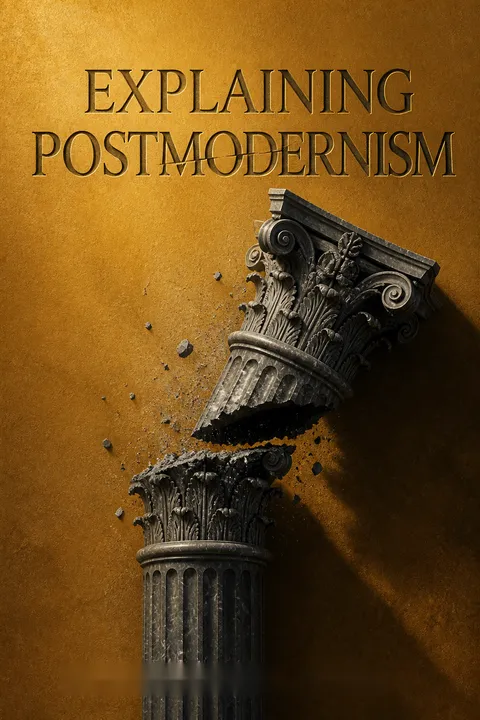


Key Takeaways
Read postmodernism as skepticism joined to a political movement under pressure
A double origin. Hicks presents postmodernism as more than an artistic style or academic fashion. In his account, it combines doubt that reason can establish objective knowledge with a view of people as shaped by social groups and conflicts over power. Foucault, Derrida, Lyotard, and Rorty differ, but Hicks sees them sharing suspicion of universal truth and sympathy for groups they regard as oppressed.
A movement in crisis. The book’s central thesis links that skepticism to the far Left’s political difficulties. As socialist predictions and regimes disappointed, Hicks argues, some intellectuals found in skeptical philosophy a way to keep political commitments while challenging the standards used against them. This is his explanation of postmodernism’s rise, not a neutral definition accepted by every scholar.
What's striking is the explanatory ambition: Hicks connects abstract disputes about knowledge to concrete academic and political incentives. That is useful because ideas do not circulate in a vacuum. Yet a movement’s political alignment cannot, by itself, establish that its philosophical arguments are evasions. Intellectual history needs both genealogy and close reading: showing who benefited from an idea is different from showing the idea is false. The book is most valuable when it prompts readers to ask how theories handle counterevidence, rather than treating suspicion itself as proof of bad faith.
Kant's limits on reason became, in Hicks's account, postmodernism's doorway
The mind shapes experience. Kant argued that people do not encounter reality in a wholly unfiltered way. The mind organizes experience through its own forms and concepts, so knowledge concerns phenomena, the world as experienced, rather than noumena, things as they are independently of experience. Kant believed this protected scientific knowledge within experience while limiting claims about ultimate reality.
Hicks's turning point. Hicks interprets that limit more radically: if reason cannot reach reality itself, then the Enlightenment ideal of objective knowledge has been surrendered. He traces a path from this separation of mind and world toward later claims that truth is socially or linguistically constructed. The book presents Kant as the pivotal break, although Kant himself did not simply reject reason or science.
The distinction between what is experienced and what exists independently of experience remains a powerful philosophical problem, not merely a historical stepping stone. Hicks makes the stakes vivid by asking whether a mind with its own structure must therefore be cut off from the world. A modern alternative is fallibilism: perception and concepts mediate knowledge, yet inquiry can still correct errors through prediction, experiment, and shared criticism. Mediation does not automatically mean imprisonment. The argument turns on whether mental structure is a barrier to reality or the means by which organisms engage with it.
Trace the route from Kant through Hegel and Heidegger before judging postmodern claims
A changing inheritance. In Hicks's history, Hegel answers Kant by making reality itself a development of mind or Spirit. His dialectical approach treats conflict and contradiction as drivers of change, and gives the collective a larger role than the individual. Later thinkers, including Nietzsche and Kierkegaard, distrust reason and elevate instinct, faith, or feeling as routes to what reason supposedly cannot reach.
Heidegger's synthesis. Heidegger brings these strands together, Hicks argues. He questions the distinction between subject and object, treats ordinary language as obscuring deeper questions, and gives moods such as anxiety and dread philosophical importance. Postmodern thinkers inherit suspicion of reason and language, but generally drop Heidegger's quest for a deeper Being. The result, in Hicks's account, is a more thoroughly anti-realist outlook.
The intellectual genealogy helps explain why later writers inherit a vocabulary of conflict, interpretation, and suspicion rather than inventing it from scratch. But influence is not identity: a thinker can borrow a question while rejecting its original answer. Hegelian contradiction, Nietzschean genealogy, and Heideggerian analysis are not interchangeable doctrines, and contemporary postmodernists do not form a single school. Reading them as a family of arguments, rather than a relay team moving toward one predetermined endpoint, preserves the history while allowing each claim to be assessed on its own merits.
When perception and logic seem conventional, science loses its automatic claim to authority
The analytic detour. Hicks argues that some twentieth-century philosophers set aside traditional metaphysical questions and focused instead on language, logic, and scientific method. Logical positivists hoped this would make philosophy rigorous. But arguments that observation is theory-laden, meaning shaped by prior concepts, and that logical rules depend on convention seemed to weaken the idea that science offers a neutral route to reality.
Kuhn's challenge. In Hicks's reading, Thomas Kuhn’s account of scientific paradigms helped popularize the idea that scientific communities work within changing frameworks, rather than moving smoothly toward one final truth. This opened space for postmodern skepticism. Hicks treats the development as a collapse of confidence in objectivity; it is more accurate to say that it raised difficult questions about how scientific communities choose, compare, and revise theories.
The distinction between theory-laden observation and arbitrary observation matters. Instruments, training, and background assumptions shape what researchers notice, but scientific communities can still test claims against recalcitrant results and build technologies that work. Social epistemology, the study of how groups produce and check knowledge, helps clarify this middle ground: objectivity can be a disciplined achievement of criticism, not a view from nowhere. Hicks is right that science needs a defense against relativist shortcuts. His account is less persuasive when philosophical criticism of scientific certainty is treated as equivalent to rejecting scientific inquiry.
Ask whether rescuing community requires handing the individual to the state
Rousseau's reversal. Rousseau argued that civilization, reason, property, and the arts had corrupted an originally simpler human life. Inequality and competition, on this account, were not inevitable features of human nature but products of social development. He favored a more communal political order, governed by the general will, the collective interest citizens are supposed to share.
The danger in the cure. Hicks emphasizes that Rousseau’s account can authorize coercion when leaders claim to speak for that common interest. The French Revolution’s Jacobin phase offers his historical example: revolutionary leaders invoked the people’s will while using violence against those judged disloyal. The lesson is not that every appeal to community ends in terror. It is that a theory needs safeguards for dissent when the collective good is defined by political authorities.
Rousseau’s critique retains force wherever formal freedom coexists with severe dependence or exclusion. Shared institutions can protect people from domination by private power, not only by governments. The crucial question is how a community identifies common interests without treating disagreement as disobedience. Constitutional rights, independent courts, and protected opposition are attempts to answer that question. Hicks's reading usefully foregrounds coercive risks, but his contrast between individual liberty and collective purpose can understate how public goods and individual rights often rely on one another.
When socialist forecasts failed, parts of the Left changed the standard of judgment
Predictions under strain. Hicks reviews Marxist forecasts that workers would grow poorer, the middle class would shrink, and capitalist ownership would concentrate among fewer winners. He argues that these patterns did not unfold as expected in prosperous capitalist countries. Attempts to create socialism also brought economic failures and political repression, most starkly exposed in 1956 when Khrushchev disclosed Stalin-era crimes and Soviet forces crushed the Hungarian uprising.
A crisis of credibility. Hicks sees these events as forcing socialist intellectuals to choose between revising their beliefs and questioning the standards used to judge them. He argues that some chose the latter, turning toward skeptical theories of truth and reason. That is a provocative causal claim, not a demonstration that every socialist thinker responded this way or that socialist criticism of capitalism was thereby invalidated.
The book’s strongest historical question is how committed thinkers respond when a theory’s predictions fail. Philosophy of science offers a useful distinction: revising a theory after anomalies can be rational, while insulating it from every possible test makes it unfalsifiable. But political movements are not laboratories, and outcomes may reflect institutions, leadership, or historical conditions as well as principles. The record of authoritarian socialist regimes is indispensable evidence. It does not settle every argument about welfare, ownership, or inequality, just as capitalist prosperity does not settle every moral criticism of market societies.
Follow how the critique shifted from unmet needs toward inequality and identity
A new moral measure. Hicks describes a strategic change after capitalist societies proved better at raising material living standards than many socialists had predicted. Some Left thinkers shifted criticism from absolute deprivation to relative inequality: people might meet basic needs yet remain disadvantaged compared with others. Political attention also moved from a universal working class toward groups defined by race, sex, and ethnicity.
Wealth becomes suspect. The critique could also reverse direction. Marcuse argued that consumer comfort dulled revolutionary opposition, while some environmental thinkers treated production and human control of nature as sources of harm. Hicks presents these changes as evidence that socialism adapted its moral standards when earlier claims became difficult to defend. The shift may reveal strategic flexibility, but it can also represent genuine changes in what a movement considers ethically important.
A political movement can change its criteria because it has lost an argument, but it can also change because new harms become visible. Relative deprivation, unequal opportunity, and environmental damage are not automatically substitutes for claims about hunger or poverty; they describe different dimensions of social life. The analytical task is to separate a moving goalpost from a broader account of justice. Hicks compellingly asks whether prosperity can be redefined as oppression whenever it undermines a theory. A fair test also asks whether the revised criticism identifies measurable harms and proposes remedies that avoid creating worse ones.
Treat language as political action, but test whether persuasion has become evasion
Two jobs for words. In Hicks's account, modern thinkers use language to describe reality and argue about it. Postmodern thinkers often treat language as unable to reach reality directly, while still using it to shape social relations. This changes unmasking, the effort to expose hidden interests: if every interpretation leads only to more language, no final factual layer may settle the dispute. Rhetoric then becomes persuasion or political action, not simply a tool for communicating knowledge.
Three readings of the strategy. Hicks calls one response Kierkegaardian: preserve a political commitment as a leap of faith. Another is Machiavellian: use relativism tactically while retaining firm political goals. A third, tied to Nietzschean ressentiment, sees corrosive resentment and a desire to diminish opposing values. These are Hicks's interpretations, not conclusions established by the fact that a writer uses deconstruction or forceful rhetoric.
Language always does more than report: it frames attention, assigns responsibility, and can mobilize people. That insight is compatible with truth-seeking, however. A legal argument can persuade while remaining answerable to evidence; a critique of power can expose whose testimony institutions discount. The practical test is whether a claim specifies what would count against it and whether opponents are represented accurately. Hicks's strategic interpretation is sharpest when it identifies double standards in argument. It risks becoming self-sealing if every postmodern claim is treated as merely a weapon, regardless of its content.
A genealogy of postmodernism explains its appeal, but does not refute it
Explanation is not rebuttal. Hicks connects postmodernism to a long Counter-Enlightenment tradition, the failures of socialist experiments, and the academic turn toward skepticism. He also interprets its darker rhetoric through Nietzsche’s concept of ressentiment, a bitter resentment that can recast weakness as moral superiority and seek to diminish the success of others. The book uses this idea to explain why some critics may attack the prestige of science, liberal institutions, or canonical works.
The unfinished task. Hicks ends by acknowledging that tracing origins and consequences does not disprove the underlying philosophy. The Enlightenment, in his view, needs a stronger defense of reason, individual agency, and objective inquiry. Readers can apply that demand to both sides: identify premises, examine evidence, and ask what could change a conclusion. A psychological diagnosis is not a substitute for answering an argument.
This closing distinction is essential. Genealogy can reveal that beliefs have histories and institutional uses, but a belief’s origin does not determine its truth. Conversely, a theory that exposes its own social location should not be exempt from scrutiny. Contemporary work on standpoint and situated knowledge offers a productive middle path: a person’s position can reveal neglected evidence, while claims remain open to comparison and correction. Hicks is right to insist that postmodernism should be answered philosophically. The same standard applies to his own account, especially where he infers political motives from intellectual commitments.
Analysis
Hicks builds a sweeping intellectual history around a double explanation: postmodernism inherits skepticism about reason from Kant and his successors, then gains political force as sections of the Left respond to socialism’s failures. The narrative’s strength is its refusal to treat academic vocabulary as politically weightless. It links arguments about perception, truth, and language to the incentives of movements, universities, and revolutionary politics. The chapters on Rousseau and the post-1956 crisis give that account a historical sequence rather than a loose list of influences.
The central weakness is a leap from association to explanation. Skeptical epistemology does not logically entail far-Left politics, and political commitment does not establish that an argument for skepticism is insincere. The book sometimes reads distinct thinkers as stages in a single decline, especially when it moves from Kant to Heidegger to contemporary postmodernism. Kant’s account of experience is not simply a rejection of reason, and Kuhn’s analysis of scientific paradigms need not imply that evidence is powerless. Likewise, highlighting atrocities under socialist governments is morally and historically important, but does not by itself resolve every debate about social provision or economic equality.
A useful way to read the book is as a challenge about intellectual accountability. Hicks asks whether theories can survive contact with evidence, whether political ideals are protected from criticism by redefining truth, and whether appeals to oppression apply consistent standards. Those questions are worth asking across ideologies. Yet the answer cannot be a motive-reading exercise. Social position can shape what people notice, and institutions can privilege some voices, without making all knowledge merely political. Objectivity is better understood as a process of public testing, contestation, and correction than as a perfectly neutral viewpoint. The book’s final demand, to defend the foundations of reason rather than merely mock postmodernism, is therefore also its best standard for assessing Hicks himself.
Review Summary
Reviews of Explaining Postmodernism are sharply divided. Supporters praise Hicks for tracing postmodernism's philosophical roots and connecting it to socialism's failures, calling it compelling and accessible. Critics argue he misrepresents key philosophers like Kant, Hegel, Heidegger, Derrida, and Foucault, relies on strawman arguments, and lets his Objectivist/Randian bias distort his analysis. Several reviewers note he conflates postmodern and critical theory, while others appreciate his identification of links between postmodernism and left-wing collectivism. The book holds a middling 3.88 rating, reflecting these deeply polarized responses.
People Also Read



Glossary
Postmodernism
Skeptical, constructionist outlookHicks uses this term for a broad intellectual movement skeptical of objective access to reality and universal standards of reason. It treats language and social context as shaping what counts as knowledge, understands identity through group membership, and often frames social relations through power and conflict. This is Hicks's organizing definition, not a neutral description accepted by all postmodern thinkers.
Counter-Enlightenment
Critique of Enlightenment assumptionsThe intellectual current Hicks traces from Rousseau and German philosophy that challenges the Enlightenment's confidence in reason, individualism, science, and universal principles. The book follows its influence through Kant, Hegel, irrationalist thinkers, and Heidegger. The term covers diverse positions, rather than one coordinated school with a single doctrine.
Noumenal
Reality beyond experienceIn Kant's vocabulary, the noumenal concerns things as they may exist independently of human experience, in contrast with phenomena, the world as it appears to us. Kant argues that human knowledge is limited to phenomena. Hicks interprets this boundary as a decisive separation of reason from reality itself, an interpretation central to his account of postmodernism's philosophical roots.
Theory-laden
Shaped by prior conceptsA description of observation as influenced by the concepts, expectations, and background theories that observers bring to it. In Hicks's account of twentieth-century philosophy of science, this idea weakens the picture of perception as a completely neutral check on theory. It does not necessarily mean observations are arbitrary or that scientific claims cannot be tested.
General will
Claimed common civic interestRousseau's idea of a shared political will directed toward the common good, distinct from the private preferences of individuals. In Hicks's reading, the danger arises when leaders claim authority to speak for this collective interest and override dissenters in its name. The concept is influential in arguments about popular sovereignty and the limits of individual choice.
Reverse Thrasymacheanism
Power politics for the weakerHicks's label for what he sees as postmodernism's reversal of the Sophist Thrasymachus's claim that justice serves the stronger party. In this account, relativist arguments about truth and power are retained, but political allegiance shifts toward groups understood as historically weaker or oppressed. It is an interpretive description offered by Hicks, not a standard name used by all postmodernists.
Kierkegaardian postmodernism
Political faith despite evidenceOne of Hicks's explanatory categories for postmodernism. It describes a response in which a thinker preserves a deeply held political ideal through commitment or faith when evidence and argument appear to undermine it. Hicks draws an analogy to Kierkegaard's account of religious commitment, while applying the pattern to socialist political belief.
Machiavellian postmodernism
Relativism as political tacticHicks's category for using skepticism about truth, reason, or interpretation as a strategic rhetorical instrument while retaining firm political goals. On this account, relativism can distract critics or weaken confidence in opposing traditions without being the user's deepest conviction. Hicks presents it as one possible explanation of postmodern political discourse, not as a proven motive for every thinker.
Ressentiment
Bitter, status-driven resentmentA Nietzschean term for deep, enduring resentment that can transform frustration and envy into a moral judgment against the successful or powerful. Hicks applies it to what he regards as a destructive strand in postmodernism, in which attacking the prestige of opposing institutions may matter more than building an alternative. The diagnosis is psychological and interpretive, not a refutation of the arguments being criticized.
Download PDF
Download EPUB
.epub digital book format is ideal for reading ebooks on phones, tablets, and e-readers.








