

Key Takeaways
Record the massacre clearly before debating the war it triggered
Begin with the event. Murray opens with Hamas’s October 7, 2023, assault on southern Israel: nearly 1,200 people were killed and roughly 250 were taken hostage. At the Nova music festival, 364 people were murdered. He describes a society struggling to grasp not only the scale of the attack, but its deliberate cruelty and the attackers’ apparent pride in recording it. His book is an act of witness, built from visits to massacre sites, hospitals, families, prisons, and Gaza itself.
Sequence shapes judgment. Murray argues that international attention shifted almost immediately from the victims to predictions about Israel’s response. He compares the Israeli death toll, relative to the country’s population, to tens of thousands of deaths in the United States. The comparison conveys scale, though it cannot capture the particular losses or settle what should follow.
The insistence on establishing what happened before arguing about what should happen is a sound discipline in any crisis. It resists the common habit of treating victims as evidence for a preferred political theory. At the same time, accurate remembrance and scrutiny of military retaliation are compatible obligations, not rival loyalties. A reader can recognize the attack as an atrocity without accepting every later claim about the conduct or justification of the war. That distinction strengthens, rather than weakens, the case for reliable testimony.
A safe room means little when the state arrives fourteen hours late
Security failed at home. Israeli border communities had fences, local security teams, and reinforced safe rooms because residents had endured years of rocket attacks. Those precautions proved no match for the coordinated October 7 incursion. In Be’eri, farmer Avida Bachar sheltered with his family as attackers tried to enter their safe room, shot through its door, and set the house on fire. His wife and son died before soldiers reached them. He and his daughter survived until evening, after almost fourteen hours of waiting.
Trust was part of the injury. Parents told children that the army would arrive within minutes. It did not. Murray presents this delay as more than a tactical failure: it damaged the belief that Israel existed to protect its citizens. He also recounts ordinary people, including Arab Israeli first responders, who risked their lives while formal systems faltered.
A state’s legitimacy is tested not only by its ability to deter attack, but by whether people can rely on it during the worst hour of their lives. The safe room becomes a stark measure of the gap between private preparation and public protection. Such failures demand investigation, clear accountability, and repair of institutional trust. Yet a vivid account of failure cannot by itself establish exactly where responsibility lies. Separating testimony from the eventual findings of an inquiry is essential to learning rather than simply assigning blame.
Treat declared aims as evidence, not rhetoric to discount
A costly assumption. Israeli security leaders, Murray argues, embraced what they called “the conception”: the belief that Hamas had become invested in governing Gaza and would avoid a major war that threatened its power and prosperity. The assumption underestimated ideological commitment. Hamas leaders’ violent public statements and preparations, he says, were treated as less important than signs of political pragmatism and personal enrichment.
Sinwar’s return mattered. In 2011, Israel exchanged 1,027 Palestinian prisoners for captured soldier Gilad Shalit. One released prisoner was Yahya Sinwar, who rose to lead Hamas in Gaza and masterminded the October 7 attack. The exchange illustrates the painful hostage dilemma: rescuing one person can carry risks that fall on others. Murray also recounts an Israeli prison dentist who helped save Sinwar’s life, only for the dentist’s nephew to be killed during the attack.
The lesson is not that adversaries never moderate, but that material incentives do not erase beliefs. Political science often distinguishes what leaders want from what constraints make convenient; a government may accept money and administrative responsibilities while retaining maximalist aims. Still, hostile rhetoric alone is not a perfect forecast of capability or timing. A robust intelligence culture tests declared goals against observable preparation, while also challenging its own preferred assumptions. In this account, the failure was not merely misreading Hamas, but treating a reassuring theory as stronger evidence than warnings.
Defense technology can normalize a threat instead of ending it
Protection had a price. Israel’s Iron Dome system intercepts incoming rockets, helping protect civilians. But the book contrasts an estimated $300 cost for a Katyusha rocket with as much as $100,000 for an interceptor. If two interceptors are needed, the defense can cost hundreds of times more than the weapon it stops. The system can save lives while leaving the source of danger intact.
A tolerable status quo? Murray describes communities where residents had adapted to sirens, shelters, and repeated rocket attacks. He argues that technological success may have encouraged the belief that an unresolved threat was manageable. The same danger appeared in the confidence that Israel’s intelligence and surveillance could detect any meaningful activity in Gaza. In retrospect, those capabilities did not prevent the breach or the massacre.
Defensive technology can create a paradox: it lowers immediate harm, yet may reduce pressure to change the conditions that produce recurring attacks. That does not make the defense a mistake. A shield buys time and protects people who cannot choose where they live. The strategic question is whether leaders use that time to address the threat or treat interception as a permanent substitute for security. Cost comparisons help reveal asymmetry, but they do not measure the value of lives saved or answer what alternatives were feasible.
Assess urban warfare by law and evidence, not casualty arithmetic
The battlefield was embedded. Murray describes an Israeli campaign in Gaza where Hamas had built tunnels and stored weapons in or near civilian sites, including homes, schools, mosques, and hospitals. He reports that the group used civilians as cover and that its leaders saw civilian deaths as useful to the battle for international opinion. The IDF faced the task of finding fighters and hostages in a dense urban area where combatants could wear civilian clothes.
Numbers are not a verdict. Murray rejects the idea that a response becomes legitimate by matching an enemy’s death toll, and he argues that war aims include defeating a threat and rescuing hostages. He also recounts the mistaken killing of three Israeli hostages by Israeli soldiers, a tragedy that shows how battlefield confusion can have irreversible consequences. The book’s central challenge is how to fight without abandoning civilian protection.
Casualty parity is not the legal test for a military operation. The rules of armed conflict focus on distinction between civilians and combatants, military necessity, and whether expected civilian harm is excessive relative to the anticipated military advantage. Those standards remain relevant even when an adversary violates them or exploits civilian sites. The book vividly describes the difficulty of fighting in such conditions, but a combatant’s account does not settle each allegation. Claims about targets, precautions, and casualties require independent evidence and scrutiny, especially when civilians bear the cost.
Notice when war reporting turns victims into political props
The argument moved quickly. Murray says large anti-Israel demonstrations began in Western cities while the October 7 attack was still unfolding, and that he saw little comparable public pressure directed at Hamas to release hostages. He recounts posters of missing Israelis being torn down, anti-Israel slogans at demonstrations, and Jewish students facing intimidation. On some campuses, he reports, speakers openly praised Hamas or called for renewed violence.
The distinction matters. Murray sees these episodes as evidence that the conflict was being used to recast perpetrators as resisters and victims as guilty representatives of Israel. He cites a poll in which 51 percent of surveyed Americans aged 18 to 24 agreed that Israel should be ended and given to Hamas and the Palestinians. A poll captures a moment and a sample, not the views of an entire generation.
Political language can flatten people into symbols: a hostage becomes an obstacle to a cause, while a civilian casualty becomes proof for a predetermined story. Murray’s examples warn against that moral inversion. But criticism of Israeli policy, support for Palestinian rights, and endorsement of Hamas are distinct positions; treating them as interchangeable would repeat the very flattening under criticism. The useful test is specific conduct and language: whether a movement condemns attacks on civilians, recognizes hostages as people, and applies its standards consistently.
Anti-Semitism changes its explanation while keeping the same target
A prejudice that adapts. Drawing on writer Vasily Grossman, Murray presents antisemitism as a changing accusation rather than a stable doctrine. Jews have been condemned for religious difference, then racial identity, and now, in his account, for having a state and defending it. The charge can reverse itself: Jews are portrayed as both powerful and weak, wealthy and poor, assimilated and alien. The contradiction does not dissolve the prejudice; it gives it room to survive.
A social diagnosis. Grossman’s argument, as Murray uses it, is that hostility toward Jews can reveal the accuser’s own fears or political failures. The book connects this pattern to postwar intellectuals who allied themselves with violent movements while seeing themselves as anti-Nazi. Murray warns that a new vocabulary of colonialism or resistance can conceal old hostility when it excuses violence against Jews.
The idea of prejudice as a flexible political instrument is powerful because it explains why rebutting one accusation may simply invite another. Yet a diagnostic lens must not become a shortcut for dismissing every criticism of Israel as antisemitic. The distinction depends on evidence, consistency, and the treatment of people: criticism of a government is not the same as collective blame of Jews, and opposition to a state policy is not automatically hatred of Jews. Precision keeps the concept useful and protects it from becoming a label that ends debate.
Treat peace as a condition democracies must actively defend
Peace can breed surprise. Murray contrasts Israel’s daily exposure to threats with Western societies that often imagine war as remote or obsolete. He cites a US poll in which 55 percent of respondents said they would stay and fight if the country were invaded, while 38 percent said they would flee. In a UK survey, nearly one-third of people aged 18 to 40 said they would refuse military service in a world war, even if invasion threatened.
Preparedness is civic, too. The book sets these hypothetical answers beside young Israelis serving in military and emergency roles, including first responders who drove toward danger when institutions failed. The comparison is intended to challenge complacency, not to romanticize war. Polls cannot predict how people would behave under actual danger, but they reveal how distant the idea of collective defense has become in some peaceful societies.
Democratic resilience is broader than military readiness. It includes trusted institutions, clear public communication, civil defense, and the willingness to protect neighbors under pressure. Hypothetical polls are weak forecasts of real behavior: people routinely misjudge themselves, and actual threats can produce both courage and flight. Still, the gap between assumed peace and practical preparedness is worth examining. A society need not imitate Israel’s permanent emergency to learn from it; it can build resilience without treating war as inevitable or civic life as a rehearsal for combat.
Defend democratic life against movements that glorify death
A moral contrast. The book’s title frames its central divide as democracies protecting ordinary life against movements that celebrate martyrdom, killing, and destruction. Murray calls such movements “death cults.” Against that outlook, he places rescuers, soldiers, bereaved families, and survivors who keep choosing connection and responsibility. A Be’eri survivor, grieving his wife and son, tells Murray that time is short and family deserves more of it. A one-armed reservist returns to service after years away.
The ending turns to life. Murray describes the October 2024 killing of Sinwar after a year of Israeli military operations and interprets it as the result of sustained pressure, not chance. He closes by arguing that Israelis fought not because they loved violence, but because they wanted their families and society to survive. That is his answer to a politics built around death.
The contrast between a politics that prizes death and a community trying to preserve ordinary life gives the book its emotional force. It also offers a useful test for public ethics: does a political project protect the lives of the people it claims to represent? The term “death cult” is rhetorically sharp, but it can obscure differences among leaders, fighters, and civilians if applied too broadly. Moral clarity is strongest when it names specific decisions and responsible actors, while refusing to treat whole populations as a single will.
Analysis
This book is best read as eyewitness reportage shaped into a political argument, not as a neutral history of the Israeli-Palestinian conflict. Its strongest method is intimate scale: a parent in a safe room, a volunteer driving toward danger, a family waiting for hostages. These accounts make the security failure and the human cost concrete, while the broader chapters connect them to intelligence assumptions, regional strategy, antisemitism, and public debate. The result is a clear narrative arc from massacre, through contested interpretation, to a defense of civic resilience.
Its central distinction between democratic societies and movements that exalt death is morally forceful, but also risks reducing a varied population to a single ideology. That risk matters because the book’s claims about Hamas leadership cannot automatically describe Gazan civilians, and the conduct of Israeli forces must be assessed independently of Hamas’s crimes. The author’s descriptions of tunnels, weapons, and battlefield precautions illuminate the dilemmas he encountered, but eyewitness access and interviews do not independently verify every military claim or casualty estimate.
The book is most persuasive when it asks readers not to erase victims or dismiss declared intentions simply because an alternative narrative feels more comfortable. It is less conclusive when it treats selected demonstrations, campus rhetoric, or polling as evidence of wider social consensus. Likewise, Sinwar’s death demonstrates that military pressure can reach an enemy leader; it does not, by itself, establish that every operation was lawful or that force alone secures lasting peace. The most durable insight is therefore dual: societies need moral clarity about deliberate attacks on civilians, and the discipline to apply scrutiny consistently, including to their own governments and allies.
Review Summary
On Democracies and Death Cults receives polarized reviews, with supporters praising Murray's moral clarity and detailed account of the October 7 attacks, while critics accuse him of pro-Israel bias and dehumanizing Palestinians. Supporters appreciate Murray's examination of Western responses and the ideological divide between democracies and extremist groups. Critics argue the book lacks historical context and perpetuates harmful narratives. Many reviewers, regardless of stance, find the content disturbing and emotionally charged, reflecting the contentious nature of the Israel-Palestine conflict.
People Also Read

Glossary
the conception
A mistaken security assumptionThe name used for an Israeli security view that Hamas had become invested in governing Gaza and would therefore avoid a major attack that could destroy its position. Murray argues that this assumption overvalued signs of pragmatism and material self-interest, while discounting Hamas’s ideological aims, public statements, and preparations.
death cults
Movements glorifying deathMurray’s polemical term for groups he sees as treating martyrdom, killing, and destruction as ideals rather than regrettable costs. In his argument, Hamas and Iran-backed armed groups place the defeat of Israel above the security and prosperity of the people they govern or claim to represent. The label is his characterization, not a neutral classification.
center of gravity
The enemy’s decisive strengthA military concept associated with Carl von Clausewitz: the concentration of an opponent’s power whose defeat could decide a conflict. Murray contrasts this conventional focus with attacks on vulnerable points. He argues that Hamas targeted peaceful communities and a music festival, exploiting places where Israel did not expect a large-scale assault.
Al-Aqsa Flood
Hamas’s operation nameThe name Hamas gave to its October 7, 2023, attack on Israel. Murray treats the name and Hamas leaders’ public statements as evidence that the assault was understood by its organizers as part of a broader campaign, not simply an isolated reaction to a particular Israeli military action.
pinkwashing
Rights framed as public relationsA term used by critics of Israel to argue that highlighting its LGBTQ rights is intended to distract from Palestinian suffering or Israeli policy. Murray objects that the accusation can dismiss a real difference between Israeli law and the treatment of LGBTQ people by Hamas and other groups. The term appears in the book as part of its discussion of activist rhetoric.
FAQ
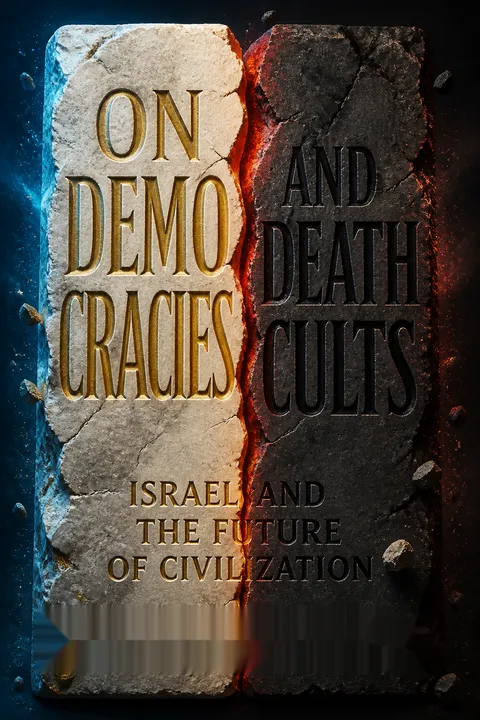
1. What is On Democracies and Death Cults: Israel and the Future of Civilization by Douglas Murray about?
- Detailed account of conflict: The book provides a comprehensive analysis of the October 7, 2023, Hamas terrorist attacks on Israel, the ensuing war, and the global reactions.
- Democracies vs. death cults: Murray explores the ideological and moral divide between democratic societies like Israel and extremist groups such as Hamas and Hezbollah.
- Historical and contemporary context: The narrative weaves together the history of anti-Semitism, the rise of Hamas, and the broader implications for the future of civilization.
2. Why should I read On Democracies and Death Cults by Douglas Murray?
- Firsthand reporting: Murray traveled to Israel and Gaza, interviewing survivors, military leaders, and even terrorists, offering perspectives beyond mainstream media.
- Insight into modern terrorism: The book explains the motivations and tactics of groups like Hamas, challenging readers to confront uncomfortable truths about fanaticism and evil.
- Critical analysis of global response: It examines Western political, academic, and societal reactions, helping readers understand the complexity and consequences of the conflict.
3. What are the key takeaways from On Democracies and Death Cults by Douglas Murray?
- Anti-Semitism’s persistence: The book shows how anti-Semitism adapts over time, targeting Jews for religion, race, and now statehood.
- Nature of extremist groups: Hamas and Hezbollah are depicted as death cults that glorify martyrdom and use civilians as shields, in stark contrast to democratic values.
- Western complicity: Murray highlights how Western institutions and individuals often ignore or enable extremist narratives, sometimes even celebrating terrorists.
- Resilience and values: Israeli society’s courage, unity, and commitment to life are emphasized as key to its survival and moral strength.
4. How does Douglas Murray describe the October 7, 2023, Hamas attacks in On Democracies and Death Cults?
- Unprecedented brutality: The attacks involved massacres, kidnappings, and terror tactics, making it the worst atrocity against Jews since the Holocaust.
- Surprise and scale: Hamas breached Israeli borders by land, sea, and air, killing nearly 1,200 people and kidnapping around 250, mostly civilians.
- Emotional and societal impact: The events shocked Israel and the world, leaving survivors and families traumatized and the nation grappling with a sense of betrayal.
5. How did Israel and its people respond to the October 7 attacks according to Douglas Murray?
- Heroism amid chaos: Ordinary Israelis and reservists displayed extraordinary bravery, defending communities and saving lives despite initial failures.
- Trauma and resilience: Survivors and families faced immense trauma, but the nation showed collective resilience and unity in the aftermath.
- Hostage families’ struggle: Families of kidnapped Israelis launched campaigns for international attention and rescue efforts, often facing a muted global response.
6. What historical and geopolitical context does Douglas Murray provide in On Democracies and Death Cults?
- Iranian influence: The book traces the rise of Iran’s revolutionary ideology and its support for proxy groups like Hamas and Hezbollah.
- Israeli security challenges: It details Israel’s withdrawal from Gaza, the rise of Hamas, and the ongoing threats from rocket attacks and tunnel networks.
- Failed assumptions: Murray discusses how Israeli and Western intelligence underestimated the fanaticism and strategic goals of Hamas, leading to catastrophic consequences.
7. How does On Democracies and Death Cults by Douglas Murray explain the persistence and nature of anti-Semitism?
- Shapeshifting hatred: Anti-Semitism is described as a societal mirror, adapting to target Jews for different reasons across history—religion, race, and now statehood.
- No-win conundrum: Jews are hated for both integrating and not integrating, for being rich or poor, religious or secular, stateless or having a state.
- Nazi legacy in the Middle East: The book explores how Nazi anti-Semitism was adopted and perpetuated in the Muslim world, embedding deep-seated hatred in regional ideologies.
8. What does Douglas Murray say about the global and Western reaction to the October 7 attacks in On Democracies and Death Cults?
- Anti-Israel protests: Many Western cities saw protests celebrating the attacks or condemning Israel, often accompanied by antisemitic slogans and violence.
- Muted response to hostages: The international community showed little coordinated effort to pressure Hamas for the release of Israeli hostages.
- Academic and institutional complicity: Elite universities became centers of anti-Israel activism, with some defending or excusing extremist rhetoric under the guise of free expression.
9. How does Douglas Murray contrast Israeli society with extremist groups like Hamas and Hezbollah in On Democracies and Death Cults?
- Value of life: Israeli society prioritizes protecting civilians and embodies the commandment to “choose life,” building bomb shelters and minimizing casualties.
- Shared sacrifice and unity: Military service is universal, fostering national responsibility and unity, with leaders and citizens personally affected by conflict.
- Moral clarity: Israelis mourn their dead and seek justice, while extremist leaders glorify death and martyrdom, even of their own children.
10. How does On Democracies and Death Cults address the concept of “proportionality” in war, especially regarding Israel’s response?
- Critique of proportionality debates: Murray argues that expecting Israel to match Hamas’s atrocities is absurd and misunderstands the need for strategic and moral victory.
- Necessity of deterrence: For Israel, deterrence is vital to prevent repeated existential threats from hostile neighbors.
- Moral and legal context: The book stresses that Israel’s military actions aim to dismantle terror infrastructure and rescue hostages, not simply to “even the score.”
11. What role do international institutions like the ICC and the UN play in the conflict, according to On Democracies and Death Cults by Douglas Murray?
- Politicization and bias: The ICC’s threats against Israeli leaders, while ignoring Hamas’s crimes, are seen as dangerous overreach and evidence of bias.
- UN failures: UN peacekeeping forces have failed to prevent Hezbollah’s rearmament and tunnel construction, allowing war preparations to continue.
- Aid mismanagement: International aid to Gaza often ends up funding Hamas’s terror activities, despite warnings from Israel.
12. What are the best quotes from On Democracies and Death Cults by Douglas Murray and what do they mean?
- “Tell me what you accuse the Jews of—I’ll tell you what you’re guilty of.” (Vasily Grossman) — Anti-Semitism reflects the accuser’s own societal failings and contradictions.
- “Choose life, that thou and thy seed may live.” (Deuteronomy) — Emphasizes the Jewish value of life, central to Israel’s resilience and moral stance.
- “We love death more than you love life.” (Jihadist slogan) — Murray counters this by highlighting the power and necessity of valuing life in the face of death-worshipping enemies.
- “The first stage of State anti-Semitism is discrimination... The second stage is wholesale destruction.” (Grossman) — Warns of the dangerous trajectory of state-sponsored anti-Semitism, relevant to both history and current threats.
- “The existence of Israel is illogical. The existence of Israel is what causes all that pain, blood, and tears.” (Hamas official Ghazi Hamad) — Illustrates the genocidal ideology driving Hamas and the existential threat Israel faces.
About the Author
Download PDF
Download EPUB
.epub digital book format is ideal for reading ebooks on phones, tablets, and e-readers.








