

Key Takeaways
When rights become a total worldview, disagreement starts looking like heresy
A new source of meaning. Murray argues that the decline of religious and political grand narratives left a vacuum in Western societies. Since the 2008 financial crash, he says, social justice, identity politics, and intersectionality have offered a powerful replacement: a way to explain injustice, identify allies and opponents, and give life a cause. Identity politics sorts people into groups by traits such as race, sex, and sexuality. Intersectionality asks how those identities combine to shape disadvantage. Murray’s concern is that legitimate campaigns for equal rights can become the foundations of an all-encompassing moral system.
From victory to new battles. He likens activists who keep searching for injustices after winning reforms to a retired dragon-slayer hunting for another dragon. The danger, in his account, is that overstating problems can amplify divisions instead of resolving them.
The book’s central insight is not that demands for equality are illegitimate, but that moral causes can become identity and purpose in their own right. That helps explain why disputes over language or symbols can carry the emotional force of existential conflicts. Sociologists describe a related process as moralization: once an issue is treated as a test of character, compromise can look like complicity. Yet the same dynamic can also keep real injustice visible when institutions would prefer to move on. The useful question is not whether a movement has won, but whether its claims remain open to evidence, revision, and limits.
Treat viral outrage as a stampede, not proof that danger is real
A town starts running. Murray opens his technology discussion with James Thurber’s account of a 1913 rumor that a dam had broken. People fled across town, even though the dam was too far away to flood their streets. The story illustrates how fear can spread through a crowd before anyone checks the facts. Murray sees a similar pattern online: private remarks become public, old mistakes are rapidly recirculated, and a surge of condemnation can make a claim seem more credible than it is.
Platforms reward heat. In his view, social media businesses benefit from engagement, and outrage is unusually good at attracting attention. That does not mean every controversy is false or manufactured. It means speed and repetition are poor substitutes for verification, proportion, and context.
The stampede analogy captures a real feature of networked communication: people often react to other people’s reactions, not to the original event. This resembles information cascades, where visible agreement can make a belief spread even when each person has little independent evidence. A practical response is to pause before sharing, check the original material, and distinguish the scale of a reaction from the scale of the harm. But the analogy has limits. Online attention can expose abuse that local institutions ignored. The challenge is to slow the rush to judgment without dismissing testimony simply because it travels quickly.
Defend open debate without confusing tolerance with endorsement
A screening is cancelled. Murray recounts a protest against a London screening of a film featuring people who said they had moved away from same-sex relationships. A cinema cancelled the private event after criticism and raised concerns about public order. Murray objects to the cancellation, while making clear that he found much of the film unpersuasive. He argues that the press had not shown that the organizers were forcing unwilling people into treatment.
Permission is not approval. Drawing on John Stuart Mill, Murray argues that hearing opposing views can reveal partial truths and prevent accepted beliefs from hardening into dogma. The distinction matters: allowing a speaker to make a claim does not establish that the claim is true, ethical, or supported by evidence. It preserves the opportunity to examine it.
This distinction is essential to pluralism. A society can protect a person’s right to speak while criticizing the substance of what they say, and it can refuse coercive practices without suppressing every discussion of them. The case also shows why procedural fairness matters most when an argument is unpopular. At the same time, an event’s private status does not settle questions about harm, professional standards, or the venue’s responsibilities. Free inquiry is strongest when it makes room for scrutiny in both directions, rather than treating either censorship or unrestricted endorsement as the only options.
Protect dignity without making rights depend on a single origin story
The nature question stays open. Murray notes that major psychological and psychiatric organizations describe sexual orientation as shaped by complex biological and environmental factors, with no single proven cause. He also cites evidence that attitudes shifted as more people knew someone gay: between 2001 and 2015, the share of Americans who considered same-sex relationships morally acceptable rose from 40 percent to 63 percent. Increased visibility and personal familiarity helped change public opinion.
Dignity should not require proof. The book argues that people are treated more sympathetically when a trait is understood as unchosen, a contrast Murray describes as hardware versus software. Yet uncertainty about why someone is gay does not establish that the trait is a choice, nor should equal dignity depend on finding a biological explanation. The debate reveals how much moral standing can be made to rest on unsettled science.
The strongest implication is that rights are more secure when grounded in equal personhood rather than a promise that a characteristic is immutable. Otherwise, scientific uncertainty becomes a political vulnerability: a discovery about causes could be misused to reopen questions of dignity. The book is right to distinguish evidence about origins from moral conclusions, although it sometimes gives the origin question more weight than that distinction warrants. Social science also suggests that contact can change attitudes without settling metaphysical questions. Familiarity may soften prejudice, but it cannot replace a clear principle that people deserve fair treatment regardless of how their identities formed.
Identity coalitions fracture when membership requires political agreement
One label, different aims. Murray describes a long-running divide in gay activism. Some advocates sought ordinary legal equality and social acceptance. Others used queer identity to challenge social norms and align with wider radical politics. These approaches could cooperate against discrimination, but they did not share a single vision of what liberation meant. The label LGBT, he argues, can conceal important differences among gay men, lesbians, bisexual people, and transgender people.
Politics becomes a membership test. Murray recounts the reaction to Peter Thiel, a gay businessman who spoke at the 2016 Republican National Convention. A prominent gay magazine questioned whether he counted as gay in a broader political sense. For Murray, this shows how a trait-based identity can become conditional on holding the expected political views. The group may then exclude the very diversity of opinion that equal rights are supposed to protect.
Coalitions are often built around a shared problem, not a shared worldview. Treating them as internally unanimous can give self-appointed representatives too much authority and make disagreement look like betrayal. This is especially risky when political identity is confused with personal identity: a person’s views can change without making their history or relationships disappear. Still, the book’s emphasis on division can understate the practical solidarity that broad coalitions sometimes achieve. Shared labels are not proof of unity, but they can help groups coordinate around specific protections. The key is to make membership broad and goals concrete, rather than requiring ideological uniformity.
Do not turn every difference into a moral ranking
The rules can change overnight. Murray contrasts older entertainment culture, where women sometimes groped men onstage to laughter, with the rapid change in public expectations during the MeToo era. He argues that the inconsistency made it difficult to know which conduct was acceptable and whose actions would be excused. He also questions compulsory unconscious-bias training, which asks people to identify hidden preferences. The Harvard Implicit Association Test became influential, but researchers associated with it later cautioned that its results were not stable enough to diagnose individuals with confidence.
Difference is not a verdict. The book challenges claims that women are always equivalent to men in every respect and also morally superior in selected domains. It questions simplified accounts of pay gaps and workplace power, while acknowledging that harassment and discrimination exist.
Norms around consent and workplace behavior do change, sometimes for good reason. The fact that standards were once inconsistent does not make current efforts to prevent harassment hypocritical; it can mean that people are learning to take harm more seriously. But training programs should be judged by evidence of improved decisions, not by how virtuous they sound. Psychological tests can reveal patterns at a group level without reliably diagnosing any one person, and that distinction matters in hiring or discipline. A fair approach identifies specific behavior and outcomes instead of assigning moral status to whole categories of people.
Race-conscious remedies can reproduce the categories they hope to dissolve
Equality can harden into sorting. Murray contrasts Martin Luther King Jr.’s hope that people would be judged by character rather than skin color with newer approaches that treat race as central to understanding people. He discusses whiteness studies, disputes over casting, and the case of Harvard admissions, where Asian-American applicants challenged policies they said disadvantaged them. These examples raise a recurring question: can institutions correct unequal outcomes without turning racial identity into a permanent ranking system?
Good intentions need a test. Murray argues that anti-racist efforts can become unfair when they presume guilt or virtue based on race. His examples are polemical, and the cases do not all establish the same thing. Still, they spotlight a genuine tension between attending to group-level disparities and treating individuals as individuals.
The tension is not solved by choosing between color-blindness and race-conscious policy in the abstract. A formally neutral rule can preserve an unequal status quo, while a remedy based on group categories can create new unfairness or overlook disadvantage within groups. The more useful test is institutional: What harm is being addressed, what evidence connects the policy to that harm, and how will its effects be reviewed? The book persuasively warns against making racial categories morally definitive. Its own argument, however, can sometimes treat a few inflammatory episodes as representative of a broad movement. That risks repeating the same generalization it criticizes.
Treat medical uncertainty as a reason for care, not silence
Different experiences need different answers. Murray distinguishes intersex people, who have biological sex variations, from people who identify as transgender. He recounts Jan Morris’s account of transition as a deeply felt and life-changing need, then contrasts it with stories of people who questioned or regretted medical intervention. One young man described being affirmed by clinicians and starting hormones before deciding to stop. These accounts show why a single explanation or path cannot capture every experience.
Caution is not contempt. The book raises concerns about treatment for young people, especially when decisions may have lasting effects and evidence is incomplete. It reports a 700 percent rise in UK referrals to child gender clinics over five years, but that increase alone does not explain why referrals rose or what treatment is appropriate. Murray argues that inquiry should not be dismissed as hatred.
The relevant distinction is between respecting a person and claiming certainty about the best clinical response. Compassion supports careful assessment, honest discussion of uncertainty, and attention to individual circumstances. It also requires taking distress seriously rather than assuming that every transition is mistaken or that every concern is bigotry. The book’s vivid cases make the stakes concrete, but personal stories cannot establish how common regret is or which interventions help most. Those questions require robust clinical evidence and long-term follow-up. Silencing debate weakens that inquiry; treating caution as a verdict against transgender people does too.
Build a culture where mistakes can be corrected and forgiven
The internet keeps the file open. Murray describes how old posts by journalist Quinn Norton were circulated when she was hired by The New York Times. Norton said that excerpts stripped from their original context created a distorted version of her. The episode illustrates context collapse: communication meant for one audience is exposed to another audience that lacks the original setting. Online archives can make a past mistake feel newly committed each time it resurfaces.
Accountability needs an exit. Drawing on Hannah Arendt, Murray argues that human actions have consequences that cannot simply be undone, making forgiveness necessary for people to move forward. Forgiveness does not mean denying harm. It asks whether a person can acknowledge an error, make amends, and change without being permanently defined by their worst moment.
A just response needs both accountability and proportionality. Permanent reputational punishment is a poor substitute for examining what happened, how serious the harm was, and whether the person has changed. Restorative approaches, which focus on acknowledgment and repair, offer one way to preserve responsibility without making social exclusion the default. Yet context should not become a universal alibi: some conduct is deliberate, repeated, or harmful regardless of audience. The important question is not whether the past should matter, but whether the response leaves any credible path back into shared life.
Keep politics from becoming your only source of purpose
Ask what the comparison is. Murray urges readers to ask “compared with what?” when told that a society is uniquely oppressive. This is not a claim that existing institutions are fair or beyond repair. It is a demand to identify a realistic alternative rather than measure present life against an undefined utopia. The book points to genuine inequalities and rights violations while arguing that liberal democracies have also achieved protections that remain rare elsewhere.
Keep meaning close to life. Murray sees identity politics as an especially tempting source of purpose in a secular age, because it offers a cause, a community, and a clear antagonist. He argues that politics matters, but should not consume every relationship or become the sole answer to what makes life worthwhile. Family, work, friendship, and culture offer forms of meaning that need not turn every difference into a battle.
The closing argument is strongest when it distinguishes civic engagement from totalizing politics. Public action can repair institutions, but a life organized entirely around grievance can make every disagreement feel like a personal threat. The comparison question is useful when it clarifies trade-offs and plausible alternatives; it is less useful if it dismisses present injustice by pointing to worse societies. A disciplined version asks both what has improved and what remains unfair, then chooses a remedy suited to the specific problem. That approach preserves political seriousness without requiring politics to supply an entire identity or moral universe.
Analysis
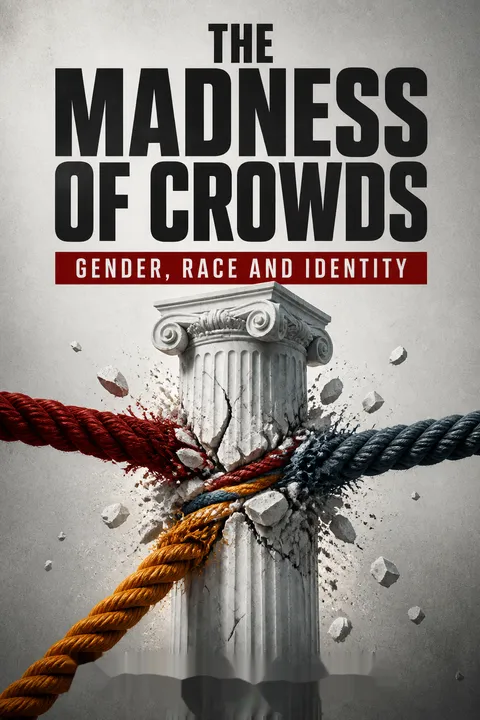
The Madness of Crowds is a polemical work of cultural criticism organized around four contested areas: sexuality, sex relations, race, and transgender identity. Its governing argument is that campaigns that began by seeking equal treatment have, in some settings, become tests of ideological conformity. The book links that shift to declining shared narratives, activist ideas circulating from universities into institutions, and social media systems that reward rapid moral judgment. Its narrative method is deliberately vivid: a cancelled film screening, campus confrontations, public shaming, and disputed medical decisions give abstract claims human faces.
The book is most persuasive when it asks procedural questions: What is the evidence? Are standards applied consistently? Can dissent be expressed without being equated with harm? Can people recover after mistakes? These questions matter even when the issue under discussion is real discrimination. Its account of online outrage also identifies a genuine institutional problem: platforms can amplify condemnation while providing few shared mechanisms for correction or forgiveness.
Its limitations are equally important. The narrative often selects extreme statements and incidents, then treats them as evidence of broad cultural direction. That makes a compelling case for vigilance, but not necessarily for the scale of the author’s diagnosis. Claims about academic disciplines, political motives, gender differences, and medical treatment vary greatly in evidential strength. The book sometimes infers a coordinated or destructive purpose where institutional incentives, sincere moral conviction, and ordinary error could also explain events. It also risks mirroring the group-based reasoning it criticizes when it generalizes about activists or institutions.
A careful reading separates three questions that the book sometimes blends: whether a person deserves dignity, what a particular policy should be, and what evidence supports a claim about causes or outcomes. Keeping those questions distinct preserves the book’s strongest contribution, its defense of open inquiry, while avoiding the assumption that every controversial claim is equally well founded or that every criticism is an act of censorship.
Review Summary
The Madness of Crowds receives mixed reviews, with many praising Murray's articulate critique of identity politics and "woke culture." Supporters appreciate his analysis of social justice movements and their potential excesses. Critics argue the book lacks nuance and relies too heavily on anecdotes. Some reviewers find Murray's arguments thought-provoking, while others see them as biased or oversimplified. The book's discussion of gender, race, and sexuality generates both agreement and controversy among readers.
People Also Read




Glossary
intersectionality
Combined identity and disadvantageAn approach to analyzing how social identities, such as race, sex, and class, can combine to shape a person’s experience of disadvantage. In Murray’s account, it also becomes a political framework for organizing groups and ranking overlapping claims of oppression. The book criticizes that use as difficult to define and apply consistently.
context collapse
Audiences merge onlineThe loss of boundaries between audiences and settings when communication intended for a particular group becomes widely visible online. A joke, argument, or remark can be detached from its original circumstances and judged by people who do not know the participants or purpose. Murray uses the idea to explain why old posts can be read as if they were newly made.
Implicit Association Test
Test of automatic associationsA computerized test designed to measure the speed with which a person associates concepts, such as racial groups and positive or negative words. The test became widely used in discussions of unconscious bias. Murray notes criticism from researchers associated with its development, who cautioned that results can be inconsistent and should not be treated as a dependable diagnosis of an individual’s character.
Machine Learning Fairness
Fairness in algorithmic systemsAn effort to reduce unfair outcomes in machine-learning systems by examining how data, design choices, and user interactions can introduce bias. The book focuses on the tension between improving representation and accurately reflecting the material being searched or analyzed. Murray argues that a system built to correct human bias can still encode the judgments of its designers.
autogynephilia
Arousal at imagining oneself femaleA term discussed in debates about some male-to-female transgender identities. It refers to sexual arousal associated with imagining oneself as a woman or possessing a female body. The book presents it as a disputed explanation, particularly controversial among transgender advocates because it frames at least some transition-related feelings in sexual rather than solely identity-based terms.
St George in retirement syndrome
Searching for new causesA phrase Murray attributes to political philosopher Kenneth Minogue. It describes the tendency of a person who has fought successfully for a cause to seek new battles after the original conflict has been won. Murray applies it to activists who, he argues, may exaggerate or continually redefine problems in order to preserve a sense of purpose and moral urgency.
hardware versus software
Innate traits versus changeable behaviorMurray’s recurring metaphor for the distinction between characteristics understood as inborn and unchangeable, or “hardware,” and behaviors regarded as learned or alterable, or “software.” He argues that people often receive more sympathy when a trait is considered innate. The metaphor highlights the political stakes of claims about identity, but it does not itself establish whether a particular trait is innate or changeable.
FAQ
What's The Madness of Crowds about?
- Exploration of societal issues: The book examines contemporary issues related to gender, race, and identity politics, suggesting society is experiencing irrational behavior.
- Collapse of grand narratives: Murray argues that traditional narratives have collapsed, creating a vacuum filled by new ideologies like social justice and identity politics.
- Critique of modern ideologies: The author critiques concepts such as "social justice" and "intersectionality," suggesting they create division rather than unity.
Why should I read The Madness of Crowds?
- Insightful analysis: Douglas Murray offers a thought-provoking examination of how modern ideologies impact societal cohesion and individual identity.
- Challenging conventional wisdom: The book encourages readers to question widely accepted beliefs about gender and race, providing a counter-narrative to mainstream discourse.
- Cultural relevance: Given ongoing debates about identity and social justice, this book provides a critical perspective on these complex issues.
What are the key takeaways of The Madness of Crowds?
- Identity politics is divisive: Murray argues that identity politics divides society into competing groups, exacerbating tensions rather than promoting understanding.
- Intersectionality is unworkable: The author critiques intersectionality as a framework that leads to confusion and frustration due to its complexity.
- Need for open discussion: Murray emphasizes the importance of free speech and open dialogue in addressing societal issues.
What are the best quotes from The Madness of Crowds and what do they mean?
- Dogmatic without knowing it: Murray highlights the irony of contemporary society, where people hold strong beliefs without questioning their validity.
- Social justice weaponization: The term "social justice" is often used to frame opposition as morally indefensible, illustrating its rhetorical power.
- Instability of new ideologies: Murray suggests that ideologies like social justice are inherently unstable and cannot sustain societal harmony.
How does Douglas Murray define "identity politics" in The Madness of Crowds?
- Atomization of society: Identity politics divides society into groups based on characteristics like race and gender, leading to a lack of common ground.
- Moral superiority claims: It often assumes individuals from certain groups possess heightened moral insights, leading to exclusionary practices.
- Historical context: Murray traces its evolution from earlier civil rights movements to a more divisive force today.
What critiques does Murray offer regarding "intersectionality"?
- Complexity and confusion: Intersectionality creates unmanageable complexity by requiring navigation of a hierarchy of identities and grievances.
- Unworkable demands: The demands of intersectionality are impractical and can lead to mental exhaustion and societal discord.
- Cultural infiltration: It has permeated institutions, leading to policies that prioritize identity over merit.
What is the significance of the term "social justice" in The Madness of Crowds?
- Ideological framework: "Social justice" is described as a new ideology gaining traction among younger generations as a response to perceived inequities.
- Anti-oppositional nature: The term is framed to make opposition difficult without being labeled as supporting injustice.
- Cultural implications: Murray argues it often leads to societal fragmentation by prioritizing group identity over individual merit.
How does The Madness of Crowds address the issue of race?
- Racial identity focus: Race has become a primary lens for viewing societal issues, often overshadowing individual character and merit.
- Critique of anti-racism: Some anti-racist movements have shifted focus to racial essentialism, which can perpetuate division.
- Call for unity: Murray advocates for judging individuals by character rather than skin color, emphasizing commonality over division.
How does The Madness of Crowds address the topic of trans rights?
- Trans identity acceptance: Murray explores societal changes regarding trans rights, noting increased acceptance but also new tensions.
- Critique of medical practices: Concerns are raised about the medical community's approach to treating gender dysphoria, especially in children.
- Personal stories: The book includes anecdotes illustrating the complexities faced by individuals navigating gender identity.
What does Douglas Murray say about the relationship between race and identity politics?
- Race as a focal point: Race is often the primary lens for viewing social issues, overshadowing other important factors.
- Racial hierarchy: A hierarchy of oppression has emerged, where individuals are judged based on racial identity rather than personal experiences.
- Call for unity: Murray advocates for an inclusive approach that transcends racial divisions, emphasizing shared humanity.
How does the book critique the current state of feminism?
- Feminism and trans issues: Tensions exist between traditional feminist views and trans rights, particularly regarding definitions of womanhood.
- Impact on women's rights: Inclusion of trans women in spaces for biological women complicates discussions about women's rights and safety.
- Need for dialogue: Murray calls for nuanced conversations about gender and feminism, rather than binary approaches.
What solutions does Douglas Murray propose in The Madness of Crowds?
- Encouraging open dialogue: Murray emphasizes fostering environments for open discussions about identity and social issues.
- Rejecting dogmatism: He calls for critical examination of contemporary ideologies, urging questioning of prevailing narratives.
- Promoting individualism: The book advocates for recognizing individual merit and character over group identity for societal cohesion.
About the Author



Download PDF
Download EPUB
.epub digital book format is ideal for reading ebooks on phones, tablets, and e-readers.








