

Key Takeaways
Treat every face as an open book of character, health, and fate
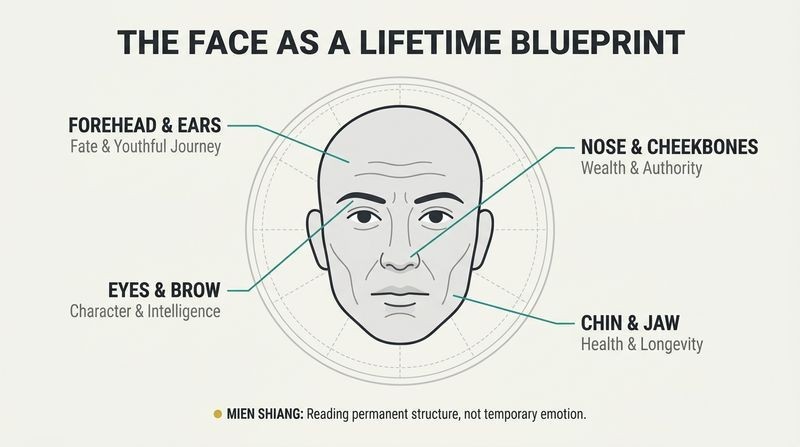
The book's central claim is that a human face is a blueprint of a person's whole life, from childhood to old age, and that anyone can learn to read it. The Chinese art is called Mien Shiang (face plus study of features), practiced since roughly 2700 BC under the Yellow Emperor and ranked among China's five classical metaphysical arts alongside Feng Shui.
Crucially, this is not reading expressions or emotions. Mien Shiang works on a completely blank, still face. Practitioners examine fixed structures: the depth of the eyes, prominence of cheekbones, length of the nose, moles, and lines. Silva promises the reader can decode health issues, wealth, personality, career fit, romantic compatibility, fertility, and destiny simply by studying these permanent features rather than fleeting moods.
The seductive premise, that structure reveals essence, taps a real cognitive habit psychologists call thin-slicing: humans form startlingly confident personality judgments within milliseconds of seeing a face (Ambady and Rosenthal). The trouble is accuracy. Those snap impressions are consistent across observers yet weakly correlated with actual traits, which is precisely how stereotypes propagate. What's valuable here is the distinction Silva draws between static bone structure and dynamic expression. Modern affective science (Ekman's micro-expressions) reads the moving face for emotion with genuine predictive power, whereas inferring destiny from a nose is a different, far shakier enterprise. Readers should hold the framework as an interpretive lens, not a diagnostic instrument.
Split any face into three horizontal zones mapped to life stages

The simplest and most accessible Mien Shiang method divides the face into three bands, each governing a chapter of life:
1. Heaven, from hairline to the top of the eyebrows, governs childhood and youth.
2. Human, from the eyebrows to the tip of the nose, governs the productive middle years.
3. Earth, from below the nose to the chin, governs old age.
Smooth, unblemished skin in a zone signals a fortunate corresponding period; scars, bumps, or discoloration flag hardship during that life stage. A discolored chin, for instance, warns of a difficult old age. Relative size matters too: if one band is visibly compressed compared to the others, the person struggled or will struggle in that era. A short forehead suggests a rough childhood.
The tripartite face is elegant precisely because it is memorable, and memorability is doing quiet persuasive work. This is textbook Barnum effect territory: vague, flattering, or ominous statements that feel personally accurate because nearly everyone has had a hard patch somewhere in life. Assign any blemish to any zone and confirmation bias supplies the story. Still, the framework has anthropological interest. Dividing the body into heaven, human, and earth mirrors Chinese cosmology's san cai (three powers) that also structures traditional medicine and architecture. As a mnemonic for organizing observations it is genuinely useful; as a forecasting tool it lacks any falsifiable mechanism linking a forehead bump to a bad childhood.
Read face shape as a shortcut to elemental temperament

Silva assigns each broad face shape a personality profile and one of the five Chinese elements. The recurring archetypes:
1. Square (earth face): pragmatic, grounded, risk-averse leaders and CEOs.
2. Heart (wood face): curious, big-picture people-pleasers and planners.
3. Round (water face): diplomatic, optimistic, business-minded diplomats.
4. Oval (metal face): high-IQ, honest, self-critical, physically weaker.
5. Triangle or pearl (fire face): charismatic, sociable, forgiving, but short-tempered.
Diamond faces read as dependable and approachable but quick to anger; rectangular faces as strong leaders prone to overthinking. Silva layers in finer cues: a woman with a recessed chin and larger nose reads as sociable, while a sharp jawline reads as introverted.
There is a fascinating grain of empirical truth buried here. Research on the facial width-to-height ratio (fWHR) finds wider-faced men show more aggression, and one study of hockey players linked broader faces to more penalty minutes (Carre and McCormick, 2008), plausibly mediated by prenatal testosterone. So the intuition that a wide, square jaw signals dominance is not pure fantasy. But Silva's shape-to-CEO leaps overreach the data badly, and the categories are so elastic that almost any face fits several. The deeper risk is the halo effect: the claim that oval faces are both prettiest and smartest simply restates the well-documented bias that we rate attractive people as more competent.
Sort people into five elemental archetypes drawn from nature's seasons
The Wu Xing, or Five Phases, form the personality engine of the whole system, each tied to a season and a cluster of features:
1. Wood (spring): growth, forward motion, defined brows and a strong jaw. Example given: Barack Obama.
2. Fire (summer): vibrant, curious, sparkling wide eyes, dimples, quick reflexes and athleticism.
3. Earth (late summer): community-minded and abundant, with plump cheeks, full lips, a round face.
4. Metal (autumn): sharp, symmetrical features, high arched brows, competitive and self-righteous. Example: Arnold Schwarzenegger.
5. Water (winter): deep, mysterious, private, with a prominent chin, large ears, and puffy under-eyes.
Silva stresses everyone is a blend, and someone can carry spring's traits while living through a winter phase.
The Five Phases are the intellectual backbone of Traditional Chinese Medicine, where they describe generative and controlling cycles among organs, emotions, and seasons rather than fixed personality boxes. Silva's translation into archetypes echoes Western typologies from the four humors to the Myers-Briggs, all of which satisfy a deep human appetite for parsimonious categories. The honest caveat she offers, that people are mixtures shifting with circumstance, is actually the system's saving grace and its escape hatch: it makes the scheme unfalsifiable but also more psychologically realistic than rigid typing. Used as a vocabulary for discussing temperament, the elements are evocative; used to predict behavior, they behave like horoscopes.
Learn the fixed vocabulary: nose means wealth, ears mean childhood
In Mien Shiang each feature carries an assigned meaning, and reading a face means combining these units. The core lexicon:
1. Nose: wealth and financial capacity; a fuller, rounder nose signals more money, not less.
2. Ears: childhood (birth to 14) and ancestral luck; thick fleshy earlobes mean a supportive, prosperous upbringing.
3. Eyebrows: relationships with siblings and friends, plus social luck.
4. Eyes: the window to the soul; big, bright, clear-whited eyes signal easy friendships.
5. Forehead: power, intellect, and career authority; high and broad means leadership.
Silva adds that the Twelve Houses map specific life domains onto specific spots, for example the corner of the eye as the Marriage House and the area under the eyes as the Children's House.
Assigning wealth to a large nose inverts modern Western beauty norms, and that inversion is itself culturally revealing: prosperity iconography, not universal aesthetics, drives the reading. The eyes-as-windows claim overlaps with genuine science, since gaze, pupil dilation, and blink rate do leak cognitive and emotional states. But the feature-to-domain mappings (eye corner equals marriage) have no causal thread, only tradition and analogy. The system's real cleverness is combinatorial: with a dozen features each carrying meanings, a reader generates a rich, personalized narrative, which feels insightful for the same reason a good cold reading does. The vocabulary is worth knowing as cultural literacy, especially for understanding Chinese art, opera, and folklore.
Trace a person's entire timeline on the face's 0 to 99 age map
The tradition maps a full 99-to-100-year lifespan onto the face, with each region governing a specific age range, scanned top to bottom as you age. The sequence:
1. Ears: 0 to 14 (left ear 0-7, right ear 8-14).
2. Forehead: 15 to 30.
3. Eyebrows and eyes: 31 to 40.
4. Nose: 41 to 50.
5. Philtrum: 51 to 55, then nasolabial folds, cheekbones, mouth, and chin carry 56 to 75.
Because childhood is considered predestined ('written' at birth in the Heaven zone), while midlife rewards effort, most fortune points cluster in the middle of the face. A blemish sitting at your current age-point warns of imminent challenges, giving you time to prepare.
The age map is the system's boldest promise and its most testable, which is why it fares worst under scrutiny: no longitudinal study links a nose mole to misfortune specifically in one's forties. Yet notice the built-in wisdom that childhood is fated while midlife is earned. That is a surprisingly modern, agency-affirming message dressed in mystical clothing, echoing behavioral genetics findings that early environment is largely outside our control while adult outcomes respond to effort. The 'warning' function also has a self-fulfilling edge: someone told to expect trouble may vigilantly find or even manufacture it, a dynamic Robert Merton described decades ago as prophecy shaping reality.
Read facial skin zones as an early-warning map of your organs
Silva bridges ancient face mapping with modern dermatology. Traditional Chinese practitioners linked each facial region to an internal organ through invisible channels of qi (vital energy), and doctors watched for skin changes to diagnose imbalance. The classic pairings:
1. Forehead: stomach and digestion.
2. Nose: heart and cardiovascular health (left nostril, left heart).
3. Cheeks: respiratory system and spleen.
4. Eyebrow area: liver and detoxification.
5. Chin and jaw: hormones and reproductive health.
She overlays the modern 'face mapping' zone system popularized by the skincare brand Dermalogica, where chin breakouts flag hormonal cycles and forehead acne flags diet. Remedies are lifestyle-based: hydration, sleep, antioxidants, and avoiding alcohol rather than cosmetic cover-ups.
This is where physiognomy earns partial scientific respect. Jaundiced eyes really do signal liver dysfunction, cyanotic lips signal oxygen problems, and hormonal acne genuinely concentrates along the jaw because androgen-sensitive sebaceous glands cluster there, a link dermatologists confirm. The chin-and-PCOS connection Silva flags is real medicine. Where the claim overreaches is the fixed organ-to-zone grid: dermatological reviews find little evidence that forehead acne specifically indicts the stomach. The safest reading is that the face is a legitimate health billboard for systemic conditions, but the ancient one-to-one organ maps are heuristics, not diagnostics. Persistent, changing, or asymmetric skin lesions warrant a physician, not a mirror.
Facial symmetry is the number-one wealth signal, above every other feature
When reading fortune, Silva ranks symmetry as the single most important marker: a face balanced along its central axis predicts a smooth, stable, abundant life, while an unbalanced one predicts struggle. She then lists nine wealth spots in priority order, including a high rounded forehead (the 'prosperity mountain'), a full 'money nose,' plump luminous cheekbones, bright steady eyes, and well-formed ears.
Tellingly, most wealth points sit in the middle Human zone, reinforcing the theme that midlife prosperity is built through effort rather than inherited. She also warns that surgically altered noses cannot be read accurately, citing Michael Jackson's repeated rhinoplasties as a cautionary tale of a natural feature disrupted.
Symmetry as a fortune omen accidentally rediscovers a robust finding from evolutionary biology: facial symmetry correlates with perceived attractiveness and is a proposed proxy for developmental stability and genetic fitness. Attractive people do, on average, earn more, the documented 'beauty premium' in labor economics. So the chain from symmetry to wealth has a real-world mediator, though it runs through social bias, not cosmic destiny. The prohibition on reading altered noses is philosophically interesting: it implicitly concedes that the face predicts nothing intrinsic and merely correlates with how others treat you, since surgery changes appearance without changing the soul the system claims to read. That tension quietly undermines the deterministic framing.
Treat moles and wrinkles as luck ledgers, each color and shape a verdict
Marks on the face are read as fortune indicators graded by color, shape, and placement. The rules Silva lays out:
1. Round, raised, bright red or dark black moles are auspicious; yellow, brown, or gray ones are unlucky.
2. Lucky black moles should be hidden; lucky red moles should be visible.
3. Hairy 'landlord' moles signal wealth and longevity, and men are warned never to trim the hair lest they reverse the luck.
Wrinkles carry their own code: three or fewer forehead lines are ideal, crow's feet at the eyes govern marriage fortune, and vertical nose-bridge lines can warn of migraines. Placement matters as much as presence, and temporary discoloration signals passing, fixable troubles.
The mole taxonomy is where the system's cultural logic shows plainly: red and black were imperial colors associated with luck, so lucky moles are red and black. Meaning follows symbolism, not biology. There is one inadvertently sound note: dermatologists agree that changing, asymmetric, or irregularly colored moles warrant attention, though for melanoma risk, not fortune. Silva's 'don't trim the hair' rule is charming folklore but also, coincidentally, aligns with the fact that hairy moles are statistically less likely to be malignant. The crow's-feet-equals-marriage claim, by contrast, is pure analogy, and its gendered readings (women with crow's feet as abuse victims) reflect the era's assumptions more than any predictive validity.
Physiognomy failed as science, so mine it for empathy, not judgment
Silva is candid that physiognomy is contested. It was used in 18th and 19th century forensics to 'identify criminals,' proved useless, and was abandoned; by the 20th century it survived mainly in fiction like Wilde's Dorian Gray. A 2017 algorithm claiming to detect sexual orientation from faces was condemned as dangerous and false. Modern individuality makes the practice look discriminatory.
Her reframe rescues its value: the point is not to condemn strangers but to understand them, slow your snap judgments, and extend compassion. She argues cosmetic surgery cannot alter your inner self or destiny, and that clearing acne through diet, hydration, sleep, and skincare (never surgery) reflects genuine inner health. The true payoff is self-knowledge and acceptance of others.
This closing pivot is the book's most defensible move: it converts a debunked predictive science into a reflective and relational practice, closer to journaling or mindfulness than fortune-telling. The historical honesty matters, because physiognomy's darkest legacy is real, from Lombroso's 'born criminal' skull measurements to Nazi race pseudoscience, and the 2017 Kosinski study revived those exact dangers with machine learning. Silva's ethical instinct to aim the tool inward is sound. The unresolved contradiction is that a system built entirely on inferring fixed traits from fixed features cannot simply be redeemed as non-judgmental; the empathy has to come from the reader's intention, not the method, which by design invites exactly the snap verdicts she warns against.
Analysis
This is an esoteric how-to manual, not an argument-driven work, and that shapes both its strengths and its liabilities. Structurally it moves from history (Greek and Chinese physiognomy) through technique (zones, shapes, the Five Elements, feature-by-feature dictionaries, the age map) to applications (health, wealth, fertility, marriage, children). Its difficulty for a summarizer is that it is a reference catalog: hundreds of discrete micro-claims with almost no connective theory, and a persistent tension between mystical determinism and the disclaimer that fate is changeable.
Intellectually, the book sits at an uneasy crossroads. Physiognomy is among the most thoroughly discredited pseudosciences in Western history, weaponized by Lombroso and eugenicists, yet it keeps returning, most recently through facial-recognition AI that claims to infer criminality or sexuality, revivals that ethicists have rightly alarmed over. Silva deserves credit for acknowledging this lineage rather than hiding it, and for redirecting the practice toward self-understanding and empathy.
What is genuinely interesting is how often the system brushes against real phenomena without a valid mechanism. The face does broadcast health (jaundice, cyanosis, hormonal acne along androgen-rich jaw skin). Facial symmetry does correlate with perceived attractiveness and, via the documented beauty premium, with income. Wider male faces do modestly predict aggression through the facial width-to-height ratio. These grains of truth make the whole edifice feel plausible, which is exactly the epistemic trap: correlation and cultural symbolism get promoted to cosmic law.
The most honest way to read this book is as cultural anthropology and as a mirror. As a window into Chinese cosmology (san cai, Wu Xing, qi) it is illuminating. As a mindfulness prompt to slow one's judgments and read others generously, it has quiet value. As a predictive instrument for wealth, marriage, or a baby's gender, it should be enjoyed as folklore, not trusted as forecast.
Review Summary
Readers found Face Reading enjoyable and interesting, praising its detailed information on studying facial features to understand personalities and detect truthfulness. Many experimented with the techniques on themselves and others, finding the results surprisingly accurate. Reviewers appreciated the guidance provided and noted how it changed their perspective when observing people. Some mentioned needing multiple readings to fully grasp the wealth of information presented. Overall, readers found the book enlightening and fun, recommending others to try face reading for themselves.
People Also Read

FAQ
What's "Face Reading: Unlock the Secrets of Chinese Physiognomy and Discover How to Read People Like Clockwork" about?
- Ancient Practice: The book explores the ancient art of face reading, a practice used in Chinese and European civilizations to interpret a person's character, emotions, and future based on their facial features.
- Comprehensive Guide: It provides a detailed history of face reading, including its evolution and significance in various cultures, particularly focusing on Chinese physiognomy.
- Practical Application: Readers learn how to apply face reading techniques to understand the people around them better, including family, friends, and acquaintances.
- Holistic Approach: The book combines historical insights with practical advice, offering diagrams and step-by-step instructions to help readers master the art of face reading.
Why should I read "Face Reading" by Mari Silva?
- Understand People Better: The book offers tools to interpret people's thoughts and emotions, enhancing your ability to empathize and connect with others.
- Cultural Insight: It provides a deep dive into Chinese physiognomy, offering a unique perspective on how ancient practices can be applied in modern contexts.
- Self-Improvement: By learning face reading, you can gain insights into your own personality and potential future, helping you make informed decisions.
- Practical Skills: The book equips you with practical skills to assess health, wealth, and relationships through face reading, which can be useful in personal and professional settings.
What are the key takeaways of "Face Reading"?
- Facial Features as Indicators: Each facial feature, such as the nose, eyes, and mouth, reveals specific traits about a person's character and future.
- Five Elements Theory: The book explains how the five elements (wood, fire, earth, metal, water) relate to personality traits and facial features.
- Twelve Houses Method: It introduces the Twelve Houses method, which divides the face into sections to predict various aspects of life, such as health and wealth.
- Practical Application: Readers learn to apply face reading techniques in everyday life, enhancing their understanding of themselves and others.
How does the Five Elements Theory relate to face reading in the book?
- Elemental Associations: Each element (wood, fire, earth, metal, water) is associated with specific facial features and personality traits.
- Seasonal Connection: The elements are linked to seasons, reflecting different phases of life and personal growth.
- Personality Insights: Understanding the elements helps in deciphering a person's dominant traits, strengths, and weaknesses.
- Holistic Understanding: The theory provides a comprehensive framework for interpreting facial features in the context of a person's overall character and destiny.
What is the Twelve Houses Method in "Face Reading"?
- Face Division: The Twelve Houses method divides the face into twelve sections, each representing different aspects of life, such as health, wealth, and relationships.
- Predictive Tool: By analyzing these sections, readers can predict a person's fortune and challenges in various life areas.
- Detailed Analysis: The method offers a structured approach to face reading, allowing for a more nuanced understanding of a person's life path.
- Cultural Significance: It reflects ancient Chinese beliefs about how facial features correlate with one's destiny and life experiences.
How can face reading predict health according to the book?
- Facial Zones: The face is divided into zones that correspond to different organs and health conditions.
- Visible Indicators: Marks, discoloration, or scars on specific facial areas can indicate underlying health issues.
- Holistic Diagnosis: The book combines traditional Chinese medicine principles with modern face mapping to assess health.
- Preventive Insights: By understanding these indicators, readers can take proactive steps to address potential health concerns.
What does the book say about using face reading to assess wealth?
- Nose as Wealth Indicator: The nose is a primary indicator of wealth, with its size and shape reflecting financial prospects.
- Symmetry and Balance: A symmetrical face is considered a sign of financial stability and abundance.
- Multiple Wealth Spots: The book identifies several facial features, such as the forehead and chin, that correlate with wealth.
- Practical Application: Readers learn to assess these features to predict financial success and stability.
How does "Face Reading" address relationships and marriage?
- Facial Features and Compatibility: The book explains how certain facial features can indicate compatibility and relationship dynamics.
- Marriage Palace: Specific areas of the face, like the Marriage Palace, are analyzed to predict relationship success.
- Gender Differences: It discusses how facial features differ between men and women in predicting relationship outcomes.
- Late Marriage Indicators: The book identifies features that may suggest a tendency towards late marriage.
What are some practical applications of face reading in daily life?
- Interpersonal Understanding: Use face reading to better understand the emotions and intentions of those around you.
- Career Guidance: Assess facial features to determine career suitability and potential success.
- Health Monitoring: Regularly check facial zones for signs of health issues, allowing for early intervention.
- Relationship Insights: Apply face reading techniques to improve personal relationships and assess compatibility.
What are the best quotes from "Face Reading" and what do they mean?
- "Faces are open books ready to spill their secrets to those who master the art of face reading." This quote emphasizes the depth of information that can be gleaned from a person's face.
- "Your face reveals your ability to work either independently or collectively." It highlights how facial features can indicate work preferences and strengths.
- "A person's face can reveal virtually everything about them – from their childhood to how their life will be when they retire." This underscores the comprehensive nature of face reading in understanding a person's life journey.
- "The ability to read faces can significantly affect a person's life as well as their habits." It suggests that mastering face reading can lead to personal growth and improved interactions with others.
How does "Face Reading" address the impact of cosmetic surgery on face reading?
- Inner Self vs. Outer Appearance: The book emphasizes that face reading focuses on the inner self, which remains unchanged by cosmetic alterations.
- Potential Misinterpretations: Cosmetic surgery may lead to inaccurate readings by altering key facial features.
- Natural Changes: It acknowledges that natural changes in facial features over time can reflect shifts in destiny and character.
- Advice on Alterations: The book advises against cosmetic surgery for aesthetic purposes, suggesting that natural features provide the most accurate readings.
What are the historical origins of face reading as discussed in the book?
- Ancient Practice: Face reading has roots in ancient Chinese and European civilizations, dating back several millennia.
- Greek Influence: The book discusses how Greek scholars like Aristotle contributed to the study of physiognomy.
- Chinese Tradition: It highlights the significance of face reading in Chinese culture, particularly among Taoist practitioners.
- Evolution Over Time: The practice has evolved, incorporating elements from various cultures and adapting to modern contexts.
About the Author


Download PDF
Download EPUB
.epub digital book format is ideal for reading ebooks on phones, tablets, and e-readers.








