

Key Takeaways
Treat a first impression as evidence of your mind, not their character.
The face feels like a verdict. People form impressions from faces in as little as 30 to 40 milliseconds. In studies of elections, judgments of which candidate looked more competent predicted the winner about 70 percent of the time. That sounds like a window into character, but it shows only that voters share a visual stereotype and act on it. The book calls the old project of reading a person’s inner nature from appearance physiognomy. Its long history runs from Lavater to Francis Galton, whose composite photographs were meant to reveal types such as the criminal.
A persuasive illusion. The skeptical thinker Georg Christoph Lichtenberg argued that behavior depends on circumstances as well as disposition. A face can spark a confident story about someone without supplying evidence that the story is true.
The distinction between a compelling judgment and a valid one is central to critical thinking. Perception often arrives before conscious reasoning, so confidence can feel like evidence even when it is only fluency. This also explains why facial profiling can seem scientific: consistent judgments look like measurement, but agreement does not establish that the measured trait exists in the face. The practical question is not whether an impression arose naturally. It is whether independent evidence confirms it.
Expect a face to sway consequential choices when reliable information is missing.
Appearance becomes a shortcut. The influence of faces reaches beyond elections. In one study, children choosing a French politician to captain an imaginary voyage picked the eventual election winner about 70 percent of the time. Research with voters suggests that appearance matters most for people with little political knowledge, who may substitute the easier question, “Who looks competent?” for the harder one, “Who is competent?” In some experiments, adding candidate pictures to ballots changed stated voting preferences substantially.
The costs are real. Similar judgments affect hiring, lending, and legal decisions. In small-claims courts, a defendant’s babyfaced appearance could help or hurt depending on whether the case involved intentional or accidental harm. Face stereotypes are not merely private opinions when institutions turn them into decisions about money, opportunity, or liberty.
This is a problem of institutional design, not just individual bias. When a decision-maker sees a face before reviewing a record, the visual impression can frame how later evidence is interpreted. Procedures that delay photographs, standardize interviews, or prioritize verifiable performance information can reduce that influence. Such safeguards do not assume that every impression is wrong. They recognize that even a potentially useful cue can overpower better evidence when it is vivid, immediate, and easy to process.
Read faces as whole patterns, not diagnostic single features.
Features work together. Artists such as Rodolphe Töpffer showed that changing a few lines could transform a drawn face from dull to focused. Modern experiments confirm that the effect depends on combinations: a smile paired with angry-looking eyebrows can suggest scheming rather than warmth. Even identical eyes can appear to smile when placed above a smiling mouth. Face perception is holistic, meaning the brain processes features as an integrated configuration rather than as independent clues.
Models reveal the pattern. Researchers created computer-generated faces and measured how people rated them. Trustworthy-looking faces tended to look happier and more feminine; dominant-looking faces tended to look more masculine and mature. These patterns organize many impressions around judgments of goodness or badness and power. With richer face samples, attractiveness also emerged as a distinct dimension.
The holistic account cautions against folk rules such as treating a particular nose or chin as a reliable personality marker. It also has implications for artificial intelligence: a system trained on facial judgments may reproduce the stereotypes embedded in those judgments, even if it never explicitly measures a single feature. The models describe what observers perceive, not what a person is. That distinction is essential whenever a perceptual map is mistaken for a map of human character.
Ask whose culture and experience taught you what looks trustworthy.
Typicality shapes trust. Face typicality means how closely a face resembles the faces an observer regards as normal or familiar. In a study, Israeli and Japanese participants judged a series of faces between a typical Israeli woman and a typical Japanese woman. As a face moved toward their own group’s average, participants from that group tended to trust it more. In another experiment, exposure to 500 faces shifted what participants considered typical and trustworthy in about half an hour.
Personal history matters too. People also extend feelings about familiar others to strangers who resemble them. Participants trusted unfamiliar faces that subtly resembled people they had learned to associate with positive behavior more than faces resembling people associated with negative behavior. These judgments can emerge without conscious recognition of the resemblance.
This resembles Bayesian learning: prior experience supplies expectations that shape how new evidence is interpreted. The process is useful when familiar patterns predict what comes next, but it can also turn social familiarity into a false proxy for virtue. Exposure can change the prior, which means these preferences are not fixed facts about faces. It also means that a “neutral” decision-maker may still carry a highly personal and culturally learned standard of what looks normal.
Never treat one photograph as a stable portrait of a person.
A photograph is a moment. Francis Goring compared composites made from selected drawings of prisoners with composites made from randomly chosen prisoner photographs. The selected drawings looked far more criminal, revealing how an observer’s expectations can shape an image presented as evidence. Modern photographs are no more neutral. In a study of Dutch celebrities, twenty different pictures of the same person could reverse which of two people appeared more attractive.
Knowledge edits what is seen. Jared Lee Loughner’s mug shot looked sinister to people who knew he had carried out a mass shooting. Students who did not know his history saw a much less remarkable face. A different photograph also produced a more ordinary impression. The image itself did not contain a stable label of evil; viewers supplied meaning from their knowledge, the photograph chosen, and its presentation.
A photograph is not simply a transparent record. Selection, lighting, camera angle, expression, and surrounding narrative all influence interpretation. This matters in news coverage, hiring, policing, and online profiles, where the chosen image may stand in for a whole person. The same concern applies to machine-learning datasets: if images are unevenly selected or produced under different conditions, an algorithm can learn the artifacts of image-making rather than the human trait it claims to identify.
Use base rates and behavior before trusting a face-based prediction.
Better than chance can still fail. In one study, participants guessed men’s sexual orientation from photographs with 52 percent accuracy, only slightly above chance in a balanced sample. But the real population is not evenly divided between gay and straight men. When a category is rare, even a modest false-alarm rate can produce many more false identifications than correct ones. Knowing the category’s base rate, or how common it is, can be more useful than the face.
Behavior beats appearance. In trust-game experiments, most players cooperated. Participants who invested based on trustworthy-looking faces missed many cooperative partners. In one analysis, indiscriminately investing would have produced better returns than relying on face judgments. In a separate political task, simple demographic rules outperformed people asked to infer party affiliation from candidates’ faces.
This is a practical lesson in signal detection: a clue must be evaluated against both its accuracy and the prevalence of the outcome. A test that seems impressive in a laboratory sample can be harmful when applied to a population where the target is uncommon. The same logic supports checking observable behavior, records, and repeated interactions rather than treating a quick impression as a diagnostic instrument. When feedback is available, it should update the judgment; when it is absent, confidence should decrease.
Do not confuse a measurable facial ratio with an honest signal.
A simple measure gained big claims. The facial width-to-height ratio, or fWHR, compares cheekbone width with the distance from the upper lip to the brow. Researchers proposed that it could signal male aggression and dominance. Yet a large analysis found almost no gender difference in the ratio: gender explained less than one quarter of one percent of its variation. Reviews found only weak links between the ratio and aggressive behavior, with reported correlations around .11 to .16.
Perception is not proof. People do tend to see wider faces as more threatening, but many facial features change together, including jaw shape and apparent masculinity. The ratio itself may not be what drives the judgment, and it is not a dependable measure of actual strength. Cross-cultural findings also ran against the idea of a universal evolved signal.
The fWHR illustrates a common scientific trap: a measurable variable can acquire an explanation that exceeds its evidence. Measurement precision does not guarantee conceptual validity. A ratio may correlate with a perception because it travels alongside other cues, while the causal story remains untested. This is not a reason to reject evolutionary explanations wholesale. It is a reason to separate a proposed mechanism, the strength of its association, and the social consequences of acting as though the mechanism were established.
Read visible wear as evidence of life conditions, not moral character.
Life leaves physical traces. Repeated emotional expression may gradually influence a resting face, though the evidence comes from studies of older adults and does not establish a simple personality code. Sleep loss can make people look tired, less healthy, less attractive, and less intelligent. Diet can alter skin color: a fruit- and vegetable-rich diet increases yellowish carotenoid tones that many observers associate with health. Smoking can contribute to wrinkles and a grayish complexion.
Appearance can predict condition. In a study of Danish twins over age 70, the twin judged to look older was more likely to die during the following years, even when the pair shared age and sex. Yearbook photographs also helped researchers estimate later health risks from apparent body weight. These are clues to health and circumstances, not evidence that a person is virtuous or blameworthy.
Appearance can carry real information without carrying the information people assume. A tired face may indicate sleep loss; it does not establish laziness. A visible health marker may help clinicians ask better questions, but using it as a moral judgment converts circumstance into stigma. The distinction is especially important because health is shaped by access to food, rest, safety, and care. A useful visual clue should open an inquiry, not close one.
Your brain is primed for faces, which explains attention, not accuracy.
The bias starts early. Newborns prefer facelike patterns with the light and dark arrangement typical of a real face. Their vision is very poor, yet they attend to faces before they have much experience with them. Infants then see faces for a substantial share of their waking time, and that exposure tunes recognition to the people around them. This perceptual narrowing can make faces from other racial groups harder to distinguish after early infancy.
The brain specializes. Face-selective neurons and brain regions respond more strongly to faces than to many other objects. Damage to some of these regions can impair recognition of familiar faces while leaving much other vision intact. This specialized machinery helps people recognize faces and respond to their social significance. It does not prove that faces reliably reveal stable traits such as honesty or intelligence.
Specialization can create expertise in one task while encouraging overconfidence in another. The brain is remarkably good at detecting, comparing, and remembering faces, but those abilities do not automatically confer access to hidden character. This resembles a skilled instrument used beyond its calibration: it may produce precise readings that answer the wrong question. The strongest conclusion from face neuroscience is that faces matter deeply to social perception, not that every impression derived from them is warranted.
Interpret faces with bodies, situations, and histories in view.
Context changes meaning. In experiments, the same facial expression placed on different bodies could be read as different emotions. Tennis players’ faces alone did not reliably show whether they had won or lost a high-stakes point. Their bodies did; adding the faces did not improve accuracy. Yet viewers often believed their judgments came mainly from the face. The emotional overgeneralization hypothesis describes how observers extend a passing expression, such as a smile, into a trait judgment about the person.
Familiarity is not transferable. People recognize familiar faces across changing photographs with ease, but often struggle to tell whether two unfamiliar photographs show the same person. Knowledge attached to a familiar face can make recognition feel effortless, encouraging the mistaken belief that unfamiliar faces are equally readable. A face is one source of social information, not a complete account of the person.
The best unit of interpretation is often the person-in-context, not the face cropped from the scene. Bodies, posture, speech, setting, and prior conduct can clarify what a facial movement means, although each source can also mislead. A useful discipline is to separate observation from inference: “the person’s mouth is raised” is an observation; “the person is trustworthy” is an inference. Keeping that distinction visible makes room for curiosity, correction, and more humane judgments.
Analysis
Face Value is a science book organized around a productive reversal: the face is not a transparent map of character, but a stimulus from which observers construct a map. Its historical thread matters because physiognomy was not merely a quaint error. Lavater and Galton gave intuitive judgments the authority of systems and measurements, and those systems helped rationalize racism, eugenics, and punitive classifications. The danger persists whenever shared agreement is mistaken for objective truth.
The book’s strongest synthesis joins three facts that are often kept apart. First, impressions form rapidly and consistently. Second, they influence consequential choices, especially when information is scarce. Third, their consistency comes from shared perceptual stereotypes, not necessarily from accurate knowledge of the people being judged. That distinction explains why a face can predict an election outcome without accurately measuring a candidate’s competence. A forecast can succeed because voters share a heuristic that shapes behavior, not because the heuristic reveals the underlying trait.
The research methods deepen the argument. Manipulated faces, visual noise, and statistical models make mental stereotypes visible, while studies of photographs expose the instability of the supposed signal. The book thereby offers a useful model of scientific restraint: describe what observers reliably see, then test separately whether it corresponds to reality. The fWHR discussion is especially instructive because a precise ratio can invite a compelling evolutionary story that outpaces its predictive power.
The practical implication is not to pretend that first impressions can be switched off. They are fast, socially useful, and built into specialized perceptual systems. The better response is to treat them as hypotheses, audit the information that produced them, and seek behavioral evidence. In settings where fairness matters, institutions can reduce the weight of appearance by delaying access to photographs and emphasizing records or performance. The face remains socially powerful, but power is not proof.
Review Summary
Face Value receives mostly positive reviews, with readers praising its comprehensive exploration of facial perception and first impressions. Many appreciate Todorov's accessible writing style and the inclusion of visual aids. The book is lauded for its scientific approach and debunking of misconceptions about judging character from faces. Some readers find the conclusions repetitive or contradictory. Overall, it's considered an informative read for those interested in psychology, neuroscience, and social interactions, offering insights into human biases and decision-making processes.
People Also Read










Glossary
Physiognomy
Character reading from appearanceHistorically, physiognomy was the claimed art or science of inferring a person’s character from facial or bodily appearance. Alexander Todorov uses the term for a persistent temptation: treating the impressions people form from faces as direct knowledge of the face-bearer. The historical systems described in the book lacked reliable evidence and often reinforced prejudice.
Pathognomy
Reading momentary passionsPathognomy refers to interpreting temporary emotional states from visible signs, especially facial expressions. The book contrasts it with physiognomy, which claims to reveal stable character. In practice, observers often extend a momentary expression into an enduring trait judgment, blurring the distinction between what someone appears to feel now and what kind of person they are.
Perceptual narrowing
Experience tunes perceptionPerceptual narrowing is the developmental process by which perceptual abilities become increasingly tuned to stimuli common in a person's environment. Infants begin with broader capacities for distinguishing faces, but early visual experience strengthens recognition of familiar kinds of faces. This tuning can make less-familiar faces, including faces from other racial groups, harder to discriminate.
Superstitious perception
Visualizing mental stereotypesSuperstitious perception is a noise-based research technique for revealing what people see in an ambiguous image. Researchers repeatedly add random visual noise to the same base face and collect judgments, such as which image looks more trustworthy. Averaging the noise patterns associated with each judgment produces a visualization of the cues observers consistently use, even when no objectively correct answer exists.
Facial width-to-height ratio
Face width divided by heightThe facial width-to-height ratio, often abbreviated fWHR, compares the distance between the cheekbones with the vertical distance from the upper lip to the brow. Some researchers have proposed it as a cue to masculinity, dominance, or aggression. Todorov reviews evidence that its relationship with actual behavior is weak and that people’s perceptions may depend on broader facial patterns.
Fusiform face area
Face-responsive brain regionThe fusiform face area is a region in the fusiform gyrus of the temporal lobe that responds more strongly to faces than to many other visual objects. Research described in the book links this region to face perception, while cases of brain damage show that injury in nearby areas can disrupt face recognition. It is part of a broader network involved in processing faces.
Emotion overgeneralization hypothesis
Extending expression into traitThe emotion overgeneralization hypothesis proposes that observers use facial configurations resembling emotional expressions to infer stable traits. A smile, for example, may lead someone to seem trustworthy, while an angry-looking resting face may suggest threat. The inference can occur even when the person is not expressing that emotion, making the cue psychologically influential but not necessarily accurate.
FAQ
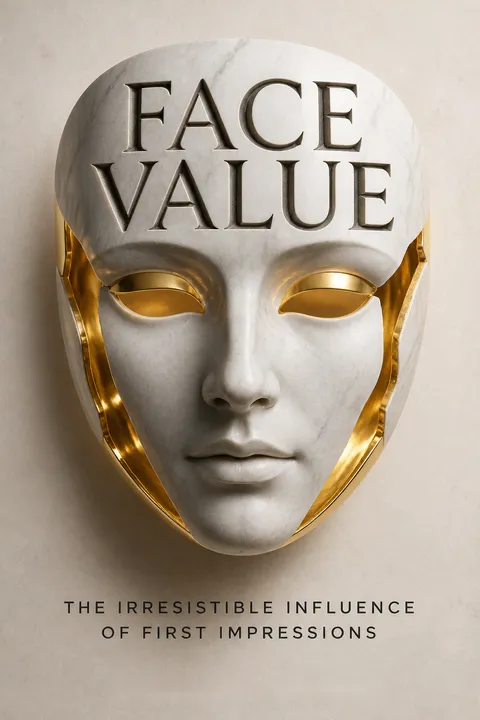
What’s [Face Value: The Irresistible Influence of First Impressions] by Alexander Todorov about?
- Explores first impressions: The book investigates how we form rapid judgments about others based on facial appearance, often within milliseconds, and how these impressions shape social decisions.
- Historical and scientific context: It traces the history of physiognomy—the pseudoscience of reading character from faces—and contrasts it with modern psychological and neuroscientific research.
- Limits and consequences: Todorov reveals that while faces carry some social signals, many first impressions are illusory or based on weak cues, often leading to misleading judgments.
Why should I read [Face Value] by Alexander Todorov?
- Understand social cognition: The book offers deep insights into how humans process faces and form social impressions, which are crucial for navigating everyday interactions.
- Debunking common myths: It challenges the belief that we can accurately judge character from faces, helping readers recognize and avoid their own biases.
- Practical and critical perspective: By explaining the science behind face perception, it equips readers to critically evaluate the influence of appearance in personal and societal decisions.
What are the key takeaways from [Face Value] by Alexander Todorov?
- First impressions are rapid: We form automatic judgments from faces within milliseconds, often without conscious awareness.
- Shared but inaccurate: People tend to agree on impressions like trustworthiness and dominance due to cultural and perceptual stereotypes, but these impressions are often inaccurate.
- Consequences in real life: Relying on facial impressions can lead to suboptimal decisions in areas like voting, hiring, and legal judgments.
What is physiognomy, and how does [Face Value] by Alexander Todorov address its historical and modern appeal?
- Definition and history: Physiognomy is the belief that one can discern character or personality from facial features, a concept popularized by figures like Lavater and Galton.
- Scientific discrediting: The book shows that physiognomy lacks scientific basis, yet its promise remains appealing due to our natural tendency to form rapid impressions.
- Modern persistence: Todorov explains that physiognomy persists because appearance-based judgments feel intuitive and fill information gaps, especially in large, impersonal societies.
How does [Face Value] by Alexander Todorov explain the psychological basis of first impressions?
- Consensus on impressions: People consistently agree on traits like trustworthiness, competence, and dominance based on facial cues.
- Perceptual and emotional rules: Impressions arise from systematic relations between facial appearance, stereotypes, and emotional expressions.
- Holistic face processing: Faces are perceived as integrated wholes, making impressions complex and context-dependent.
What scientific methods does [Face Value] by Alexander Todorov describe for studying first impressions?
- Noise-based techniques: Researchers distort facial images with random noise to identify which features drive specific impressions.
- Data-driven modeling: Statistical models generate and manipulate faces to visualize and exaggerate traits like trustworthiness and dominance.
- Composite photography: Techniques like morphing and averaging faces help study how variations affect social judgments.
What are the main dimensions of first impressions discussed in [Face Value] by Alexander Todorov?
- Trustworthiness (Goodness): Reflects perceived intentions, often linked to emotional expressions and cues of friendliness or threat.
- Dominance (Power): Relates to perceived ability to enact intentions, associated with masculinity, facial maturity, and strength.
- Attractiveness (Youthfulness): An independent dimension influenced by age and gender cues, affecting impressions but distinct from trustworthiness and dominance.
How accurate are first impressions from faces according to [Face Value] by Alexander Todorov?
- Limited predictive power: First impressions predict only a tiny fraction of actual personality traits or behaviors, often less than 1% of variance.
- Misleading images: Still photographs can distort impressions due to lighting, expression, and selection bias.
- Better alternatives: General knowledge about demographics or behavior frequencies often predicts outcomes better than facial impressions alone.
What are the consequences of relying on first impressions, as described in [Face Value] by Alexander Todorov?
- Suboptimal decisions: Appearance-based judgments can lead to errors in voting, hiring, legal sentencing, and economic exchanges.
- Bias reinforcement: Impressions are shaped by cultural stereotypes and personal experiences, perpetuating prejudice.
- Hard to override: Rapid, automatic impressions are difficult to correct, even when contradictory information is available.
How does [Face Value] by Alexander Todorov explain individual differences in first impressions?
- Role of experience: Unique social environments and personal histories shape what we perceive as typical faces and influence our impressions.
- Adaptation effects: Exposure to certain faces shifts our perception of typicality and trustworthiness, altering impressions of new faces.
- Self and familiar resemblance: We tend to trust and prefer faces resembling ourselves or people we know, affecting social judgments.
What does [Face Value] by Alexander Todorov reveal about the brain’s face-processing system?
- Face-selective neurons: Specialized neurons in the temporal cortex respond selectively to faces, supporting holistic perception.
- Dedicated brain network: Areas like the fusiform face area (FFA), occipital face area, and amygdala form a network for face perception and social evaluation.
- Causal evidence: Electrical stimulation of face-selective areas can distort face perception, demonstrating their critical role in recognition and interpretation.
How does [Face Value] by Alexander Todorov address the persistence of physiognomy and the illusions of facial judgment?
- Evolutionary origins: Humans evolved to read social signals from dynamic facial cues for immediate intentions, not stable character traits.
- Cognitive and cultural biases: The brain’s readiness to attend to faces and form rapid impressions creates illusions of accuracy, reinforcing belief in physiognomy.
- Social and historical factors: Physiognomy persists because it offers an intuitive way to reduce uncertainty about strangers, despite weak empirical support.
Download PDF
Download EPUB
.epub digital book format is ideal for reading ebooks on phones, tablets, and e-readers.








