

Key Takeaways
Learn money from practitioners before trusting the stories told about it.
A costly blind spot. In 1972, Kiyosaki and another Marine pilot flew behind enemy lines hoping to buy gold cheaply. They reached a village and met a dealer who knew the international price. The two college-educated officers did not even know how to recognize genuine gold. She refused to discount it, and the encounter exposed how little they understood about money.
Curiosity becomes education. The episode became a starting point for Kiyosaki’s financial study, begun after his rich dad warned him that the 1971 end of dollar convertibility to gold had changed the monetary system. His broader point is that classroom credentials do not guarantee practical knowledge. He urges readers to seek people who actually work with the subject they want to understand.
The scene is memorable because expertise is shown through a small, testable act: the dealer knows her product and its market. That resembles the distinction between textbook knowledge and tacit skill, the know-how people acquire by repeatedly doing a task. It is a useful corrective to credential worship. Still, one vivid encounter cannot establish that gold is safer than every alternative or that formal education is useless. The durable lesson is narrower: test claims against practical competence, and notice what a confident expert can and cannot demonstrate.
Judge an asset by its cash flow, not its respectable label.
Follow the money. Kiyosaki defines an asset as something that puts money in a person’s pocket and a liability as something that takes money out. A house is not automatically one or the other. A rental property producing income may be an asset; a personal home with mortgage, taxes, repairs, and other costs may be a liability under his cash-flow definition.
Use the whole statement. He reduces financial literacy to tracking income, expenses, assets, liabilities, and cash flow. The label on an account or possession matters less than the actual movement of money. This is why he argues that people who lost homes during the 2008 crash discovered too late that an assumed asset could become a financial burden.
The cash-flow test is powerful because it replaces status labels with observable behavior. It also resembles systems thinking: an object’s role depends on its relationship to the wider system, not just its name. A home can provide shelter and stability even when it does not generate income, so the author’s definition is a practical accounting lens, not a complete measure of personal value. Readers can use it to assess affordability and liquidity while keeping nonfinancial benefits, such as security and community, in view.
Trace who owes whom before trusting money built from layered promises.
Promises have counterparties. Counter-party risk is the possibility that someone in a financial agreement will fail to meet an obligation. A bank deposit, insurance policy, bond, or paper claim depends on institutions and people keeping their promises. Kiyosaki contrasts these claims with physical gold and silver, which he regards as money without a counterparty.
Complexity can hide risk. His account of 2008 follows mortgages from borrowers to banks, investment firms, packaged securities, and insurers. When borrowers stopped paying, losses traveled through the chain. The book cites estimates of roughly $700 trillion in derivatives in 2008 and $1.2 quadrillion in 2018, using them as warnings about systemic exposure. These are measures of contract value, not a direct estimate of losses.
Mapping obligations is a strong habit because financial crises often arise not from one bad asset alone, but from connected claims whose risks are hard to locate. The mortgage example makes that structure legible. The distinction between underlying value and contract size matters, however: derivative notional totals do not mean that the same amount is likely to vanish. Complexity warrants scrutiny, not automatic condemnation. A useful reader’s question is: who bears the loss if the next promise in this chain fails?
Choose teachers who practice, and rehearse before risking real capital.
Experience changes the lesson. Kiyosaki contrasts his father, a highly educated public educator, with his rich dad, an entrepreneur who taught through business examples and the Monopoly board game. He also praises military flight instructors because they could perform the skills they taught. A teacher’s credentials, in this account, matter less than relevant practice and the ability to explain mistakes.
Make learning active. Kiyosaki describes taking a real estate seminar, then analyzing 100 properties over 90 days before choosing one. He presents this as a way to learn by examining real cases rather than only memorizing concepts. His preferred sequence is to observe, practice, and then act, although the book also acknowledges that only a few students completed the assignment.
The emphasis on deliberate practice fits a broad principle of skill learning: feedback and repeated attempts reveal errors that passive exposure can leave untouched. The 100-property assignment also converts enthusiasm into observable work. Yet practitioners can be poor teachers, and success in one period or market does not guarantee sound advice in another. A strong teacher combines firsthand experience with transparent reasoning, explains failures as well as wins, and makes it possible for students to check the claims independently.
Treat mistakes as tuition, then use a team to learn faster.
Failure needs review. Kiyosaki recounts a business employee taking $100,000 that his poor dad had lent the company. The business later failed, and repaying the loan took years. He does not present the loss as automatically beneficial. Its value came from what he learned about trust, cash needs, and rebuilding, including help from his younger brother.
Practice without catastrophe. He argues that school often treats mistakes as evidence of stupidity, while business requires experimentation and cooperation. The CASHFLOW game was designed to let people make financial decisions with play money and discuss them together. In this view, asking for help is not cheating but a basic part of team-based work. The practical cycle is to try, review what happened, and change the next attempt.
The book’s most useful qualification is implicit in its stories: mistakes teach only when someone examines them honestly. A loss can also be mere damage, especially when it is repeated without feedback or when others bear the cost. Simulation, peer discussion, and staged practice lower the price of experimentation. That makes the lesson relevant well beyond investing, from medicine to engineering. The productive mindset is not to seek failure, but to make learning visible before a small error compounds into a large one.
Borrow only when the cash flow and downside are understandable.
Leverage magnifies outcomes. Kiyosaki’s rich dad taught him to use debt to acquire income-producing property, while warning that debt can either help or harm. In one example, Kiyosaki bought a small condominium priced at $18,000, using borrowed funds, including a credit-card charge for the down payment. He reported that it generated $25 a month after expenses.
An infinite return. The book calls a deal an infinite return when the investor recovers the cash initially contributed while retaining an asset that continues producing income. The phrase describes a particular calculation, not a guarantee of profit. Debt still requires repayment, and a property can lose tenants, fall in value, or cost more to maintain than expected. Kiyosaki urges training and practice before using leverage.
Leverage is a tool for amplifying control over an asset, but it amplifies losses and obligations too. The example’s small monthly surplus illustrates why cash flow must be measured after expenses, not inferred from rent alone. The author’s emphasis on debt as money can be useful for understanding how investors operate, yet it should not be read as a universal recommendation. A sound decision also tests vacancy, interest-rate changes, repairs, taxes, and the possibility that the borrower’s income disappears.
Audit retirement fees and guarantees before trusting rosy projections.
Know what changed. Kiyosaki contrasts older defined-benefit pensions, which promised a retirement payment, with defined-contribution plans such as 401(k)s, where the final amount depends on contributions and investment performance. He argues that workers were asked to manage retirement savings without being taught how to invest.
Look beneath returns. The book warns that fund and advisory fees can steadily reduce savings, even when a portfolio appears to grow. It cites a 2016 example in which a household with retirement accounts holding a median $135,000 might receive about $600 a month in annuity income. Those figures describe a period-specific estimate, not every household’s outcome. Kiyosaki’s practical advice is to inspect fees, assumptions, and who benefits from the account before relying on it.
The shift from promised benefits to individual investment risk is a real change in who bears uncertainty: workers now need to understand fees, contribution levels, and market exposure. That makes the author’s demand for financial literacy compelling. His sharp contrast between paper investments and real assets can obscure an important distinction, though: diversified retirement funds can serve a useful purpose, especially for people without time or expertise to manage property or businesses. The relevant question is not whether a product is labeled fake, but whether its costs and risks are appropriate.
Treat gold as a hedge, not a guaranteed escape hatch.
A reserve, not a promise. Kiyosaki describes gold and silver as protection against government mistakes and declining purchasing power, not as investments meant to produce regular income. He also distinguishes physical metals from exchange-traded funds, which represent financial claims and depend on custodians and market structures. His own practice is to buy physical coins and store them outside ordinary bank accounts.
Three kinds of money. The book groups modern money into government currency, precious metals, and digital currencies such as Bitcoin. Kiyosaki considers the future of digital currencies uncertain but sees blockchain as a challenge to centralized banking. He argues that gold has no counterparty risk. Physical metals still carry risks of price swings, theft, storage, authenticity, and the difficulty of turning them into cash when needed.
The hedge idea is clearer than the claim that metals have no risk. Physical gold avoids dependence on an issuer’s promise, but its owner still faces custody, liquidity, and price risk. This distinction is central to portfolio thinking: insurance can be valuable without being a growth engine, and its cost may be the return forgone elsewhere. The book is strongest when it asks readers to identify what they trust and why, rather than when it treats one form of money as immune to uncertainty.
Use setbacks as training, but never confuse risk-taking with wisdom.
A life under pressure. Kiyosaki recalls a helicopter engine failure during the Vietnam War. His crew had practiced emergency procedures repeatedly, which helped them respond when the crisis became real. They survived the crash and waited hours for rescue. He later describes meditation and spiritual study as ways to observe fear and ego rather than let them dictate every decision.
Stay open to correction. Across the book, he urges readers to admit mistakes, seek help, and question inherited beliefs. His image of a three-sided coin asks people to consider opposing perspectives rather than insist that one side contains the whole truth. The aim is not constant danger, but the ability to learn under pressure while retaining humility and concern for others.
The emergency story shows why rehearsal matters: under stress, people often fall back on practiced responses rather than inventing a plan from scratch. Reflection can also help separate a useful warning from a reflexive fear. Still, adversity does not automatically produce strength, and severe stress can impair judgment or cause lasting harm. The valuable distinction is between chosen, bounded challenges with support and preventable exposure to danger. Resilience is built through preparation, feedback, and recovery, not through hardship for its own sake.
Analysis
FAKE combines personal memoir, financial education, polemic, and spiritual self-help. Its organizing metaphor is visibility: money became harder to see when currency detached from gold, while layers of debt and financial contracts made risk less obvious. Kiyosaki’s strongest teaching device is unusually concrete: instead of beginning with market jargon, he asks where cash enters and leaves, who depends on whom, and whether a teacher has practiced the subject. The Vietnam gold-dealer episode gives that method a human origin, and his failed businesses show that the narrator’s confidence was acquired through costly trial and error.
The book also contains tensions readers should keep in view. It warns against unquestioned authority, yet sometimes presents sweeping judgments about elites, schools, fiat currency, and financial products with more certainty than its evidence supports. It calls gold riskless, though physical ownership brings storage, theft, liquidity, and price risks. It treats derivative totals as looming catastrophe indicators, though notional contract values are not equivalent to likely losses. And its encouragement to use debt sits uneasily beside its warnings about financial collapse. These tensions do not erase the useful questions; they make verification more important.
The most transferable reading is therefore not to copy Kiyosaki’s portfolio or adopt his predictions. It is to learn enough accounting to inspect cash flows, understand incentives and counterparties, compare fees, and stress-test decisions. His educational argument is similarly strongest as a call for practice, mentorship, collaboration, and tolerance for correctable mistakes, rather than as a blanket rejection of schools. The book’s lasting challenge is epistemic: financial independence begins by noticing which claims are observed, which are interpretations, and which are bets about an uncertain future.
Review Summary
FAKE receives mixed reviews, with an average rating of 3.74 out of 5. Some readers appreciate Kiyosaki's teachings on financial education and his perspective on the global economy. Critics find the book repetitive, poorly edited, and lacking practical advice. Many note the book's focus on buying gold and silver as a hedge against economic instability. Some readers value the author's challenges to conventional thinking, while others see the content as fear-mongering or lacking substance. Overall, opinions are divided on the book's merits and relevance.
People Also Read










Glossary
Fake Money
Currency that loses purchasing powerKiyosaki’s critical label for government-issued fiat currency, especially money no longer convertible into gold. He argues that expanding its supply can erode purchasing power and benefit people who borrow or control financial assets while harming savers. The term expresses his interpretation of modern money, not a standard economic classification.
Grunch
A system-wide wealth transferKiyosaki adopts the term from Buckminster Fuller’s book Grunch of Giants, where it expands to Gross Universal Cash Heist. In Kiyosaki’s account, Grunch describes powerful institutions and financial actors extracting wealth through monetary systems, policy, education, banking, and investment markets. He uses it as a broad explanatory frame for concentrated wealth and hidden incentives.
Counter-party risk
Risk another party defaultsThe risk that a person or institution on the other side of a financial agreement will not fulfill its obligation. A bond depends on repayment by its issuer, an insurance policy on the insurer’s ability to pay, and a bank deposit on the bank’s capacity to return funds. Kiyosaki contrasts such claims with physical gold and silver.
Mandrake Mechanism
Bank-created credit expansionKiyosaki’s name for the expansion of money and credit through fractional-reserve banking. In his simplified illustration, deposited funds support loans, and loan proceeds may be deposited and lent again. The comic magician Mandrake supplies the metaphor for money seeming to appear from thin air, while the mechanism represents credit creation through bank lending.
CASHFLOW Quadrant
Four ways to earn incomeKiyosaki’s framework divides income sources into four groups: employees, self-employed people or specialists, business owners, and investors. He argues that the first two groups generally trade time and work for income, while business owners and investors can build systems or assets that generate income. The quadrant is a lens for comparing work, taxes, and financial strategy.
Infinite Return
Ongoing return after capital recoveryKiyosaki’s term for an investment whose initial cash contribution has been recovered while the investor still owns an asset that produces income. He uses examples involving borrowed funds, real estate, stocks, and intellectual property. The label describes a calculation where the investor’s remaining cash invested is treated as zero; it does not mean the asset is risk-free.
Financial IQ
Ability to solve money problemsKiyosaki’s measure of practical financial problem-solving ability. He frames it in terms of the size and complexity of money problems a person can handle, rather than school grades or academic intelligence. In his approach, financial IQ grows through learning financial language, studying cash flow, practicing decisions, and reviewing mistakes.
FAQ
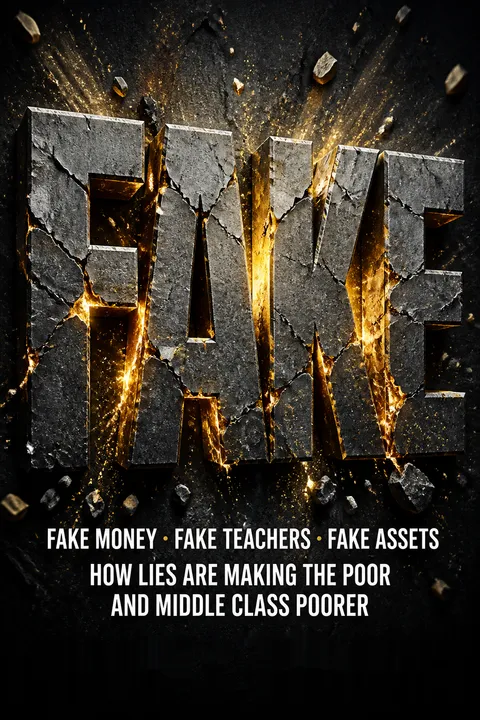
What's FAKE: Fake Money, Fake Teachers, Fake Assets about?
- Core Theme: The book by Robert T. Kiyosaki explores how misinformation in financial education contributes to the wealth gap between the rich and the poor.
- Three Main Topics: It is divided into three parts: Fake Money, Fake Teachers, and Fake Assets, each examining how these elements perpetuate financial ignorance.
- Personal Journey: Kiyosaki shares experiences from his life, contrasting the financial philosophies of his "poor dad" and "rich dad."
Why should I read FAKE: Fake Money, Fake Teachers, Fake Assets?
- Financial Awareness: The book helps readers understand the importance of financial literacy and how to navigate a system that often obscures money matters.
- Real vs. Fake: It encourages readers to differentiate between real assets and liabilities, emphasizing informed financial decision-making.
- Empowerment: Kiyosaki aims to empower readers to take control of their financial futures by understanding money, investing, and wealth creation.
What are the key takeaways of FAKE: Fake Money, Fake Teachers, Fake Assets?
- Fake Money: Kiyosaki explains that fiat currency loses value over time due to inflation, advocating for investments in tangible assets like gold and silver.
- Fake Teachers: He critiques the education system for not teaching practical financial skills, urging readers to seek mentors with real-world experience.
- Fake Assets: Kiyosaki defines assets as things that put money in your pocket, warning against the misconception that homes are always assets.
What are the best quotes from FAKE: Fake Money, Fake Teachers, Fake Assets and what do they mean?
- "You cannot catch fish in clean water.": Opportunities often exist in challenging situations, requiring navigation through confusion and misinformation.
- "Fake money makes the rich richer, but makes the poor and middle class poorer.": Highlights how fiat currency benefits those who understand it while disadvantaging others.
- "Mistakes are the key to real success.": Emphasizes learning from failures as essential for personal and financial growth.
How does Robert T. Kiyosaki define "fake money" in FAKE: Fake Money, Fake Teachers, Fake Assets?
- Definition: "Fake money" is government-issued currency not backed by physical assets like gold, losing value over time.
- Impact on Wealth: It contributes to the wealth gap, allowing the rich to accumulate more while the poor struggle.
- Alternative Investments: Kiyosaki advocates for investing in gold and silver as a hedge against fiat currency devaluation.
What is the difference between assets and liabilities according to FAKE: Fake Money, Fake Teachers, Fake Assets?
- Definition of Assets: Assets are things that put money in your pocket, such as rental properties or investments generating cash flow.
- Definition of Liabilities: Liabilities take money out of your pocket, like mortgages or personal loans.
- Practical Application: Understanding this distinction is crucial for financial success, as many mistakenly consider their homes as assets.
How does Robert T. Kiyosaki suggest we find real teachers in FAKE: Fake Money, Fake Teachers, Fake Assets?
- Seek Real Experience: Look for mentors with practical financial experience rather than relying solely on academic qualifications.
- Learning from Mistakes: Emphasizes learning from both personal and others' mistakes, with real teachers encouraging this approach.
- Cooperative Learning: Promotes students teaching each other and sharing experiences for a deeper understanding of financial concepts.
How does FAKE: Fake Money, Fake Teachers, Fake Assets address the issue of student debt?
- Student Loan Crisis: Highlights the burden of student loans, warning that it can hinder financial freedom.
- Lack of Financial Education: Criticizes the education system for not preparing students for real-world financial challenges.
- Alternative Paths: Encourages seeking alternative education and financial literacy to avoid student debt pitfalls.
What is the significance of the "CASHFLOW" game mentioned in FAKE: Fake Money, Fake Teachers, Fake Assets?
- Educational Tool: Designed to teach money management, investing, and financial literacy in a fun and engaging way.
- Learning Through Play: Allows individuals to practice financial decision-making without real money risk, encouraging learning from mistakes.
- Building Financial IQ: Aims to increase financial intelligence by understanding cash flow, assets, and liabilities.
How does Robert T. Kiyosaki view the education system in FAKE: Fake Money, Fake Teachers, Fake Assets?
- Obsolete and Ineffective: Criticizes the system for not teaching practical financial skills, contributing to financial ignorance.
- Focus on Compliance: Argues that it trains students to be compliant employees rather than innovative entrepreneurs.
- Need for Change: Advocates for including financial literacy and entrepreneurship in education to empower individuals.
How does Robert T. Kiyosaki suggest we achieve financial independence in FAKE: Fake Money, Fake Teachers, Fake Assets?
- Invest in Real Assets: Encourages investing in real estate, businesses, and commodities rather than paper assets like stocks.
- Use Debt Wisely: Advocates for leveraging debt to acquire assets, leading to greater financial freedom if managed properly.
- Continuous Learning: Emphasizes ongoing financial education and learning from real-world experiences.
How does Robert T. Kiyosaki view the future of the economy in FAKE: Fake Money, Fake Teachers, Fake Assets?
- Predictions of Crisis: Warns of an impending economic crisis due to the growing wealth gap, potentially leading to civil unrest.
- Role of Education: Argues that without proper financial education, the situation will worsen, with more people struggling financially.
- Call to Action: Encourages readers to take control of their financial futures by seeking knowledge and understanding economic realities.
About the Author
Other books by Robert T. Kiyosaki




Download PDF
Download EPUB
.epub digital book format is ideal for reading ebooks on phones, tablets, and e-readers.








