


Key Takeaways
Buy knowledge before assets; the asset alone cannot make you rich.
Skill beats the object. At 25, Kiyosaki bought gold for about $70 an ounce. By 1980, it approached $800, prompting hopes of an even higher price. He held on, then sold as it fell below $500. Gold eventually sank to about $250 in 1999. The episode taught him that owning a promising asset is not the same as knowing when and why to own it. The useful advantage, in his view, is financial intelligence: the ability to interpret information and make decisions about money.
He compares investing in assets without learning how they work to buying new golf clubs while refusing lessons. Better equipment cannot substitute for skill. His five-part framework covers earning more, keeping more, budgeting for a surplus, using leverage, and improving financial knowledge.
The distinction between an asset and the skill to evaluate it is powerful because it shifts attention from shopping for returns to building judgment. In finance, expertise can improve how a person assesses risk, fees, liquidity, and time horizons. But knowledge does not make markets predictable, and no amount of study guarantees a profitable trade. The golf analogy works best as an argument for learning before committing significant money, not as a promise that education will beat uncertainty. A sound financial education should also teach when not to invest, and how to recognize the limits of one's competence.
Turn money trouble into practice, not a verdict on your ability.
Problems can teach. Kiyosaki tells of his academically brilliant father, whose family faced medical bills, career setbacks, and a failed ice-cream investment. Despite his education and hard work, his father never developed a durable way to manage money. His wealthy mentor took a different approach: treat a financial problem as something to investigate and solve, rather than deny or postpone.
The book uses a toothache to explain how neglect can compound. An unpaid bill may lead to more borrowing, while borrowing to cover spending without changing the spending pattern keeps the underlying problem alive. The author argues that solving problems builds financial ability, much as repeated practice makes difficult math easier. He also recognizes that low wages, poor health, and limited job options can constrain people beyond their individual control.
The practical insight is to make a problem visible early, identify its cause, and learn from the attempt to fix it. That resembles the feedback loops used in engineering: detect a deviation, diagnose the system, adjust, and measure again. The story also gives money problems emotional weight, showing how they can shape a person's identity and family life. Its limits matter, though. Poverty is not simply a shortage of solutions or a failure of attitude. Illness, discrimination, housing costs, and unstable work can restrict choices. Personal learning helps, but it cannot replace sound public policy or fair economic conditions.
Choose work that teaches you to earn, not only a paycheck.
The process builds capacity. After the Marines, Kiyosaki could have returned to a well-paid maritime job or pursued airline work. Instead, he joined Xerox for $720 a month because its sales training could help him overcome shyness and learn to sell. After nearly two years of struggling, he became the top salesperson in his Honolulu branch. The low initial salary bought him a capability he believed could serve future businesses.
He later used those skills while building a nylon wallet company. When cheap copies threatened the business, licensing rock-band names gave the wallets a distinctive identity. When competitors copied that strategy, he shifted from costly lawsuits to working with overseas producers. These stories support his larger point: earning more can come from learning to solve a problem people value. The right path differs by person, and entrepreneurship is not the only valid choice.
This section makes a useful distinction between income and income-producing capacity. Skills such as selling, negotiating, and adapting can travel across employers and industries, while a job title may not. The wallet business also illustrates how differentiation can protect a product from pure price competition. Still, the narrative is a survivor's account, not evidence that persistence reliably produces success. A career change can carry real costs, and some people cannot afford a low-paid training period. The transferable lesson is to seek deliberate skill-building, while weighing the downside, available alternatives, and the value of stable employment.
Measure what you keep, and learn who can legally claim it.
Gross income can mislead. Kiyosaki treats financial protection as more than avoiding theft. Taxes, fees, interest, legal exposure, and poorly chosen products can all reduce what remains. He distinguishes earned income from portfolio income, such as some investment returns, and passive income, such as rental income. The book argues that tax treatment varies by income type and by how assets are held, so the headline amount earned does not reveal the full financial result.
His examples include hidden retirement-plan fees, brokers who sell without educating clients, and credit-card purchases that take years to pay off. He recommends learning enough to question advisers, checking whether a broker invests in what is being sold, and using qualified legal and tax professionals. He also discusses insurance, estate planning, and business structures as ways to manage exposure, not as shortcuts around the law.
The emphasis on net outcomes is valuable: fees compound, conflicts of interest exist, and legal structure can affect both risk and tax obligations. Consumer finance research consistently finds that people often underestimate fees when they are obscured or expressed in unfamiliar ways. Asking how an adviser is paid is therefore a practical form of due diligence. The book's language can make every intermediary sound predatory, which is too sweeping. Many advisers provide useful services, and lower taxes are not automatically the best goal if they increase legal or investment risk. Tax rules depend on jurisdiction and circumstances, so this section calls for qualified advice, not imitation.
Make surplus a planned expense before lifestyle consumes it.
Give surplus a place. Kiyosaki's budgeting method reverses the common habit of paying every bill first and saving whatever remains. He tells a bookkeeper to direct 30 percent of income toward savings, giving, and investment before covering other expenses. Because the household sometimes came up short, he and his wife had to find additional work rather than quietly spend the reserved money.
The approach turned budgeting into a test of both spending and earning. Kiyosaki says the point is not simply to live cheaply, but to make future assets a priority. He gives the example of his wife's first rental property: a $5,000 down payment generated $25 in monthly cash flow. The small beginning mattered because it started an investment habit. The book's percentages are personal examples, not universal targets.
This method resembles automated saving: when money is allocated before discretionary spending begins, the decision does not need to be remade every month. Its strongest feature is that a shortfall becomes information about the budget rather than a reason to raid the savings automatically. But fixed percentages can be unsafe for households facing high-interest debt, irregular income, or urgent needs. A resilient plan generally balances saving with essentials, debt costs, and a cash buffer. The deeper principle is prioritization, not copying a particular 30 percent rule. A sustainable contribution, increased gradually, is more useful than an ambitious target that triggers missed bills.
Borrow only when operating control can support the repayment.
Leverage magnifies decisions. Leverage means using resources beyond one's own capital to increase the scale of an investment. Kiyosaki contrasts a savings account, funded entirely by the saver, with a $17 million apartment property in Tulsa, where he says a bank financed 80 percent of the purchase. The plan was to improve units, add washers and dryers, raise rents, and reduce operating costs. He estimated that an extra $100 per month across 300 units could add $360,000 in annual gross income.
His case depends on more than borrowed money. He describes partners with property-management experience, a fixed-rate loan, local demand for rentals, and the ability to influence expenses and rents. These are forms of control over the investment's operations. The book argues that debt becomes more dangerous when the borrower cannot affect the asset's income or costs.
The distinction between controlled operations and a passive bet on rising prices is analytically useful. A property manager can influence vacancy, maintenance, and tenant retention, whereas a small shareholder usually cannot direct a company's decisions. Yet control is not a shield against risk. Tenants may leave, repairs may exceed estimates, financing terms may change, and a local employer can disappear. Borrowing also magnifies losses, not just gains. The example depends on assumptions about rent growth, expenses, and financing that need independent verification. The sound application is to stress-test cash flow under unfavorable conditions before deciding whether leverage is tolerable.
Treat financial claims as hypotheses, then verify their evidence.
Separate evidence from hope. During the Vietnam War, Kiyosaki received reports that people were exchanging currency for gold as the conflict worsened. He and a friend inferred that miners near the front might sell gold at a discount. They traveled there, only to find that the seller knew the international price and would not lower it. The encounter taught him that having information is not the same as understanding its meaning.
He recommends judging financial information by its timeliness, source credibility, context, and possibility of deception. A prediction that a stock will rise is an opinion until supported by evidence. A company's price estimate or a home's appraisal is not the same as cash received from operations. He also encourages attention to trends, while acknowledging that trends can reverse and investment choices require ongoing review.
The seller's refusal to discount the gold is a vivid lesson in local knowledge and bargaining power. It also exposes a common cognitive error: turning a plausible story into a confident forecast. In scientific reasoning, a hypothesis becomes stronger when it survives attempts to disprove it, not merely when supporting evidence is collected. Investors can borrow that discipline by checking assumptions, incentives, and downside scenarios. Trend analysis can help organize information, but patterns in past prices do not reliably predict future prices. The most useful habit here is not finding a perfect signal. It is making uncertainty explicit before risking money.
Check whether familiar money rules fit today's actual institutions.
Rules have histories. Kiyosaki places two important shifts in 1971 and 1974. He argues that ending the dollar's gold convertibility changed the nature of money, while the move from guaranteed pensions toward plans based on employee contributions shifted more retirement responsibility to workers. He uses these changes to question advice such as saving, avoiding debt, and relying on diversified mutual funds as timeless solutions.
His argument is that a strategy must be judged against the economic system it operates in. Currency purchasing power, taxes, retirement benefits, and investment fees affect what a nominal return can buy. The book presents strong claims about inflation, public debt, and the risks of saving. Readers should distinguish the historical events from the author's interpretations of their consequences, then examine their own time horizon, income, retirement plan, and tolerance for loss.
The historical framing asks readers to test financial advice against institutional change rather than repeat slogans. That is a useful form of economic thinking: a household plan depends on the rules governing taxes, pensions, and monetary policy. But the book's claim that savers are necessarily losers does not follow from the end of gold convertibility. Cash can serve short-term needs, and diversified, low-cost portfolios can be appropriate for long-term goals, depending on circumstances. Neither a past policy change nor a prediction about currency value settles the right choice for an individual. The productive question is how a strategy performs under several plausible futures.
Build assets around durable demand, not hoped-for price increases.
Value needs a business case. Kiyosaki uses the term intrinsic value for qualities that make a business more likely to earn money over time. His examples include a distinctive niche, protection from easy imitation, room to expand, and revenue that is reasonably predictable. Coca-Cola's trademark illustrates how a brand can defend a product, while Kiyosaki's own books and games show how licensing can extend a product to new markets.
For property, he focuses on rental income and the ability to improve operations, rather than assuming the market price will rise. A personal financial statement, in this view, helps reveal whether money comes from ongoing income or from an estimated resale value. The concept is a useful checklist, not a guarantee: a famous brand can weaken, a rental market can change, and even a strong business can be overpriced.
The emphasis on durable demand and repeatable revenue aligns with business analysis that looks beyond a single year's sales or a rising share price. A protected brand can reduce direct price competition, while licensing can scale a product without owning every part of distribution. The framework also helps distinguish operating performance from optimistic valuation. Its limitation is that words such as durable and predictable can sound more certain than business life permits. Competitive threats, regulation, and changing consumer preferences can erode a niche. A careful investor treats these qualities as questions to investigate, not labels that certify an asset as safe.
Choose a learning environment that trains action, feedback, and nerve.
Practice should involve decisions. Kiyosaki describes himself as an average student who learned better through building, doing, and working with a team than through lectures alone. He draws on Howard Gardner's account of different intelligences and presents a simplified model of left-brain analysis, right-brain creativity, and subconscious emotional reactions. He argues that fear can stop people from acting on what they know.
His CASHFLOW board game was designed to let players practice accounting and investing decisions with play money, then discuss their choices and mistakes. The book cites an Arizona State University study that found students learned and retained material better through the game than through other teaching approaches. Kiyosaki also stresses mentors, teams, and environments where feedback is direct. His brain model is best read as a teaching metaphor, not a complete map of neuroscience.
Simulation can make abstract concepts concrete while lowering the cost of a mistake. That principle appears in flight training, medical education, and other fields where rehearsal prepares people for consequential decisions. Immediate feedback is especially useful when learners can connect an action to its result and try again. The book's broad claim about classroom learning should be treated cautiously because the cited study is not described in enough detail to assess its design or generalizability. Similarly, dividing cognition into three separate brain systems oversimplifies modern neuroscience. The practical core remains sound: combine explanation with practice, reflection, and honest feedback.
Analysis
The book's strongest organizing idea is that money management is not a single talent or product choice. It is a linked set of abilities: earning, retaining, allocating, deploying, and interpreting money. The recurring family contrast gives this framework emotional force. Kiyosaki's father is highly educated but financially vulnerable; the mentor represents learning through business problems. The author's own career then supplies a narrative of experimentation, failure, and adaptation, from sales training to product licensing and property investment.
The most useful material is less about which assets to buy than how to examine a decision. Readers are urged to distinguish operating income from estimated appreciation, examine fees and incentives, learn the terms of financing, and verify claims before acting. Those habits are valuable even for people who reject the author's preferred investments. The budget-surplus example likewise shows how a financial plan can reveal a mismatch between income and commitments, though the specific allocation is not universally suitable.
The book is also a forceful argument against treating conventional financial advice as timeless. Its historical account of monetary and retirement changes raises legitimate questions about inflation, pensions, and personal responsibility. Yet the author often turns questions into categorical conclusions. The claim that debt is advantageous when currency loses value, or that controlled investments can produce high returns with low risk, depends on conditions that can fail. Operational control may reduce some uncertainties while leaving market, liquidity, legal, and financing risks intact. The book's warnings about taxes and financial intermediaries are similarly useful as prompts for scrutiny, not as proof that standard products or advisers are inherently harmful.
A careful reading therefore separates the durable method from the author's prescriptions. Learn the language of finance, track what actually enters and leaves a household, investigate incentives, and test assumptions under adverse conditions. Financial intelligence is valuable not because it guarantees wealth, but because it helps people make more informed choices, recognize uncertainty, and avoid confusing a confident story with a sound plan.
Review Summary
Rich Dad's Increase Your Financial IQ receives generally positive reviews, with readers appreciating Kiyosaki's insights on financial intelligence. The book emphasizes five key aspects: making money, protecting it, budgeting, leveraging, and improving financial information. Many readers find the content enlightening and practical, though some criticize repetition and lack of specific "how-to" advice. Kiyosaki's unconventional views on wealth-building, such as focusing on assets and cash flow rather than traditional saving, resonate with many. However, some readers find his writing style overly simplistic and self-promotional.
People Also Read







Glossary
Financial IQ
Measured money problem-solvingKiyosaki uses Financial IQ to mean a measure of how effectively someone solves financial problems. It is distinct from academic intelligence: a person may perform well in school yet struggle to earn, retain, budget, or invest money. In the book, the measure is practical, reflected in financial outcomes rather than test scores.
The Five Financial IQs
Five money-management abilitiesThe book's framework divides financial intelligence into five abilities: increasing income, protecting what is earned, planning a surplus, using leverage, and improving financial knowledge. Kiyosaki presents them as interdependent. A person who earns well but spends everything, pays avoidable costs, or relies on weak information may still be financially vulnerable.
CASHFLOW Quadrant
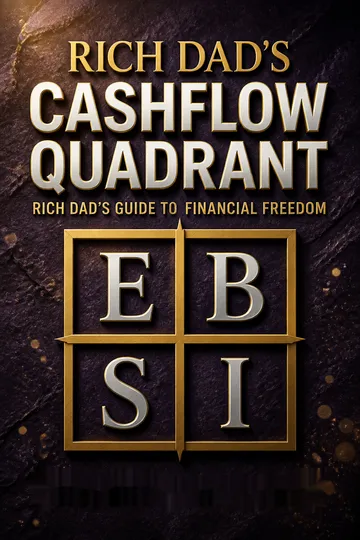
Four ways to earnKiyosaki's framework groups income earners into four categories: employees, self-employed people or specialists, business owners, and investors. It distinguishes working mainly for wages or fees from building a business system or acquiring assets. The categories describe different economic roles, not fixed personality types, and a person may participate in more than one.
Financial Integrity
Completeness of financial abilityKiyosaki redefines integrity as wholeness and applies it to personal finances. Financial Integrity means the essential parts of money management work together, including earning, protection, budgeting, leverage, and information. A weakness in one area can undermine the others, much as a failure in one system can impair a machine.
New Capitalism
Debt-shaped money systemKiyosaki's term for the economic conditions he associates with the post-1971 monetary system and the shift toward worker-funded retirement plans. He argues that these changes made currency depreciation and personal investing more consequential, and that debt and asset ownership gained importance. This is his interpretation of economic history, not a neutral technical definition.
Intrinsic Value
Durable earning capacityKiyosaki uses Intrinsic Value to describe qualities that can support a business's continuing ability to earn, such as a defensible niche, a recognizable brand, room to expand, and predictable revenue. He applies the idea to businesses and income-producing property. The term is related to, but not identical with, its varied uses in financial analysis.
CASHFLOW game
Practice game for financeCASHFLOW is Kiyosaki's board game for practicing accounting and investment decisions in a simulated setting. Players use play money, observe the consequences of choices, and discuss mistakes without risking real capital. The author presents the game as a way to make financial concepts active and memorable rather than relying only on lectures or reading.
Multiple Intelligences
Varied forms of abilityThe framework associated with Howard Gardner that Kiyosaki references to argue that people learn and perform through different abilities, including linguistic, mathematical, spatial, musical, bodily, interpersonal, and intrapersonal strengths. The book uses it to question schooling that privileges reading and mathematics. It should not be confused with Kiyosaki's separate simplified model of three brain systems.
Cone of Learning
Hierarchy of learning activitiesA learning model cited in the book to compare methods such as reading, lectures, simulation, and direct experience. Kiyosaki uses it to argue that active practice and games can help learners retain financial material. The book does not provide enough methodological detail to establish how broadly its cited ranking applies across subjects or learners.
FAQ
What's "Rich Dad's Increase Your Financial IQ" about?
- Financial Education Focus: The book emphasizes the importance of financial education and intelligence in achieving financial success.
- Five Financial IQs: It introduces the concept of five financial IQs necessary for managing money effectively: making more money, protecting your money, budgeting your money, leveraging your money, and improving your financial information.
- Challenging Conventional Wisdom: The author challenges traditional financial advice, such as saving money and diversifying, suggesting these are outdated strategies.
- Practical Advice: It provides practical advice and strategies for increasing financial intelligence and achieving financial freedom.
Why should I read "Rich Dad's Increase Your Financial IQ"?
- Improve Financial Literacy: The book aims to enhance your understanding of money and how to manage it effectively.
- Challenge Old Beliefs: It encourages readers to question traditional financial advice and adopt new strategies for wealth creation.
- Actionable Strategies: Offers practical steps and real-life examples to help readers apply the concepts in their own financial lives.
- Empowerment: Reading the book can empower you to take control of your financial future and make informed decisions.
What are the key takeaways of "Rich Dad's Increase Your Financial IQ"?
- Five Financial IQs: Understanding and developing the five financial IQs is crucial for financial success.
- Control and Leverage: Having control over your investments and using leverage wisely can lead to higher returns with lower risk.
- Financial Education: Continuous learning and improving your financial knowledge is essential in the Information Age.
- Challenge Conventional Advice: Questioning traditional financial advice can open up new opportunities for wealth creation.
What are the five financial IQs according to Robert T. Kiyosaki?
- Making More Money: Focus on increasing your income through various means, such as entrepreneurship or investments.
- Protecting Your Money: Learn to safeguard your wealth from taxes, inflation, and financial predators.
- Budgeting Your Money: Create a budget surplus by prioritizing savings and investments over expenses.
- Leveraging Your Money: Use other people's money and resources to increase your returns and build wealth.
- Improving Your Financial Information: Continuously seek and apply accurate financial information to make informed decisions.
How does Robert T. Kiyosaki suggest protecting your money?
- Tax Strategies: Use legal tax strategies to minimize the amount of money lost to taxes.
- Financial Predators: Be aware of financial predators, such as bureaucrats and bankers, who may take your money.
- Asset Protection: Use legal entities and insurance to protect your assets from lawsuits and other risks.
- Financial Education: Stay informed and educated to recognize and avoid financial scams and pitfalls.
What does Robert T. Kiyosaki mean by "leveraging your money"?
- Using Debt Wisely: Leverage involves using borrowed money to increase potential returns on investment.
- Control Over Investments: Leverage is less risky when you have control over the investment, such as in real estate.
- Higher Returns: Proper use of leverage can lead to higher returns without significantly increasing risk.
- Financial Intelligence: Requires a high level of financial intelligence to use leverage effectively and safely.
What is the significance of "improving your financial information" in the book?
- Information Age: In the Information Age, having the right information is crucial for making sound financial decisions.
- Avoiding Overload: Learn to filter and process information to avoid being overwhelmed by data.
- Insider Information: Understand the importance of having access to timely and relevant information for investment decisions.
- Continuous Learning: Commit to lifelong learning to stay ahead in the rapidly changing financial landscape.
How does "Rich Dad's Increase Your Financial IQ" challenge conventional financial advice?
- Questioning Diversification: The book argues that diversification is a protection against ignorance and not necessary for informed investors.
- Living Below Means: It suggests that living below your means is not a path to wealth; instead, focus on expanding your means.
- Old vs. New Rules: Highlights the shift from old financial rules to new ones post-1971 and 1974, emphasizing the need for updated strategies.
- Empowerment Through Education: Encourages readers to take control of their financial education rather than relying solely on financial advisors.
What are some of the best quotes from "Rich Dad's Increase Your Financial IQ" and what do they mean?
- "It's financial education that enables people to process financial information and turn it into knowledge." This quote emphasizes the importance of financial literacy in making informed decisions.
- "The rich get richer because they learn to solve financial problems." Highlights the idea that wealth is built by addressing and overcoming financial challenges.
- "If you cannot control your emotions, you cannot control your money." Stresses the role of emotional intelligence in financial success.
- "A budget surplus is an expense." Suggests that creating a surplus should be a priority, treated as a necessary expense.
How does Robert T. Kiyosaki define financial intelligence?
- Problem-Solving Ability: Financial intelligence is the ability to solve financial problems effectively.
- Measurable Results: It is quantified by the results you achieve, such as the percentage of income retained after taxes.
- Continuous Improvement: Involves constantly seeking to improve your financial knowledge and skills.
- Application of Knowledge: It's not just about acquiring information but applying it to make better financial decisions.
What role does emotional intelligence play in financial success according to the book?
- Controlling Emotions: Emotional intelligence involves managing emotions to make rational financial decisions.
- Delayed Gratification: The ability to delay gratification is crucial for long-term financial success.
- Overcoming Fear: Helps in overcoming the fear of failure and taking calculated risks.
- Consistency: Emotional intelligence ensures consistency in financial behavior, leading to better outcomes.
How can someone start increasing their financial IQ based on the book's advice?
- Education: Begin by educating yourself through books, seminars, and courses on financial topics.
- Practical Experience: Gain hands-on experience by managing your finances and making small investments.
- Seek Mentors: Find mentors or join groups like CASHFLOW Clubs to learn from others' experiences.
- Continuous Learning: Commit to lifelong learning and stay updated with financial news and trends.
Rich Dad Series





About the Author
Other books by Robert T. Kiyosaki





Download PDF
Download EPUB
.epub digital book format is ideal for reading ebooks on phones, tablets, and e-readers.








