


Key Takeaways
Replace the job-and-savings script with financial skills you can control
Question the old script. Kiyosaki argues that the familiar route of school, job, saving, debt avoidance, homeownership, and long-term stock investing no longer guarantees security. He points to globalization and automation as pressures on employment, and to low interest rates as a threat to the purchasing power of savings. His alternative is financial education: learn how businesses, assets, debt, taxes, and cash flow interact instead of handing every decision to advisers.
Keep the warning in proportion. The book’s argument is a call to build options, not proof that every job, savings account, or diversified investment is foolish. These can still serve important purposes. The useful question is whether a plan depends on one paycheck or one market behaving as hoped, and whether the person understands the risks involved.
The central insight is less about abandoning employment than about reducing dependence on a single financial mechanism. Resilience research often treats diversification of resources, skills, and income as protection against shocks; that broader idea fits the book’s call for more than one route to security. Yet the language of obsolete advice risks replacing one rigid formula with another. Saving, diversified investing, and paid work can be sensible components of a plan. The stronger lesson is to understand what each can and cannot do, then avoid mistaking a historically successful strategy for a guarantee.
Judge assets by the cash they generate, not the labels on them
Follow the cash. Kiyosaki teaches financial literacy through a simple financial statement: income and expenses show cash moving in and out, while assets and liabilities help explain why. In his working definition, an asset sends money into a person’s pocket, while a liability takes money out. A home can therefore be a liability when its mortgage, taxes, and upkeep consume cash, even if its market price rises. A rental property can be an asset if rent exceeds its operating costs and debt payments.
Draw the whole picture. The book contrasts employees who focus mainly on paychecks with investors who monitor assets, liabilities, and cash flow. It urges readers to write down their own figures rather than rely on a vague sense of net worth. The point is not the label on a possession, but its effect on the household’s finances.
The cash-flow lens is memorable because it makes financial claims testable: a reader can compare rent, expenses, and debt service rather than argue over whether a house is an asset in the abstract. It also resembles managerial accounting, where timing and liquidity matter alongside reported value. But the book’s definition is narrower than standard accounting usage. A home may be an asset on a balance sheet while still draining monthly cash. Both descriptions can be true. A useful personal statement should track cash flow and net worth separately, so one does not obscure the other.
Know whether you earn wages, sale gains, or recurring cash flow
Separate three income types. The book distinguishes ordinary income, portfolio income, and passive income. Ordinary income is generally pay from work. Portfolio income comes from selling an investment for more than its purchase price. Passive income, in Kiyosaki’s examples, is recurring cash from an asset, such as rent. He argues that tax systems often treat these categories differently, and that people who understand those rules can make more informed choices.
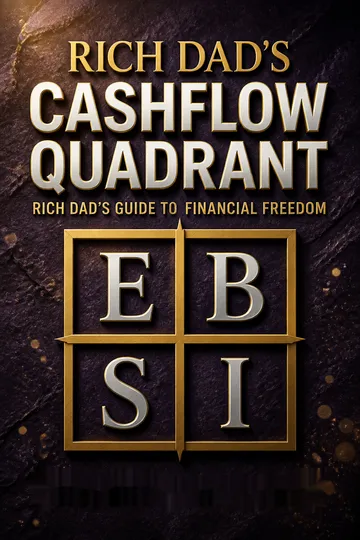
Use the quadrant as a map. The CASHFLOW Quadrant groups earners as employees, self-employed people or specialists, business owners, and investors. Kiyosaki says tax incentives and the nature of work differ across these positions. The framework is meant to help readers ask what skills and income sources they want to build, not simply choose a label. Tax treatment varies by country, activity, and individual circumstances.
The framework’s strength is that it connects income sources to the work and ownership behind them. A salary, a one-time gain, and monthly rent may all add money, but they differ in predictability, effort, and exposure to loss. That distinction supports more precise planning than treating every dollar as interchangeable. The weaker move is to imply that one quadrant universally pays lower taxes or has superior outcomes. Tax codes are intricate, and passive income can still demand substantial labor and capital. The quadrant works best as a learning map, not a ranking of people or a substitute for qualified advice.
Borrow only when an asset can reliably carry the debt
Debt cuts both ways. Kiyosaki treats borrowing as a tool, not automatically as a mistake. His example is an early Maui condominium bought for $18,000 with a small down payment financed on a credit card. After expenses and debt payments, it produced about $25 a month in positive cash flow. The lesson he draws is to use borrowed funds for an income-producing asset, rather than use credit to buy something that immediately loses value.
Test repayment first. The author calls debt dangerous because the same leverage that magnifies returns can magnify losses. A property that stops covering its mortgage can become a burden quickly. Before borrowing, the investor needs to examine operating costs, vacancy, interest rates, and the ability to repay if expected income disappears. A profitable example from the past is not a guarantee that a similar deal will work today.
This is the book’s most useful counterintuitive distinction: debt’s consequences depend on what it finances and who carries the repayments. In corporate finance, leverage can increase returns on invested equity, but it also makes an enterprise more fragile when income falls. That is why the cash-flow test matters more than the slogan that debt is either good or bad. The Maui story is vivid, but it was a small historical transaction under particular conditions. A present-day reader should stress-test a deal, include reserves, and treat borrowed money as an obligation before treating it as opportunity.
Track the tax advantages and obligations hiding behind phantom income
Name the invisible gains. Kiyosaki uses phantom income as an umbrella for financial benefits that may not arrive as spendable cash. His examples include borrowing instead of using after-tax savings, property appreciation, loan balances being paid down by tenants, and depreciation deductions. He illustrates the tax effect with a hypothetical $20,000 down payment: at a 40% tax rate, he says, earning that sum as ordinary income could require about $35,000 in gross pay.
Do not confuse tax effects with cash. The book describes refinancing appreciated property to access borrowed money without selling it, and using depreciation to reduce taxable income. These strategies can create liquidity or lower a tax bill, but borrowing still creates debt, and deductions depend on law and eligibility. A tax benefit is not necessarily profit, and appreciation is not cash until realized or borrowed against.
The concept encourages readers to notice how financing and tax rules affect real returns, a worthwhile expansion beyond salary and account balances. It also exposes a common accounting trap: economic value, taxable income, and liquid cash are different measures. The book sometimes groups them under one attractive label, which can make borrowing or deductions sound like income itself. A disciplined analysis should show each separately: cash received, tax owed or deferred, debt outstanding, and asset value. This preserves the insight while preventing a tax strategy from appearing safer or more profitable than it is.
Rehearse investments before risking money, then study every mistake
Practice before committing. After a three-day real estate course, Kiyosaki’s instructor assigned students to evaluate 100 properties in 90 days, without buying any during the exercise. The work required finding listings, inspecting properties, estimating costs and income, and writing a short assessment. Kiyosaki says only two members of his original group completed it. The process taught him to recognize opportunities through repeated analysis rather than expect a seminar to supply a magic deal.
Treat errors as information. Kiyosaki contrasts this with schooling that marks wrong answers but moves on. In his view, mistakes reveal what a learner has not understood. Simulation, practice, and honest review make errors less costly before a person acts with real money. The principle is not to celebrate every failure, but to extract a specific lesson and change the next decision.
The 100-property assignment turns education into deliberate practice: repeat a task, get feedback, and improve judgment before the stakes rise. That resembles training in fields where performance depends on recognizing patterns, not merely recalling rules. It also counters the false confidence produced by consuming information without applying it. Still, practice cannot eliminate uncertainty. Property analysis depends on assumptions about future rents, costs, and financing, and repeated exercises can reinforce bad models if feedback is weak. A sound learning loop pairs action with independent review and records what the forecast got wrong.
Prepare for downturns without pretending anyone can time them
See downturns as both danger and opportunity. The book recounts three major market shocks in 2000, 2007, and 2008, and argues that investors with preparation and cash-flowing assets can buy when others are forced to sell. Kiyosaki and his wife describe acquiring real estate after prices fell, including apartment properties with business partner Ken McElroy. Their story shows how prior study and access to capital shaped their response to a crash.
Separate preparation from prophecy. Kiyosaki repeatedly predicts a coming major crash and criticizes long-term market investing. The broader actionable point is to understand what a downturn could do to income, debt, and investments before it arrives. Forecasts are uncertain, however. A reader should not mistake the authors’ successful timing and purchases for evidence that the next crash can be predicted precisely.
The contrast between panic selling and prepared buying is powerful because it reframes a crash as a liquidity test: who can wait, and who must sell? This connects to the idea of having reserves and avoiding forced decisions. Yet a crash is not automatically a bargain. Prices may fall because an asset’s underlying earnings or financing prospects have deteriorated, and leverage can turn a paper loss into insolvency. The book’s confident forecasts deserve caution. A robust plan should survive several scenarios rather than depend on correctly naming the date or scale of the next market decline.
Build a Plan B that adds skills beyond your current job
Prepare for a change in circumstances. Kiyosaki’s father built his life around a career in public education, then lost his government position after an unsuccessful political campaign. His attempt to start an ice cream franchise failed because success as an employee had not prepared him to run a business. Kiyosaki presents the story as a warning against assuming that one career path will remain available forever.
Build capabilities, not just a backup job. His own Plan B began with sales training at Xerox, followed by business attempts and real estate study. The book describes moving from employee work toward entrepreneurship and investing as a demanding process that requires different skills, emotional tolerance, and a team. Not everyone needs to become an investor or business owner. The practical lesson is to develop options before a crisis forces a rushed transition.
The father’s story makes career risk personal rather than abstract: expertise in one institution may not transfer cleanly to a new role. This is a useful reminder that adaptability is built through practice, not declared after a layoff. The quadrant model gives readers a vocabulary for considering different forms of work, while the Xerox episode emphasizes selling as a portable skill. But entrepreneurship is not a universal escape hatch. It can bring volatile income, long hours, and failure. A credible Plan B could also involve retraining, savings, or a second professional path rather than business ownership.
Let cash-producing assets pay for luxuries, as the Porsche deal did
Make the purchase serve the plan. Kiyosaki wanted a rare Porsche but did not want to spend his available $50,000 cash and end up with only a car. He and his wife had agreed that a desired liability should be funded by an asset. He bought a mini-storage property, using cash as a down payment and borrowing for the balance, then borrowed separately for the Porsche. In his account, income from the storage business covered its costs and the car payments.
Preserve the test, not the fantasy. The point is to ask whether an asset can generate enough dependable cash to support a discretionary purchase. The arrangement depends on the property’s performance, financing terms, and tax treatment. It is not a license to borrow for luxuries and hope that investment returns arrive. The book’s memorable example works as a decision rule only when the underlying asset is sound.
The story makes a financial principle memorable by attaching it to a desire rather than a deprivation. It shows how a budget can be designed around priorities, while requiring an asset to carry the cost instead of quietly draining household cash. That can be more motivating than simply being told to spend less. The catch is that a narrative can make a complex transaction look tidier than it was. The storage property had operational and debt risks, and the car depreciated. Readers should compare the full cost of borrowing and ownership with the asset’s conservative net cash flow.
Teach money through games and decisions, not lectures alone
Make learning active. Kiyosaki credits Monopoly, played with his mentor as a child, with helping him understand property, rent, and cash flow. Later, he and his wife created the CASHFLOW game to let players practice financial decisions with play money. The book describes students teaching the game at a Boys and Girls Club in Phoenix, and workshops at St. Andrew’s College in South Africa where students, teachers, and local business owners learned together.
Connect simulation to reality. Participants played, discussed their decisions, and worked through actual financial examples. The author’s approach follows a clear sequence: try a model, explain what happened, then consider applying the lesson outside the game. He emphasizes that learning continues after the class ends. A game can make money concepts less intimidating, but it cannot replace careful analysis of real contracts and investments.
The teaching method draws on a strong educational principle: learners often understand abstract systems better when they can act within a simplified model and then discuss the consequences. Games make choices visible and lower the cost of early mistakes. The student-led examples add a social dimension, since explaining a concept can reveal gaps in one’s own understanding. But simulation is not a miniature version of every real market. Games simplify uncertainty, legal constraints, and unequal access to capital. Their best role is to build questions and basic fluency, not to certify readiness for a high-stakes investment.
Analysis
The book’s most effective move is pedagogical: it turns financial literacy from a list of tips into a change of viewpoint. The recurring contrast between two fathers, one oriented toward employment and one toward ownership, gives readers a story they can use to interrogate their own assumptions. Financial statements, cash flow, income categories, and the CASHFLOW Quadrant make unfamiliar distinctions concrete. Stories such as the Maui condominium and the Porsche purchase then dramatize how the author believes debt, assets, and taxes interact.
The framework is strongest when it asks readers to understand their numbers, practice decisions, and recognize that income, wealth, and liquidity are not identical. Its central weakness is that it sometimes treats a personal strategy as a general economic law. Borrowing can accelerate asset acquisition, but it also magnifies losses and can force a sale. Tax deductions and investment structures vary by jurisdiction and individual eligibility. Assertions that savings, diversification, or employment are obsolete are too sweeping: each can be useful within a broader plan.
The book also makes large claims about monetary history, political power, and future crashes with a certainty that exceeds what its examples establish. Readers should distinguish the useful question, how might inflation, automation, debt, or a market shock affect a household, from the much stronger claim that a particular crisis is inevitable or precisely forecastable. The same care applies to its quadrant hierarchy: moving toward ownership may offer more control, but it requires capital, expertise, and tolerance for risk that are unequally distributed.
Taken as a practical prompt rather than a universal investment manual, the book offers a durable exercise: map cash flows, identify liabilities, learn the rules that apply to a chosen strategy, practice analysis before committing money, and build more than one source of resilience. Its best lesson is not that everyone must become rich by the same route, but that financial decisions improve when people understand the machinery behind them.
Review Summary
Why the Rich Are Getting Richer receives mixed reviews, with an average rating of 3.85/5. Some readers find it informative about financial education, taxes, and debt, while others criticize its repetitiveness and lack of concrete advice. Many note it rehashes concepts from Rich Dad Poor Dad. Positive reviews appreciate insights on financial systems and wealth-building strategies. Negative reviews cite excessive self-promotion, disorganized writing, and questionable ethical stances. Several readers express disappointment with the book's emphasis on manipulating the system rather than advocating for change.
People Also Read








Glossary
CASHFLOW Quadrant
Four work and income rolesA framework dividing economic activity into four groups: employees, self-employed people or specialists, business owners, and investors. The book uses the quadrants to compare how people earn income, organize work, and encounter tax rules. It presents moving between quadrants as a change in skills and mindset, though the categories are a teaching model rather than a complete account of work or wealth.
Financial IQ
Ability to solve money problemsKiyosaki’s term for a person’s ability to understand and solve financial problems. The book links financial intelligence to practical outcomes, such as interpreting cash flow, distinguishing assets from liabilities, and making decisions about debt and taxes. It treats learning and problem-solving as more important than academic credentials alone.
Phantom income
Financial benefits without immediate cashThe book’s umbrella term for financial advantages that may not arrive as ordinary spendable income. Examples include borrowing rather than using after-tax earnings, depreciation deductions, property appreciation, and debt reduction funded by tenants. These mechanisms are not identical: some affect cash, some affect taxable income, and some represent changes in asset value or liabilities.
ordinary income, portfolio income, and passive income
Three income categoriesThe book groups income into three types. Ordinary income generally means earnings from work; portfolio income comes from selling investments for a gain; and passive income refers chiefly to recurring cash from assets such as rental property. Kiyosaki emphasizes that tax rules may treat these sources differently. Their definitions and tax treatment depend on the specific law and circumstances.
Velocity of money
Reinvesting capital repeatedlyKiyosaki’s phrase for moving investment capital through successive asset purchases rather than leaving it parked in savings or long-term holdings. In his examples, an investor may borrow against an appreciated property, keep ownership, and use the proceeds to acquire more assets. The approach can increase exposure to returns, but it also increases debt and financial risk.
CASHFLOW game
A financial learning simulationA board game created by Robert and Kim Kiyosaki to let players practice decisions involving income, expenses, assets, liabilities, and investment opportunities. The book presents it as a simulation that makes financial concepts interactive before players use real money. It is an educational tool, not a substitute for professional advice or real-world due diligence.
Cone of Learning
A model of learning activitiesThe book uses Edgar Dale’s Cone of Learning to organize learning experiences from more passive activities, such as reading or listening, toward more active ones, such as discussion, simulation, and doing the real task. Kiyosaki uses the model to support games, practice, and teaching others. The text presents it as a guide to active learning, not as a guarantee of precise retention percentages.
About the Author
Other books by Robert T. Kiyosaki




Download PDF
Download EPUB
.epub digital book format is ideal for reading ebooks on phones, tablets, and e-readers.








