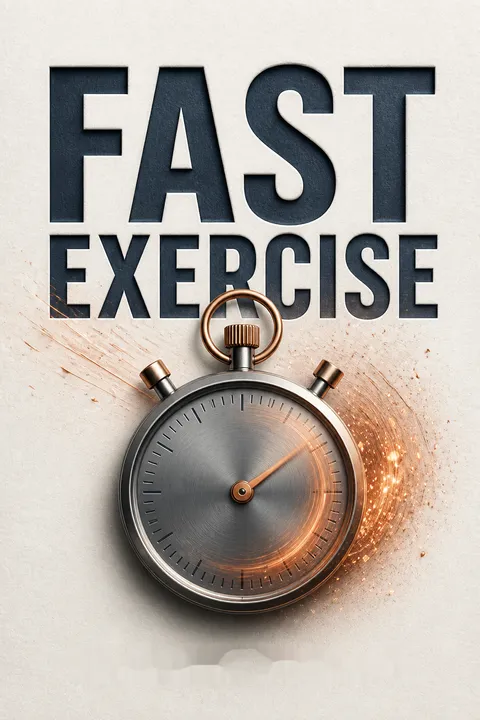


Key Takeaways
Trade long workouts for brief, hard intervals you can actually repeat
Short can still count. Fast Exercise centers on brief bursts of strenuous effort separated by recovery. Research reviewed in the book found that several minutes of high-intensity training each week could improve measures such as aerobic fitness and insulin sensitivity, sometimes comparably to much longer steady workouts. The promise is not that every benefit comes from every tiny workout, but that limited time need not prevent meaningful training.
Mosley tested the claim. Worried about his family history of diabetes, he tried three 20-second cycling sprints, three times a week, for four weeks. His insulin sensitivity improved by 25%, while his aerobic fitness did not significantly change. The result made the case for short training, and for measuring more than one outcome.
The useful innovation is not simply making exercise harder. It is challenging the assumption that health requires long blocks of scheduled time, a design that excludes people with crowded lives. Short bouts may lower the threshold for starting and repeating a routine. But “brief” describes duration, not ease: near-maximal effort can feel intimidating, and the findings cited here mostly come from small, short studies. The sound practical lesson is to treat intervals as a time-saving option, not a universal replacement for all forms of movement or a guarantee of identical results.
Use intensity for fitness, but don't expect exercise alone to erase fat
Calories are not a simple bargain. A mile of running may burn roughly 126 net calories for a 180-pound person, while a large muffin contains around 480. Net calories estimate the extra energy used by exercise beyond what the body would have burned at rest. The book argues that steady, moderate workouts often produce little weight loss because exercise burns less than people imagine, and people may eat more or move less afterward.
Intervals showed more promise. In a 15-week study of overweight women, the high-intensity group lost an average of 2.5 kilograms, while the group cycling moderately for longer gained some fat. Still, weight loss is not guaranteed. The authors recommend pairing exercise with calorie control, rather than treating a workout as permission to eat back its energy cost.
This distinction separates two outcomes that fitness marketing often blurs: becoming fitter and becoming lighter. Exercise can improve health even when the scale barely moves, while weight change is shaped by food intake, appetite, and activity outside workouts. That is a more humane measure of success than judging a run by its effect on body size. The studies described suggest intervals may help with fat loss, but they do not prove that intensity reliably overcomes eating compensation in everyone. A useful plan tracks fitness and eating patterns separately.
Build a week around intervals, strength, and ordinary movement
Use more than one gear. The book’s model draws on observations of hunter-gatherer activity: frequent light movement, occasional strenuous effort, and time to recover. It translates this into Fast Fitness, interval work aimed at cardiovascular and metabolic fitness, and Fast Strength, brief body-weight circuits for major muscle groups. A sample week might include two or three interval sessions and two strength sessions, adjusted to the person’s fitness and schedule.
The idea has a history. Roger Bannister, a busy medical student, trained with short fast runs separated by recovery and became the first person to run a mile in under four minutes. His workouts were not the book’s only template, but they illustrate why alternating effort and rest can be useful. Options range from a few cycling sprints to a seven-minute body-weight circuit.
This framework avoids the false choice between “cardio” and “strength” while keeping the schedule compact. Alternating types of stress also gives different muscles and systems a chance to recover. The hunter-gatherer comparison works best as a broad organizing idea, not as proof that a modern routine recreates ancestral life; the book itself describes those lifestyles as difficult to reconstruct precisely. The practical strength of the model is its flexibility: readers can choose cycling, hills, swimming, stairs, or body-weight movements rather than depend on a gym or a single ideal workout.
Interrupt sitting every half-hour; even brief walks improve post-meal glucose
Movement between workouts matters. The book calls everyday movement NEAT, short for Non Exercise Activity Thermogenesis: energy used for ordinary actions such as standing, walking around, and doing chores, rather than deliberate exercise. Mosley wore movement-tracking “fidget pants” and found that he sat for about 11 hours on an average day. When he deliberately moved more, the monitoring showed a substantial increase in daily activity without a formal workout.
Brief breaks can affect metabolism. In a study described in the book, adults who took a 1-minute-40-second walk every 30 minutes during a long sitting period had lower post-meal glucose and insulin responses than when they sat continuously. The reported decreases were 39% for glucose and 26% for insulin. The authors’ practical advice is simple: stand, walk, or take the stairs regularly.
This insight widens the definition of exercise from a scheduled event to the shape of an entire day. It also explains why a short workout cannot automatically cancel many motionless hours. The reported laboratory changes make movement breaks plausible tools for metabolic health, although a single controlled sitting experiment cannot establish the same effect for every workplace or person. The durable design implication is to make movement convenient: place routine conversations, errands, and breaks where standing or walking is the natural choice, rather than relying on a perfect exercise schedule.
Treat your response as individual, not a verdict on effort
People adapt differently. In a 21-week Finnish training study of 175 untrained, middle-aged adults, some participants increased VO2 max, a measure of aerobic capacity, by 42%, while others saw it fall by 8%. Strength responses also varied widely. These results challenge the comforting idea that a single exercise prescription produces the same gains for everyone.
Mosley’s results made the point personal. His short cycling routine improved insulin sensitivity but did not significantly improve aerobic fitness. A genetic test suggested he might respond poorly in that area, though the book cautions that genetic predictions were still developing. Peta Bee received conflicting results from two commercial tests. The practical message is to assess different outcomes and avoid interpreting one weak response as proof that exercise is pointless.
Variation matters because population averages can make a useful intervention sound more predictable than it is. In practice, a person may gain strength without much change in aerobic capacity, or improve glucose control without losing weight. That supports measuring several outcomes before judging a program. Genetic explanations deserve caution, especially when the book reports contradictory commercial tests and developing methods. Genes may help explain differences, but they do not turn a limited test into a definitive forecast. A poor result on one measure should prompt adjustment, not resignation.
Progress gradually, recover deliberately, and seek medical advice when risk is present
Hard effort needs preparation. The workouts recommend beginning with gentle, activity-specific movement, building intensity gradually, and allowing recovery between demanding sessions. A beginner might start with shorter sprints before attempting longer or harder intervals. The book favors dynamic movements before exercise over routine static stretches, which its cited reviews found did not reliably prevent injury and could briefly reduce muscle power. A gentle cool-down can help the heart rate and blood pressure return toward normal.
Safety is not a reason for panic or bravado. The authors describe research in cardiac rehabilitation suggesting that supervised high-intensity training can be feasible for some people with heart disease. They still advise people with health concerns to speak with a clinician before starting, and warn against rushing into strenuous exercise. Their guidance is not a substitute for individual medical advice.
The strongest version of the safety argument is neither “intense exercise is dangerous” nor “intense exercise is safe for everyone.” It is that risk depends on health status, preparation, and the way training is introduced. Recovery is not wasted time; it is part of a repeatable dose. This matters because the brief workouts can sound deceptively easy to begin, even when the effort itself is demanding. The book’s caution around medical supervision is especially important for people with existing conditions, who should not infer personal clearance from studies conducted in supervised settings.
Measure health beyond the scale: aerobic capacity, glucose handling, waist, and strength
Weight tells only part of the story. The book emphasizes VO2 max, the maximum amount of oxygen the body can use during intense exercise, as an indicator of aerobic fitness. It also highlights glucose tolerance, or how effectively the body brings blood sugar down after a glucose load. These measures can change even when body weight does not.
Track what the workout is meant to change. An exercise diary can record resting heart rate, strength, waist size, weight, and aerobic fitness. The authors note that waist size can reveal risk that body mass index misses: they advise keeping the waist below half of one’s height. Their examples include Mosley, who appeared not to be overweight but discovered substantial internal fat on a scan. Measurements are most useful when repeated consistently, not treated as a daily scorecard.
This is a shift from appearance-based evaluation to function and risk. A scale compresses muscle, fat, fluid, and many health changes into one number, so it can obscure progress or give false reassurance. Multiple measures provide a more useful dashboard, though each has limits: estimates of VO2 max and body fat are not all equally accurate, and home glucose testing is not a diagnosis. The broader lesson is to choose indicators that match the goal, establish a baseline, and use professional testing when a result would change medical decisions.
Schedule exercise at a fixed time to outwit daily excuses
Make the decision in advance. The authors recommend choosing specific days and times, setting realistic targets, and recording sessions or health measures. Their SMART goal-setting approach asks people to make goals specific, measurable, attainable, rewarding, and time-specific. A vague hope to become fitter is easier to abandon than a clear commitment fitted around work and family obligations.
Design around the obstacle. Put exercise cues where they are visible, tell other people about the plan, or find a companion for a walk. Mosley does strength exercises in the morning because he is likely to forget them otherwise; Peta prefers exercising after the school run. The best time is therefore not universally morning or afternoon. It is the time a person can repeat, with the least friction.
The practical psychology here is important: adherence is partly a design problem, not a test of character. A fixed cue reduces repeated negotiation, while a social commitment can make skipping more costly. The advice also leaves room for preference, which is crucial when one co-author enjoys exercise and the other resists it. Structure should not become rigidity, however. Work, caregiving, illness, and access to safe places vary, so a good plan needs a fallback version that preserves continuity without demanding a perfect week.
Analysis
Fast Exercise is both a science-led argument and a practical answer to a behavioral problem: many people do not exercise because conventional recommendations seem to require more time than they can spare. Its central reframing is to separate the dose of deliberate training from the total movement of a day. Brief, strenuous intervals may deliver substantial improvements in some fitness and metabolic measures, while regular walking and interruptions to sitting fill a different role. Neither is presented as a magic substitute for every other health behavior.
The book’s most persuasive narrative device is Mosley’s own imperfect experiment. His insulin sensitivity improved, but his aerobic fitness did not. That split result does more than dramatize a new method. It exposes the weakness of judging an intervention by one outcome, and of treating average research results as guarantees for an individual. The authors also preserve an important distinction between fitness and fat loss: intense training may be time-efficient, but appetite compensation and energy intake can blunt weight change.
The evidence base described is promising, not conclusive. Many studies are small, brief, or conducted under supervised conditions. Results in young volunteers or cardiac rehabilitation settings cannot establish the safest dose for every person or the long-term effects of a routine across diverse populations. The book acknowledges some of these uncertainties, even as its punchy premise risks making the science sound more settled than it was in 2013.
Its enduring contribution is therefore less a universal workout prescription than a useful menu of choices. Start at a tolerable level, select outcomes that matter, and distinguish a hard session from the ordinary movement that sustains an active life. The approach is most convincing when it lowers the barrier to beginning without promising that a few minutes can solve every problem associated with inactivity, diet, or health.
Review Summary
Readers generally found Fast Exercise informative and accessible, appreciating its time-efficient approach to fitness through High Intensity Interval Training (HIIT). Many valued the scientific explanations and simple exercise routines. Some critics felt the book lacked detailed exercises or was too simplistic for advanced users. Overall, readers found it motivating and practical for incorporating short bursts of intense exercise into busy schedules. The book's emphasis on reducing sedentary behavior and increasing daily movement was also well-received.
People Also Read





Glossary
Fast Exercise
Brief, intense exerciseThe authors’ umbrella term for a time-efficient approach combining short bursts of high-intensity activity, body-weight strength work, and more movement in daily life. It is intended to make exercise easier to fit into ordinary routines. It does not mean every session is easy, nor does the book claim that exercise alone guarantees weight loss.
High Intensity Training (HIT)
Hard efforts with recoveryA training approach that alternates vigorous exercise with periods of easier activity or rest. In the book, protocols range from brief all-out sprints to longer intervals performed below maximum effort. Researchers use different formats, so HIT is not one standardized workout. The authors present it as a time-efficient way to improve selected measures of fitness and metabolic health.
Sprint Interval Training (SIT)
Repeated all-out sprintsA demanding form of interval training involving short, near-maximal or maximal efforts separated by substantial recovery. The book describes cycling studies using 30-second sprints, repeated several times in a session. Because the effort can be exhausting, the authors distinguish it from gentler interval protocols and caution that it may not suit everyone.
Reduced Exertion High Intensity Training (REHIT)
Very brief sprint trainingA low-volume interval approach studied in the book using a small number of short, all-out cycling bursts. One cited six-week study gradually built participants up to two 20-second sprints per session. The results suggested that very little intense exercise could improve aerobic fitness in the studied volunteers, though effects on insulin sensitivity differed by sex.
Fast Fitness
Intervals for cardiovascular fitnessThe book’s label for short interval workouts intended to challenge the cardiovascular system and improve aerobic or metabolic fitness. Examples include cycling sprints, uphill running, fast walking, swimming intervals, and stair efforts. The authors suggest doing these sessions a few times weekly, with recovery and gradual progression rather than simply increasing the number of hard workouts.
Fast Strength
Brief body-weight circuitsThe authors’ term for short circuits using body weight to work major muscle groups. Movements include squats, press-ups, lunges, step-ups, and planks, often performed for timed intervals with brief rests. The routines require little or no equipment and can be done at home or outdoors. The book advises adapting exercises to ability and notes cautions for certain isometric movements.
Non Exercise Activity Thermogenesis
Energy from everyday movementUsually abbreviated as NEAT, this term refers to energy used through ordinary movement rather than deliberate exercise. It includes standing, walking between tasks, doing chores, and other routine activity. The book uses NEAT to explain why reducing long periods of sitting and adding small movements throughout the day can matter alongside formal workouts.
VO2 max
Maximum oxygen-use capacityA measure of the maximum amount of oxygen the body can use during intense exercise. The book treats it as an indicator of aerobic fitness and a useful way to assess change beyond body weight. It can be measured in a laboratory or estimated using field tests, though estimates are less direct than laboratory testing.
Microlives
Half-hour units of life expectancyA communication tool attributed in the book to statistician David Spiegelhalter. A microlife represents roughly 30 minutes of life expectancy, allowing researchers to translate population-level associations between habits and lifespan into a more intuitive unit. The measure is a way to explain statistical estimates, not a literal prediction of how much time a particular action adds to an individual’s life.
FAQ
1. What is "Fast Exercise" by Michael Mosley and Peta Bee about?
- Core concept: "Fast Exercise" introduces the science and practice of High Intensity Training (HIT), showing how short bursts of intense activity can deliver significant health and fitness benefits in minimal time.
- Target audience: The book is for people who want to get fitter, stronger, and healthier but struggle to find time for traditional exercise routines.
- Approach: It combines the latest research with practical workouts, aiming to make exercise accessible, efficient, and sustainable for both exercise lovers and those who dislike working out.
- Authors' perspectives: Michael Mosley, a self-described exercise-phobe, and Peta Bee, a fitness enthusiast, provide balanced viewpoints and personal experiences to guide readers.
2. Why should I read "Fast Exercise" by Michael Mosley and Peta Bee?
- Time-efficient fitness: The book offers a solution for busy people by showing that just a few minutes of HIT per week can yield major health benefits.
- Science-backed advice: It demystifies complex exercise science, translating cutting-edge research into actionable routines.
- Broad applicability: Whether you love or hate exercise, the book provides strategies and motivation tailored to different personalities and fitness levels.
- Challenging myths: It debunks common misconceptions about exercise, such as the need for long, moderate workouts for weight loss.
3. What are the key takeaways from "Fast Exercise"?
- Short, intense workouts work: High Intensity Training (HIT) can improve aerobic fitness, insulin sensitivity, and body composition more efficiently than traditional exercise.
- Not all exercise is equal: Intensity, not duration, is the key to fat loss and metabolic health; long, slow workouts rarely lead to significant weight loss.
- Genetic differences matter: People respond differently to exercise due to genetics, but most will benefit in some way from HIT.
- Everyday activity counts: Combining HIT with increased daily movement (like walking and standing) maximizes health benefits.
4. What is High Intensity Training (HIT) as defined in "Fast Exercise"?
- Definition: HIT involves short bursts of vigorous activity (e.g., 20-60 seconds) interspersed with recovery periods, performed a few times per week.
- Scientific basis: Research shows HIT can rapidly improve cardiovascular fitness, insulin sensitivity, and fat loss, often in less total time than conventional workouts.
- Versatility: HIT can be applied to cycling, running, swimming, stair-climbing, and bodyweight exercises.
- Safety and accessibility: The book provides protocols for beginners, those with health concerns, and even people recovering from heart issues.
5. How does "Fast Exercise" explain the science behind why HIT works?
- Mitochondrial boost: HIT increases the number and activity of mitochondria (the cell's power plants), enhancing energy production and fat burning.
- Hormonal effects: Intense exercise triggers a surge in catecholamines (like adrenaline), which target abdominal fat and suppress appetite.
- Muscle activation: HIT recruits a larger percentage of muscle fibers compared to moderate exercise, leading to greater metabolic benefits.
- Afterburn effect: The metabolic stress from HIT causes the body to burn more calories and fat even after the workout ends.
6. What are the main Fast Exercise/HIT workouts recommended in the book?
- The Bare Minimum: Two 20-second all-out sprints (cycling, running, stairs) with recovery, done 2-3 times per week.
- 30-Second Sprinter: Four 30-second sprints with 3-4 minutes of recovery between, totaling about 16 minutes.
- 60-Second Workout: Five 60-second bursts at 90% effort, each followed by 90 seconds of recovery.
- Fat Burner Routine: Alternating 8 seconds of sprinting with 12 seconds of gentle cycling for up to 20 minutes.
- Fast Strength Circuits: Bodyweight exercises (e.g., squats, push-ups, planks) performed in quick succession for muscle tone and flexibility.
7. How does "Fast Exercise" address weight loss and fat burning?
- Intensity over duration: HIT is more effective for fat loss, especially abdominal fat, than long, steady-state cardio.
- Appetite suppression: HIT temporarily reduces appetite and may help prevent compensatory eating after workouts.
- Set Point Theory: The book explains why the body resists weight loss and how combining HIT with dietary changes can overcome plateaus.
- Diet and exercise synergy: Exercise alone is rarely enough for significant weight loss; combining HIT with calorie control is most effective.
8. What does "Fast Exercise" say about the risks and safety of HIT?
- Low injury risk: When started gradually and with proper technique, HIT is safe for most people, including older adults and those with heart disease.
- Medical advice: The authors recommend consulting a doctor before starting HIT if you have health concerns.
- Progression matters: Beginners should ease into HIT, starting with shorter intervals and building up intensity and duration.
- Research support: Studies show HIT is well-tolerated and can even be beneficial in cardiac rehabilitation settings.
9. How does "Fast Exercise" suggest measuring progress and results?
- VO2 max: Aerobic fitness can be estimated using formulas or simple field tests like the Rockport one-mile walk.
- Glucose tolerance: Improvements in blood sugar control can be tracked with at-home or clinical glucose tolerance tests.
- Strength tests: The number of press-ups or other bodyweight exercises completed in a set time can indicate muscular fitness.
- Body composition: Tracking waist size, weight, and body fat percentage (if possible) helps monitor fat loss and muscle gain.
10. What are the most common myths about exercise that "Fast Exercise" debunks?
- "More is better": The book shows that longer workouts are not necessarily more effective; intensity is what counts.
- "Exercise guarantees weight loss": Moderate exercise alone rarely leads to significant fat loss due to compensatory eating and metabolic adaptation.
- "Stretching prevents injury": Static stretching before workouts does not reduce injury risk and may temporarily decrease muscle power.
- "You must warm up and cool down for long periods": Brief, activity-specific warm-ups and cool-downs are sufficient for HIT.
11. How does "Fast Exercise" address motivation and adherence to exercise routines?
- SMART goals: The book encourages setting Specific, Measurable, Attainable, Rewarding, and Time-specific goals.
- Habit formation: Scheduling workouts at consistent times and creating visual cues (like keeping shoes by the door) increase adherence.
- Social support: Exercising with others or joining groups can boost motivation and accountability.
- Mindset strategies: The authors suggest using self-affirmation, focusing on progress, and reframing discomfort as a sign of improvement.
12. What are the best quotes from "Fast Exercise" and what do they mean?
- "Intensity is the key": Emphasizes that short, hard efforts are more effective than long, slow ones for health and fat loss.
- "The chair is a killer": Highlights the dangers of prolonged sitting and the importance of regular movement throughout the day.
- "We were born to move": Reminds readers that human bodies are designed for activity, not sedentary lifestyles.
- "For the sloths among us, HIT is a joy because it liberates us from the hell of slogging round the running track or going to the gym": Encourages those who dislike exercise that HIT offers a practical, sustainable alternative.
- "No one size will fit all but we hope this book will give you the information you need to create an effective and enjoyable exercise regime that works for you": Underlines the book’s flexible, individualized approach to fitness.
About the Author
Other books by Michael Mosley




Download PDF
Download EPUB
.epub digital book format is ideal for reading ebooks on phones, tablets, and e-readers.








