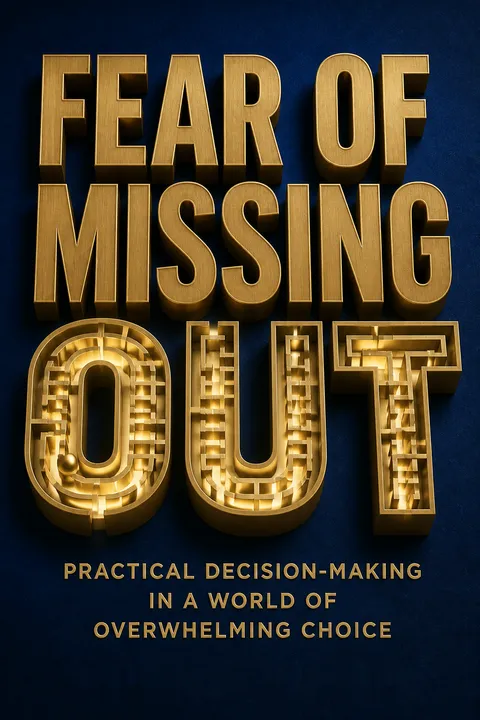


Key Takeaways
Choose one good path, because indecision turns abundance into a trap.
Two fears, one trap. Fear of Missing Out, or FOMO, is anxiety that others are having better experiences or that you will be excluded from something worthwhile. Fear of a Better Option, or FOBO, is the urge to delay commitment because an even better choice might appear. FOMO pushes toward everything; FOBO holds back from choosing anything. When they collide, McGinnis calls the result FODA, or Fear of Doing Anything.
Decisiveness creates room. At Harvard Business School, McGinnis found himself racing between events, classes, and clubs, convinced that every missed invitation mattered. The answer is not to find a way to do it all. It is to decide what matters, commit to it, and accept the options that commitment closes. The book's central promise is that choosing narrows the menu but frees attention for the life actually being lived.
The useful distinction is between having options and being able to use them. A menu can expand freedom when it offers meaningful alternatives, yet become a burden when every choice is treated as a referendum on the best possible life. This is a problem of attention as much as choice: each open possibility competes for mental space. The argument is strongest when it treats commitment as a practical act, not a guarantee of perfect outcomes. Decisiveness cannot make uncertainty vanish, but it can prevent uncertainty from consuming the time meant for action.
Treat FOMO as a signal, not proof that someone else's life is better.
Two levers provoke FOMO. Aspirational FOMO is the belief that an experience or opportunity will improve your life. Herd FOMO is the fear of being left out of a group experience. Both depend on incomplete information: a polished vacation post or a limited-time offer shows an appealing surface, not the full reality. McGinnis calls this gap information asymmetry.
The sales pitch can be social. Fyre Festival used celebrity influencers and promises of luxury to create a sense of an unmissable event. Tickets sold quickly, but the festival lacked basic infrastructure and collapsed. Black Friday uses a less spectacular version of the same formula: uncertainty about limited stock combines with the crowd's excitement. FOMO predates smartphones, but constant feeds and notifications make comparison and social pressure harder to escape.
What's striking is how often the trigger is not the opportunity itself but a story about what it means to join. Scarcity, visible crowds, and admired people can make an option feel more valuable before its actual benefits are known. That insight applies to consumer choices and to career decisions, where prestige can masquerade as personal fit. Still, not every popular option is manipulation, and a desire to belong is not inherently foolish. The practical test is whether the appeal survives scrutiny once the imagined audience and the sales pressure are removed.
FOBO costs other people trust, time, and the chance to plan.
Keeping doors open has a bill. FOBO is not just private overthinking. When someone delays replying, holds several plans in reserve, or cancels when a more attractive option appears, other people lose time and certainty. McGinnis describes a friend who received a job offer in London that met nearly all his needs. While trying to use it to find a better position in Paris, he accidentally sent his negotiation email to the prospective boss. The employer gave him a day to accept or lose the offer.
Organizations can stall too. McGinnis calls FOBO an anti-strategy because excessive analysis and hedging can prevent action, innovation, and clear leadership. Audi had presented electric-car concepts years earlier but, in the account given, kept studying while competitors moved toward market. Caution is useful; repeated delay can turn it into lost opportunity.
This section makes indecision visible as a social behavior, not merely an internal discomfort. Reliability is a form of coordination: other people make plans around a commitment, and uncertainty transfers the cost of one person's optionality to everyone else. That is why a late cancellation can damage trust beyond the single event. The organizational example makes the same point at scale. At the same time, delay can be responsible when evidence is weak or the consequences are severe. The key distinction is whether further analysis can change the decision, or only postpone owning it.
Match decision effort to stakes, not to how anxious you feel.
Sort before you solve. McGinnis groups decisions into three levels. High-stakes choices have important longer-term consequences and need structured thought. Low-stakes choices recur and have several acceptable answers. No-stakes choices have little consequence and no meaningful wrong answer. Anxiety can make a trivial choice feel momentous, so the category should be based on consequences, not intensity of feeling.
Use help where it fits. For a no-stakes choice, McGinnis's friend Francesca advised him to assign options to parts of a watch face and follow its hand. For a low-stakes work decision, delegate to one trusted person, with clear boundaries. He learned the value of that approach from a boss who gave junior staff responsibility while keeping an eye on important risks. Save personal deliberation for decisions that merit it.
This is a compact form of cognitive triage. It protects attention by reserving careful thought for decisions where additional reasoning could materially improve the outcome. Delegation also serves two purposes: it reduces the decision-maker's load and gives another person room to exercise judgment. The watch technique is deliberately playful, but its logic is serious: when alternatives are equivalent, speed is more valuable than optimization. The caveat is that labels like low-stakes depend on context. A seemingly minor choice can matter greatly to someone with different resources, responsibilities, or constraints.
Investigate big temptations before deciding whether they deserve your life.
Turn a feeling into a question. For a high-stakes opportunity that triggers FOMO, McGinnis borrows from venture capital due diligence. State the decision clearly, set a short list of criteria, gather facts from relevant sources, and write down the reasoning. His suggested checks include whether you can explain why you want the opportunity, afford it, make room for it alongside other priorities, identify its likely return, and realistically pursue it.
Then check whose dream it is. Research can correct the fantasy that a job, investment, or experience will be better than it really is. But facts alone cannot tell whether the goal is yours. Ask whether you actually want it or are responding to the crowd. The Theranos case illustrates the stakes: prominent investors and partners were drawn by reputation and momentum, while the company's claims were not adequately established.
The framework usefully separates two tasks that are often confused: testing whether an opportunity is feasible and testing whether it is personally worthwhile. Written criteria make it harder to retrofit reasons after becoming emotionally attached. Seeking views from people with different experience can also reveal assumptions that a like-minded circle shares. Yet due diligence has a limit: information cannot eliminate uncertainty about the future, and research itself can become a respectable disguise for avoidance. A sound process needs a stopping point, after which judgment must take over.
For hard choices, eliminate acceptable options once, then back your front-runner.
FOBO needs a process. When several options already meet your needs, endless searching can hurt more than the goal of choosing the best. McGinnis recommends setting a few criteria, checking each option against them, and removing any that fail. From the acceptable choices, identify a front-runner, then compare each remaining option against it. Replace the front-runner only when another choice is genuinely better.
Do not reopen the whole field. Once an option is eliminated, leave it behind. Keep a written record of the reasoning, and if two candidates remain indistinguishable, ask a small, diverse group for advice. The decision is not a claim that the chosen path is perfect. It is a commitment based on the best information available, with the possibility of learning from the result rather than endlessly rehearsing alternatives.
This method addresses a subtle source of regret: repeatedly reopening options can make a completed comparison feel unfinished. A clear elimination rule gives the mind closure without pretending that discarded paths lacked value. The distinction between the goal of excellence and the process of compulsive reconsideration is especially useful. Still, an eliminated option should not be treated as permanently irrelevant when facts materially change. The rule works best as protection against circular rumination, not as a ban on updating a decision when circumstances truly shift.
Put your phone in its place so other people's lives stop rewriting yours.
Attention needs boundaries. The book describes how persistent information, social sharing, and easy comparison intensify FOMO and FOBO. McGinnis recommends a digital audit: track time on devices and notice when messages, feeds, or news interrupt work, rest, and conversation. Practical changes include disabling nonessential notifications, removing distracting apps, creating device-free periods, and keeping phones out of the bedroom.
Aim for control, not escape. The book cites a University of Pennsylvania study in which students who limited social media use reported lower loneliness and depression. It also presents mindfulness as a way to return attention to present sensations instead of rehearsing the past or imagining every alternative. Joy of Missing Out, or JOMO, can describe contentment with a missed event, but it is an outcome, not a reliable method for reaching it.
The strongest recommendation is environmental rather than moralistic. A person need not become unusually disciplined if the phone is not constantly offering another comparison or interruption. Boundaries reduce the number of decisions that must be resisted in the first place. Mindfulness adds a different skill: noticing attention being pulled away without immediately obeying the pull. The argument also makes room for technology's genuine benefits, rather than treating disconnection as the only answer. Its limits are practical: some jobs and relationships require responsiveness, so boundaries must fit the demands of a person's actual life.
Test a passion part-time before betting your whole life on it.
Make exploration sustainable. McGinnis argues that FOMO can sometimes point toward a real interest rather than mere comparison. Instead of quitting a job or rebuilding a life at once, try the interest in a limited, committed way. His term 10% Entrepreneurship describes investing a portion of one's time or money in a venture while keeping a primary job. The emphasis is ownership and learning, not simply earning extra income.
Small experiments can matter. The Nyamangwanda sisters built a fashion business alongside their careers, while Dan Brendtro organized a crowdfunding effort to restart research into his daughter's rare disease. Both pursued meaningful projects without immediately abandoning other responsibilities. The same approach can apply to learning a language, developing a skill, or exploring a cause. The experiment should be manageable enough to continue, but serious enough to teach something real.
This is a useful answer to the false choice between total commitment and permanent postponement. A bounded experiment can produce evidence about interest, capacity, and fit while limiting the cost of being wrong. In decision theory, an experiment has value because it buys information, not just because it might succeed. The book's examples also show that part-time effort can create value for people beyond the individual. However, access to spare time, money, and flexibility is uneven. A sustainable experiment must account for those constraints rather than treating them as failures of ambition.
Set firm boundaries when someone keeps you waiting for a better offer.
Do not subsidize another person's indecision. In negotiations, a potential investor may repeatedly request more evidence while preserving the freedom to decline. A founder can respond with a clear deadline or terms that change after a date, making the cost of delay visible. HotelTonight used a related tactic for customers: its limited hotel selection reduced choice overload, while a short-lived discount encouraged a decision.
Protect ordinary relationships too. With a flaky person, make plans you would keep regardless, confirm arrangements in writing, and give a small number of clear options with a response deadline. If the pattern continues, step back or name the behavior directly. McGinnis stresses that pressure cannot rescue a genuinely bad option, so deadlines should clarify a real decision rather than manufacture panic.
This advice identifies a power asymmetry: the person who delays may preserve flexibility by making others absorb uncertainty. Clear terms restore some balance and make the cost of waiting explicit. The commercial examples also expose the ethical ambiguity of scarcity tactics. A genuine deadline can coordinate action; an artificial countdown can exploit anxiety. The same tool that counters FOBO can provoke FOMO, so its legitimacy depends on whether the limit reflects a real constraint and whether the other party has enough information to choose freely.
Treat available choices as a privilege, then spend yours with intention.
Options are not universal. In the closing account, McGinnis visits Syrian refugee families in Lebanon. A teenager named Mohammed hopes to become a programmer, but his family needs him to work in the fields, and he has not been able to attend school regularly. His situation makes clear that FOMO and FOBO are problems of abundance: both require options that a person can imagine and potentially pursue.
Abundance can still immobilize. People with many opportunities may become stuck through indecision, even while people facing hardship would welcome those choices. The point is not to feel guilty for having options, but to recognize them as contingent and valuable. McGinnis returns to his own reunion with a deliberate choice to attend selected events rather than chase every possibility. Commitment becomes a way to use opportunity, not merely to preserve it.
The refugee camp story gives the book's decision advice a necessary social frame. It distinguishes choice overload from deprivation without claiming that abundance makes every decision easy or every hardship comparable. Gratitude is most constructive when it sharpens responsibility, not when it silences distress or excuses unequal access. The closing argument also recasts decisiveness as stewardship: opportunities are finite in time, and attention is one of the resources through which they become real. That perspective can move the reader beyond personal optimization toward asking how available choices might also serve other people.
Analysis
The book's central tension is that modern abundance can enlarge freedom while making it harder to act freely. McGinnis makes that tension memorable by distinguishing two responses to opportunity: FOMO says to pursue more, while FOBO says to keep searching before committing. Their combination produces paralysis, but they are not identical problems. FOMO often begins in comparison and belonging; FOBO becomes visible in delayed commitments and the burdens those delays impose on others.
The strongest contribution is the shift from self-judgment to decision design. Rather than treating indecision as a character defect in every instance, the book asks what kind of choice is at hand, what information is missing, and whether more analysis can change the outcome. Its practical sequence moves from triage for trivial decisions to due diligence for consequential ones, then to deliberate elimination when too many acceptable alternatives remain. This preserves ambition while rejecting the fantasy of perfect certainty.
The narrative examples make the abstract problem concrete. Fyre Festival shows how social proof and incomplete information can sell an imagined experience. The London job offer illustrates how preserving options can jeopardize a satisfactory opportunity. The refugee camp account supplies a needed counterweight: abundance-driven indecision is not a universal human condition, and the ability to choose is unevenly distributed.
A limitation is that the book sometimes frames indecision in moral terms, especially when discussing FOBO. This is persuasive when someone repeatedly leaves colleagues or friends waiting, but hesitation can also reflect real risk, limited resources, or obligations that a simple framework cannot resolve. The most durable reading is therefore not that every delay is selfish, but that delay should have a reason and a cost. Decisiveness is valuable not because it guarantees the best outcome, but because it converts available opportunity into chosen action and makes the remaining uncertainty livable.
Review Summary
Fear of Missing Out explores FOMO (Fear of Missing Out) and FOBO (Fear of Better Options), concepts coined by McGinnis. The book examines how these phenomena affect decision-making and life satisfaction in the digital age. Readers appreciated the insights on managing FOMO/FOBO, though some found parts repetitive. The book offers practical advice and self-assessment tools, resonating with those struggling with indecision or social media anxiety. While some readers found it enlightening, others felt it lacked depth. Overall, it's seen as a relevant exploration of modern psychological challenges.
People Also Read

Glossary
FOMO
Fear of missing outFear of Missing Out is anxiety that others are having more satisfying experiences, or that one will be excluded from a positive shared experience. In the book, FOMO can be driven by aspiration, such as believing an opportunity will improve life, or by a desire for inclusion. Social media can intensify it by making comparison and exposure to alternatives constant.
FOBO
Fear of better optionsFear of a Better Option is an anxiety-driven tendency to delay commitment because a more attractive alternative might exist. It involves both searching for something better and preserving the possibility of choosing later. The book emphasizes that this behavior can waste time, damage relationships, and prevent organizations from acting, even when several acceptable choices are already available.
FODA
Fear of doing anythingFear of Doing Anything describes the paralysis that can result when FOMO and FOBO operate together. The person feels pressure to pursue appealing possibilities but also resists committing to any one of them. Attention and effort go into cycling among alternatives, while no course of action receives sustained commitment.
Aspirational FOMO
FOMO driven by perceived improvementAspirational FOMO is the desire to pursue an experience, product, or opportunity because it appears likely to make life better. It depends on perception, which can be distorted by incomplete information, selective presentation, or personal insecurity. The term distinguishes this upward-looking desire from FOMO driven mainly by fear of exclusion from a group.
Herd FOMO
FOMO driven by inclusionHerd FOMO is the urge to join an activity because other people are participating and exclusion feels threatening. The book connects it to the human desire for belonging and to marketing that uses crowds, social proof, and scarcity. It can motivate group participation even when the individual has not established whether the activity fits personal priorities.
reference anxiety
Anxiety from comparing livesReference anxiety is the insecurity that arises when people compare their own lives with visible examples of other people's apparent success or enjoyment. Social media increases access to these comparisons, while curated posts conceal much of the reality behind them. The comparison can make a person's present life seem inadequate despite the uncertainty of the evidence.
10% Entrepreneurship
Part-time venture ownership10% Entrepreneurship is McGinnis's approach of committing a portion of one's time or capital to a business venture while maintaining a primary job. Its aim is not simply extra income, but a stake in the value being created and a manageable way to test entrepreneurial interests. The approach seeks exploration and potential upside without immediately risking one's full livelihood.
10% Activist
Part-time cause-buildingA 10% Activist applies the part-time venture approach to a social cause. Rather than abandoning existing responsibilities, the person uses a limited but focused investment of time, skills, or money to advance a project. Dan Brendtro's fundraising effort for research into his daughter's rare disease is the book's example of this model.
JOMO
Joy of missing outThe Joy of Missing Out is contentment with not participating in an event or experience. McGinnis treats it as a possible emotional result of being comfortable with a choice, rather than as a process that reliably resolves FOMO. It is most applicable to modest, short-lived opportunities, not necessarily to major ambitions or life decisions.
decision stakes
A three-level decision filterDecision stakes is McGinnis's framework for sorting choices into High-Stakes, Low-Stakes, and No-Stakes categories. High-Stakes decisions merit structured analysis because of their potential long-term consequences. Low-Stakes choices recur and have several reasonable answers. No-Stakes choices have negligible consequences and can be decided quickly or outsourced.
FAQ
What's "Fear of Missing Out: Practical Decision-Making in a World of Overwhelming Choice" about?
- Focus on FOMO and FOBO: The book explores the concepts of FOMO (Fear of Missing Out) and FOBO (Fear of a Better Option), examining how they affect decision-making in a world with overwhelming choices.
- Author's Perspective: Patrick J. McGinnis, who coined the term FOMO, shares his insights and personal experiences with these phenomena, offering strategies to manage them.
- Decision-Making Strategies: It provides practical advice on how to make decisions with confidence and clarity, reducing the anxiety and stress associated with FOMO and FOBO.
- Cultural and Technological Impact: The book discusses how modern technology and culture exacerbate these fears, influencing both personal and professional lives.
Why should I read "Fear of Missing Out: Practical Decision-Making in a World of Overwhelming Choice"?
- Understand Modern Challenges: It helps readers understand the psychological and cultural challenges posed by FOMO and FOBO in today's fast-paced world.
- Improve Decision-Making: The book offers actionable strategies to improve decision-making skills, helping readers to focus on what truly matters.
- Reduce Stress and Anxiety: By addressing the root causes of FOMO and FOBO, readers can reduce stress and anxiety, leading to a more fulfilling life.
- Gain Insight from the Creator: As the creator of the term FOMO, McGinnis provides unique insights and firsthand experiences that enrich the reader's understanding.
What are the key takeaways of "Fear of Missing Out: Practical Decision-Making in a World of Overwhelming Choice"?
- FOMO and FOBO Defined: FOMO is the anxiety of missing out on rewarding experiences, while FOBO is the fear of making a decision due to the possibility of a better option.
- Impact on Life: Both FOMO and FOBO can lead to stress, indecision, and dissatisfaction in personal and professional contexts.
- Strategies for Decisiveness: The book provides strategies to overcome these fears, such as setting clear priorities, relying on facts, and learning to let go of less important options.
- Cultural and Technological Influence: It highlights how social media and technology amplify these fears, making it crucial to manage digital consumption.
How does Patrick J. McGinnis suggest managing FOMO and FOBO?
- Prioritize Decisions: McGinnis suggests categorizing decisions into high-stakes, low-stakes, and no-stakes to focus on what truly matters.
- Outsource Decisions: For low-stakes decisions, he recommends outsourcing or delegating to reduce mental clutter and focus on more important tasks.
- Conduct Due Diligence: For high-stakes decisions, he advises gathering data and setting criteria to make informed choices.
- Embrace Mindfulness: Practicing mindfulness can help individuals stay present and reduce the impact of FOMO and FOBO.
What is the difference between FOMO and FOBO according to the book?
- FOMO Explained: FOMO is driven by the perception that others are having more rewarding experiences, often exacerbated by social media.
- FOBO Explained: FOBO is the fear of committing to a decision due to the possibility of a better option, leading to indecision and procrastination.
- Emotional vs. Process-Oriented: FOMO is more emotional, while FOBO is related to decision-making processes and the desire to maximize outcomes.
- Impact on Others: FOMO primarily affects the individual, while FOBO can impact others by causing delays and indecision in group settings.
What are some practical strategies from the book to overcome FOMO?
- Set Clear Criteria: Establish clear criteria for decisions to reduce the influence of emotions and focus on facts.
- Limit Social Media Use: Reduce time spent on social media to decrease exposure to triggers that cause FOMO.
- Focus on Gratitude: Practice gratitude to appreciate what you have and reduce the desire for what you might be missing.
- Embrace JOMO: Find joy in missing out on unnecessary distractions to focus on what truly matters.
How can FOBO be detrimental in professional settings, according to McGinnis?
- Analysis Paralysis: FOBO can lead to analysis paralysis, where decisions are delayed due to overthinking and fear of missing better options.
- Stifles Innovation: It can stifle innovation by causing individuals and organizations to stick with the status quo rather than taking risks.
- Impacts Relationships: FOBO can damage professional relationships by causing delays and indecision, leading to frustration among colleagues.
- Leadership Challenges: Leaders with FOBO may struggle to make decisive choices, impacting their ability to guide teams effectively.
What role does technology play in exacerbating FOMO and FOBO?
- Constant Connectivity: Technology keeps individuals constantly connected, increasing exposure to experiences and options that trigger FOMO and FOBO.
- Social Media Influence: Social media platforms amplify FOMO by showcasing curated, idealized versions of others' lives.
- Information Overload: The abundance of information available online can lead to FOBO by overwhelming individuals with too many choices.
- Digital Wellness: The book suggests implementing digital wellness practices to manage technology's impact on decision-making.
What are some of the best quotes from "Fear of Missing Out: Practical Decision-Making in a World of Overwhelming Choice" and what do they mean?
- "FOMO is the enemy of valuing your own time." This quote highlights how FOMO can distract individuals from focusing on their priorities and valuing their time.
- "The antidote to these challenges is the same: you must learn to be decisive." It emphasizes the importance of decisiveness in overcoming FOMO and FOBO.
- "When you miss out on an opportunity, you don’t necessarily limit your options. On the contrary, you give yourself freedom." This quote suggests that letting go of certain options can lead to greater freedom and focus.
- "You cannot have it all. Overcoming FOMO will require you to determine whether any of the many opportunities that you feel tempted to explore are actually worth pursuing." It underscores the need to prioritize and focus on meaningful opportunities.
How does McGinnis propose using FOMO for good?
- Listen to FOMO: Use FOMO as a source of inspiration to explore new opportunities and interests that align with your goals.
- Part-Time Entrepreneurship: Consider part-time entrepreneurship to pursue passions without sacrificing stability, using FOMO as motivation.
- Mini-Lives: Embrace the concept of mini-lives, where you temporarily explore different lifestyles or locations to satisfy curiosity and growth.
- Incremental Approach: Adopt an incremental approach to pursuing interests, allowing FOMO to guide you without overwhelming your current commitments.
How can one deal with FOMO and FOBO in others, based on the book's advice?
- Recognize the Signs: Identify when others are exhibiting FOMO or FOBO and understand how it affects interactions and decisions.
- Set Clear Boundaries: Establish clear boundaries and expectations to minimize the impact of others' indecision on your own plans.
- Encourage Decisiveness: Encourage others to make decisions by providing clear options and deadlines, reducing their FOBO.
- Use FOMO Strategically: Leverage FOMO to motivate others to take action, such as creating scarcity or urgency in negotiations.
What is the significance of the epilogue in "Fear of Missing Out: Practical Decision-Making in a World of Overwhelming Choice"?
- Perspective on Privilege: The epilogue highlights the privilege of having options and the importance of appreciating them.
- Gratitude for Choices: It encourages readers to be grateful for the choices they have, contrasting with those who have limited options.
- Call to Action: The epilogue serves as a call to action to make the most of available opportunities and live decisively.
- Reflection on Life's Fragility: It reminds readers of life's fragility and the importance of making meaningful decisions while they can.
Download PDF
Download EPUB
.epub digital book format is ideal for reading ebooks on phones, tablets, and e-readers.








