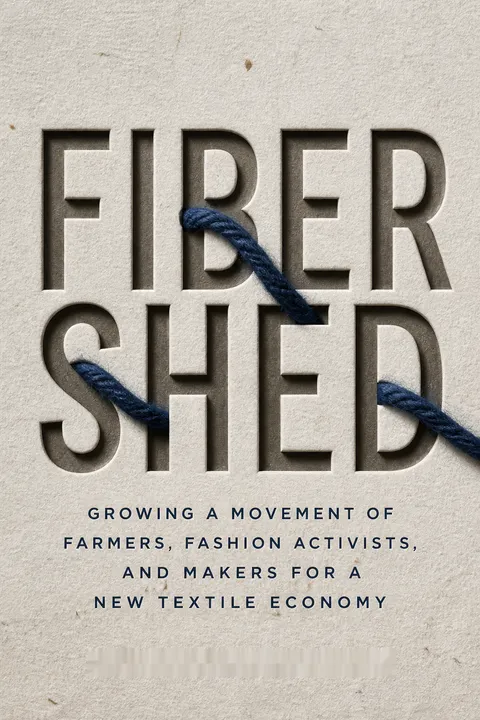


Key Takeaways
Treat every garment as an agricultural choice, not a disposable trend
Clothing has a supply chain. Clothes begin with land, labor, and materials, yet shoppers often see only color, price, and style. The book reports that the world sells more than 80 billion garments annually, while the average person buys 60 percent more clothes than in 2000 and keeps them for about half as long. Polyester, now used in roughly 60 percent of garments, comes from fossil fuels and sheds plastic microfibers when washed. Cotton, wool, and plant dyes also have impacts that depend on how they are grown and processed.
The costs stay hidden. Textile production consumes enormous amounts of water, creates pollution through dyeing and finishing, and often relies on poorly paid workers. Because supply chains stretch across countries, the people wearing a garment may never see its ecological or human costs.
What's striking is how the garment label usually describes a product, not the system that made it. That gap resembles hidden costs in food and energy markets: the checkout price excludes damage borne by workers, ecosystems, and public health. More information can help, but information alone does not change purchasing power or factory conditions. The book's strongest move is therefore to make clothing an agricultural and labor question, not merely a matter of personal taste. Its many health claims vary in evidentiary strength, so transparency and precaution are more persuasive than implying every synthetic finish carries equal risk.
Map the people and land behind one local garment
A fibershed connects a place. The book defines a fibershed as a regionally grounded textile system that links the source of raw materials to processing, garment-making, use, and return to soil. Burgess tested the idea by wearing a wardrobe made within 150 miles of her Northern California home for a year. The project connected growers, ranchers, dyers, millers, knitters, and sewers who had rarely worked together.
Indigo made the network visible. When thousands of seedlings were mistakenly delivered to another farm, a local farmer kept them alive and planted them. Growing enough indigo for year-round dyeing then required about 5,000 plants and 440 pounds of dried leaves for fermentation. Contributors pooled their harvests and work. A life-cycle assessment of locally made pants found one-sixth the carbon and water footprint of a conventional equivalent.
The wardrobe challenge turns an abstract supply chain into relationships that can be seen, visited, and negotiated. This is close to the idea of embedded economies: value circulates through local knowledge and social ties rather than disappearing into anonymous transactions. The model also reveals a practical constraint. A region may have abundant fiber but lack the machinery or skills to finish it, so geographic boundaries cannot be treated as a purity test. The useful question is not whether every input is local, but whether the chain becomes more transparent, accountable, and beneficial to the people and land involved.
Design clothes to return carbon to soil, not persist as waste
Follow the carbon. The Soil-to-Soil framework traces material from atmospheric carbon captured by plants, through crops or grazing animals, into fiber and clothing, and finally back into compost. Plant fibers and wool can decompose under suitable conditions; synthetic fibers can persist as plastic waste and shed microfibers. The book reports that an estimated 136 billion metric tons of carbon have been lost from global soils since the Industrial Revolution.
Soil is working infrastructure. In a Northern California experiment, one application of compost increased forage production by 40 to 70 percent across two grassland sites. After three years, soil water-holding capacity had risen nearly 25 percent, and soil carbon increased about 0.4 metric ton per acre annually. The authors use this example to show how land management can support both agricultural productivity and climate goals.
The framework improves on a narrow focus on factory emissions by asking where a material's carbon came from and where it goes after use. That is a valuable form of systems accounting, especially when a garment's farming stage can affect soil, water, and habitat. But soil carbon is not a permanent deposit by default. Results depend on local ecology, management, and duration, and measurement can be difficult. The framework is most credible when claims are site-specific and independently tracked. Compostability also depends on the garment's full composition and the receiving compost system, not simply the fiber name on a tag.
Pay for land stewardship, not just fiber volume
Management changes the result. Carbon farming means managing a farm or ranch so that carbon gains in soils and vegetation exceed losses. Practices can include keeping soil covered, reducing disturbance, planting trees and hedgerows, adding compost, and managing livestock with carefully timed grazing and recovery periods. The aim is to improve soil function while drawing carbon from the atmosphere.
Wool can carry that story. Fibershed's Climate Beneficial label identifies materials grown on farms implementing carbon farm plans. In a wool life-cycle model described in the book, a scenario combining land practices that stored additional soil carbon with regional processing and renewable energy produced a net-negative carbon result. The modeled land needed to sequester about three additional tons of carbon dioxide equivalent per hectare. This result depends on the specific assumptions and conditions, not on wool alone.
This approach broadens the meaning of a fiber premium: a higher price can reward ecological work that conventional commodity markets overlook. It also connects climate accounting to rural income, giving producers a reason to invest in practices whose benefits may take years to mature. The necessary discipline is to distinguish a verified farm outcome from a broad marketing promise. Livestock impacts vary with stocking, soils, climate, and management, and a favorable case study cannot settle every debate about grazing. Buyers need transparent methods, baselines, and monitoring before treating a label as proof of net climate benefit.
Grow overlooked local fibers before importing a miracle material
Start with the landscape. Fibersheds explore crops suited to local conditions rather than assuming one material belongs everywhere. Sally Fox's Northern California farm breeds naturally colored cotton, reducing the need for dye, and integrates cotton with legumes, wheat, and sheep. In India, the Tula project revived locally adapted cotton grown in polycultures, including without irrigation in some settings, and paid small farmers more than the market rate for comparable Bt cotton. Its network eventually supported more than 300 cotton-related livelihoods.
Other plants offer different fits. Chico Flax grows flax during California's rainy winter, seeking a locally processed linen supply. Milkweed floss can insulate clothing while the plant supports monarch habitat. Hemp and nettle also have textile potential, but each requires suitable growing practices and processing knowledge.
The examples challenge the assumption that innovation must begin in a laboratory. Plant breeding, seed saving, and rediscovered processing skills can produce useful material while keeping knowledge and choices in farmers' hands. Yet natural does not automatically mean sustainable. Cotton can demand irrigation, and a crop's effects depend on local water, soil, labor, and processing. The book's place-based method is strongest when it compares real alternatives in context rather than treating traditional materials as inherently benign. The most compelling projects also stack functions: a crop can contribute fiber while supporting soil, food production, or habitat.
Rebuild mills where raw fiber already accumulates
Processing is the bottleneck. A region can grow excellent fiber and still be unable to make clothing if it lacks mills. The book compares mills to kitchens: without equipment for cleaning, combing, spinning, and weaving, raw material cannot become everyday fabric at useful scale. California produces more than three million pounds of wool each year, while northern California's milling capacity was about 10,000 pounds annually.
The hidden supply was substantial. Fibershed inventoried 1.4 million pounds of California wool, nearly half the state's annual production, and found that close to 80 percent was suitable for some kind of garment. Its proposed boutique mill would process 1.3 million pounds a year, but the projected investment was $26 million. The proposal shows both the opportunity and the capital required to reconnect farms with manufacturers and customers.
The mill argument shifts sustainability from consumer virtue to industrial design. Local production cannot scale through craft labor alone, and infrastructure determines which fibers become usable clothes rather than waste. Still, a mill is not automatically resilient because it is nearby. It needs reliable demand, skilled jobs, fair purchasing terms, and a plan for operating costs and environmental performance. Cooperative ownership and phased investment can help distribute risk, but cannot erase it. The book's emphasis on mapping supply and building relationships before buying machinery is a useful antidote to the familiar habit of funding equipment before proving who will use it.
Extend garment life before searching for cleaner production
Use is part of the design. Fast fashion accelerates both production and disposal. The book describes a system with as many as 52 microseasons, where trends change quickly and low-cost garments are often worn only a few times. Buying fewer clothes and keeping them longer reduces demand for constant replacement. Mending, secondhand shopping, clothing swaps, and take-back or repair programs can keep garments in use.
Care changes the footprint. Burgess recommends washing less often, using cold water and mild, fragrance-free detergent, and line-drying when practical. Worn-out garments made entirely from natural fibers may be compostable if local systems accept them; blended synthetics generally complicate that route. The book's broader aim is to move from disposable purchasing toward durable clothes that can be repaired, reused, recycled, and, where suitable, returned to soil.
The focus on use counters a common sustainability trap: replacing a wardrobe with supposedly greener purchases while leaving consumption habits untouched. Longer garment life can reduce demand for new production, and repair also builds practical skill and emotional attachment. However, resale and donation are not guaranteed solutions; low-quality clothing may simply move the waste problem elsewhere. Nor does buying durable clothing help if it becomes an excuse to own more. The relevant measure is not just the material's footprint but the amount of new material demanded over time. Care is useful precisely because it makes that demand visible.
Demand proof before calling engineered biology sustainable
A green claim needs a whole system. Synthetic biology uses engineering methods to redesign or construct biological systems, often microbes, for industrial production. The book questions claims that engineered fibers such as lab-produced spider silk are automatically ecological. Their feedstocks may come from industrial sugar crops, and their impacts on land, water, and biodiversity need assessment. The author also raises concerns about accidental release, limited oversight, and the possibility that engineered organisms could be difficult to recall.
Ownership matters too. The book contrasts proprietary engineered seeds with Sally Fox's classical cotton breeding, which develops traits across generations and allows further breeding under plant variety protection. Its account of Bt cotton in India describes farmers' dependence on purchased seed and chemicals, while the Tula project builds markets around locally adapted cotton and farmer livelihoods. The contrast is about who controls the technology as well as how it works.
The precautionary argument is strongest where biological systems can reproduce, spread, or resist recall, while commercial incentives reward speed and patent control. It is also important not to collapse all genetic research into one category: methods, risks, oversight, and benefits differ. A fair evaluation asks for life-cycle evidence, ecological safeguards, and public accountability before a technology is scaled. The book's historical examples remind readers that a product can solve one technical problem while worsening dependence or concentrating power. That lesson applies beyond textiles, but it does not prove that every engineered intervention will fail.
Give local producers power over the textile economy
A movement needs institutions. Fibershed began as a personal wardrobe experiment and grew into a network connecting farmers, artisans, designers, mills, and wearers. Its affiliate groups share research and adapt the model to local conditions. In Northern California, the producer directory grew to more than 170 members, while a producer-led cooperative created a market for regional materials. These structures help small businesses find customers and producers find one another.
Localism must face history. Cotton wealth was built through colonial expansion, land seizure, and slavery, while contemporary garment supply chains often obscure labor conditions. Burgess argues that rebuilding regional systems should also restore respect, access, and decision-making power to Indigenous and folk traditions, especially traditions marginalized by industrial fashion. The goal is not simply to buy nearby goods, but to make textile economies more accountable and broadly beneficial.
The book's political claim is that supply chains distribute power, not only products. Cooperatives, directories, and shared infrastructure can give producers more bargaining strength and help communities retain skills and value. But regional identity is not automatically inclusive: land access, wages, and who gets visibility still matter. Local brands can become premium niches serving affluent buyers unless affordability and worker participation are designed in. The global affiliate network offers a useful counterpoint to isolation: communities can adapt shared knowledge without surrendering local control. A just textile economy must be locally grounded and answerable to histories that local pride can otherwise overlook.
Analysis
Fibershed's central contribution is to change the unit of analysis. Fashion is usually discussed through consumer choice, brand commitments, or factory efficiency. Burgess instead follows material across a landscape and asks who controls each transition: seed to crop, fleece to yarn, cloth to garment, and worn-out fabric to waste or soil. This makes the book more than an appeal to buy local. It is a proposal for rebuilding missing institutions, especially mills, cooperatives, training, and transparent purchasing relationships, so that ecological practices can support durable livelihoods.
The narrative earns its framework through a concrete experiment. The wardrobe challenge begins with personal discomfort and practical limits, then reveals that regional materials exist but processing capacity and coordination have disappeared. The indigo project is especially effective because a crop, a farmer, a dye recipe, and shared labor turn an abstract supply chain into a visible community. The book's strongest evidence also concerns this level: project outcomes, regional supply surveys, and soil studies that connect management to measurable changes.
Its evidence is not uniform. Soil trials and life-cycle models offer testable claims, while some discussions of chemical exposure and biotechnology are advocacy-driven and sometimes treat uncertainty as a reason for alarm. Readers should preserve the book's precautionary principle while distinguishing demonstrated harms from plausible risks. Likewise, carbon sequestration by managed grazing is a conditional possibility, not a universal property of animal agriculture. The book itself provides a useful basis for that distinction by emphasizing place, measurement, and management.
The most important tension is scale. Regional systems can improve traceability and keep value near producers, but they cannot replace every global supply chain or guarantee fairness by proximity alone. Their success depends on public investment, worker protections, accessible prices, and meaningful participation by communities whose land and labor shaped textile history. Fibershed is persuasive when understood not as a return to an idealized past, but as a blueprint for combining ecological knowledge with modern infrastructure and democratic control.
Review Summary
Fibershed explores sustainable textile production through local, environmentally-friendly practices. Readers praise its eye-opening information on the harmful impacts of fast fashion and synthetic fibers. Many found it inspirational, though some critiqued the author's privilege and pseudoscientific claims. The book's detailed research and passion impressed most readers, who appreciated learning about alternative clothing production methods. Some found it dry or disorganized, but overall, reviewers considered it an important read for those interested in sustainable fashion and environmental stewardship.
People Also Read




Glossary
Fibershed
Regional textile supply systemA geographically grounded textile system that connects the land and people producing fiber and dye with processors, makers, wearers, and end-of-life recovery. The boundaries are shaped by local resources and practical relationships, not by a universal radius. Its purpose is to make the origins and consequences of clothing more visible while strengthening regional ecological and economic capacity.
Soil-to-Soil
A regenerative textile cycleA framework for tracing clothing from its ecological source through production, use, and disposal, with the goal of returning natural materials to the soil. Plants capture atmospheric carbon; crops and grazing animals provide fibers; garments are used and repaired; suitable natural textiles can be composted. The framework contrasts this cycle with fossil-derived materials that persist as pollution.
Carbon farming
Land management that builds carbonAn approach to agriculture that uses practices intended to increase carbon stored in vegetation and soil while supporting the land's capacity for self-renewal. Examples in the book include keeping soil covered, reducing disturbance, planting hedgerows or trees, applying compost, and managing grazing. It succeeds as carbon management only when gains exceed losses, and outcomes depend on local conditions.
Climate Beneficial
Verified carbon-farming materialsFibershed's trademarked term for materials produced on farms or ranches implementing carbon farm plans. The label ties fiber production to land practices intended to capture and store atmospheric carbon, rather than judging a garment only by factory emissions or transport. The book presents the term as a verification approach, with claims depending on measured or modeled site-specific outcomes.
Carbon Farm Planning
A farm carbon action planA planning process that inventories a farm or ranch, maps opportunities to reduce emissions and increase carbon storage, estimates the benefits of potential practices, and ranks projects according to ecological goals and economic feasibility. Plans can include actions such as stream restoration, hedgerows, silvopasture, compost application, and managed grazing, then be monitored and revised as conditions change.
Synthetic biology
Engineered biological systemsAn approach combining engineering and life sciences to design or construct biological parts, devices, or systems, or to substantially alter existing ones. In the book's textile examples, engineered microbes may be used as production systems for fibers or dyes. Burgess emphasizes questions about feedstock impacts, ecological release, regulation, patent ownership, and whether products' environmental claims are independently assessed.
Biologically Enhanced Agricultural Method (BEAM)
Fungal-focused soil restorationA soil-building methodology described by David Johnson that seeks to restore balance between bacteria and fungi in agricultural soils. It uses practices such as cover crops, compost, and livestock integration, along with fungal-rich compost extract produced in a bioreactor. The book presents BEAM as an approach being tested for effects on crop growth, soil biology, water retention, and resilience.
Adaptive Multi-Paddock grazing
Planned livestock rotationA grazing approach that concentrates livestock temporarily and controls when and how intensely they graze particular areas, then allows pastures recovery time before animals return. The timing, animal impact, and rest periods are adjusted to ecological conditions and objectives. The book discusses this method as one way to mimic periodic herbivore disturbance while avoiding continuous grazing damage.
FAQ
What is Fibershed: Growing a Movement of Farmers, Fashion Activists, and Makers for a New Textile Economy by Rebecca Burgess about?
- Regional textile revolution: The book explores the creation of local, regenerative textile economies—called “fibersheds”—that source fibers and dyes from within a specific geographic region.
- Soil-to-skin approach: It connects soil health, fiber farming, and sustainable fashion, advocating for closed-loop systems that restore ecological balance.
- Historical and global context: Burgess examines the colonial, industrial, and social history of textiles, highlighting the environmental and human costs of conventional production.
- Movement and solutions: The narrative showcases practical projects, case studies, and a vision for transforming how we produce, consume, and value clothing.
Why should I read Fibershed by Rebecca Burgess?
- Reveals hidden impacts: The book uncovers the environmental, social, and health costs of the global textile industry, including pollution, labor exploitation, and synthetic chemical use.
- Offers regenerative solutions: It presents hopeful, actionable frameworks for building sustainable, local textile systems rooted in regenerative agriculture.
- Empowers readers: Burgess provides practical advice and inspiration for individuals and communities to participate in ethical, ecological textile movements.
- Connects history to action: Understanding the roots of textile problems helps readers make informed choices and advocate for meaningful change.
What are the key takeaways from Fibershed by Rebecca Burgess?
- History shapes the present: The textile industry’s legacy of colonialism, slavery, and industrialization underpins today’s environmental and social crises.
- Soil health is central: Regenerative practices like cover cropping, composting, and managed grazing are foundational for climate-beneficial fiber production.
- Local systems are viable: Regional projects with natural fibers (cotton, flax, wool, etc.) demonstrate that sustainable, place-based textile economies are possible.
- Community and transparency matter: Building relationships among farmers, makers, and consumers fosters resilient, transparent supply chains.
What is a “fibershed” as defined by Rebecca Burgess in Fibershed?
- Geographic textile ecosystem: A fibershed is a region where fibers and dyes are grown, processed, and made into clothing locally, similar to a watershed or foodshed.
- Closed-loop supply chain: It emphasizes a soil-to-skin-to-soil cycle, where garments are compostable and production supports soil health.
- Empowering local communities: Fibersheds foster collaboration among farmers, artisans, and consumers, supporting cultural heritage and ecological cycles.
- Transparency and sovereignty: The model prioritizes traceability, ecological stewardship, and local economic resilience.
How does Fibershed by Rebecca Burgess explain the “soil-to-skin” model and its importance?
- Definition: The soil-to-skin model is a closed-loop system where every stage—from fiber cultivation to garment creation—occurs within a regional ecosystem, prioritizing soil health.
- Ecological benefits: This approach enhances carbon sequestration, biodiversity, and water retention, reducing reliance on synthetic inputs and mitigating climate change.
- Social and economic impacts: It creates local jobs, supports rural economies, and preserves traditional textile knowledge.
- Transparency and accountability: The model enables traceable, ethical supply chains, empowering both producers and consumers.
What are the environmental and social costs of the industrial textile system according to Fibershed?
- Toxic chemical pollution: Widespread use of synthetic dyes and chemicals contaminates waterways and poses health risks to workers and consumers.
- Labor exploitation: The industry is marked by poor working conditions, child labor, and tragedies like the Rana Plaza collapse.
- Climate and resource impact: Heavy reliance on fossil fuels, synthetic fibers, and water-intensive crops contributes to greenhouse gas emissions and microplastic pollution.
- Global inequalities: The system perpetuates economic and social injustices, especially in cotton-producing regions.
How does Fibershed by Rebecca Burgess address the history and challenges of cotton production?
- Colonial and industrial legacy: Cotton’s history is intertwined with land theft, slavery, and forced labor, shaping global inequalities.
- Environmental degradation: Conventional cotton relies on irrigation, pesticides, and GMOs, leading to water crises and soil depletion.
- Market pressures: Farmers face volatile prices and high input costs, often resulting in unsustainable practices and social distress.
- Regenerative opportunities: The book highlights projects that revive indigenous cotton varieties and promote organic, water-efficient, and soil-building methods.
What innovative fiber and cotton projects does Fibershed highlight as models for sustainable textile production?
- Sally Fox’s color-grown cotton: Fox’s farm uses organic, biodynamic practices and breeds naturally colored cotton, reducing water and chemical use.
- Chico State University’s CRARS project: This initiative demonstrates how regenerative soil practices can double cotton yields and improve drought resilience.
- Tula organic cotton in India: Tula supports smallholder farmers growing indigenous cotton without irrigation or chemicals, reviving traditional spinning and weaving.
- Regional flax and wool projects: The book also features efforts to revive flax in the Pacific Northwest and develop local wool processing infrastructure.
What is “Climate Beneficial” fiber as described in Fibershed by Rebecca Burgess?
- Definition: Climate Beneficial fiber is produced on farms that implement carbon farming practices, sequestering more carbon than they emit.
- Verification process: Life cycle assessments and soil carbon data are used to ensure that fiber production has a net positive climate impact.
- Market challenges: Consumer education and pricing remain hurdles, but supporting these fibers helps build resilient, regenerative rural economies.
- Broader impact: Investing in Climate Beneficial fiber supports both ecological restoration and local livelihoods.
How does Fibershed by Rebecca Burgess address the role of animal fibers and milling infrastructure in regional textile economies?
- Diversity of animal fibers: The book discusses sheep’s wool, alpaca, yak, mohair, and more, each offering unique properties for different textile uses.
- Importance of local mills: Regional milling is essential for processing raw fibers into yarn and fabric, adding value and supporting local economies.
- Infrastructure challenges: There is a critical shortage of small-scale mills, limiting the growth of local fiber systems.
- Economic and social benefits: Decentralized milling creates jobs, fosters transparency, and revitalizes rural communities.
What concerns does Fibershed by Rebecca Burgess raise about synthetic biology and genetically modified fibers?
- Unassessed risks: The book critiques the promises of synthetic biology, warning of unknown environmental and health impacts.
- Ecological dangers: Potential genetic pollution and reliance on industrial feedstocks like sugarcane can cause habitat destruction and pollution.
- Regulatory gaps: Burgess highlights inadequate oversight and the risks of self-regulation in the biotech industry.
- Ethical considerations: The prioritization of profit over ecological and social well-being is a central concern.
What practical advice does Fibershed by Rebecca Burgess offer for individuals and communities wanting to engage with fibershed principles?
- Adopt slow fashion: Wear clothes longer, mend garments, buy secondhand, and choose natural fibers dyed with local plants.
- Build community connections: Collaborate with local farmers, artisans, and designers to create transparent, place-based textile economies.
- Support regenerative agriculture: Advocate for and support farmers transitioning to organic and regenerative practices.
- Educate and advocate: Raise awareness about textile impacts and critically evaluate new technologies to ensure sustainable futures.
Download PDF
Download EPUB
.epub digital book format is ideal for reading ebooks on phones, tablets, and e-readers.








