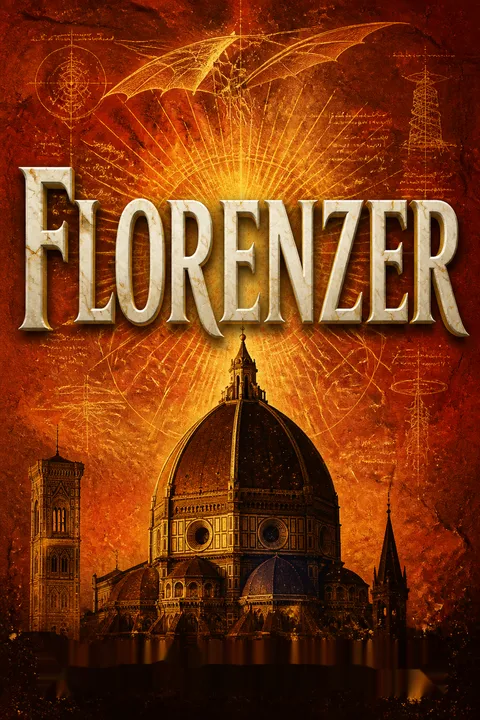


Plot Summary
Prologue
In 1464, twelve-year-old Leonardo arrives in Florence with charcoal hidden in his boot and a hunger to draw everything he sees. At Cosimo de’ Medici’s funeral, he studies the strange-faced Lorenzo, the boy destined to inherit the city’s power. Lorenzo, fourteen, promises his mother he will protect that inheritance and make himself magnificent.
Among the mourners, priest Francesco Salviati is humiliated by Lorenzo’s father, Piero, who questions his family and belonging. Salviati leaves Florence convinced the city has no place for him. The three boys enter the same city carrying very different needs: Leonardo wants to make, Lorenzo to rule, and Salviati to rise.
The opening binds three lives to Florence before any of them can shape it freely. Leonardo arrives as an observer, trained by curiosity to notice what others overlook. Lorenzo receives power as an inheritance and immediately turns grief into a promise of permanence. Salviati experiences the city as a gate guarded by class and appearance, so departure becomes his first act of self-authorship. Their perspectives establish the novel’s central tension: art, political authority, and religious ambition all seek recognition, yet each depends on institutions that can grant or withhold it.
The Bronze David
At nineteen, Leonardo has spent nearly six years in Andrea del Verrocchio’s workshop, mastering pigments and technique while remaining an apprentice without work of his own. The bronze David, modeled on his younger body, is finally ready for the Medici palace.
When Andrea presents it, Lorenzo identifies Leonardo as the model and considers the nude Donatello David nearby an indecent contrast. Leonardo’s attraction to that statue deepens the private difference he has learned to conceal. Lorenzo studies Leonardo’s lilac tunic, then leaves without promising him a commission.
Andrea urges his pupil to turn the encounter into an opportunity. The praise and rebuff arrive together: Leonardo has been noticed, but only as a possibility in a city where powerful men decide whose talent becomes visible.
The David makes the body both artistic material and social evidence. Leonardo’s likeness is publicly celebrated as a warrior, while the desire he associates with male beauty remains dangerous and unspoken. Lorenzo, meanwhile, looks at art through its usefulness to civic identity, rejecting Donatello’s ambiguity because it unsettles the story he wants Florence to tell about itself. Their meeting therefore establishes a conflict beyond patron and artist: each sees the same image through a different need. Andrea’s encouragement matters because it names the structural limit Leonardo faces. Talent can make him visible, but patronage determines whether visibility becomes a livelihood.
Banker Before the Pope
When Pope Paolo II dies, Cardinal Rovere is elected, and Lorenzo travels to Rome hoping to secure influence for Florence and a church career for his younger brother, Giuliano. The new pope welcomes Lorenzo’s family as a favored bank, then presents classical busts and asks for continued loans.
Lorenzo privately presses Giuliano’s case, but Florentine priest Francesco Salviati is asked for advice and refuses to endorse another Florentine’s elevation. Salviati’s own ambitions make the refusal costly, though he masks them behind caution.
Lorenzo returns with no promise for his brother and with a clearer sense that wealth buys access without guaranteeing respect. In Rome, Salviati is told to dress more magnificently for court, forcing him to seek a loan from the Pazzi Bank.
The Roman audience exposes the difference between access and power. Lorenzo can stand close to the pope because his bank is useful, but the pope’s gratitude does not make him an equal. Giuliano’s hoped-for clerical rise becomes another asset to negotiate rather than a vocation freely chosen. Salviati’s silence shows a competing form of exclusion: though educated and well-born, he must learn the court’s visual codes before his counsel will count. Both men discover that institutions translate personal worth into their own currencies, money in Lorenzo’s case and status in Salviati’s. Their disappointment pushes them toward increasingly strategic forms of self-advancement.
Iac Enters the Frame
Leonardo’s study of a draped model earns a rebuke from Verrocchio, who insists that technical skill must lead to paid work. Unable to ask his father for help, Leonardo wanders to the Buco, where he finds Iac, the goldsmith’s apprentice who posed in the workshop.
Their first night together gives Leonardo a brief escape from shame and uncertainty, then leaves him wanting to preserve Iac’s face and body through art. He registers with the painters’ guild as Leonardo da Vinci, spending nearly all the money he has.
At dinner, his father dismisses the new title and rejects the name Leonardo chose, but gives him one florin and promises introductions. Leonardo leaves with little capital, yet no longer able to mistake secrecy for the absence of desire.
Leonardo’s first night with Iac does not resolve his isolation; it gives his desire a human face and his art a new source of attention. The distinction matters. He initially approaches Iac as a subject to study, but the encounter resists being reduced to a sketch or an exercise. His registration as a master painter is similarly incomplete: the institution recognizes his status while leaving him without commissions or resources. Piero’s limited help contains affection and control in equal measure. Leonardo receives a coin, but not full recognition as a son. He begins to understand that making a name for himself will require more than permission.
Volterra's Blood Price
After the Signoria rejects Lorenzo’s demand to send troops against rebellious Volterra, he hires twelve thousand soldiers with his own money and orders a restrained siege. The town submits only after its food runs out.
Lorenzo rides there expecting a ceremonial welcome, but rain, damaged homes, dead civilians, and a pyre reveal what his purchased army actually did. Giuliano vomits at the sight of a murdered woman; Lorenzo refuses to apologize, blaming Volterra and the mercenary commander instead.
Back in Florence, he later sees the council choose diplomacy over force in another dispute, despite his efforts to sway its members. The lesson hardens his politics: money can bypass a vote, but it cannot make violence obedient or turn a private decision into public legitimacy.
Volterra punctures Lorenzo’s belief that command is simply a matter of paying the right people. He imagined his money could purchase a bloodless demonstration; the mercenaries treated payment as permission to do what armies do. His refusal to accept responsibility protects his authority in the moment, but it also narrows his moral field: if every consequence belongs to someone else, he can keep acting without revising his assumptions. Giuliano’s physical horror supplies a counterpoint to Lorenzo’s defensive explanations. The episode also clarifies the political danger of ruling through wealth. Money can overpower civic procedure, yet it cannot secure trust after the damage is done.
A Loan Changes Hands
Salviati borrows from the Pazzi Bank to buy silk clothes and a respectable Roman household, believing these signs will bring him closer to a bishopric. When Lorenzo refuses the pope’s request for forty thousand ducats to secure Imola for Girolamo Riario, Salviati sees an opening. He persuades Francesco de’ Pazzi to offer the money, then helps convince the pope to shift the Curial account from Medici to Pazzi management.
In return, Girolamo supports Salviati’s advancement, and the pope promises him a bishopric. Salviati’s debt is forgiven, but the bargain binds him more tightly to the powerful men he serves. He has escaped dependence on one bank by making his ambition useful to another family’s rivalry.
Salviati’s rise is built from the same instrument that threatens him: debt. He treats a loan as a bridge to dignity, then converts the pope’s financial need into an opportunity to renegotiate his place in the church. His success is real, but its terms expose the difference between advancement and autonomy. The promise of a bishopric arrives through Girolamo and the Pazzi, not through a stable merit system or a clear spiritual calling. Salviati can tell himself that this is providence because he needs a moral account of his choices. The scene shows how ambition recruits religious language to soften the fact of political bargaining.
A Madonna Without Halo
Leonardo first paints Ginevra de’ Benci, a wealthy young woman whose reserved face he cannot fully know. Soon Giuliano commissions a Madonna for Fioretta Gorini, the professor’s daughter he loves. Leonardo observes their unguarded tenderness and gives Fioretta a human face rather than a conventional haloed ideal.
Unable to invent a convincing Christ child, he draws his newborn half-brother Antonio at the baptistery, capturing the infant’s restless limbs and rounded features.
Lorenzo learns that Giuliano has commissioned the painting as a gift, then rebukes him for choosing a woman without a suitable dowry. He nonetheless orders Leonardo to paint a Saint Sebastian. Leonardo’s Madonna earns the Medici brothers’ attention, but their family conflict threatens to make the painting’s intended home impossible.
Leonardo’s portraits reveal the limits of looking. He can render Ginevra’s face with care yet recognizes that likeness is not understanding; with Fioretta, witnessing her love for Giuliano gives him a more demanding subject than beauty alone. The infant Antonio solves a technical problem, but the act also presses Leonardo against his exclusion from his father’s legitimate family. Meanwhile, Lorenzo turns Giuliano’s affection into a question of dynasty and finance. The Madonna becomes a fragile meeting point between private love and public arrangements. Its naturalism is not merely a stylistic choice: Leonardo is trying to make sacred meaning credible by grounding it in ordinary bodies and relationships.
The Cell and the Fire
As Leonardo begins a life-size Saint Sebastian modeled on Iac, he imagines a shared workshop and a future beyond the Buco. Then officers arrest him on a sodomy accusation and imprison him in darkness. He fears his father arranged the charge, though he cannot prove it.
Lorenzo secures Leonardo’s release, but Iac has been accused before and is banished from Florence. The officers also burn the Sebastian as evidence; Verrocchio rescues only a charred fragment.
Leonardo returns to the workshop, learns what happened, and blames himself for bringing danger to Iac and his master. He moves to a small shop across the river, but cannot paint. The destroyed panel leaves a single eye and a few traces of color, while Leonardo’s belief that art can shelter desire collapses.
The arrest turns private intimacy into a public instrument of discipline. Florence’s accusation system claims to police conduct, but it also makes artistic and erotic visibility vulnerable to anonymous judgment. Leonardo’s assumption that his father engineered the charge reflects years of emotional injury, whether or not the suspicion is true. Iac’s banishment carries the heaviest consequence because Leonardo survives while losing the person around whom he had begun to imagine a life. The burned Sebastian literalizes that rupture: the work is treated as proof of guilt, not as a painting. Leonardo’s retreat is therefore not a simple crisis of confidence. It is an attempt to stop creating evidence that others can use against him.
A Holy Coup
After gaining the archbishopric of Pisa, Salviati finds that his new cathedral does not quiet his frustration. Lorenzo’s refusal to appoint him and his growing hostility toward the Pazzi leave him resentful, while Girolamo Riario fears losing Imola and his place at court.
Salviati and Girolamo turn Galeazzo Sforza’s assassination into an argument that Florence’s Medici rule can be overturned without a full war. They recruit Francesco de’ Pazzi, the papal guard captain, and men supported by Naples and Urbino.
At the Vatican, they present the plan as a restoration of a godless city. Pope Sixtus refuses to openly desire Lorenzo’s death, yet gives the conspirators permission to pursue a change of government. Salviati mistakes that ambiguity for moral authorization.
Salviati’s political transformation grows from a grievance he can no longer contain within religious obedience. He once wanted a place inside the church; now he uses its language to justify force against a rival city. Girolamo’s fear of losing Imola gives the plot a concrete incentive, while Salviati supplies the rhetoric that can make private ambition sound like public reform. The pope’s equivocation is decisive because it lets each participant hear what he needs: no order to kill, but enough approval to proceed. Their plan is thus built on deliberate interpretive convenience. The men do not merely break their ideals; they redesign those ideals to bless the break.
Daggers at Mass
On Easter Sunday, the conspirators gather at the Medici palace before a service honoring Cardinal Raffaele Riario. Giuliano stays home with a leg injury, disrupting the plan to strike both brothers together.
Salviati and the others follow Lorenzo and the cardinal to the cathedral, where priests attack during the Eucharist. Lorenzo is slashed in the neck and dragged toward the sacristy by Agnolo Poliziano and other allies. Giuliano, lured or forced into the church after the service begins, is stabbed repeatedly and dies on the cathedral floor.
The conspirators fail to seize the Palagio; armed citizens rally to Lorenzo, while the Pazzi attempt to take control of the government. The attack meant to remove Medici rule instead leaves Lorenzo alive, injured, and newly backed by the city.
The cathedral attack weaponizes the very ritual that should suspend ordinary violence. Its timing makes the murder not only political but sacrilegious, and the crowd’s panic briefly obscures who is attacking whom. Giuliano’s absence from the initial gathering changes the plan but does not save him; the conspiracy adapts by drawing him into the same danger. Lorenzo’s survival depends on immediate loyalty from people who know how to move him through the chaos. The event also converts a family rivalry into a civic crisis. The conspirators expected Florence to accept a new ruler after a decisive strike, but their violence produces a public spectacle that strengthens the injured ruler instead.
The City Takes Revenge
After escaping the cathedral, Lorenzo reaches his palace and learns Giuliano is dead. He accuses Bianca’s Pazzi relatives, sends his sister and her husband into custody, and orders captured mercenaries killed. Francesco de’ Pazzi is dragged before the Signoria; Salviati, Bracciolini, and others are seized.
Lorenzo has Salviati hanged from the Palagio, along with the other conspirators, while a furious crowd celebrates and mutilates the bodies. Leonardo, released from the tower, sees the executions and later passes the shuttered Buco, where Iac once lived.
He realizes that Florence’s beauty has covered its appetite for punishment, just as his paintings had tried to make sacred stories orderly. In the aftermath, Fioretta dies after giving birth to Giuliano’s son, and Lorenzo’s mother brings the child and Leonardo’s Madonna into the family’s care.
The punishment does not restore the city to innocence; it gives its violence a sanctioned direction. Lorenzo’s grief for Giuliano is inseparable from the political need to make an example of the conspirators, and the crowd’s approval blurs the line between justice and appetite. Leonardo’s witness position matters: he is not simply observing history but recognizing the same coercive city that imprisoned him and expelled Iac. Fioretta’s infant and the painting preserve a tender remnant within this machinery of power. Yet the family’s acceptance of the child cannot undo the loss that produced him. Private affection survives, but only in forms managed by dynastic necessity.
The Workshop Goes Dark
Rome excommunicates Lorenzo and places Florence under interdict; papal and Neapolitan forces invade while plague and flooding compound the city’s suffering. Leonardo cannot recover his confidence as a painter.
After his father secures him a commission for an altarpiece, he delays starting it and turns instead to designs for weapons, bridges, and engines. Atalante Migliorotti arrives seeking an apprenticeship, and Leonardo reluctantly takes him in. The young musician organizes Leonardo’s scattered drawings, helps build mechanical devices, and brings conversation and music back into the workshop.
Leonardo is tempted by Atalante but keeps his distance, haunted by what happened to Iac. Around them, Florence empties, and Leonardo begins to see invention as a possible route out of the city that has made his art feel dangerous.
Leonardo’s turn toward machines is both a practical adaptation and a defense against exposure. Mechanical designs promise a kind of truth that seems less vulnerable to moral judgment than images of beautiful bodies. Yet he does not become detached from human consequences: his inventions are shaped by war, siege, and the city’s need to survive. Atalante’s presence unsettles the isolation Leonardo has used as protection. The apprentice offers help without demanding that Leonardo explain himself, but desire still feels capable of repeating the earlier harm. Their workshop becomes a place where creativity returns through collaboration, even as Leonardo remains unsure whether he deserves another attachment.
Naples Buys a Truce
With Florence losing ground and Milan no longer a dependable ally, Lorenzo rides south to ask King Ferrante to end the war. He kneels, flatters, and spends roughly sixty thousand florins on gifts, charity, and the king’s favor, mortgaging family property and draining public reserves.
Ferrante finally agrees to a truce, persuading the pope to negotiate. Lorenzo then travels secretly to Rome, where he submits to Sixtus’s absolution and accepts taxes for the clergy and ships for the papal campaign against the Turks.
In return, Florence’s interdict is lifted and Lorenzo is reconciled with the church. The journey leaves him physically weakened, his hands and knees showing signs of illness. His mother urges him to conceal the pain and keep governing, but the price of peace has become bodily.
Lorenzo secures peace through a form of self-abasement that contradicts his public image as Florence’s master. He spends not only money but status, kneeling before Ferrante and later before the pope. The truce protects the city while leaving its finances and political independence compromised. His secret absolution adds another layer: the public reconciliation is collective, but his own submission remains private, suggesting that authority can be repaired without being emotionally reconciled. The disease emerging in his body makes the cost impossible to treat as abstract. His mother’s advice, practical and severe, shows how governance has become a discipline of concealment for both city and ruler.
Bethlehem in Florence
After the interdict lifts, Leonardo’s father secures him a commission from the friars of San Donato: an Adoration of the Magi. A strict contract promises a valuable property but requires Leonardo to fund a bride’s dowry, making the work another judgment on his unmarried life.
With Atalante assisting and posing, Leonardo invents a crowded scene instead of a conventional stable. The Madonna and child sit among poor people, while soldiers fight, a pagan temple crumbles, and the city’s rich pursue their own concerns.
Leonardo includes himself at the edge, turning away from the sacred event. He understands the panel as Florence remade into Bethlehem, with its beauty and violence occupying the same frame. For the first time in years, he works obsessively, believing the painting may carry him beyond the city.
The Adoration becomes Leonardo’s attempt to hold contradiction without smoothing it away. Rather than separate the holy from civic disorder, he places the Madonna inside a world of poverty, conflict, and distraction. His self-portrait at the edge acknowledges that witnessing is not the same as intervening. The contract also exposes how patronage governs even supposedly sacred work: the friars determine the subject, his father determines the terms, and Leonardo must convert his labor into a dowry for someone else. Yet the painting’s originality gives him a rare feeling of ownership. The work is both a commissioned object and a personal record of what Florence has taught him to see.
The Unfinished Mother
The friars inspect Leonardo’s Adoration and reject its crowded violence, demanding a simpler, more familiar version. His father blames him for ignoring the clients’ wishes, and Leonardo tells Atalante to leave rather than remain trapped by an unpaid commission. At the same time, Lorenzo’s mother dies after years of illness.
At her funeral, Lorenzo sees how depleted his family and city have become, then retreats to the thermal villa she built at Morba. From there he sends Leonardo a personal request to paint her as she truly was. The letter offers the artist work and recognition, but it arrives after both men have been disappointed by the roles Florence assigned them. Leonardo has not yet decided whether to accept it.
Two forms of inheritance fail to pass cleanly from one generation to the next. Leonardo’s father offers practical support only when it serves a contract, then treats artistic independence as a defect. Lorenzo’s mother leaves behind counsel, but her death makes that guidance impossible to revise in conversation. The rejected Adoration and the commission to paint her are linked by a question of likeness: who gets to decide what a person should look like? Leonardo’s refusal to simplify the city’s violence has cost him the friars’ approval, yet Lorenzo’s request recognizes that truthful representation may require disobedience. The letter arrives as an invitation, but also as a test of whether Leonardo can return to a patron who once helped imprison him.
The Road to Milan
Leonardo goes to Verrocchio to entrust him with the paintings he cannot carry, only to learn that his old master has stopped painting and still believes in his talent. Atalante returns from packing for Milan, where Ludovico Sforza’s court may employ musicians and artists.
When Lorenzo’s letter arrives offering a commission to paint his late mother, Leonardo tears it apart rather than reenter the Medici household’s orbit. He leaves the unfinished Adoration with Giovanni de’ Benci, who can give it to Ginevra, and loads his drawings and paintings onto a cart.
On the journey north, Leonardo asks Atalante to write a letter advertising his engineering and artistic skills. They become lovers, and Leonardo opens a fresh notebook, ready to define himself beyond Florence’s judgment.
Leonardo’s departure is not a triumphant escape from dependence. He leaves with limited money, unfinished paintings, and no guarantee that Milan will welcome him. What changes is his willingness to make a future that does not require Florence’s permission. Verrocchio’s gift and faith counterbalance the father’s accounting of past failures, while Atalante’s companionship turns departure into a shared risk rather than solitary exile. Tearing Lorenzo’s letter refuses a powerful patron, but it also rejects the old terms under which recognition was offered. The final blank page joins art to invention: Leonardo is not abandoning painting so much as claiming the right to decide what forms his work may take.
Analysis
Florenzer treats the Renaissance not as a clean ascent toward artistic brilliance, but as a system that decides who may create, govern, desire, and be remembered. Leonardo’s eye is his power: he notices how a fish’s wound explains its story, how an infant’s limbs move, and how a familiar religious image can conceal an unexamined convention. Yet seeing clearly does not protect him. Florence’s institutions can criminalize his intimacy, patrons can redirect his work, and family can turn support into a ledger of obligation. His eventual departure is therefore a claim to authorship over the conditions of his life, not simply a career move.
Lorenzo’s parallel story complicates the idea that power means freedom. He inherits a bank and influence, then repeatedly discovers that money cannot guarantee loyalty, obedience, or peace. Volterra exposes the violence behind his confidence; the Pazzi conspiracy turns his political authority into a bodily wound; the truce leaves him dependent on the very rulers he resents. His capacity to protect Florence grows alongside his appetite to control it. The city’s praise does not erase that contradiction.
Salviati shows how religious ambition can become a language for personal grievance. He wants service, security, and advancement, but repeatedly interprets compromised choices as divine direction. His political plot is not a sudden fall from faith so much as the endpoint of a long habit of bargaining with himself. Across the three lives, art, banking, and religion all promise permanence while depending on unstable human arrangements. The novel’s most difficult insight is that beauty and justice are not opposites, but neither does beauty absolve the violence that finances or surrounds it. Leonardo’s unfinished works endure precisely because they refuse to pretend that the world has been made whole.
Review Summary
Reviews for Florenzer are generally positive, averaging 3.86/5 across 882 ratings. Readers consistently praise the vivid, immersive descriptions of Renaissance Florence and the beautifully crafted prose. Leonardo da Vinci's chapters are widely regarded as the most compelling, with many wishing the novel had focused more exclusively on him. Common criticisms include the density of historical detail, difficulty tracking multiple characters and perspectives, and slower pacing in Lorenzo de' Medici's sections. The climactic Pazzi Conspiracy sequence receives particular acclaim.
People Also Read


Characters
Leonardo da Vinci
Restless makerLeonardo is a curious, observant young artist whose mind moves easily between painted shadows, human bodies, and the mechanisms that lift stone. Born outside marriage and raised between country and city, he carries a lasting hunger to be recognized without surrendering the parts of himself that make him unusual. His attraction to men exposes him to legal and social danger, while his intense attention turns private experience into artistic knowledge. He is skilled but hesitant to claim his own work, often delaying until an image feels truthful. The tension between independence and the need for patrons shapes his relationships with his father, Verrocchio, Iac, and Atalante.
Lorenzo de’ Medici
Florence's ambitious heirLorenzo inherits the Medici bank and the practical rule of Florence while still young enough to mistake ambition for certainty. His physical insecurity sharpens his attention to magnificence, public display, and the permanence of buildings and art. He loves his brother, but repeatedly treats Giuliano’s future as a family asset to arrange. Skilled at reading debts and people, Lorenzo trusts money as a source of authority, even when events show that force and loyalty cannot be bought so neatly. His private tenderness toward family coexists with a habit of control, and the gap between those impulses drives many of his choices.
Francesco Salviati
Ambitious churchmanSalviati leaves Florence for the church after experiencing class prejudice and feeling marked as different. He wants a life of service, but he also longs for influence, security, and proof that he deserves more than a modest parish. His religious convictions are sincere, yet he increasingly bends them around political ambition and the promises of powerful men. Debt intensifies his dependence, while his relationship with Girolamo gives him both companionship and an opening into papal politics. Salviati’s self-understanding depends on seeing his decisions as providential, a belief that becomes harder to sustain as the consequences accumulate.
Iac Saltarelli
Artist's first belovedIac is a goldsmith’s apprentice who also sells sexual companionship at the Buco. He is frank about the practical nature of his work and determined to save enough to complete his training. With Leonardo, he is patient, perceptive, and capable of warmth without pretending their arrangement is simple. He understands that Leonardo looks at him as both a person and a possible image, and he wants to be seen as more than a model. His combination of self-possession and vulnerability challenges Leonardo to distinguish artistic attention from intimacy.
Giuliano de’ Medici
The gentler Medici brotherGiuliano is handsome, sociable, and less certain of himself than Lorenzo. His family expects him to serve the Medici through the church or a strategic marriage, but he longs to make a life with choices that feel personal. He admires art and recognizes emotional qualities that Lorenzo often treats as secondary to politics. His love for Fioretta gives him a private world outside his brother’s management, while his loyalty to Lorenzo keeps him from openly breaking away. Giuliano’s gentleness is not weakness, though it makes him more vulnerable to the family’s arrangements.
Lucrezia de’ Medici
The family's strategistLorenzo’s mother is a formidable political thinker who treats money, marriage, art, and ceremony as parts of one governing system. She raised her children with discipline and expects Lorenzo to protect the power the family built. Her advice often serves both family interests and her own need to remain close to authority. She can be severe, but her severity comes from an intimate knowledge of how quickly influence can vanish. Beneath her command is deep attachment to her sons, especially the fear that Lorenzo’s confidence will make him careless with the lives and alliances entrusted to him.
Clarice Orsini
Lorenzo's Roman wifeClarice is Lorenzo’s wife, a Roman noblewoman who values family connection and long-term stability. She bears the demands of dynastic marriage while trying to protect her children and keep open a path back to her own relatives. Her quiet manner can be mistaken for passivity, but she notices tensions between Lorenzo and Giuliano and understands the cost of political estrangement. She offers practical counsel without sharing Lorenzo’s appetite for spectacle, and she is often the person who must live with the consequences of decisions made by men around her.
Andrea del Verrocchio
Leonardo's demanding mentorVerrocchio is a respected sculptor and workshop master who trains Leonardo in the material and practical demands of art. He can be impatient when Leonardo retreats into studies without pursuing paid work, yet he recognizes a rare imagination in his pupil. Their relationship combines affection with the unequal obligations of apprenticeship: Leonardo depends on his master for shelter, instruction, and access to clients. Verrocchio understands that an artist needs both solitude and contact with the world, and he tries to push Leonardo toward independence without denying the care that binds them.
Atalante Migliorotti
Musician and apprenticeAtalante approaches Leonardo hoping to learn art, but his musical talent, practical intelligence, and patience soon make him a valuable companion in the workshop. He organizes Leonardo’s drawings, assists with mechanical experiments, and brings music into a household shaped by silence and anxiety. Atalante is perceptive without being intrusive, which allows Leonardo to feel both seen and unsettled. He wants to travel and build a life beyond Florence, and his confidence in a shared future gives Leonardo a model of companionship that is not based solely on secrecy or payment.
Fioretta Gorini
Giuliano's belovedFioretta is the daughter of a professor and the woman Giuliano loves. She is warm, open, and more candid than the formal world around the Medici expects her to be. She understands that her relationship with Giuliano exists within unequal social arrangements, yet she does not reduce it to a convenient fantasy. Her presence gives Leonardo a chance to paint affection rather than a merely idealized face, and her modest background makes her relationship with Giuliano politically contentious.
Jacopo de’ Pazzi
A rival banking patriarchJacopo leads the Pazzi Bank and is Salviati’s older cousin, friend, and early benefactor. He is measured and worldly, often able to see the practical limits of ambition more clearly than Salviati. His rivalry with the Medici is sharpened by banking competition and political exclusion, but he does not initially share Salviati’s appetite for dangerous action. Jacopo’s belief in knowing when to stop contrasts with the younger men’s drive to turn every slight into a decisive contest.
Francesco de’ Pazzi
Pazzi banker in RomeFrancesco manages the Pazzi Bank’s Roman branch and is Jacopo’s nephew. He is blunt, proud of banking discipline, and skeptical of Salviati’s claims that a new papacy will transform his prospects. Their shared Florentine background gives their exchanges an intimacy sharpened by rivalry. Francesco is willing to consider opportunities that could benefit the bank, but he expects repayment and resists sentimental explanations for business.
Guglielmo de’ Pazzi
Medici's uneasy in-lawGuglielmo is Jacopo’s nephew, Francesco’s brother, and Bianca de’ Medici’s husband. His marriage places him between two families whose financial and political interests increasingly clash. He is personally friendly with Lorenzo and devoted to Bianca, but he cannot easily detach himself from the Pazzi name. His position illustrates how marriage can create a bond without dissolving inherited loyalties.
Girolamo Riario
A restless papal nephewGirolamo is Pope Sixtus’s supposed nephew and captain of the papal army. He resents being denied the independent power he believes he deserves, especially when his younger brother appears more acceptable to the church hierarchy. Salviati becomes one of the few people with whom he can speak openly, and that intimacy develops into political reliance. Girolamo’s ambition is direct where Salviati’s is disguised by religious language, but both men want a future not wholly controlled by the pope.
Pope Sixtus IV
The calculating pontiffSixtus is a former Franciscan whose papacy combines pious ceremony with lavish building projects, family advancement, and hard political bargaining. He wants Rome restored to grandeur and surrounds himself with nephews and advisers who compete for influence. His public speech often leaves room for multiple interpretations, allowing him to preserve deniability while encouraging action. For Lorenzo, he is a potential ally who continues to treat the Medici chiefly as bankers; for Salviati, he is both patron and source of spiritual validation.
Piero da Vinci
Leonardo's notary fatherPiero is a successful notary who wants his son to follow a stable profession and carry the family name through conventional means. He brings Leonardo to Florence and supports his apprenticeship, but his affection is difficult to separate from judgment, obligation, and financial accounting. He can arrange introductions and commissions, yet he expects clients’ wishes to take precedence over an artist’s private vision. His relationship with Leonardo is shaped by the distance between the son he can acknowledge and the son Leonardo wants to become.
Agnolo Poliziano
Lorenzo's poet secretaryAgnolo is Lorenzo’s secretary, a poet and scholar who helps turn the ruler’s intentions into letters, records, and public accounts. He is close enough to challenge Lorenzo at moments, but remains conscious of the power imbalance between them. During crisis, he becomes a practical ally, helping Lorenzo survive danger and manage its political aftermath.
Ferrante
Naples's calculating kingFerrante rules Naples with a keen sense of military advantage and royal dignity. He is capable of warmth toward Lorenzo, but he makes the younger ruler work for every concession. Their old friendship gives Lorenzo an opening, not a guarantee. Ferrante weighs peace against the ambitions of his son and the demands of the pope, treating diplomacy as an exchange whose costs must be made explicit.
Galeazzo Sforza
Milan's feared dukeGaleazzo is the Duke of Milan, an ally whose conduct makes other rulers wary. His marriage alliances and territorial ambitions affect the balance among Florence, Rome, and Naples. His daughter Caterina’s marriage to Girolamo gives the pope’s family a route toward Imola.
Giovanni de’ Benci
Patron and family friendGiovanni is Ginevra’s brother and a wealthy man connected to the Medici through banking and patronage. He commissions Leonardo’s portrait of Ginevra and later offers a channel through which Leonardo’s work can survive outside the artist’s own workshop. He values art, though his preferences remain those of a client who wants a finished object for a particular purpose.
Plot Devices
Patronage contracts
Art with conditionsCommissions give Leonardo the money and recognition required to work, but each comes with a patron’s expectations. Lorenzo wants a devotional for his brother, the friars demand a familiar Adoration, and Leonardo repeatedly tries to make commissioned images more truthful than their buyers expect. Contracts also expose the economic imbalance between artist and client: Leonardo can possess unusual skill while remaining vulnerable to delays, debt, and withheld payment. The device connects artistic form to social power, showing how the work’s meaning is negotiated before a brush touches the panel.
The accusation boxes
Anonymous civic controlFlorence’s church letter boxes allow anonymous reports of sexual conduct to reach the Officers of the Night. The system claims to protect public morality, but its secrecy makes private relationships vulnerable to denunciation and political use. Leonardo’s arrest demonstrates how quickly desire becomes evidence when a city’s authorities decide to police it. The boxes also give Lorenzo a means to present himself as a guardian of civic respectability, even as the state’s public virtue rests on coercive surveillance.
Bank debts and loans
Money becomes authorityMedici and Pazzi banking ties make private finance inseparable from diplomacy, church appointments, and control of Florence. Lorenzo’s money lets him hire an army without the Signoria’s consent, while a refused papal loan gives Salviati a way to redirect Curial business toward the Pazzi. Salviati’s personal borrowing also makes his advancement feel both possible and precarious. Debt is never only a sum owed: it creates obligations, buys access, and turns favors into political leverage.
David statues
Power made visibleThe bronze Davids recur as measures of public identity and private desire. Verrocchio’s statue carries Leonardo’s youthful likeness into the Medici palace, while Donatello’s more sensual David unsettles Lorenzo’s preferred image of Florence as a disciplined warrior city. Leonardo repeatedly sees himself reflected in the figure, first as a model and later as an artist who cannot decide what kind of life to claim. The sculptures make the city’s argument about masculinity, heroism, and civic pride visible in a body.
The unfinished Adoration
A painted civic recordLeonardo’s Adoration of the Magi begins as a contracted devotional and grows into a crowded vision of Florence, where sacred arrival coexists with warfare, poverty, and self-absorption. His inclusion of himself at the edge records his own habit of witnessing without intervening. The friars’ rejection leaves the panel unfinished, but its incompletion becomes more than a practical failure: it holds the conflict between an artist’s truth and a patron’s demand for reassurance. The painting gathers the novel’s questions about memory, responsibility, and the power to represent a city.
Download PDF
Download EPUB
.epub digital book format is ideal for reading ebooks on phones, tablets, and e-readers.








