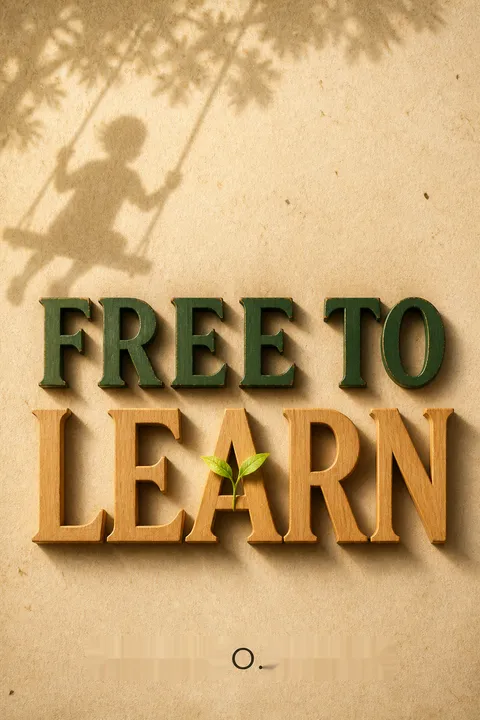


Key Takeaways
Treat a child's resistance as information, not simply disobedience
A turning point at school. Peter Gray opens with his nine-year-old son Scott confronting a roomful of adults who insist he attend school and obey its rules. Scott had been refusing assignments he saw as pointless, inventing his own ways to solve problems, and sometimes walking home. His parents eventually recognized that the struggle was not just a discipline problem. They moved him to a radically different school, where he could direct his own education.
The larger claim. Gray argues that children are naturally driven to learn, and that play, curiosity, and exploration are central to that learning. When adults take over the process, children may learn to treat learning as something imposed and unpleasant. The book asks what conditions let children remain active participants in their own development.
The opening story works because it turns an abstract argument about education into a family decision with real emotional stakes. It invites adults to ask what a child's resistance is communicating before treating it as defiance. That does not mean every refusal is wise or that every school is a bad fit. It means behavior should be interpreted in context: persistent resistance may signal a mismatch between a child's needs and the environment. The useful distinction is between protecting a child's voice and granting every demand. Adults still have responsibilities, but listening can reveal whether the problem is the child, the setting, or both.
Protect free play because it teaches children to direct their own lives
Play led by children. Gray defines free play as activity whose players choose what to do, set or change the rules, and can leave when they wish. A pickup game, for instance, differs from a coached league because children govern the activity themselves. Gray argues that these conditions let children practice making decisions, solving conflicts, building friendships, and discovering what interests them.
A shrinking share of childhood. Diary studies cited by Gray found that six-to-eight-year-olds spent 25 percent less time playing in 1997 than similar children had in 1981. Over that period, time in school and doing schoolwork at home rose. Gray also reports that outdoor play with friends ranked above television or computer games in children's stated preferences. He links reduced play with rising distress, while acknowledging that trends occurring together do not prove that one caused the other.
The case for play is strongest when play is understood as a setting for practicing agency, not as empty downtime. Children who negotiate a game must notice other people's wishes, make rules workable, and adapt when circumstances change. Those are consequential skills, even when the game itself is trivial. The statistics make the loss visible, but they do not isolate its cause: family schedules, neighborhood design, technology, and school demands can all shape children's time. The practical implication is broader than adding recess. Children need regular stretches of time they can actually govern, with other children available and adults not directing every move.
Let children learn culture by joining real activity, then playing at it
A different childhood model. Gray describes Ju/’hoan children in the Kalahari spending much of their days playing and exploring in mixed-age groups. They practiced tracking, hunting, tool-making, music, and other activities important to their community. Adults did not prescribe lessons, but children could observe them, ask for help, and use suitable tools. Gray notes that humans lived as hunter-gatherers through most of their evolutionary history, and argues that childhood learning developed in conditions like these.
Culture and competence. These communities valued personal autonomy, sharing, and equality. Children learned demanding skills by watching adults, hearing stories, and practicing through play. Tracking, for example, required noticing small changes in footprints and vegetation, then using those clues to infer an animal's movement. The point is not that modern children need to learn to hunt. It is that self-directed practice can help them acquire the skills and knowledge their own culture requires.
The hunter-gatherer comparison gives Gray a useful lens: children are not merely empty containers awaiting instruction, but participants in a social world they can observe and explore. It also clarifies why meaningful tools, skilled people, and time matter. The comparison should not be mistaken for proof that one historical model can simply be copied into modern cities. Cultures differ, and today's knowledge includes complex literacies and institutions. The more transferable insight is functional: children benefit when learning is connected to activity that matters to them, and when they can move between observation, experimentation, and asking for help.
Do not confuse compulsory schooling with education children choose to pursue
A system with a history. Gray traces compulsory schooling through religious instruction, state-building, and industrial society. Early schools emphasized memorization, obedience, and regular schedules; Prussian schools helped establish standardized curricula and state control over attendance. As schooling expanded, age-graded classrooms and tests made education look like a fixed sequence of tasks delivered to children.
The costs Gray identifies. In his view, coercive schooling can undermine self-direction and curiosity, make learning feel like work, and encourage status competition through grades. Students may focus on pleasing evaluators rather than asking their own questions. Age segregation and limited free play can also weaken opportunities to cooperate across differences. Gray's criticism is not that every teacher intends harm. He argues that even caring educators work within a structure that limits both student choice and teacher autonomy.
Historical context helps explain why familiar school routines can seem natural even though they are relatively recent institutions. Gray's strongest point is that a system designed around compliance should not be assumed to cultivate initiative automatically. At the same time, the account risks making schooling's history sound more uniform and deliberate than it was; schools have also spread literacy, shared knowledge, and access to opportunity. The more productive question is not whether schools are wholly good or bad, but which functions require common instruction and which are damaged by compulsion, ranking, and excessive control. That distinction keeps institutional criticism from becoming a simple rejection of education.
Give students real authority, not decorative choice
A school governed by its members. At Sudbury Valley, students from age four through high school choose how to spend their time. There is no required curriculum or testing. A weekly School Meeting, with one vote per person, makes rules, decides major matters, and hires staff. A student-led Judicial Committee handles alleged rule violations. Adults provide care, expertise, and resources, but students are not required to take classes.
What happened to graduates. Gray and David Chanoff surveyed 69 former students, representing 84 percent of the school's graduates at that point. About three-quarters had pursued higher education, and 82 percent said the school had benefited their later education or careers. Graduates described learning responsibility, pursuing interests, and speaking comfortably with authority figures. These findings are encouraging, but they come from a small, self-selected community and graduates reporting on their own experiences.
Sudbury Valley makes autonomy concrete: students do not merely choose among options adults have preselected, but participate in governing the institution. That experience connects education to civic practice, since rules become something a community creates and applies rather than orders handed down. The graduate survey offers useful evidence that this model need not close off college or employment, but it cannot establish that the model caused those outcomes or would work identically at scale. The strongest lesson is therefore a design principle, not a universal verdict: give young people consequential, age-appropriate responsibility, and make adult support available without making adults the sole authors of the day.
Start with curiosity, then let peers turn discoveries into skill
A computer without a teacher. Sugata Mitra placed internet-connected computers in public spaces in India, including communities where many children had never used one. Children gathered, experimented, and taught one another. Mitra estimated that one computer could make roughly 300 children computer-literate within three months. Gray uses the experiment to illustrate three educative instincts: curiosity draws children toward the unfamiliar, playfulness helps them practice, and sociability spreads what one child discovers.
Teaching can narrow exploration. In experiments described by Gray, preschoolers given a toy without a full explanation explored more of its possible functions than children who were explicitly shown one function. The children who saw only one effect could infer that it was all the toy did. Self-directed exploration, especially with peers, encouraged them to test possibilities rather than merely repeat a demonstration.
The computer experiment shows that learning can travel through a group rather than down a chain from expert to novice. One child's discovery becomes a prompt for another child's experiment, producing a shared learning process. This is a powerful corrective to the assumption that useful learning requires continuous direct instruction. Yet access alone is not a complete recipe: the children had time, a compelling object, and peers with whom to share discoveries. The lesson is not to remove teachers, but to distinguish useful guidance from premature closure. A helpful adult can make resources available and answer questions while leaving room for learners to find more than the first demonstrated answer.
Keep learning playful: choice, process, imagination, and low pressure
What makes play educative. Gray describes play as self-chosen and self-directed, focused more on the activity than its external reward, governed by rules the players accept, imaginative, and mentally active without excessive stress. The term playful state of mind refers to this alert, interested, low-pressure approach. Play is not the absence of effort: players repeat actions, set challenges, and try to improve because the activity itself matters to them.
Pressure can obstruct learning. In one pool-hall study, experts improved when observed, while novices' success rates fell. In a separate problem-solving experiment, 75 percent of participants who watched a comedy clip solved the candle problem, compared with 20 percent who watched a serious mathematics clip and 13 percent who saw no film. Gray argues that evaluation and fear of failure can narrow attention, while a playful mood supports exploration and creative thought.
The useful distinction is not between serious and unserious work, but between effort driven by interest and effort driven mainly by judgment. Play can include difficulty, rules, and persistence; what changes is the learner's relationship to the activity. This helps explain why a task can become less educational when rewards dominate it. Still, evaluation is not uniformly harmful: feedback can orient beginners, and shared standards matter in many fields. The design challenge is to provide information without turning every attempt into a public verdict. Learners need room to practice imperfectly before performance becomes the main event.
Mix ages so children can teach, stretch, and care
Learning across ages. The zone of proximal development is the range of activities a child cannot manage alone but can take part in with someone more skilled. In age-mixed play, an older child may adjust a game so a younger one can join, while the younger child brings energy and ideas. At Sudbury Valley, researchers found that more than half of observed student interactions involved age gaps greater than two years, and one-quarter spanned gaps greater than four years.
Benefits in both directions. In one classroom comparison, kindergarteners in an age-mixed setting read nearly four times as much and wrote six times as much during play as kindergarteners in a same-age setting. Older children also practice leadership, explanation, and care. Younger children observe new skills and join more complex play. Gray emphasizes that age mixing complements, rather than replaces, friendships among children close in age.
Age mixing supplies a kind of informal mentorship without assigning anyone a permanent teacher role. Older children can offer just enough help to keep a game going, while younger children give older peers a reason to explain, adapt, or invent. The arrangement also complicates the assumption that development proceeds only among same-age classmates. The reported classroom comparison is suggestive, not a guarantee that mixing ages produces the same results everywhere. Its value depends on voluntary interaction and a range of interests and abilities. Forced pairing can feel like another assignment; freely chosen contact lets children find the level of challenge and companionship they want.
Allow manageable risks so children practice fear, restraint, and recovery
Practice for uncertainty. Gray argues that children use vigorous and sometimes frightening play to test their bodies and emotions. They climb, chase, and play-fight, adjusting the challenge to what feels thrilling rather than overwhelming. In social play, children can stop or leave; that control lets them practice coping with fear without being trapped in the experience. Gray also describes children in Nazi camps playing games based on the violence around them, suggesting that play can help children process realities adults would rather shield them from.
Screens are not the whole problem. Gray rejects the claim that video games alone explain the decline of outdoor play. He argues that games can provide challenge, choice, and social connection, and that children who lack satisfying opportunities elsewhere may rely on them more. His prescription is not to eliminate digital play, but to make real-world play with other children possible too.
The point is not that danger is inherently beneficial, but that carefully chosen challenges let children learn what their own limits feel like. Adults cannot perfectly calibrate a risk for someone else, so children need some say in the level of difficulty. This argument is compatible with sensible safeguards: prevent severe, avoidable hazards while allowing ordinary uncertainty and recoverable mistakes. The Holocaust examples underline play's adaptive power, but they should not romanticize trauma or imply that play makes horrific conditions acceptable. Children's capacity to cope is a reason to respect them, not a reason to leave them unsupported.
Parent for competence by making room for independent choices and playmates
Trust without neglect. Gray calls trustful parenting an approach that supports children's development without trying to direct every step. It means providing care, love, useful resources, and appropriate safety while trusting children to make choices and learn from mistakes. He contrasts it with directive-protective parenting, which restricts freedom because adults see children as fragile or incapable. Gray recounts allowing his thirteen-year-old son, who had diabetes, to plan and make a solo trip to London after the boy demonstrated responsibility.
Make freedom practical. Gray recommends finding or building neighborhoods where children can play together, reducing constant monitoring, and considering alternatives such as Sudbury-style schools or unschooling. Unschooling means children learn through chosen interests and everyday life rather than a required home curriculum. These options demand time, resources, and community support; they are not equally available to every family.
Trustful parenting is more than a private attitude. Children need places to go, peers to meet, and adults who can offer help without supervising every moment. A parent cannot simply decide that a neighborhood is safe or that work and school demands do not matter. This makes Gray's practical suggestions important: freedom grows when families and communities shape environments that make independent activity feasible. The advice also avoids treating trust as permissiveness. A child’s abilities, health, and the specific situation matter. The central commitment is to build competence through graduated responsibility rather than waiting for adulthood to grant it all at once.
Analysis
Gray's central intervention is to change the unit of analysis. Instead of asking how adults can deliver knowledge more efficiently, he asks what children do when the conditions for self-directed learning are available. His answer draws together anthropology, developmental psychology, animal play research, and the unusual institutional example of Sudbury Valley. This synthesis is memorable because it links apparently separate outcomes: curiosity, practical skill, emotional regulation, social negotiation, and civic responsibility all depend, in his account, on meaningful freedom and time with other people.
The evidentiary case is strongest when it shows mechanisms rather than making sweeping comparisons. A child learns a game by negotiating its rules; an older peer adjusts the challenge; a curious group explores a computer together. These examples make plausible how play can produce learning without the players setting out to study. The broader claim that declining play has driven rising anxiety or depression is less conclusive. Historical trends and correlations do not establish causation, and the Sudbury alumni evidence is retrospective and drawn from families who chose an unusual school. Gray acknowledges some of this, but the book's advocacy can outpace what these designs prove.
That limitation does not erase the central challenge. Conventional education often treats measurable performance as a proxy for durable understanding, while children's ability to choose and sustain an inquiry is hard to quantify. A sound reform agenda should therefore test both: whether children acquire essential shared knowledge, and whether the process preserves motivation, agency, and social competence. Self-direction need not mean abandoning adult expertise. Adults can provide strong instruction when requested or necessary, ensure equitable access to tools and knowledge, and protect children from serious harm while leaving substantial room for initiative.
The book's most useful contribution is not a universal blueprint for abolishing schools. It is a diagnostic question: does this arrangement help children become capable of directing their own learning and lives, or does it train them mainly to comply with someone else's plan? That question applies to classrooms, homes, playgrounds, and digital spaces alike.
Review Summary
Free to Learn receives mostly positive reviews for its compelling arguments about the importance of free play in children's development and learning. Readers appreciate Gray's critique of traditional schooling and his advocacy for alternative approaches like unschooling. Many find the book thought-provoking and inspiring, particularly in its discussion of the Sudbury Valley School model. However, some reviewers criticize Gray's reliance on anecdotal evidence and idealization of hunter-gatherer societies. Overall, the book challenges conventional views on education and encourages parents to trust children's natural learning instincts.
People Also Read








Glossary
Free play
Player-directed activityPlay in which participants choose what to do, direct their own activity, and can modify the rules or stop. Gray distinguishes it from adult-organized activities, such as coached sports, even when those activities are enjoyable. Its educational value comes partly from the decisions, negotiations, and practice children undertake on their own.
Educative instincts
Drives for self-educationGray's term for the natural drives that support children's acquisition of the culture around them. He identifies curiosity as a motive for exploring and understanding, playfulness as a motive for practicing and creating, and sociability as a means of learning with and from others.
Minimally invasive education
Learning with little instructionSugata Mitra's description of learning arrangements in which children encounter accessible technology or information with minimal adult direction. In the experiments Gray discusses, groups of children explored public computers and helped one another discover how to use them, illustrating how curiosity, practice, and peer exchange can support learning.
Sudbury Valley School
Democratic self-directed schoolA Massachusetts school founded in 1968 where students choose how to spend their time and there is no required curriculum or routine testing. Students and staff govern the community through a School Meeting, while a Judicial Committee handles rule violations. Adults provide resources, care, and expertise without directing each student's education.
Zone of proximal development
Reachable with skilled helpA term coined by Lev Vygotsky for activities a learner cannot yet perform independently but can manage with collaboration from someone more capable. Gray applies the idea to children of different ages playing together: an older child can adjust a game or offer reminders that let a younger child participate and develop skills.
Scaffolding
Temporary support for learningA metaphor introduced by Jerome Bruner and colleagues for the help that enables a less-skilled participant to join a challenging activity. Support may include reminders, hints, encouragement, or adjustments to the task. In age-mixed play, Gray describes older children providing this help naturally, often without taking over the game.
Trustful parenting
Support with room for choiceA parenting approach that trusts children to guide much of their own learning and development while providing care, respect, resources, and appropriate protection. It does not mean neglect. Parents support children's goals and help when needed, while avoiding unnecessary direction, monitoring, and attempts to control every developmental step.
Directive-protective parenting
Control motivated by protectionA parenting style in which adults limit children's freedom because they believe children are fragile, unsafe, or unable to make good decisions. Gray distinguishes it from older domineering parenting, which sought obedience for labor or social hierarchy. Though protective parents may act with good intentions, he argues that excessive control can restrict practice in responsibility.
Unschooling
Interest-led home learningA form of home-based education in which parents do not impose a school-like curriculum, assignments, or tests. Children pursue interests and learn through everyday activities, using resources and help as needed. The approach treats learning as part of ordinary life rather than as a separate program of required lessons.
Playful state of mind
Alert, interested, low-pressure focusA mental stance in which a person is actively engaged but not dominated by stress, fear of failure, or concern about evaluation. Gray connects it with play's self-chosen quality, emphasis on the activity itself, rule-following, and imagination. He argues that this state supports experimentation, learning, and creative problem-solving.
FAQ
What's Free to Learn about?
- Focus on Play: Free to Learn by Peter O. Gray emphasizes the critical role of play in children's education, advocating for self-directed activities as the best learning method.
- Critique of Traditional Education: Gray critiques conventional schooling for stifling creativity and curiosity through rigid structures and forced learning.
- Advocacy for Freedom: The book promotes a more humane educational approach, allowing children the freedom to learn through play, leading to happier and more self-reliant individuals.
Why should I read Free to Learn?
- Insightful Perspective: The book offers a compelling view on child development and education, supported by scientific research and historical context.
- Practical Advice: It provides actionable advice for parents and educators to create environments that foster natural learning through play.
- Cultural Relevance: Gray's insights are increasingly relevant as many question the effectiveness of traditional schooling methods today.
What are the key takeaways of Free to Learn?
- Importance of Play: Play is essential for children's emotional, social, and intellectual development, serving as a primary means of self-education.
- Critique of Forced Education: Gray outlines the "seven sins" of forced education, which undermine intrinsic motivation and personal responsibility.
- Alternative Models: The book discusses successful alternative educational models, like the Sudbury Valley School, that allow children to direct their own learning.
What are the best quotes from Free to Learn and what do they mean?
- Learning as Work: “The biggest, most enduring lesson of school is that learning is work, to be avoided when possible.” This highlights how traditional schooling can make learning seem negative.
- Innate Drive to Learn: “Children are biologically predisposed to take charge of their own education.” This emphasizes children's natural curiosity and drive to learn.
- Freedom from Coercion: “If we had the will, we could free children from coercive schooling.” This suggests viable alternatives to traditional education that support natural learning instincts.
How does Peter Gray define play in Free to Learn?
- Exploratory Behavior: Play is a form of exploratory behavior that is self-motivated and enjoyable for children.
- Freedom and Choice: It must be voluntary and free from adult direction, allowing children to make their own choices.
- Learning Through Play: Play is a crucial mechanism for learning about the world and developing essential life skills.
What are the "seven sins" of forced education mentioned in Free to Learn?
- Denial of Liberty: Forced education denies children their freedom without just cause, requiring attendance regardless of individual needs.
- Interference with Responsibility: It discourages personal responsibility, leading children to rely on external validation.
- Undermining Motivation: By turning learning into work, it diminishes children's natural desire to learn and explore.
What is the role of play in learning according to Free to Learn?
- Primary Learning Tool: Play is a primary means through which children learn about the world, allowing exploration without fear of failure.
- Enhances Creativity: It fosters creativity and problem-solving abilities, with positive moods improving insight and flexible thinking.
- Social Skills Development: Play is essential for developing social skills, as children learn to negotiate, cooperate, and empathize.
What is the Sudbury Valley School, and how does it relate to Free to Learn?
- Democratic Education Model: Sudbury Valley School is a democratic school where students direct their own learning, embodying Gray's principles.
- No Formal Curriculum: Students choose what and how they want to learn, fostering a love for education.
- Successful Outcomes: Graduates succeed in higher education and careers, demonstrating the effectiveness of self-directed learning.
What are the negative effects of traditional schooling discussed in Free to Learn?
- Stifling Creativity: Traditional schooling often stifles creativity and intrinsic motivation, leading to minimal effort to meet requirements.
- Increased Anxiety: The pressure of standardized testing and rigid curricula can lead to anxiety and depression.
- Loss of Autonomy: Children often lose their sense of autonomy and self-direction, preventing them from taking ownership of their lives.
How can parents implement the ideas from Free to Learn at home?
- Encourage Free Play: Provide ample opportunities for unstructured play, allowing children to explore interests without interference.
- Create a Supportive Environment: Foster an environment that values curiosity and exploration over academic achievement.
- Trust Children’s Instincts: Trust children to take charge of their education in a natural and engaging way.
What is the significance of age mixing in play according to Free to Learn?
- Learning from Peers: Age mixing allows younger children to learn from older peers, who can scaffold their learning experiences.
- Benefits for Older Children: Older children practice leadership and nurturing skills by interacting with younger ones.
- Fostering Creativity: Age mixing encourages creativity, as older children engage in imaginative play with younger ones.
What are some examples of play enhancing learning in Free to Learn?
- Sociodramatic Play: Children act out roles and scenarios, enhancing social understanding and creativity.
- Games and Problem Solving: Games like chess enhance cognitive skills and strategic thinking.
- Physical Play: Physical play develops motor skills and social interactions, with controlled rough-and-tumble play as an exercise in restraint.
Download PDF
Download EPUB
.epub digital book format is ideal for reading ebooks on phones, tablets, and e-readers.








