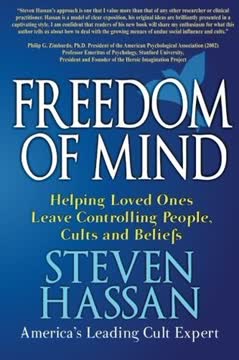
Key Takeaways
1. Destructive Influence: Beyond "Brainwashing"
Social influence becomes destructive when it is used to undermine a person’s ability to think and act independently.
Redefining control. The book advocates for replacing terms like "mind control" and "brainwashing" with "destructive social influence" to better reflect modern understanding and avoid alienating those trapped in cults. "Brainwashing" often implies overt coercion, whereas cult influence is typically subtle, insidious, and perceived as voluntary by the victim. This redefinition helps in understanding the nuanced psychological manipulation at play.
Subtle manipulation. Destructive influence does not erase a person's authentic personality but rather superimposes a new, dominant cult identity that suppresses individual will. This creates an illusion of control, where individuals believe they are making their own choices, even when their thoughts, feelings, and actions are being manipulated by external forces. The individual's critical and decision-making capacity is disconnected.
Historical context. Research into "thought reform" following the Korean War (Lifton, Singer) and social psychology experiments (Asch, Milgram, Zimbardo) graphically demonstrate human susceptibility to social pressure. These studies show how easily individuals can alter their behavior and beliefs under specific environmental and social conditions, even in short durations, highlighting the pervasive nature of social influence.
2. The BITE Model: Unpacking Cult Control
These four factors, which can be remembered as BITE (Behavior, Information, Thoughts, and Emotions), serve as the foundation for understanding destructive influence.
Comprehensive framework. The BITE model provides a structured way to understand how cults gain and maintain control over an individual's life. It expands on earlier theories by explicitly including "Information Control" as a crucial component, alongside Behavior, Thought, and Emotion Control. This model helps identify the specific mechanisms of manipulation.
Four pillars of control. Each component of the BITE model contributes to fostering dependency and obedience:
- Behavior Control: Regulating physical environment, tasks, sleep, finances, and even sexual expression.
- Information Control: Deception, withholding critical information, compartmentalizing knowledge, encouraging spying, and disseminating propaganda.
- Thought Control: Indoctrinating group doctrine as absolute truth, using loaded language and thought-stopping techniques, and suppressing critical analysis.
- Emotional Control: Manipulating feelings through "love-bombing," instilling fear and guilt, and systematically indoctrinating phobias.
Continuum of influence. It's important to note that not every item on the BITE list needs to be present for a group to be destructive, and the degree of control can vary significantly. Individuals can live seemingly normal lives, with jobs and families, yet still be unable to think for themselves due to these pervasive influences. The model helps assess the extent to which an individual's autonomy is compromised.
3. Dual Identities: The Authentic vs. Cult Self
Cult influence is designed to disrupt a person’s authentic identity and replace it with a new identity.
The psychological split. A core concept in understanding cult victims is the presence of dual identities: the pre-cult/authentic self and the superimposed cult identity. This psychological split makes communication challenging, as family and friends often find themselves interacting with a programmed persona that seems alien and unresponsive to their genuine concerns.
Co-opting the past. Cults strategically exploit aspects of an individual's pre-cult identity, such as idealism, spirituality, or unmet childhood needs, to construct the new cult identity. They encourage psychological regression, often telling members to become "children of God," and use activities like games or singing to revert recruits to a childlike state, making them more susceptible to manipulation.
Resilience of the authentic self. Despite intense indoctrination, the authentic self is never truly erased, only suppressed. It can manifest through subtle cues like illness, thematic dreams, or subconscious hints, offering vital pathways for reconnection. The Strategic Interactive Approach (SIA) aims to liberate these suppressed parts, integrating them into a new, healthy post-cult identity that honors the individual's true self.
4. Strategic Interactive Approach (SIA): A Non-Coercive Path to Freedom
The essence of Steve Hassan’s work is the liberation of the human potential in all of us.
Empowering choice. The Strategic Interactive Approach (SIA) is presented as a family-centered, non-coercive, and legal method for helping individuals leave destructive cults, contrasting with older, often illegal, deprogramming techniques. Its fundamental goal is to empower the individual to make an informed choice about their involvement, rather than forcing them to leave.
Process-oriented and customized. SIA emphasizes a gradual, step-by-step process built on "mini-interactions" such as phone calls, letters, and visits, rather than a single, confrontational event. This approach is highly customized to fit the unique circumstances of each cult, individual, and family, recognizing that a "one-size-fits-all" solution is ineffective.
Building rapport and sowing doubt. The core objectives of SIA are to build rapport and trust with the cult member, gather information about their experiences, and subtly plant "seeds of doubt" about the cult's claims and practices. By fostering open communication and encouraging critical thinking, SIA aims to motivate the individual to independently question their commitment and seek alternative perspectives.
5. Empowering the Support Team: Healing the Helpers
When each Team member addresses his own problems, he empowers himself and the Team, and sets an example for the cult member.
Holistic family healing. Cult involvement profoundly impacts the entire family system, often exacerbating pre-existing issues like guilt, anger, or communication breakdowns. The Strategic Interactive Approach adopts a family systems perspective, recognizing that the healing and growth of family members and friends (the "Team") are as crucial as the cult member's recovery.
Addressing personal "stuck points." Team members are encouraged to confront and resolve their own psychological and emotional challenges. This includes:
- Self-esteem: Identifying and leveraging personal strengths.
- Personality differences: Using tools like the Myers-Briggs test to understand diverse communication styles.
- Values and beliefs: Examining personal "shoulds" and cultivating open-mindedness.
- Addictions/Sibling issues: Addressing personal problems to model positive change.
- Stress management: Learning techniques like visualization, self-hypnosis, and deep breathing to maintain emotional resilience.
Modeling positive change. By actively working on their own issues and demonstrating personal growth, open-mindedness, and constructive communication, family members gain credibility and provide a powerful example for the cult member. This modeling reinforces the idea that change is possible and beneficial, creating a more supportive and influential environment for the individual to consider leaving the cult.
6. Unlocking Phobias: The Key to Mental Liberation
In my opinion, phobia indoctrination is the single most powerful technique for keeping people dependent and obedient.
Psychological imprisonment. Cults deliberately install and activate phobias—persistent, irrational fears—as a primary mechanism to maintain control over their members. These phobias short-circuit critical thinking, creating a psychological prison that can keep individuals dependent and obedient even after they stop believing in the leader or doctrine.
The three-step intervention. The book introduces a therapeutic technique called the three-step phobia intervention to systematically dismantle these fears:
- Step One: Educate the individual on what a phobia is, how it differs from legitimate fear, and how it can be cured, using general examples.
- Step Two: Explain how other destructive groups or individuals deliberately install phobias to control people, providing specific examples without directly criticizing the individual's group.
- Step Three: Guide the individual to connect these insights to their own situation, encouraging them to question their fears and imagine a fulfilling life outside the cult.
Installation methods. Phobias are often installed during altered states of consciousness (trance, sleep deprivation) using direct or indirect suggestion, fabricated stories, testimonials, and the exploitation of existing personal fears. Successfully addressing and neutralizing these cult-induced phobias is a critical step in empowering the individual to regain autonomy and make informed choices.
7. Mastering Communication: Building Bridges, Not Walls
The more you encourage non-cultic behavior, information, thoughts and emotions, the more productive your communication will be.
Goal-oriented dialogue. Effective communication in the Strategic Interactive Approach is goal-oriented, focusing on building rapport, gathering information, and subtly planting seeds of doubt over time, rather than attempting a single "knock-out blow." Each interaction, whether by email, phone, or in person, is designed to progressively open the loved one's mind to perspectives beyond the cult.
Strategic techniques. Key communication strategies include:
- Rehearsal: Visualizing and role-playing conversations to anticipate responses and prepare effective reactions.
- Intention/Delivery/Response: Consciously aligning your intended message with your verbal and non-verbal delivery, and carefully observing the loved one's actual response.
- Non-confrontational approach: Adopting a curious, concerned attitude, using open-ended questions, and avoiding judgmental statements or direct criticism of the cult.
- Written and verbal strategies: Crafting short, warm, focused messages, coordinating communication with the team, and using silence effectively during phone calls.
Planting doubt hypothetically. To avoid triggering defensive reactions, use hypothetical "what if" questions to encourage the cult member to consider alternative scenarios or negative possibilities about their group. This approach allows them to explore doubts without feeling directly attacked, gradually motivating them to question their involvement and seek independent information.
8. The Intervention: A Coordinated Effort for Informed Choice
The main focus of the Strategic Intervention is to inspire the family and other Team members to do mini-interactions, building rapport and trust and "tuning in" to help the loved one.
Formalizing support. A formal intervention is considered when mini-interactions and phobia interventions have not led to the desired outcome, or in urgent, high-risk situations. It is a carefully planned, multi-day event involving a dedicated team, often guided by a professional consultant, to provide concentrated support and information.
Strategic planning. Key elements of intervention planning include:
- Team Selection: Comprising individuals most significant to the cult member (family, friends, former members), chosen for their rapport and effectiveness.
- Timing and Location: Strategically selected (e.g., after a family event, in a neutral, private, and comfortable setting) to maximize the individual's receptiveness and minimize cult interference.
- Approach: Honest, direct, and non-threatening, emphasizing genuine concern and the opportunity for informed choice, often framed as "helping the family understand."
Three-day model. A typical intervention often follows a three-day structure:
- Day 1: Focus on building rapport, family counseling, and general discussions of social influence.
- Day 2: Deeper dive into cult influence, phobia intervention, and introduction of former members or experts.
- Day 3: In-depth discussion of specific group beliefs, reality-testing, and ultimately, the individual's decision to stay or leave, with plans for ongoing support.
9. Post-Cult Recovery: Reintegrating the Self
Physically leaving a cult does not necessarily resolve all of a person’s issues.
The journey of healing. Leaving a cult marks the beginning, not the end, of a complex recovery process. Former members face significant challenges in readjusting to life outside the controlled environment, often grappling with depression, profound guilt, and a fragmented sense of self. This period requires sustained support and understanding.
Common post-cult challenges. Ex-members frequently experience:
- Psychological impact: Depression, nightmares, panic attacks, Post-Traumatic Stress Disorder (PTSD), and difficulties with concentration or memory.
- Trust issues: Struggling to trust themselves or others, leading to fear of intimacy and commitment.
- Shame and guilt: Over past actions, lies told, and people recruited while in the cult.
- Floating: Involuntary flashbacks or dissociative states triggered by sensory cues, reactivating the cult mindset.
- Cognitive rigidity: Difficulty overcoming black-and-white, all-or-nothing thinking patterns.
Rebuilding and reintegration. Post-cult counseling is crucial for processing trauma, undoing triggers, and rebuilding an authentic identity. This involves encouraging independent decision-making, re-engaging with past hobbies and interests, and channeling idealism into healthy, constructive pursuits. The goal is to integrate the cult experience as a learning opportunity, fostering strength and wisdom, rather than repressing it.
10. A Societal Call to Action: Protecting Freedom of Mind
To safeguard our personal and collective freedom, it is imperative that people learn more about how the mind can be positively and negatively influenced.
Global threat. The book concludes with a call to action, emphasizing the growing threat of destructive influence from extremist groups and the malicious misuse of the Internet for recruitment and manipulation. It highlights the urgent need for global awareness and a focus on mutual interdependence to protect individual and collective freedom.
Systemic reforms. Several systemic changes are proposed:
- Government Action: Establishing consumer bureaus for non-profits, investigating cult lobbies, publicly disclosing past mind control research, funding "open mind" research, and launching public awareness campaigns.
- Mental Health Professionals: Conducting more research on the epidemiology of cults, improving diagnosis and treatment for "undue social influence" related issues, and training professionals in the Strategic Interactive Approach.
- Religious Institutions: Developing guidelines for ethical proselytizing, providing preventive education, and speaking out against groups that pervert true spiritual principles.
Citizen empowerment. The legal community is urged to hold cults accountable, establish legal definitions of destructive mind control, and provide legal options for families. Ultimately, citizen involvement, through activist groups and former members sharing their stories, is vital to educate the public, challenge negative stereotypes, and create a safer world where freedom of mind is universally protected.
Last updated:
Review Summary
Freedom of Mind receives mostly positive reviews (4.21/5) for its practical guidance on helping loved ones leave cults. Readers appreciate Hassan's BITE model (Behavior, Information, Thought, Emotional control) and his compassionate, non-judgmental approach emphasizing patience over confrontation. The book draws on case studies and Hassan's personal experience. Some criticisms include its textbook-like style, repetitiveness, focus on those who join cults rather than those born into them, and perceived selective denouncement of certain cult types. Many find it eye-opening about manipulation tactics applicable beyond traditional cults.
Similar Books