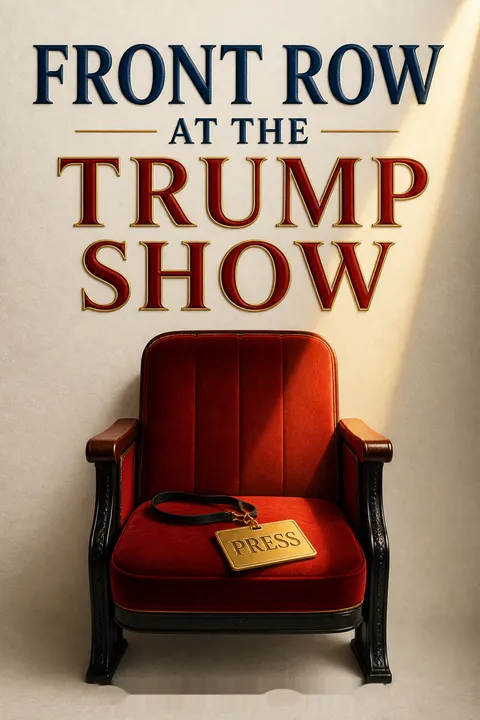


Key Takeaways
See the Trump Show as an attention machine, not a media feud.
Attention was the prize. In 1994, when Jonathan Karl was a young New York Post reporter, Trump gave him a tour of Trump Tower because the story about Michael Jackson and Lisa Marie Presley could also showcase Trump’s building. Decades later, Trump still tracked headlines, ratings, and crowd sizes, even while denouncing the outlets that supplied them. Karl calls this dynamic the Trump Show: the president made himself its central character, and conflict with the press kept the audience watching.
The incentives ran both ways. Trump craved coverage, including negative coverage, while news organizations benefited from enormous public interest in his actions. That mutual dependence made the press both a target and a stage. The feud was real, but so was the attention it generated.
What's striking is how neatly this relationship fits an attention economy: outrage can function as promotion even when it damages trust. A politician does not need favorable coverage if every dispute keeps him at the center of public conversation. News organizations face a parallel temptation, since high audience interest can reward conflict-heavy coverage. The account is strongest when it shows those incentives operating together. It also raises a useful question: when covering an attention-seeking leader, does the reporting illuminate the underlying decision, or simply extend the performance?
Take unconventional candidates seriously before their opponents do.
The campaign looked unreal. In 2015, Trump’s operation was so small that Hope Hicks handled nearly all communications. Its headquarters in Trump Tower looked more like a film set than a functioning presidential campaign, and the dormant set of The Apprentice sat upstairs. That appearance encouraged observers to treat the candidacy as another publicity stunt.
The field helped him grow. Jeb Bush and other Republicans often refused to discuss Trump, dismissing his attacks as distractions. Meanwhile, networks aired his rallies and remarks because he was unpredictable and drew viewers. Fox News initially challenged him, but CNN and other outlets gave him extensive exposure. By the time many rivals decided he was serious, he had become the front-runner. A thin campaign operation did not mean a weak political force.
The episode illustrates a common forecasting error: mistaking institutional form for political capacity. A conventional campaign signals experience, but it does not guarantee that voters will respond to its message. Conversely, an improvised organization can exploit attention, partisan frustration, and opponents' reluctance to engage. The account does not prove that ignoring a rival always strengthens that rival; some provocateurs fade without oxygen. Its sharper lesson is to distinguish strategic silence from wishful dismissal, and to measure a candidacy by voter response as well as organizational polish.
A correct national poll can still miss who wins the presidency.
The popular vote was not the map. ABC News and The Washington Post’s final national poll showed Hillary Clinton ahead by four points. She won the popular vote by about 2.1 points, so the poll was broadly accurate. Yet the national result did not determine the Electoral College, where narrow shifts across states decide the presidency.
The state picture failed. Two days before the election, the Republican National Committee projected Trump losing 298 to 240 electoral votes, and its model wrongly showed him behind in Florida and Iowa. An experimental state analysis using multilevel regression with poststratification, or MRP, showed a much closer contest, but the method was untested and not widely relied on. On election night, junior analyst Ryan Struyk spotted the swing-state pattern before more senior observers did. The lesson: accurate national averages can conceal decisive local variation.
This is a useful distinction between measurement and prediction. A survey can estimate national preference well while a winner-take-all electoral system converts small, geographically concentrated errors into a large outcome difference. The episode also shows how expertise can become groupthink: a junior analyst's close attention to returns outperformed confident institutional projections. Still, one successful experimental model should not be mistaken for proof that a particular method solves forecasting. Models clarify assumptions; they do not remove uncertainty or make the underlying electorate stable.
Defend a shared factual record before politics makes truth tribal.
Falsehood became a governing tactic. After Trump’s inauguration, Sean Spicer claimed the crowd was the largest ever, despite abundant evidence that it was not. Kellyanne Conway defended his claims as “alternative facts,” implying that factual disagreement could be treated as competing versions of reality. By mid-2019, The Washington Post’s fact-checking team had documented more than 10,000 false or misleading Trump statements.
The damage spreads beyond one claim. The book describes false statements by staff, denials of accurate reporting, and attacks on fact-checkers. Trump even persisted in disputing a minor National Weather Service correction about Hurricane Dorian’s path through Alabama. The episode mattered less for the forecast than for the effort to make a public correction seem untrustworthy. When people cannot agree on what happened, accountability becomes much harder.
The deeper danger is not simply that leaders make false claims. It is that they can teach supporters to treat correction itself as evidence of hostility. This resembles a breakdown in shared measurement: institutions lose their ability to settle even basic questions, so every dispute becomes a contest of allegiance. Precision matters here. A mistake, an exaggeration, and a deliberate falsehood are not identical, and lumping them together weakens criticism. The book's strongest examples distinguish the claim, the available evidence, and the official response.
Keep journalism adversarial in method, not partisan in identity.
Questions are part of the job. In Mexico City, Trump’s campaign intended a tightly controlled appearance with no press questions. Karl asked whether Trump regretted his statements about Mexico and whether Mexico would pay for the border wall. The exchange exposed a gap between the campaign promise and the diplomatic performance. A reporter’s role, Karl argues, is to test public claims and show when officials refuse to answer.
Fairness is not passivity. Karl also acknowledges that news organizations sometimes amplified stolen Clinton emails without adequately foregrounding the Russian operation behind them, and that some journalists behaved like political opponents. Reporting should correct false statements and defend access, but reporters lose credibility when they turn a briefing into a personal protest. The standard is rigorous scrutiny without making the reporter the story.
The distinction between adversarial method and partisan identity is valuable because it separates scrutiny from opposition. A reporter can challenge an official's claim without claiming a mandate to defeat that official. That discipline is especially important when a leader tries to provoke a visible fight, since the spectacle can displace the underlying issue. Yet objectivity cannot mean equal weight for unequal evidence. Fair reporting requires accurate context and proportion, not a reflexive balance between a supported fact and an unsupported denial.
A president's impulses can outrun every guardrail built around him.
Staff could delay, not command. Trump’s advisers repeatedly tried to manage access, messaging, and policy. Chief of Staff John Kelly restricted who could enter the Oval Office and sought to slow decisions. But Trump could still improvise a nuclear threat, reverse an announced policy, or bypass his communications team with a tweet.
Law constrained him, but angered him. Attorney General Jeff Sessions recused himself from campaign-related investigations because his role in the Trump campaign created a conflict. Trump tried through aides to stop the recusal and later erupted at White House Counsel Don McGahn for failing to prevent it. The recusal showed that presidential power has legal limits, but the president treated those limits as personal disloyalty. In this account, the “guardrails” were mostly people trying to contain a leader who could dismiss them.
The White House appears here as a principal-agent problem: advisers are expected to carry out policy, yet also to prevent a president from acting recklessly. That tension can produce quiet obstruction, resignation, or compliance, none of which is a reliable substitute for formal checks. Kelly's approach sometimes prevented immediate damage, but it depended on personal access and influence. The episode invites a hard institutional question: should democratic stability rely on staff members privately filtering a president's impulses, or on rules that remain effective when loyal advisers leave?
Diplomatic spectacle can open doors without resolving the problem.
The North Korea turn was dramatic. Trump moved from threatening North Korea with devastating force to accepting a meeting with Kim Jong Un, a summit no previous US president had held. The Singapore meeting created an opening for direct contact after decades of failed policies under earlier administrations. That history matters: the older, expert-led approaches had not stopped North Korea from building nuclear weapons and long-range missiles.
The performance outran the agreement. In Singapore, Kim agreed only to work toward denuclearization, with no specific dismantling plan or timetable. Trump nevertheless suspended major US-South Korean military exercises and declared the nuclear threat gone, though North Korea’s arsenal remained. The Hanoi summit also failed when Kim sought sanctions relief in return for dismantling one nuclear site. The new approach created access and headlines, but not the promised settlement.
This is a case where nontraditional diplomacy deserves evaluation on outcomes, not style alone. Direct leader-to-leader contact may create opportunities that routine negotiations miss, especially after previous strategies have stalled. But visibility and access are not equivalent to leverage or verified disarmament. The book's comparison with earlier failures is a necessary corrective to easy dismissal, while the lack of concrete concessions is a necessary corrective to triumphal claims. A sound assessment must track what changes on the ground, not just what happens on camera.
Public rhetoric becomes dangerous when it turns critics into targets.
A crowd can become part of the attack. At a Mississippi rally, Trump singled out pool cameraman Stuart Clark for not turning his camera toward the audience. The crowd booed and chanted for Clark to be fired, although he was following the networks’ rules. The incident showed how a president could convert a routine disagreement about coverage into a public target for thousands of supporters.
Words shape the conditions for access. Trump repeatedly called journalists enemies of the people, while the White House revoked CNN reporter Jim Acosta’s press pass after a combative news conference. A judge ordered the pass restored while the case proceeded, and the White House eventually backed down. The book connects such episodes to a broader risk: intimidation can chill reporting and make public scrutiny physically or professionally dangerous.
Rhetoric matters not because every hostile phrase directly causes violence, but because repeated delegitimization can lower the social cost of intimidation. The Clark episode makes that mechanism unusually visible: a named worker, a misleading accusation, and a crowd encouraged to punish him. The Acosta dispute adds an institutional dimension, since access rules can be used to discipline unwelcome reporting. Care is still needed in separating political insult from a credible threat, but the combination of official power and public targeting raises the stakes.
Measure public service by what leaders place above themselves.
McCain made service concrete. John McCain spent five and a half years as a prisoner of war in Vietnam and refused early release when he believed it would give his captors a propaganda victory at the expense of fellow prisoners. He later served decades in Congress and urged Americans to commit themselves to causes larger than personal ambition.
The contrast was visible. After McCain died, Trump ignored Karl’s ten questions about his legacy and delayed lowering the White House flag. The comparison is not about matching McCain’s wartime experience. It is about the different moral centers the book sees in the two men: one made service and shared ideals central, while the other repeatedly returned to personal grievance, attention, and loyalty.
McCain functions as more than a counterexample to Trump. His refusal of preferential release shows how public character is tested when personal advantage conflicts with obligations to others. That standard can illuminate leadership without requiring a saintly portrait; McCain remained a politician with errors and opponents. The useful question is not whether leaders are selfless, but whether institutions and choices reveal some durable commitment beyond self-protection. The book's contrast is compelling precisely because it is grounded in a specific act rather than an abstract claim about virtue.
Protect the institutions that let facts outlast their authors.
The press has a civic function. Karl argues that a free press is not an opposition party; it informs the public, questions authority, and preserves a record that people can use to judge their leaders. The book ends with the recovery of the White House Correspondents’ Association’s 1914 founding charter, missing for nearly fifteen years before a junior White House staffer found it in a battered box.
The document outlasted its custodians. Its eleven signers and many of their news organizations were gone, but the charter still represented a continuing practice: reporters asking questions inside the White House. The document does not guarantee good journalism, and the book acknowledges reporters’ errors and bias. Its point is more modest and more durable: institutions can carry a public purpose across the failures of individual people.
The charter offers a material image of institutional memory: a founding document can survive neglect and return to public view, but only because someone recognizes its significance. That is a useful counterweight to leader-centered political storytelling. Democratic accountability depends not on flawless journalists, but on repeated practices that allow claims to be checked, records preserved, and power questioned. The limitation is equally important: a press institution earns trust through performance, not pedigree. Its history gives it a responsibility, not immunity from criticism.
Analysis
Front Row at the Trump Show is both a political chronicle and an argument about the conditions under which public truth survives. Its central contribution is not merely the claim that Trump attacks the press, but the close observation of a reciprocal system: Trump needs news attention, news organizations need audiences, and conflict supplies both. The opening story of the young reporter touring Trump Tower establishes a continuity between the celebrity developer and the president. The setting changes, but the appetite for attention remains. What changes is the consequence. A publicity tactic becomes a governing style when the person staging the show can direct federal agencies, shape policy, and influence how millions interpret events.
Karl’s reporting is strongest when it treats journalism as a practice under pressure rather than as a flawless institution. He describes reporters correcting claims, seeking access, and protecting a record, while also acknowledging occasions when news organizations amplified stolen material or let their own opposition to Trump overwhelm their reporting. This self-criticism strengthens the argument, although the book’s first-person vantage point inevitably centers the White House press corps and its conflicts. The reader sees the administration through a reporter whose access is both a professional asset and a source of dependence.
The book also reveals that institutions are not self-enforcing. Legal rules constrain the president in episodes such as Sessions’s recusal, but advisers often try to contain presidential impulses informally, through delay, persuasion, or control of access. Such arrangements depend on people who may be fired, ignored, or replaced. The resulting instability is not simply a personality story; it is a test of whether systems can function when leaders treat limits as personal affronts.
The deepest warning concerns shared reality. Political disagreement is compatible with democracy; disagreement over whether evidence counts at all is more corrosive. The recovered press charter provides the book’s modest answer: no individual journalist, president, or document can secure truth alone. Durable accountability depends on institutions, public records, and a willingness to correct allies as well as opponents.
Review Summary
Front Row at the Trump Show provides an insider's perspective on the Trump presidency from veteran journalist Jonathan Karl. Readers praise Karl's balanced reporting and insights into Trump's relationship with the media. The book is lauded for its readability and behind-the-scenes details, though some find it covers familiar ground. Karl is commended for his ethical approach and fair treatment of both Trump and the press. Many reviewers consider it one of the better books on Trump's interactions with journalists, offering a nuanced look at the administration's "show business" mentality.
People Also Read
Glossary
The Trump Show
Politics staged for attentionKarl’s description of Trump’s approach to politics as a continuing performance centered on the president. Trump tracked ratings, crowds, and headlines, attacked the press while seeking its attention, and used public conflict to keep himself central to the news. The phrase also describes the media’s role as both target and platform.
Alternative facts
A defense of false claimsKellyanne Conway’s phrase for the Trump administration’s account of the inauguration crowd after Sean Spicer made demonstrably inaccurate claims about its size. In the book, the phrase represents an attempt to treat verifiable facts as if they were merely one competing interpretation, rather than correctable statements about what happened.
Enemy of the people
A label delegitimizing the pressTrump’s description of major news organizations that criticized or investigated his administration. Karl places the phrase in historical context, noting its use by leaders including Robespierre, Nazi propagandists, and Stalin to designate supposed threats to the public. The term matters because it casts independent reporting as betrayal rather than scrutiny.
Protective pool
A small traveling press groupA rotating group of reporters, photographers, and broadcast personnel who accompany the president when the full White House press corps cannot be present. Pool members share their observations and images with other news organizations. The arrangement ensures that presidential movements and events have witnesses, including when access is limited.
Readout
An official call summaryA statement released by the White House after a presidential conversation with a foreign leader. Readouts typically confirm that a call occurred and summarize its topics in broad, diplomatic language. Karl contrasts these official summaries with leaked transcripts that revealed the sharper and more detailed exchanges behind them.
Multilevel regression with poststratification
A method for state estimatesA statistical method, abbreviated MRP, that combines survey responses with demographic and geographic information to estimate opinion across smaller populations, such as individual states. In the book, an experimental MRP analysis suggested Trump was more competitive across states than conventional expectations indicated. The method was untested before the 2016 election.
On Background
Quotable, unnamed sourcingA reporting agreement that lets a journalist use and directly quote information from a source but not identify that source by name. Instead, the journalist describes the source with a role or affiliation, such as a senior administration official. The agreement allows some sources to speak more freely while preserving context about their position.
Deep Background
Information without attributionA reporting agreement that permits a journalist to use information from a source but not quote the source directly or identify the source’s position. Such conversations can help generate leads or assess whether information from other sources is credible. The source’s information may guide reporting, but it cannot itself be presented as an attributable statement.
Off the Record
Information barred from publicationA reporting agreement under which a journalist may not use or quote what a source says. Karl describes such conversations as useful for understanding the motivations and thinking of people being covered, even when the information cannot appear in a story. He argues that a source who deliberately lies violates the trust underlying the agreement.
Recuse
Withdraw from a conflicted matterTo remove oneself from participation in a decision or investigation because of a conflict of interest. Jeff Sessions recused himself from campaign-related investigations after serving as a senior Trump campaign official. Justice Department ethics lawyers concluded that his campaign role created a conflict that required him to step aside.
Download PDF
Download EPUB
.epub digital book format is ideal for reading ebooks on phones, tablets, and e-readers.








