

Key Takeaways
Build a comedy career around what you need to express
The route zigzags. Randazzo moved from broadcast journalism to reality television, a fruit-basket company, improv, The Onion, and Adult Swim. His career did not follow a tidy ladder, and he argues that many comedy professionals first had to discover that comedy could be a job at all. The path differs for everyone, so copying another comedian’s route is unlikely to work.
Flaws can be fuel. Randazzo’s satirical list of traits for comedy success includes insecurity, fear, procrastination, and poor planning, but its serious point is the final item: a need to express something. Persistence matters because comedy offers uncertain work, frequent disappointment, and the rare reward of making an audience laugh.
What's striking is the book's refusal to treat a comedy career as a single profession with a reliable entrance. It resembles portfolio careers in other creative industries, where people assemble paid work from different skills and relationships. The need to express something can sustain that effort, but it is not a substitute for income, health, or luck. The book is strongest when it turns insecurity into a joke without pretending that instability itself is a virtue.
Write from your own obsessions, not the broadest possible taste
Funny is not enough. In the foreword, John Hodgman describes writing in a polished style that hid his own comic instincts. His editor urged him to use what was distinctive about himself, and that shift led him toward the peculiar subjects that became his work. The lesson is not to insert random personal details, but to recognize which ideas genuinely hold a writer’s attention.
A voice has a point of view. Comedian Pete Holmes recounts being told that his performances were funny but gave no sense of who he was. Personal upheaval helped him identify what mattered to him and shaped a more recognizable stage presence. Material becomes individual through its concerns, emotional angle, and choices, not just through punch lines.
What's striking is that voice is framed as both artistic identity and practical distinction. In a crowded market, an audience can find another joke about a familiar subject, but a precise perspective is harder to replace. Personal experience alone does not guarantee compelling work, however. It must be selected, shaped, and made legible to strangers. The creative task is not confession for its own sake, but turning private preoccupations into recognizable human patterns.
Build surprise on a reality the audience already understands
Comedy bends expectation. Randazzo describes humor as a departure from what people anticipate, or a familiar truth recognized with pleasure. Physical mishaps, absurdity, shock, and wit can all work, but none guarantees a laugh. A joke needs a context that lets the audience notice what has changed and why the change matters.
Grounding makes surprise legible. A sketch may have an outrageous premise, but a small recognizable detail can give it traction. An alien character who needs morning coffee, for instance, puts an everyday routine inside an impossible situation. Once the audience understands the ordinary rule, the writer can distort it. Without that foothold, bizarre events may feel random rather than funny.
The useful connection is to incongruity, a long-standing account of humor in which laughter often follows a mismatch between expectation and outcome. The book adds a practical point: the audience must first have an expectation to violate. This helps explain why clarity is not the enemy of originality. Still, what feels normal varies across cultures and communities, so comedy writers need to understand whose expectations a joke is playing with.
Cut each sketch to its strongest joke and leave immediately
One premise, pushed far. A sketch usually starts with a central idea and explores it quickly, either through escalating details or one fully earned payoff. Randazzo recommends identifying what the writer personally finds funny, reading the piece aloud, and finding the moment the whole sketch builds toward. Once that moment lands, a fast ending is often stronger than an explanation.
Make the idea producible. Web videos compete for attention from their opening moments, so they should establish the setting, character, and situation quickly. Keep locations, cast size, and elaborate effects manageable. A script that depends on expensive spectacle may be harder to make and may be using production complexity to disguise a weak joke. Brevity helps both the audience and the people making the work.
What's striking is how the book links comic economy to production design. A short script is not simply easier to consume; it also reduces the number of resources needed to test an idea. That resembles rapid prototyping in product design, where a small working model exposes flaws sooner than an elaborate plan. But shortness is not an absolute rule. A longer piece earns its duration when each section changes the audience's understanding or deepens the comic pattern.
Find a trusted creative partner who challenges your first version
Trust makes criticism useful. Randazzo describes a strong writing partnership as a source of honest feedback, morale, shared shorthand, and complementary instincts. One partner may push a joke toward exaggeration while the other favors restraint. Their disagreement can reveal a more interesting version than either would have found alone.
Treat ideas as starting points. Tim Heidecker and Eric Wareheim explain that a concept can begin as little more than a phrase or a seed. They talk, test, write, and reshape it together, sometimes discovering more during filming than on the page. Their process depends on shared taste and trust, not on protecting every first draft. A partner acts as an immediate audience, while a large committee can add politics and dilute focus.
What's striking is the balance between psychological safety and useful friction. Teams need enough trust for members to expose unfinished ideas, but also enough difference for those ideas to change. This principle appears in collaborative research and design as well as comedy. Similar taste can make work efficient, though too much agreement can narrow the range of possibilities. A good partnership welcomes challenge without turning every decision into a contest.
Use repeated stage time to turn failure into useful information
Start in small rooms. Open mics give new comedians brief sets in front of audiences that are often made up partly of other performers. The point at first is not simply to collect laughs. It is to learn how material sounds aloud, how a performer inhabits the stage, and how rejection feels without letting it end the effort.
Test, review, revise. Joan Rivers kept notes on new jokes, recorded performances, and tried revised versions again. Randazzo calls a failed set bombing, the comedy term for not getting the audience to laugh. It can result from weak material, a mismatched crowd, or the room itself. The practical response is to examine what happened, keep perspective, and perform again soon.
The book's advice aligns with deliberate practice: repetition becomes improvement when paired with specific feedback and adjustment. Simply doing more sets is not enough if a comedian never examines timing, wording, or audience response. At the same time, live audiences are noisy measures. A joke's reception depends on the room, the order of performers, and the crowd's mood, so one bad set should not be mistaken for a complete verdict.
Learn how camera, editing, and performance shape the same joke
Comedy is made in stages. A live act relies on the whole performer, while a camera can isolate a face, a glance, or a small physical choice. On set, a comic actor must react as well as deliver lines, repeat movements consistently, and give editors more than one usable version of a moment.
Production choices carry the joke. Directors shape tone through pacing, framing, casting, and what they leave out. Editors can create rhythm, remove dead weight, or make a reaction funny by placing it beside an unexpected image or sound. Good sound, lighting, and visual detail help establish the world. The written joke is only one part of the finished experience.
What's striking is the book's picture of comedy as distributed work. Meaning is shared among writer, performer, camera operator, director, editor, and sound designer. This is close to systems thinking: the result depends on how parts interact, not on one brilliant contribution alone. That view also discourages the myth of the solitary comic genius. Yet technical polish cannot rescue every weak idea, and sometimes roughness is itself part of the comic style.
Publish consistently, then treat platforms as conversations, not megaphones
Reliability builds an audience. Randazzo presents YouTube, podcasts, and social networks as routes to publish work without waiting for traditional gatekeepers. He emphasizes regular releases, clear formats, and attention to how viewers find and share material. A podcast needs a repeatable structure, while a video channel benefits when audiences know what kind of work to expect.
Participation matters. Viewers can comment, respond, share, and help create a community around the work. Kathleen Grace, who worked with YouTube creators, stresses both consistent publishing and engagement with the audience. Metrics can show whether viewers stay or return, but the point is to make work people value, not to chase numbers without a creative purpose.
The book anticipates the shift from broadcasting to creator-audience relationships. Consistency reduces the effort required for an audience to know when and why to return, while conversation can turn passive viewers into participants. The limitation is that a creator may build a community on a platform whose rules and reach can change. Audience connection is durable, but the channel carrying it may not be. Metrics also reward attention, not necessarily artistic depth.
Shape each submission for the exact show, buyer, and audience
A packet is a job sample. Television employers may request sketches, monologue jokes, a sample scene, or a spec script, an unproduced episode written in the style of an existing show. The right material depends on the show. Applicants should study its voice, format, and limits, then edit their sample until every piece belongs there. A packet can fail because it is a poor fit, even when the writer is talented.
The business tests the idea too. Comedy is also a product competing for a buyer's time and money. In development, producers and executives may reshape a project, and only a small share of projects discussed make it to production. Rejection often reflects timing, priorities, or internal decisions, not a definitive judgment on the writer's ability.
What's useful here is the distinction between quality and fit. Hiring is a decision under constraints: a show needs particular voices, formats, and skills at a particular moment. Tailoring work is therefore a form of audience awareness, not necessarily artistic surrender. The risk is overfitting, where a writer imitates a show's current habits so closely that the sample feels stale. The strongest submission understands the format and still brings a fresh point of view.
Protect your rights and cash flow before the next opportunity arrives
Know what the contract transfers. A creator may license work for limited use while retaining ownership, or sell it outright. Exclusivity clauses can restrict future work, so terms deserve careful attention before signing. Copyright, fair use, and plagiarism also matter, especially when comedy borrows recognizable material. The book advises getting qualified legal guidance rather than treating a general guide as a substitute for a lawyer.
Smooth out irregular income. Many comedy workers freelance, which means handling taxes, insurance, and savings without the routines of a salaried job. Randazzo recommends tracking expenses, considering quarterly tax payments, and setting aside savings during better-paid periods. He also closes by stressing that work matters, but so do the people affected by how a career is pursued.
The practical argument is that creative freedom depends partly on infrastructure. Understanding ownership and saving against unpredictable income can preserve choices when an attractive offer arrives. This is a useful corrective to stories that romanticize financial chaos as proof of artistic commitment. The legal details vary by jurisdiction and contract, so the book's soundest advice is to seek professional help on consequential decisions. Its broader point is equally important: career success is not the only measure of a life.
Analysis
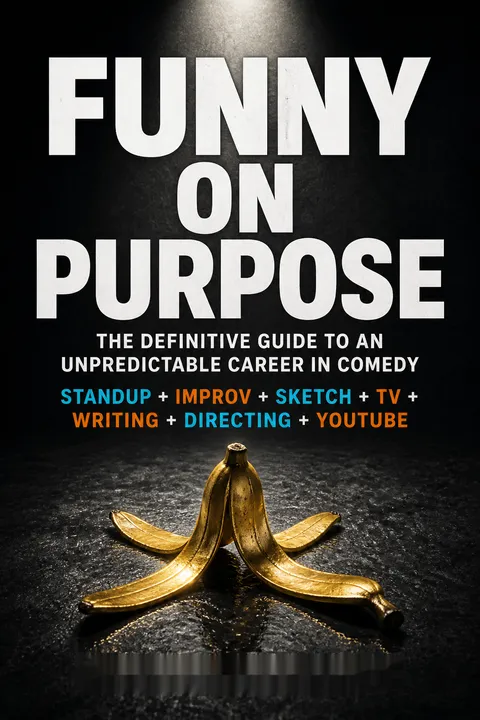
Funny on Purpose is a field guide to an industry that resists neat career maps. Its five-part structure moves from writing and performance through visual and digital media to business, while interviews with working comedy professionals provide multiple routes rather than a single formula. That breadth is also the hardest thing to compress. A guide to sketch writing, standup, television packets, animation, podcasting, contracts, and taxes risks becoming a catalogue. Its unifying thread is the claim that a comedy career depends on personal voice, repeated making, audience awareness, and the practical ability to get work produced and seen.
The book's humor is not decorative. The jokes make discouraging facts bearable: many jobs are unpaid or poorly paid, rejection is routine, and even a good project may never reach an audience. The comic tone also prevents its advice from sounding like a rigid success system. The author repeatedly admits that individual careers take different paths, even while offering concrete techniques for writing, pitching, performing, and managing money.
A productive tension runs through the book. The introduction treats backup plans as a threat to commitment, while the business chapters urge creators to save, manage taxes, protect rights, and prepare for irregular income. These ideas can coexist if commitment means sustained effort rather than financial recklessness. The career requires both appetite for risk and methods for limiting avoidable damage.
The book also understands that a joke is not finished when it is written. A performer, editor, production crew, platform, buyer, and audience all shape its final form. This makes the guide unexpectedly relevant beyond comedy: it portrays creative work as a chain of craft and coordination, where distinctive ideas need practical delivery. Its most durable advice is therefore not that talent guarantees a living, but that voice becomes more valuable when paired with practice, collaboration, and an understanding of how work reaches people.
Review Summary
Funny on Purpose is praised as a comprehensive guide to starting a comedy career. Readers appreciate its practical advice on various aspects of the industry, from writing to performing to business. Many find it informative and enjoyable, with useful interviews and insights. Some readers note it's more focused on career guidance than teaching comedy writing. The book is generally well-received for its broad overview, though a few wished for more in-depth content on specific topics. Overall, it's recommended for aspiring comedians and those curious about the comedy industry.
People Also Read

Glossary
Seven Traits of Highly Successful Comedy People
A comic career inventoryRandazzo's deliberately humorous list of qualities associated with comedy workers, including self-doubt, procrastination, fear, laziness, and poor planning, alongside a need to express something. It is not a validated career test. The joke points toward a serious idea: difficult temperaments can be redirected into creative work when paired with persistence and a reason to make it.
Comedy Idea
A hollow comic premiseRandazzo's term for a premise assembled to look funny according to familiar comic ingredients but lacking genuine amusement or a compelling point of view. Warning signs include relying on extremity, crude dialogue, violence, or a premise that resembles many existing sketches. The concept may work logically on paper yet feel lifeless when performed.
ESP Technique
A character-building methodA character-development mnemonic built from Essence, Specificity, and Practice. The performer identifies a character's central quality, chooses concrete vocal or physical details that express it, and rehearses those choices until they can be sustained. The method is intended to produce a distinctive, committed portrayal rather than a collection of generic funny faces.
Yes, and
Accept, then addA foundational improv principle: accept what another performer establishes in a scene, then contribute information or action that develops it. The practice keeps scenes moving and helps performers react to shared circumstances instead of rejecting them. It does not forbid conflict between characters; it discourages performers from denying the reality their partners have created.
The Harold
A connected long-form structureA long-form improv format that typically begins with an open-ended group opening, develops several related scenes in successive beats, and uses group games between sections. Later scenes can revisit earlier characters, themes, or details. The form gives performers a structure for building connections and callbacks from material created spontaneously.
Packet
A comedy writing sampleA collection of writing submitted when applying for a comedy job. Its contents depend on the employer and can include sketches, monologue jokes, segment ideas, or scripts. A packet demonstrates both writing ability and understanding of the particular show's voice and format. Writers are advised to keep samples current because openings can arrive with little notice.
Spec script
An unproduced show sampleAn unsolicited, unproduced episode of an existing television program, written to demonstrate a writer's skills. A prospective employer may request one for a different show from the one being staffed, allowing the reader to assess range as well as craft. Writers need to understand the model show's characters, tone, and structure before submitting.
Bombing
A set without laughsComedy industry slang for failing to get laughter from an audience. A set may fail because the material is weak, the performer is not connecting, or the crowd and conditions are unfavorable. The book treats bombing as an unavoidable part of performance and recommends maintaining perspective, learning what can be learned, and returning to the stage.
Proximity Method
Build access through presenceA career approach based on regularly spending time where comedy work happens, such as local shows, theaters, or creative communities. Relationships and opportunities can develop through participation rather than a carefully engineered plan. The method does not guarantee employment, but it increases contact with peers and professionals and helps newcomers learn how the local scene operates.
Four Quadrants
Four audience demographicsA film-industry term for audiences divided by gender and age, with age groups generally separated into under twenty-five and over twenty-five. A project that appeals across all four groups is considered especially attractive to studios because it may reach a broad market. The concept is a commercial lens, not a measure of a film's artistic quality.
Download PDF
Download EPUB
.epub digital book format is ideal for reading ebooks on phones, tablets, and e-readers.








