

Key Takeaways
Treat game theory as a map of choices, not a machine for predicting people.
Models simplify reality. Game theory studies decisions where each participant’s result depends partly on what others do. A strategy, in its technical sense, is a complete plan for every possible situation, even a foolish one. The point is not to predict every human choice, but to isolate the structure of a decision: players, options, information, and outcomes. Like physics models that ignore friction to make motion calculable, game theory deliberately leaves out some human messiness.
Use the map carefully. The Brexit referendum illustrates the danger of assuming people define rationality only through economic gain. Voters also weighed identity, immigration, sovereignty, and distrust. A model can clarify how a decision might work under stated assumptions, but it cannot make those assumptions true.
The useful distinction is between a model’s internal logic and its fit to the world. A map can reveal a route without representing every tree, just as a game matrix can expose incentives without capturing history, emotion, or power. This is close to the logic of scientific modeling: simplification creates leverage, but only when omissions remain visible. The danger is not abstraction itself, but mistaking an answer to a simplified question for an answer to the real one. Good use of game theory therefore begins by asking whose payoffs count and which motives have been left outside the model.
Evaluate choices by probability and personal consequences.
Expected value is an average. It is calculated by multiplying each possible payoff by its probability and adding the results. A game paying £100 for heads on one toss has the same expected value as one paying £200 for two consecutive heads: £50. Yet the first game wins more often, so the better choice depends on how much the outcome matters to the player.
Utility captures personal stakes. Daniel Bernoulli’s famous escalating coin game doubles its prize each time tails delays the first head. Every possible stage adds 50p to the expected return, producing an infinite theoretical expected value. In practice, the likely prize is small, while enormous prizes are exceedingly unlikely. A player’s resources and tolerance for loss matter more than the infinite average.
Expected value is powerful when choices can be repeated and risks are affordable, but it can mislead when a single loss would be catastrophic. This distinction appears in modern decision science as the difference between average payoff and risk-sensitive choice. Someone with little financial cushion may rationally prefer a smaller, more certain gain, even when the gamble has a higher mathematical average. The same logic matters in public policy: a tiny probability of severe harm can deserve more attention than its expected cost suggests. The calculation is a starting point, not a complete account of what a person can bear.
Track what each player knows, because information changes the game.
Hidden information creates strategy. In poker, players do not see every card, so betting can reveal clues while bluffing deliberately muddies them. In games with complete information, such as chess, every player can inspect the same board. The amount and quality of information shape which plans are sensible.
A host’s knowledge changes the odds. In the Monty Hall problem, a contestant chooses one of three doors. The host, who knows where the prize is, opens a different door to reveal a goat, then offers a switch. The original choice had a one-in-three chance; the two unchosen doors together held a two-in-three chance. Since the host selectively reveals a goat, switching wins two times in three. The reveal is not random, so the remaining doors are not equally likely.
The Monty Hall puzzle is a compact lesson in conditional probability: the meaning of new evidence depends on how that evidence was produced. The host’s rule matters as much as the goat. Similar reasoning applies to medical tests, hiring signals, and online ratings, where an observation may be filtered by a process that is invisible to the observer. The puzzle also shows why intuition often ignores selection mechanisms. Its practical question is not simply, “What did I learn?” but, “Why was this information shown, and what alternatives were excluded?”
Use minimax to resist worst-case exploitation, and randomize when predictable patterns invite it.
Minimax guards against an adversary. In a two-player, zero-sum game, one player’s gain is the other’s loss. The minimax method chooses the plan whose worst likely outcome is as good as possible. In the cake-cutting problem, one person divides the cake and the other chooses a piece. The cutter anticipates that the chooser will take the larger piece, so the safest plan is to divide as evenly as possible.
Randomness can be a strategy. In a colour-matching game, a player who always chooses red can be exploited by an opponent who chooses blue. Choosing each colour at random prevents a pattern from being used against them. This is a mixed strategy: a plan that assigns probabilities to different actions, even when only one action will be taken in a particular round.
Randomization is not indecision. It is a way to deny an opponent a reliable signal when the interaction rewards prediction. The same principle appears in cybersecurity, where varied routines make systems harder to exploit, and in sports, where a predictable serve becomes easier to return. Minimax is especially useful when the opponent is capable and hostile, but it can be overly defensive in relationships where cooperation is possible. Its value depends on the model’s premise: protection against the worst case is not always the same as pursuing the best shared result.
A stable Nash outcome can still leave everyone worse off.
Equilibrium is not a moral verdict. A Nash equilibrium occurs when no player can improve their result by changing strategy alone, given what the others are doing. In the prisoner’s dilemma, two prisoners each do better individually by giving evidence, whether or not the other does. If both follow that logic, they receive longer sentences than if both stayed silent.
The group can lose through individually sensible choices. The same pattern appears in the tragedy of the commons. Each herder benefits by adding another animal to shared grazing land, but widespread overuse ruins the resource for all. A Pareto-efficient outcome is one where nobody can be made better off without making someone else worse off. The cooperative result in the dilemma is better for both prisoners, yet it is not the individual incentive equilibrium.
This distinction helps separate stability from welfare. Equilibrium describes what may persist under particular incentives; it does not establish that the result is fair, wise, or socially optimal. Institutional design matters because rules can alter payoffs, make cooperation enforceable, or prevent one participant from taking a free ride. Elinor Ostrom’s work on shared resources, for example, highlights how communities can create monitoring and graduated sanctions rather than relying only on privatization or central control. The model identifies a coordination problem; it does not prove that cooperation is impossible.
In repeated games, reward cooperation and answer betrayal without endless revenge.
The future changes today’s payoff. When people expect to interact again, a short-term gain from betrayal can cost them future cooperation. The strategy called tit for tat begins cooperatively, then repeats the opponent’s previous move. It is easy to understand and can encourage a defector to return to cooperation.
Punishment can also trap both sides. If both players copy every move exactly, one betrayal can trigger an endless alternation of retaliation. A more forgiving response can let the relationship recover. The book describes computer tournaments in which tit for tat often performed well against competing strategies, especially when players retained information about past partners. If the number of rounds is fixed and known, however, backward reasoning can weaken cooperation because players see no future penalty in the final round.
Repeated interaction creates a shadow of the future: present conduct affects the value of later encounters. This helps explain why trust can be economically rational rather than merely sentimental. Yet tit for tat is not universally best. It is vulnerable to noise, misunderstandings, and opponents who exploit a forgiving response. Real relationships need ways to distinguish intentional betrayal from error, and to repair damage without abandoning accountability. The broader lesson is that cooperation depends not only on goodwill, but on memory, communication, and rules that make recovery possible.
Judge rationality by what people value, not cash alone.
People weigh more than money. In the ultimatum game, one player proposes how to divide a sum, and the other can accept or reject it. Rejection means neither receives anything. Although accepting any positive amount maximizes the responder’s cash, low offers are often rejected as unfair. The book notes that offers as small as 10p from a £10 pot are commonly turned down, though responses vary across cultures and with the size of the stakes.
Values alter the payoff table. A decision that looks irrational under a narrow financial model may protect dignity, punish unfairness, or express political priorities. The Brexit vote, for example, cannot be understood by economic forecasts alone. To model a choice well, include the motives participants actually care about, rather than labeling them irrational when they reject the analyst’s preferred outcome.
The ultimatum game connects strategic analysis to behavioral economics and social norms. Fairness can function as a real payoff because people may accept material loss to reject a relationship they regard as exploitative. That does not mean every refusal is wise, or that stated motives perfectly explain behavior. Experimental choices can shift with framing, anonymity, culture, and stakes. Still, the game warns analysts against defining rationality so narrowly that human motives become errors by definition. A richer model asks what people are trying to protect, not only what they are trying to acquire.
Design auctions to reveal value while blocking bidder collusion and signaling.
Auctions turn bids into information. A bidder’s willingness to pay helps reveal how valuable a scarce item is, but a badly designed auction can invite collusion or strategic signals. The 2017 US spectrum process paired a reverse auction, paying television broadcasters to release frequencies, with a forward auction in which mobile networks bid to use them. Broadcasters faced simple choices and could leave without ending up materially worse off.
Rules shape the result. The process raised more than $10 billion for broadcasters and left over $7 billion in government surplus. Other spectrum auctions performed poorly when rules enabled bidders to signal intentions through unusual bid amounts, or when too few firms competed. Designers can reduce such tactics through anonymous bids, rounded amounts, strong participation rules, and meaningful penalties for defaulting.
Auction design is a practical example of mechanism design: shaping rules so participants reveal useful information while limiting manipulation. The central challenge is that bidders respond to the rules themselves, not just to the item being sold. A safeguard can close one loophole while opening another, so design requires anticipating strategic adaptation. Transparency also has tradeoffs: more public information can help price discovery, but it can make signaling easier. The spectrum case shows that market outcomes are not simply discovered; they are partly constructed by the procedures that let buyers and sellers interact.
Recognize when complexity outruns neat game-theory solutions.
Some games explode in scale. Go has simple rules but an estimated 10^170 possible positions, compared with about 10^50 for chess. Conventional attempts to encode expert strategy struggled to master it. AlphaGo Zero instead learned through reinforcement learning, playing itself nearly five million times and improving from the results. Its success came from a method that did not need human strategy explanations.
A useful model has limits. This does not make game theory pointless. It marks the point where calculating every move becomes impractical, much as tracking every molecule in a gas is replaced by statistical methods. Human settings add further difficulty: rules may be unclear, preferences may change, and small differences can produce large effects. Game theory is most valuable as a tool for exploring incentives and scenarios, not as a guarantee of a single correct prediction.
The Go example distinguishes explicit reasoning from successful learning. A system can discover effective behavior without being able to explain it in human strategic language. That distinction matters in complex environments, where interpretability and performance may diverge. At the same time, AlphaGo’s success does not imply that every human system can be solved by more computation: social settings contain shifting goals, contested rules, and participants who react to predictions. The practical standard should be whether a model improves decisions under uncertainty, not whether it claims to capture the entire world.
Make threats credible by considering what happens after the decision.
Order changes the available choices. In a sequential game, one player acts first and the next can respond with that action in view. A threat matters only if carrying it out remains in the threatener’s interest when the moment arrives. In a simple coordination game, a player who announces a preferred meeting place may shape the other’s choice, but a threat to go somewhere alone may fail if the player would rather join the other person.
Reputation can make commitment real. Nuclear deterrence depends on an opponent believing that retaliation would occur after an attack. If retaliation is not credible, the warning may not deter. The Cuban Missile Crisis illustrates the stakes of strategic brinkmanship: both superpowers faced choices where continuing could be disastrous, and survival depended on restraint and concessions.
Credibility is a commitment problem: a promise or threat must remain believable after circumstances change. In negotiation, a boundary backed by a consistent policy carries more force than an emotional warning that will be withdrawn. But commitment can be dangerous when it removes room for de-escalation. Strategic rigidity may deter an opponent, yet it can also turn a misunderstanding into a crisis. The best use of this insight is not to make ever-larger threats, but to examine whether the threatened action is genuinely executable, what incentives it creates, and what safe exits remain.
Analysis
The book’s deepest contribution is not a catalogue of games but a disciplined way to ask what a decision depends on. Who are the players? What do they know? Which outcomes matter to them? Do they interact once or repeatedly? These questions translate vague conflicts into structures that can be inspected. The examples move from coins and cake to nuclear deterrence and spectrum auctions, showing how the same analytical grammar can illuminate very different settings.
The method is strongest when rules and incentives are explicit. It can expose why individually attractive actions produce collective harm, or why an auction’s procedures determine whether bids reveal value or encode threats. It is weaker when preferences, identities, and institutions are treated as fixed. People learn, misread one another, change goals, and sometimes reject the model’s account of what counts as a payoff. That is not a reason to abandon formal analysis; it is a reason to make assumptions testable and revise them when behavior disagrees.
A useful modern interpretation is to treat game theory as a diagnostic instrument rather than an oracle. Its mathematics can identify strategic pressure points, while behavioral evidence and institutional knowledge explain which pressures actually move people. It also has a normative edge: a model can reveal when rules reward defection, but choosing to redesign those rules requires an ethical judgment about whose welfare matters. The reader’s lasting skill is therefore not predicting every move. It is recognizing how incentives, information, and time shape choices, then asking whether the resulting equilibrium is one worth sustaining.
Review Summary
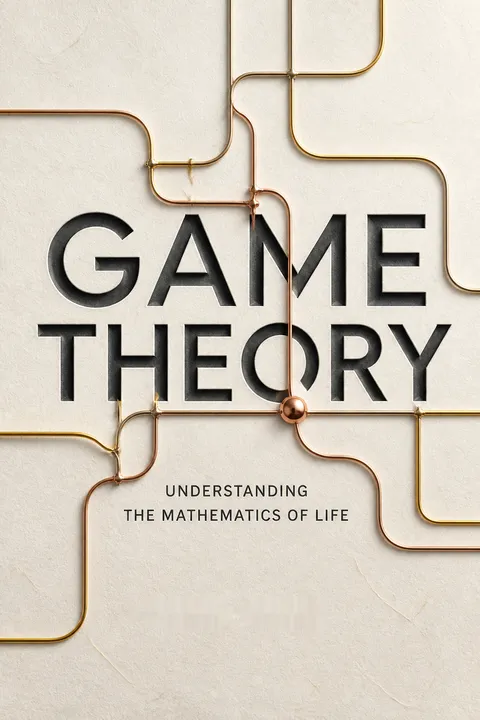
Game Theory receives mixed reviews, averaging 3.26 out of 5 stars. Readers appreciate its accessibility and concise introduction to the subject for beginners. Many find it informative and well-explained, with interesting examples and applications. However, some criticize its tangential discussions and lack of depth. The audiobook version is challenging due to referenced figures. Overall, it's considered a solid primer on game theory, though perhaps too basic for those already familiar with the subject.
People Also Read




Glossary
Game theory
Strategic decision analysisA mathematical approach to situations in which each participant’s outcome depends on choices made by others. A game-theory model identifies players, available actions, information, and payoffs. It can clarify incentives and likely strategic responses, but its conclusions depend on the assumptions used to simplify real behavior.
Strategy
A complete action planIn game theory, a strategy specifies what a player would do in every possible situation in the game. It does not have to be wise or effective. This technical meaning is broader than everyday use, where strategy usually refers to a considered plan intended to achieve a goal.
Expected value
Probability-weighted average payoffA calculation of the average payoff a choice would produce across repeated trials. Each possible outcome is multiplied by its probability, and the results are added. Expected value helps compare uncertain options, but it does not by itself represent how painful a loss would be to a particular person.
Utility
Personal value of outcomesA measure of how significant an outcome is to a particular player, rather than its monetary amount alone. The same sum can have very different utility for people with different resources or priorities. Utility explains why a person may prefer a more reliable small gain over a risky chance at a larger one.
minimax theorem
Best defense against worst caseJohn von Neumann’s result for two-player, zero-sum games. It establishes that each player can choose a strategy that maximizes the minimum payoff they can guarantee, assuming the opponent acts to worsen their result. Some games require a mixed strategy, using probabilities across available actions, to reach this outcome.
mixed strategy
Probabilistic choice planA strategy that assigns probabilities to different actions instead of always choosing the same one. In a single round, the player still takes one action, but selects it according to the assigned probabilities. Randomization can prevent an opponent from exploiting a predictable pattern.
Nash equilibrium
No profitable solo changeA set of strategies in which no player can improve their own outcome by changing their choice alone, while the other players keep theirs unchanged. A game can have one or several Nash equilibria. An equilibrium describes strategic stability, not necessarily fairness or the best collective outcome.
Pareto efficient
No improvement without harmAn outcome is Pareto efficient when no participant can be made better off without making at least one other participant worse off. An outcome may be a Nash equilibrium without being Pareto efficient. The distinction helps explain how individually stable choices can leave everyone with a worse result than cooperation would.
tit for tat
Mirror the previous moveA strategy for repeated games that begins by cooperating, then chooses the action the opponent used in the preceding round. It can encourage cooperation by reciprocating good behavior and responding to defection. If applied without adjustment, however, mutual retaliation can create a prolonged cycle after a single breach.
Vickrey auction
Winner pays second bidA sealed-bid auction in which the highest bidder wins but pays an amount based on the second-highest bid, rather than paying their own full bid. Because the winner does not pay the maximum amount they offered, the format is intended to encourage bidders to state their valuations more honestly.
asymmetric information
Unequal access to informationA condition in which participants in a transaction or game possess different amounts or kinds of relevant information. A used-car seller, for example, may know more about a vehicle’s history than a prospective buyer. Information gaps influence bids, trust, and the strategies each side considers safe.
Bayes’ theorem
Update probability with evidenceA mathematical rule for revising the probability of an event when new evidence is observed. It combines prior chances with information about how likely the evidence is under different conditions. In the book’s medical-test example, it helps distinguish the chance of a false positive from the chance that a positive result is false.
simultaneous multiple-round auction
Repeated bids across multiple lotsAn auction format in which several items are open for bidding at the same time across successive rounds. Bidders see information about prior bids and can revise their offers as the auction proceeds. Spectrum auctions use this structure to allocate related licences, while careful rules aim to limit collusion and strategic signaling.
FAQ
What's "Game Theory: Understanding the Mathematics of Life" about?
- Exploration of Game Theory: The book delves into the mathematical study of game theory, explaining how it models human decision-making and interactions.
- Real-World Applications: It covers how game theory applies to various fields, including economics, politics, and biology, providing insights into strategic decision-making.
- Historical Context: The book traces the development of game theory, highlighting contributions from key figures like John von Neumann and John Nash.
- Complex Concepts Simplified: It aims to make complex mathematical concepts accessible to a general audience, using examples and analogies.
Why should I read "Game Theory: Understanding the Mathematics of Life"?
- Broaden Understanding: It offers a deeper understanding of how mathematical models can explain and predict human behavior.
- Practical Insights: The book provides practical insights into decision-making processes that can be applied in everyday life and professional settings.
- Interdisciplinary Approach: It connects game theory to various disciplines, showing its relevance across different fields.
- Engaging Content: Brian Clegg presents the material in an engaging and accessible manner, making complex ideas understandable.
What are the key takeaways of "Game Theory: Understanding the Mathematics of Life"?
- Game Theory Basics: Understanding the fundamental principles of game theory, including zero-sum games and Nash equilibria.
- Strategic Thinking: The importance of strategic thinking in decision-making and how game theory can guide optimal choices.
- Real-World Applications: Insights into how game theory is used in auctions, economics, and even biological systems.
- Mathematical Modeling: The role of mathematical models in simplifying and solving complex real-world problems.
How does Brian Clegg explain the concept of Nash Equilibrium in the book?
- Definition: A Nash equilibrium is a situation where no player can benefit by changing their strategy while the other players keep theirs unchanged.
- Examples: The book uses examples like the prisoner’s dilemma to illustrate how Nash equilibria work in practice.
- Application: It shows how Nash equilibria can be applied to real-world scenarios, such as economic markets and competitive strategies.
- Significance: Understanding Nash equilibria helps in predicting the outcome of strategic interactions in various fields.
What is the Monty Hall problem, and how is it explained in the book?
- Game Show Scenario: The Monty Hall problem is based on a game show scenario where a contestant chooses between three doors, one hiding a car and the others hiding goats.
- Counterintuitive Solution: The book explains the counterintuitive solution that switching doors increases the chance of winning from 1/3 to 2/3.
- Mathematical Explanation: It provides a mathematical breakdown of why switching is the better strategy, challenging common sense assumptions.
- Illustration of Game Theory: This problem is used to illustrate the importance of probability and strategy in game theory.
How does "Game Theory: Understanding the Mathematics of Life" address the concept of zero-sum games?
- Definition: Zero-sum games are situations where one player's gain is exactly balanced by the losses of other players.
- Examples: The book provides examples like chess and poker to explain zero-sum dynamics.
- Strategic Implications: It discusses how understanding zero-sum games can help in developing strategies where resources are limited.
- Broader Context: The book contrasts zero-sum games with win-win scenarios, highlighting different strategic approaches.
What are some real-world applications of game theory discussed in the book?
- Economic Markets: Game theory is applied to understand competitive strategies in markets and auctions.
- Biological Systems: The book explores how game theory models interactions in biological systems, such as predator-prey dynamics.
- Political Strategies: It discusses the use of game theory in political decision-making and negotiations.
- Everyday Decisions: The book also touches on how game theory can inform personal and business decision-making processes.
How does the book explain the concept of auctions in game theory?
- Auction Types: It covers different types of auctions, including English, Dutch, and Vickrey auctions, and their strategic implications.
- Game Theory Application: The book explains how game theory is used to design auctions that maximize seller revenue.
- Real-World Examples: It provides examples of spectrum auctions for telecommunications, illustrating the complexity and importance of auction design.
- Strategic Bidding: The book discusses strategies bidders might use and how auction design can influence these strategies.
What is the significance of the prisoner’s dilemma in game theory, as explained in the book?
- Classic Example: The prisoner’s dilemma is a classic example used to illustrate the conflict between individual rationality and collective benefit.
- Nash Equilibrium: It demonstrates a Nash equilibrium where both players choose to betray each other, leading to a worse outcome for both.
- Real-World Relevance: The book discusses its application in understanding cooperation and competition in various fields.
- Moral Implications: It also touches on the ethical considerations and the importance of trust and communication in strategic interactions.
How does Brian Clegg address the limitations of game theory in the book?
- Complexity and Chaos: The book acknowledges that real-world situations often involve complexities and chaotic elements that game theory models may not fully capture.
- Rationality Assumptions: It discusses the assumption of rationality in game theory and how real human behavior can deviate from this.
- Incomplete Information: The book highlights challenges in applying game theory when players have incomplete or asymmetric information.
- Model Limitations: It emphasizes that while game theory provides valuable insights, it is not a one-size-fits-all solution for decision-making.
What are the best quotes from "Game Theory: Understanding the Mathematics of Life" and what do they mean?
- On Rationality: The book discusses the multi-dimensional nature of rationality, emphasizing that decisions are not solely based on economic gain.
- On Game Theory's Reach: It highlights the broad applicability of game theory across different fields, from economics to biology.
- On Strategic Thinking: The book underscores the importance of strategic thinking in navigating complex interactions and decisions.
- On Mathematical Models: It reflects on the power and limitations of mathematical models in simplifying and solving real-world problems.
How does the book explore the role of information in game theory?
- Information Asymmetry: The book discusses how asymmetric information can affect strategic decisions and outcomes in games.
- Auctions and Bidding: It explains how auctions reveal information about the value players place on items, influencing bidding strategies.
- Decision-Making: The book highlights the importance of information in making informed decisions and developing effective strategies.
- Real-World Implications: It provides examples of how information plays a crucial role in economic markets, negotiations, and everyday interactions.
About the Author



Download PDF
Download EPUB
.epub digital book format is ideal for reading ebooks on phones, tablets, and e-readers.








