

Key Takeaways
Treat quantum computers as specialist accelerators, not universal replacements.
A different kind of machine. Quantum computers use quantum properties to speed up particular calculations. They are not simply faster versions of laptops, and most everyday computing remains better suited to conventional machines. Physicist Richard Feynman’s original motivation was practical: simulating quantum physics on a classical computer can be extraordinarily difficult, so a machine built from quantum systems might model those systems more naturally.
Advantage depends on the task. The book’s central promise is quantum advantage: completing a useful calculation that would be infeasible, or take far too long, on conventional hardware. The likely arrangement is a conventional computer that hands selected jobs to a specialized quantum processor, much as it can hand graphics work to a graphics processor. A quantum machine matters when its particular strengths match the problem.
The accelerator comparison is useful because it replaces the misleading image of a single machine destined to make every other computer obsolete. Specialized hardware succeeds when a task has a structure it can exploit, not merely because it is newer. The analogy also sets a demanding standard: a quantum processor must outperform the best practical classical approach, including the costs of preparing data and interpreting results. A striking laboratory demonstration is evidence of capability, but not yet evidence of a useful advantage for ordinary users.
Algorithms can outlive machines: Babbage and Grover designed for engines not yet built.
Plans before prototypes. In the nineteenth century, Charles Babbage designed the Analytical Engine, a mechanical computer that could, in principle, follow changeable instructions. Ada Lovelace translated an account of his lectures and added extensive notes describing possible uses. The machine was never completed, and her role as the first programmer is disputed: Babbage had already developed many of the examples, though Lovelace did create a procedure for calculating Bernoulli numbers.
Quantum ideas arrived early. In 1996, Lov Grover devised a search algorithm while practical quantum computers were still out of reach. Like Babbage’s engine instructions, the algorithm described what a future machine might do before that machine existed. The story shows that mathematical ideas can reveal the potential of a technology before engineers can build it.
This history separates two kinds of invention that public narratives often collapse: specifying a computation and constructing a device capable of carrying it out. Lovelace’s case also warns against turning complex collaboration into a clean origin myth. The same caution applies to quantum computing, where an elegant algorithm does not establish that a robust machine can implement it at scale. Still, theory-first progress is powerful: it gives hardware researchers a precise target rather than a vague hope that unusual physics will somehow prove useful.
Choose the algorithm before celebrating the hardware.
Instructions shape the work. An algorithm is a defined sequence of steps for reaching an answer. It can be carried out by a person, a conventional computer, or, if designed appropriately, a quantum one. The book makes this concrete with sorting books: repeatedly swapping out-of-order neighbours, called bubble sort, can require many operations, while a merge sort repeatedly combines smaller sorted groups and is more efficient for a large collection.
Machines follow structures. Conventional computers represent information with bits, each holding 0 or 1, and process it through logic gates. Alan Turing’s theoretical machine showed how simple operations can perform any computable task; John von Neumann’s architecture provided a practical model for storing programs and data. Quantum computing changes the physical resources available, but it still depends on carefully designed instructions.
The sorting example illustrates a broader lesson from computer science: performance depends on the relationship between a problem and the procedure chosen to solve it. Better hardware cannot rescue every inefficient approach. In complexity theory, problems are grouped by how resource demands grow as their inputs grow; that perspective helps distinguish a genuine breakthrough from a faster run on one small example. Quantum computing adds new resources, but it does not erase the need to ask what the algorithm requires, what it can return, and how much overhead its implementation introduces.
A qubit carries probabilities, but measurement returns one result.
More than a tiny bit. A qubit, or quantum bit, stores information in a quantum property such as an electron’s spin or a photon’s polarisation. Unlike a conventional bit, it can occupy a superposition: a state with possible outcomes weighted by probabilities. A measurement does not reveal every possibility at once. It produces one outcome, such as spin up or spin down.
The algorithm shapes the odds. Quantum operations can change how these possibilities combine, strengthening the probability of some outcomes and weakening others. This is why the popular claim that a quantum computer simply tries every answer simultaneously is misleading. For example, three qubits describe a system with eight possible binary states, but reading the system does not yield eight answers. The challenge is to arrange the computation so that measurement is likely to reveal the useful one.
This distinction is essential because metaphors about parallel universes or limitless simultaneous calculation can make quantum computing sound like magic. The operational advantage comes from manipulating quantum amplitudes, including their interference, so that outcomes combine in useful ways. The measurement bottleneck remains: a machine must produce an answer that can be extracted and checked. That makes algorithm design inseparable from the physics. An impressive internal state has little practical value if the final measurement mostly yields noise or an unhelpful result.
Entanglement links distant qubits, but cannot send controllable messages.
Connected outcomes. Entanglement is a relationship between quantum particles in which measurements of one are correlated with measurements of another, even when they are far apart. Experiments building on John Bell’s work have supported quantum predictions over the alternative idea that particles simply carried hidden instructions. In 2017, the Micius satellite helped demonstrate entangled photons at ground stations 1,200 kilometres apart.
Correlation is not communication. Entanglement does not let someone choose a result and send it instantly to a distant recipient. Quantum teleportation transfers a quantum state from one particle to another, but the source state is lost and ordinary communication is needed to complete the process. Entanglement can also support secure quantum key distribution, where interference can reveal an attempt to intercept the key. It does not, by itself, encrypt every message.
The difference between correlation and communication is a useful model well beyond quantum physics. Two events can be linked in a way that exceeds ordinary intuition without enabling a sender to control what a receiver observes. That distinction prevents a common leap from entanglement to faster-than-light messaging. The practical security idea is similarly precise: quantum effects can help parties establish or check a key, while the message still needs an encryption method. The physics offers a valuable ingredient, not an all-purpose security shield.
Target problems quantum algorithms actually accelerate, not every hard problem.
Search gains are specific. Grover’s algorithm searches unstructured data using roughly the square root of the number of entries in oracle queries. For a million-item list, that is about 1,000 checks rather than a classical search that may need to examine hundreds of thousands. The result is probabilistic, so the process may need repeating. This is a quadratic improvement, not a universal exponential speedup.
Factoring could threaten RSA. Peter Shor’s algorithm could factor very large numbers much more efficiently than known classical methods. That matters because RSA public-key encryption depends on the difficulty of factoring products of large primes. Quantum algorithms may also accelerate Monte Carlo simulations, which use repeated random trials for estimates such as financial option prices. None of this means every difficult task, such as every route-planning problem, suddenly becomes easy.
The book’s examples make clear that quantum advantage is problem-dependent, a point easily obscured by headlines about exponential speed. Grover’s search improvement is meaningful at scale, but it is not equivalent to making any database query instant. Shor’s security implications are serious, yet they depend on building a sufficiently large, fault-tolerant machine; meanwhile, encryption methods designed to resist quantum attacks are being developed. The right question is not whether a problem sounds hard, but whether a quantum algorithm exploits its structure better than the strongest available alternatives.
Protect logical information; raw qubit counts exaggerate usable computing power.
Quantum states are fragile. Decoherence occurs when a qubit interacts with its surroundings and loses the delicate quantum state needed for computation. Devices try to reduce these interactions with approaches such as ion traps, vacuum chambers, and extreme cooling. But gates and measurements can also introduce errors, so protecting the computation is a major part of the work.
Physical is not logical. A logical qubit is a reliable unit of information built using multiple physical qubits and error-correction procedures. The book estimates that a fully fault-tolerant logical qubit might require hundreds to around a thousand physical qubits, while devices at the time had around 75 physical qubits. Quantum states also cannot simply be copied to make backup duplicates, so error correction must use more subtle methods. Raw qubit totals alone therefore say little about a machine’s useful capacity.
The distinction between physical and logical qubits resembles the difference between raw data and dependable information: more components do not automatically produce a more capable system. Reliability, connectivity, gate accuracy, and the time a state remains usable all matter. Error correction is not a minor repair step added after computation; it shapes the architecture and consumes resources from the start. This is why progress should be measured through several linked indicators, not a single impressive headline number. A smaller system that performs accurately may be more valuable than a larger, unstable one.
Treat quantum supremacy as a narrow benchmark, not practical utility.
A difficult demonstration. In 2019, Google reported that its 53-qubit Sycamore processor completed a specially chosen sampling task in about 200 seconds. The team estimated that a conventional supercomputer would need 10,000 years. IBM researchers disputed that estimate, arguing that the Summit supercomputer could finish in about 2.5 days using more storage than Google had assumed. Either way, the task was designed to show a quantum device’s capability, not to solve a pressing real-world problem.
Not all quantum machines are alike. D-Wave sold systems based on quantum annealing, a specialized approach for optimization problems. Its machines are quantum devices, but they do not run the same general-purpose algorithms as gate-based quantum computers. A benchmark, an annealing machine, and a flexible quantum computer demonstrate different things.
The argument over Google’s comparison is a reminder that computational superiority is always relative to a specified task, competitor, and model of resources. A demonstration can be technically significant while offering no immediate commercial benefit. Calling this quantum supremacy risks implying that quantum machines have broadly overtaken classical computers, when the result concerns a narrow benchmark. The more informative standard is application-level advantage: a task with real value, a fair comparison, and an end-to-end benefit after setup and error costs are counted.
Expect hybrid cloud systems and incremental gains, not a sudden revolution.
A remote specialist. Most practical quantum systems require controlled conditions and complex equipment, making them unlikely to resemble home computers. The book expects conventional computers to handle ordinary work and connect to quantum processors for selected calculations, often through cloud services. This is similar to astronomers using remote telescopes rather than keeping every instrument beside their desks.
Progress comes in steps. Researchers continue to test different qubit technologies and improve connections between them. One Oxford team reported entangling 182 pairs of ions per second, compared with about five pairs per second in 2014. Such gains address real engineering bottlenecks, though they do not yet create a useful general-purpose machine. The path resembles the development of other technologies: promising prototypes, overconfident forecasts, and gradual improvements before dependable applications emerge.
The cloud model shifts attention from owning a quantum computer to accessing a quantum service, which could make specialized hardware useful without making it commonplace. It also makes the surrounding infrastructure important: users need software, clear interfaces, and a way to judge whether a quantum result improves the task. Historical comparisons with artificial intelligence offer a useful warning against promises of imminent general transformation. Yet slow progress is not failure. Improvements in connection rates and stability can accumulate into capabilities that were previously impractical, even if the public-facing revolution looks more incremental than dramatic.
Analysis
The book’s strongest organizing idea is that quantum computing is a meeting point between mathematical possibility and physical engineering. Its opening pair of stories establishes this elegantly: Babbage and Lovelace imagined computation before a workable machine existed, while Grover devised a quantum search method before the hardware could execute it. The sequence then gives readers the classical computing vocabulary needed to understand what changes, before introducing quantum states, algorithms, devices, and limits.
The central claim is deliberately narrower than many popular accounts suggest. Quantum computers are not general-purpose replacements, and their advantage depends on the structure of a problem. Grover offers a quadratic search improvement; Shor points toward a far more dramatic change for factoring; quantum sampling and simulation provide other possible niches. The account’s value lies partly in refusing to treat these as interchangeable demonstrations. A specialized machine completing a contrived task is not the same achievement as a reliable processor solving a valuable problem faster from end to end.
The most important conceptual hazard is the language of superposition. Saying a qubit is both zero and one can help a beginner, but can also imply that a machine openly stores and returns every answer. The actual computational story concerns quantum amplitudes, controlled operations, interference, and measurement. This more careful view makes the engineering challenge intelligible: the system must preserve delicate states, combine them in useful ways, and produce a readable result despite errors.
The book also reveals why headline metrics mislead. Physical qubit counts obscure error correction, connectivity, stability, and the number of useful operations a system can sustain. A meaningful assessment therefore needs benchmarks tied to applications and fair classical comparisons. The likely future is not a quantum laptop in every home, but a hybrid computing ecosystem in which remote specialized devices serve particular workloads. That outcome may be less cinematic, but it is a more credible account of how transformative technologies enter ordinary life.
Review Summary
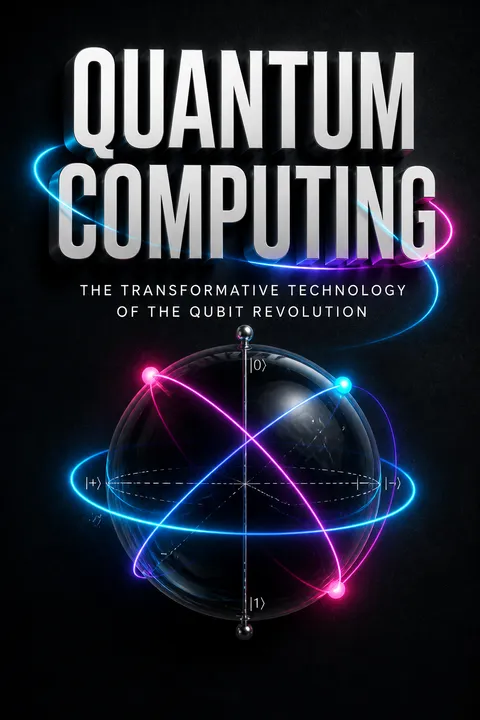
Quantum Computing: The Transformative Technology of the Qubit Revolution receives mixed reviews. Readers appreciate its accessible introduction to quantum computing for laypeople, praising the author's clear explanations and historical context. However, some find it too basic or lacking in technical depth. Critics note that a significant portion of the book covers conventional computing history rather than quantum specifics. Overall, readers value the book as a starting point for understanding quantum computing but suggest supplementing it with more advanced resources for a comprehensive grasp of the subject.
People Also Read








Glossary
qubit
Quantum information unitA quantum bit, usually represented physically by a particle or a controlled quantum system. Its information may be encoded in a property such as spin, polarisation, or energy level. Unlike a classical bit, a qubit can be prepared in a superposition of possible measurement outcomes, but a measurement returns a single outcome.
superposition
Combination of possible statesA quantum state that combines possible outcomes with particular amplitudes, such as the two possible spin measurements of a qubit. Before measurement, the system is not simply a classical object whose definite value is unknown. Quantum operations can alter the amplitudes and their interference, affecting the probabilities of results observed in a measurement.
decoherence
Loss of quantum behaviourThe process by which a quantum system interacts with its environment and loses the delicate relationships needed for superposition or entanglement. Unwanted interactions can make a qubit unreliable for computation. Quantum hardware limits decoherence through isolation, cooling, trapping, and error-correction techniques, although these protections require substantial engineering.
entanglement
Shared quantum relationshipA relationship between quantum systems whose properties are correlated in ways that cannot be explained by treating each system as having an independent, pre-existing value. Measuring one system constrains what can be predicted about the other, even across large distances. Entanglement supports quantum information processing, but does not allow controllable faster-than-light communication.
quantum teleportation
Transfer of a quantum stateA procedure for transferring the state of one quantum particle to another using a previously entangled pair, measurements, and ordinary communication of the measurement result. The source particle does not remain in its original state, so the procedure is not a way to make a second copy. It transfers quantum information, not matter.
Grover's algorithm
Faster unstructured searchA quantum algorithm for searching an unstructured set of possible answers. It can find a marked item using a number of queries proportional to the square root of the number of candidates, rather than a number proportional to the full set. Its result is probabilistic, and the speedup is quadratic rather than a universal improvement for every search task.
Shor's factorisation algorithm
Quantum integer factoringA quantum algorithm for finding the prime factors of a large composite number. Its potential importance comes from the use of factoring difficulty in RSA public-key encryption. Running it against the large keys used in real systems would require a sufficiently powerful, error-corrected quantum computer, not merely a small experimental device.
logical qubit
Error-protected information unitA reliable unit of quantum information encoded across multiple physical qubits and managed with quantum error correction. The extra physical qubits help detect and correct faults without directly copying the quantum state. Because this protection consumes substantial hardware and operations, the number of logical qubits can be far smaller than the device’s advertised physical qubit count.
quantum annealing
Energy-based optimization methodA specialized quantum computing approach that encodes a problem so that a low-energy state corresponds to a desired solution. The system is manipulated to seek that state, using quantum effects such as tunnelling. Quantum annealing devices can be useful for certain optimization tasks, but they do not operate as general-purpose gate-based quantum computers.
About the Author



Download PDF
Download EPUB
.epub digital book format is ideal for reading ebooks on phones, tablets, and e-readers.








