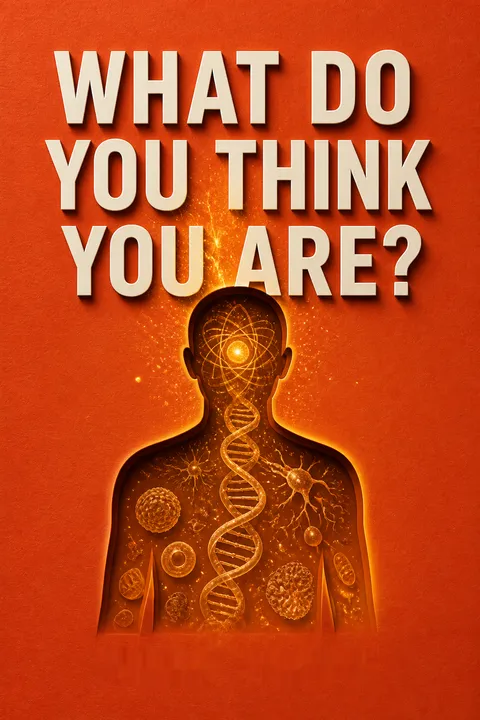


Key Takeaways
Treat yourself as an emergent pattern, not a single hidden ingredient.
Many strands make one person. The book’s central claim is that no lone factor explains what makes you you. Atoms, ancestry, biology, brain activity, upbringing, technology, and chance all contribute. Their interactions create properties that are not present in any one component. This is emergence: a whole acquires qualities through the interactions of its parts. Atoms alone are not alive, but arranged and functioning together they form a living person.
Science has a boundary. Clegg uses observation and revisable evidence to explore what science can say about identity. That approach does not disprove a soul or spiritual life; it simply cannot test claims defined as beyond nature. The result is not a final definition of the self, but a map of the many physical and social processes that help make one.
The useful shift is from searching for an essence to tracing relationships. The same atom can belong to a rock, a cell, or a person, yet its role changes with its organization. That makes identity neither an illusion nor a hidden object; it is a real pattern sustained by interacting layers. The distinction also keeps scientific explanation appropriately modest. A map of physical causes can be powerful without claiming to settle every metaphysical question about personhood.
Your family tree eventually includes kings, peasants, and nearly everyone else.
Trees become tangles. Each generation doubles the number of theoretical ancestors, so a tidy family tree quickly demands more people than history contained. The solution is overlap: the same individuals recur across branches. Mathematical models estimate that all living people share a recent common ancestor within a surprisingly small number of generations. One model places a common ancestor of all people around 1,415 BC, and a generation in which everyone with living descendants was an ancestor around 5,353 BC. The figures depend on assumptions about migration and partnering.
Ancestry is not status. If you have European ancestry, the model implies that Charlemagne is among your ancestors, but so are countless ordinary people. A genetic study cited in the book found 93 to 95 percent of human genetic variation within populations, not between them. Race labels therefore divide people more sharply than the biology supports.
Genealogy is compelling because it turns the past into a personal story, but the mathematics makes that story less exclusive. Royal ancestry loses its power as a badge when it is shared by whole populations. The distinction between genealogical descent and inherited DNA matters too: an ancestor can appear in a family tree without leaving identifiable genetic material in a particular descendant. The broader lesson is not that ancestry is meaningless, but that it cannot justify rank or biological separation.
The atoms in your body predate you by billions of years.
Matter has a long history. A typical human body contains about 7 x 10^27 atoms. Eleven elements account for 99.95 percent of its weight, and most of those atoms are continually replaced, with most replaced over roughly a decade. The atoms are not created at birth. They enter through food, drink, and air, and have passed through earlier organisms and environments.
Stars supplied the ingredients. The early universe produced mostly hydrogen, with some helium and lithium. Stars fused lighter elements into heavier ones; stellar explosions and other events dispersed still heavier elements into space. Later, this material formed planets, including Earth. The atoms in a person are ordinary matter, but their arrangement is particular and temporary. A body’s individuality comes less from unique kinds of atoms than from the distinctive living organization they form.
This account joins personal identity to cosmic history without reducing a person to chemistry. The same materials move through stars, planets, organisms, and bodies, while organization determines what those materials are doing at a given moment. That distinction is crucial: continuity of matter does not mean continuity of the person. The image also makes uniqueness more precise. It is not that a human contains exotic ingredients, but that an extraordinarily complex arrangement of familiar ones is maintained for a time.
Life depends on managed energy flows, while access to resources remains unequal.
Life is not a magic spark. Scientists lack one universally accepted definition of life. Common tests list processes such as growth, reproduction, and response to the environment, but viruses complicate the checklist. A NASA definition instead describes life as a self-sustaining chemical system capable of Darwinian evolution. The book also explores how living things use energy to maintain order while releasing energy and increasing disorder around them. Hydrothermal vents could have supplied early life with energy, minerals, and a structure for chemical reactions, though the origin remains uncertain.
Abundance does not mean access. Earth holds vast quantities of water, and global food production exceeds human needs, but location, waste, and politics determine who can use them. Human energy use also releases greenhouse gases, affecting climate. The biological need for energy is universal; the systems that deliver it are not.
The chapter’s strongest distinction is between a resource existing and a person being able to reach it. That applies to water and food, but also to the energy systems that support daily life. It prevents scarcity from being treated as a simple matter of planetary supply. The origin-of-life discussion is more provisional: thermodynamics helps describe conditions that could support life, but it does not by itself explain how life began. Keeping that difference clear preserves both the insight and the uncertainty.
Evolution is a branching history, not a staircase aimed at humans.
Selection has no destination. When inherited variations help organisms survive and reproduce in a particular environment, those traits become more common. Small changes accumulate over many generations, eventually producing populations different enough to be classified as new species. The peppered moth illustrates how quickly selection can respond to changing conditions: darker moths became more common where pollution darkened trees, then lighter forms returned as the environment changed.
The record is fragmentary. Humans did not descend from modern apes; humans and other apes share ancestors. Fossils offer scattered clues, not a complete chain of human progress. The Chicxulub impact, which helped end the dominance of large dinosaurs, reshaped conditions for mammals. Human traits, including upright walking and large brains, have several proposed explanations, not a settled account of evolution’s purpose.
Rejecting a ladder changes how human distinctiveness is understood. A branching history leaves room for extinct relatives, simultaneous species, and evolutionary dead ends rather than treating every predecessor as a step toward modern people. It also clarifies why a fossil discovery rarely proves direct ancestry: resemblance and chronological proximity do not establish a line of descent. The book’s account is strongest when it distinguishes evidence from reconstruction, especially where the fossil record is too incomplete to resolve competing stories.
Your brain edits experience, and conscious choice arrives after much processing.
Perception is constructed. The brain does not display a perfect internal picture of the world. It fills in the eye’s blind spot, smooths over rapid eye movements, and can misjudge size or colour. In the invisible gorilla experiment, people counting passes often fail to notice a person in a gorilla suit crossing the scene. Attention selects only part of what the senses provide.
Awareness is not the whole process. Skilled actions such as typing or steering use processes outside conscious attention. In experiments by Benjamin Libet, brain activity associated with a movement appeared before participants reported deciding to move. The result is debated: timing a private decision is difficult, and correlation does not prove that unconscious activity caused it. Consciousness remains scientifically unresolved, even as evidence shows that it is not the brain’s sole operator.
These examples weaken the intuitive picture of a little commander behind the eyes without making conscious experience disappear. Awareness seems partial: much processing is hidden, while the subjective feeling of seeing and choosing remains. That distinction avoids a false choice between total control and total illusion. The caution around Libet is especially important because measurements of brain activity and reports of intention are not identical kinds of evidence. The chapter invites a more careful question: what does consciousness contribute, if it does not run every operation?
Modern identity includes tools, institutions, and information systems.
Culture changes the human condition. Tools and fire made food preparation and protection easier; cooking also improved digestibility and reduced exposure to harmful organisms. Before modern medicine and reliable food systems, childhood death was common: more than 40 percent of children in 1800 died before age five. Technology has therefore changed not just comfort, but who survives to become an adult.
Information reshapes daily life. Writing, printing, telegraphy, computers, and the internet let knowledge travel beyond face-to-face contact and individual memory. The telegraph carried messages between cities in minutes rather than by horseback. Today, digital networks shape work, communication, navigation, and access to information. These systems are not merely objects people use; they form part of the environment in which people live and develop.
The argument expands identity beyond the body without pretending that technology makes biology irrelevant. A person’s capacities depend partly on shared systems: stored knowledge, transport, medicine, and communication. Those systems also redistribute risks and opportunities, so their effects cannot be described as purely personal choices. The historical examples make progress concrete, while the climate discussion elsewhere in the book cautions against treating every technological gain as cost-free. Human capability grows through tools, but the surrounding world absorbs their consequences.
Genes shape dispositions, but no DNA script can predict a life.
Inheritance is not a blueprint. DNA stores information in sequences of four bases, but only about 2 percent of human DNA forms genes. Most characteristics arise from many genetic influences interacting with one another and with the environment. Research discussed in the book suggests that psychological traits are roughly half genetic and half environmental, but this is a broad estimate, not a recipe for predicting an individual.
Experience resists control. Identical crayfish raised under apparently similar conditions grew to different sizes, lived for different lengths of time, and behaved differently. Small developmental variations can matter. Parenting can also respond to a child’s partly inherited behaviour, making cause and effect run in both directions. Mental conditions are often better understood as positions on spectra than as simple categories, while social opportunity remains distinct from genetic makeup.
The 50:50 summary is memorable, but it can sound more exact than the evidence permits. The book’s deeper point is that both sides contain many interacting influences, and the environment includes chance events that are hard to measure or reproduce. The crayfish example makes that unpredictability vivid. It also guards against treating genetic contribution as destiny: a statistical influence across groups does not determine an individual’s outcome, and it says nothing by itself about the opportunities society provides.
Question dramatic stories about identity; statistics and moral instincts both distort.
Perception favours drama. Surveys described by Hans Rosling found that people often underestimated improvements in areas such as global poverty and life expectancy. Bobby Duffy’s polling showed that people also misjudged emotionally charged issues, including immigration. Numbers can mislead too: early GDP estimates are revised, and a headline statistic may not measure what readers assume it does.
Moral judgment shifts with context. In Stanley Milgram’s experiments, 65 percent of participants continued to the highest shock setting when urged by an authority figure, though the shocks were not real. In trolley problems, many people accept diverting a vehicle to save five people but reject pushing someone onto its path, despite similar stated outcomes. Such examples show how authority, distance, and emotion influence judgments. Identity and belief can be firm in some areas and flexible in others.
The section links two kinds of error: people misread the world, and they may misread their own reasons for acting. Neither polls nor thought experiments provide a transparent window into belief or morality. Question wording, emotional investment, and the situation itself shape responses. The practical discipline is to inspect how a claim was measured and what a moral scenario leaves out. That does not make judgment impossible; it makes confidence proportional to the quality and limits of the evidence.
Analysis
The book’s architecture moves from the smallest constituents of a person to the largest contexts that shape a life. That sequence matters. It starts with atoms and ancestry, where identity seems reducible to ingredients or lineage, then shows why neither is sufficient. Life depends on organization and energy; evolution supplies a branching history without a destination; consciousness complicates the idea of a central self; technology and culture alter what biology makes possible; genes and environment interact without yielding a reliable individual forecast. The unifying idea is not that everything influences everything in an undifferentiated way. It is that different explanatory levels answer different questions. Chemistry describes bodily materials, but not the lived person. Genetics estimates tendencies, but not social opportunity. Brain activity illuminates mechanisms, but does not settle the subjective experience of consciousness. The book is most persuasive when it marks these boundaries and treats uncertainty as part of scientific understanding rather than as a failure of it.
Its breadth creates an unevenness: some subjects, such as the origins of life and consciousness, remain deeply unsettled, while other claims are presented with more quantitative confidence. The reader benefits from distinguishing established mechanisms, model-dependent estimates, and hypotheses. The recurring warning against confusing correlation with causation applies to the book’s own large-scale synthesis too. No single strand explains a person, but not every strand has equal evidential weight.
The result is a useful account of individuality without either mystifying it or flattening it. A person is materially continuous with the universe, biologically linked to other life, psychologically shaped by inheritance and circumstance, and situated in a technological culture. The self is real as a living pattern, even though it has no single, isolated source.
Review Summary
What Do You Think You Are? receives mixed reviews, with an average rating of 3.31/5. Readers appreciate its entertaining and informative approach to science, but some find it superficial or lacking depth. The book covers topics like human evolution, DNA, and consciousness, offering insights for those new to these subjects. However, more knowledgeable readers may find the content familiar. Some praise its readability and humor, while others criticize its organization and feel it doesn't fully deliver on its title's promise.
People Also Read



Glossary
emergence
whole-level propertiesA property is emergent when it arises from interactions among components but is not present in any component by itself. The book uses life as an example: individual atoms are not alive, yet their organized interactions form a living organism. The concept also helps frame consciousness and other complex features of a person.
mitochondrial Eve
maternal-line common ancestorThe most recent woman from whom all living humans inherit mitochondrial DNA through an unbroken maternal line. She was not the first woman, nor the only woman alive in her time. The term describes a particular genetic lineage, not a unique origin for humanity or a complete account of anyone’s ancestry.
dissipative adaptation
energy-driven adaptationA concept associated with physicist Jeremy England’s attempt to explain life-like behaviour through thermodynamics. It concerns structures that take in energy and release it into their surroundings, increasing surrounding entropy while remaining in a non-equilibrium state. The idea offers a physical framework for exploring how life-like processes could arise, but does not by itself establish how life began.
neoteny
retained juvenile traitsThe retention into adulthood of characteristics normally associated with an organism’s juvenile stage. The book discusses the hypothesis that humans retain features resembling those of young apes, including aspects of skull shape and body form. Neoteny is proposed as one possible explanation for human traits, not as a complete or conclusively demonstrated account of human evolution.
Cartesian theatre
imagined inner screenA misleading model of consciousness in which a central observer inside the brain watches sensory information displayed on an internal screen and directs the body. The model creates a regress problem: the supposed observer would itself need an observer. The book uses it to challenge the intuitive feeling that a separate, centralized self sits behind the eyes.
Miller-Urey experiment
early-life chemistry experimentA 1950s experiment by Stanley Miller and Harold Urey that exposed a mixture of gases thought to represent the early Earth’s atmosphere to electrical sparks. The experiment produced organic molecules, including amino acids, but not life. Its original atmospheric assumptions are now considered inaccurate, and producing basic molecules does not explain the transition to living organisms.
Libet's experiments
timing intention and movementExperiments by neuroscientist Benjamin Libet that compared brain activity, reported awareness of an intention, and voluntary movement. In some trials, brain activity associated with movement appeared before participants reported deciding to move. The results are often used in debates about free will, but the timing of subjective intention is difficult to measure, and the findings do not by themselves prove that conscious choice is absent.
Marmorkrebs experiment
cloned crayfish variation studyA study of parthenogenic marbled crayfish, or Marmorkrebs, which can reproduce without mating and produce genetically similar offspring. Researchers raised animals under apparently similar conditions, yet found wide differences in size, lifespan, appearance, and behaviour. The study illustrates how biological development can vary even when researchers try to hold genes and environment constant.
About the Author
Download PDF
Download EPUB
.epub digital book format is ideal for reading ebooks on phones, tablets, and e-readers.








