

Key Takeaways
Meet an alien mind built by evolution, not kinship
A distant encounter. In Australian waters, an octopus can watch a diver, explore a reaching hand, or pull a visitor toward its den. The encounter feels like contact with another intelligence, yet humans and octopuses last shared an ancestor roughly 600 million years ago. That small, probably wormlike animal lived before life moved onto land and was nothing like either species today.
Two evolutionary experiments. The vertebrate line produced humans; a separate branch of mollusks produced cephalopods, including octopuses, squid, and cuttlefish. Both lines developed large nervous systems and image-forming eyes, but their brains are organized very differently. The octopus is compelling not because it resembles us, but because evolution reached some comparable capacities by another route.
The comparison changes the usual question from whether another animal is a lesser version of a human to how different biological designs solve similar problems. That is a stronger test of what minds require: a feature shared by distant lineages may be fundamental, while a human-specific feature may be only one route. The analogy to extraterrestrial intelligence is evocative, but it has limits. Octopuses still share Earth’s chemistry, evolutionary pressures, and sensory world, so their strangeness is profound without being absolute.
Treat nervous systems as body coordinators, not just stimulus-response cables
Life already senses. Even E. coli bacteria detect chemicals and adjust their movement. A bacterium cannot sense which direction food lies, so it compares present conditions with conditions a short time earlier. It tumbles less when the chemical environment is improving, increasing the chance it will keep moving toward food. This is elementary sensing linked to action, not a miniature human mind.
Coordination comes first, too. When cells joined into animals, signals once exchanged between separate organisms became tools for coordinating a single body. Neurons made this communication fast and targeted, but costly: in humans, running the brain consumes a large share of the body’s energy. The sensory-motor view emphasizes using perception to select actions. The action-shaping view adds another problem: coordinating small movements into a coherent whole-body act.
The action-shaping perspective corrects a familiar bias: people readily notice how an animal responds to the world, but may overlook the work required to make any coordinated movement possible. That distinction also helps explain why nervous systems need not begin as sophisticated decision engines. Their earliest value may have been organizing activity within a body. The account is a useful evolutionary hypothesis, not a settled history. Ancient soft-bodied animals left few fossils, so the first roles of nervous systems remain difficult to reconstruct.
Predators made the animal world watchful, and minds changed with it
A quieter ancient world. Ediacaran fossils, from roughly 635 to 542 million years ago, show strange animals living mostly on the sea floor. Many appear to have moved little, and the record offers scant evidence of weapons, armor, or predation. Some mobile animals, such as Kimberella, probably crawled and fed across microbial mats, but their surroundings may not have demanded constant vigilance.
Then came the chase. During the Cambrian explosion, predators and prey became tightly entangled. Animals evolved eyes, antennae, claws, and defenses. When prey hid or fought back, predators faced pressure to track and capture it more effectively. The resulting evolutionary feedback made other animals increasingly important parts of each animal’s environment. Sensation and action now had higher stakes: failing to notice a nearby predator could mean being eaten.
The Cambrian story makes intelligence relational. A sensory system is not valuable in isolation; its usefulness depends on what other organisms are doing and how quickly the animal must respond. This resembles an arms race in technology, where one side’s innovation changes the demands on everyone else. The fossil record makes the broad shift persuasive, but it cannot reveal every interaction. Chemical communication, soft tissues, and brief encounters are poorly preserved, so an apparent absence of ancient conflict is not proof that conflict never occurred.
Read octopus intelligence in its body, not just its brain
A nervous system spread wide. A common octopus has about 500 million neurons, with most located outside its central brain, especially in its arms. Each sucker can process touch and chemical information. An arm can perform basic movements without central direction, while experiments show that an octopus can also guide an arm through a maze using visual information. Control is shared between the brain and local systems in the limbs.
Flexibility is the signature. Octopuses learn mazes, open jars, explore unfamiliar objects, and sometimes use discarded coconut shells as portable shelters, carrying the two halves before assembling them. In a classic lever experiment, one octopus learned the task but also bent the lever, attacked the lamp, and squirted the experimenter. Such behavior warns that a standard laboratory task may measure an animal’s interest as much as its capacity.
The octopus makes the brain-as-chief-executive metaphor unusually hard to sustain. Its limbs are not passive tools awaiting detailed instructions; local sensing and control help produce action. This offers a useful contrast with machines designed around centralized processing, where peripheral devices mostly follow commands. Still, autonomy should not be mistaken for a collection of independent minds. The evidence supports a mixture of local and central control, while the subjective experience of that arrangement remains unknown. The animal’s odd behavior also exposes how easily human-designed tests mistake compliance for intelligence.
Separate basic feeling from the richer machinery of consciousness
Feeling may come early. The book distinguishes sentience, the capacity for experience that feels like something, from consciousness in a richer sense involving more unified, organized awareness. Its transformation view proposes that simple experience arose before advanced memory, language, or an integrated model of the world. Later capacities changed experience rather than switching it on for the first time.
Pain is a test case. Fish injected with a suspected pain-causing chemical preferred an environment containing painkiller, even when that environment was not their usual choice. Hermit crabs tolerated stronger shocks to keep higher-quality shells, especially when predator odor made shelter more valuable. Such flexible trade-offs are harder to explain as simple reflexes. They support, but do not prove, the possibility of felt pain in animals with very different brains from ours.
The distinction matters ethically because requiring humanlike self-reflection before granting the possibility of suffering sets an unnecessarily high bar. Flexible behavior that changes with competing needs is more informative than a simple withdrawal reflex. Yet behavior cannot directly reveal subjective feeling, and the same evidence can leave room for disagreement about what pain entails. The book’s gradual account avoids a false choice between humanlike consciousness and total inner darkness, while keeping uncertainty visible rather than pretending a behavioral test can settle the matter.
Perception is an active loop, not a camera recording the world
Actions change what arrives. What an animal senses depends partly on its own movement. In tactile vision substitution, a camera converts images into patterns of stimulation on a blind person’s skin. With training, users can experience objects as located in space, especially when they can move the camera themselves. The feedback between action and incoming sensation helps organize the experience.
The loop needs sorting. Reafference is sensory input caused by an animal’s own actions; exafference comes from outside events. An animal must distinguish the two. A moving worm, for instance, must avoid treating every self-produced touch as a threat. Perceptual integration is also not automatic: pigeons in one study failed to transfer a learned task between eyes, while octopuses needed extended training to do so. Unity is an evolved capacity, not a given.
This account places the perceiver inside the process of perception. The world is not merely recorded; movement changes the evidence available, and the nervous system must interpret those changes. That idea connects neatly to everyday tools such as notes: a person acts now to shape what a future self will perceive. The examples also caution against assuming that a single animal has one seamless picture of its surroundings. A unified point of view may be a biological achievement, and its degree can vary across species.
A cuttlefish's skin can hide, signal, and reveal inner activity
A living display. Cuttlefish skin contains millions of pigment sacs called chromatophores, whose muscles expand or contract to expose color. Reflective cells beneath them help produce other hues and effects. A giant cuttlefish can rapidly alter its appearance, matching a background, warning off a rival, or producing a startling display while escaping danger. At Whyalla, males competing for access to females use elaborate color and posture displays to assess one another.
Not every pattern is a message. Cephalopods are generally considered color-blind, which makes their camouflage and color matching puzzling. Research described in the book found that octopus skin can respond directly to light, though this does not explain color vision. Some conspicuous color changes may be signals, while others may be unintentional activity, a kind of visual chatter. What looks expressive to a human observer may not have a clear recipient or meaning.
The skin’s display system blurs categories that humans often keep separate: camouflage, communication, and expression. A signal only communicates if another animal detects and interprets it, so elaborate output alone is not evidence of a language. The comparison with baboons is telling: baboons have a small vocal repertoire but interpret social calls in context, while cephalopods can produce extraordinarily varied patterns whose meanings remain uncertain. That asymmetry is a reminder that communication depends on receivers as much as on senders.
Language gives thought a tool, not its only possible medium
Speech turns inward. Lev Vygotsky proposed that children internalize public speech as inner speech, a tool for organizing thought and behavior. Silent words can help someone rehearse steps, compare possibilities, or resist an immediate impulse. One proposed explanation links inner speech to efference copies, internal signals that let the brain compare intended speech with what was actually said. The precise origin of inner speech remains a hypothesis.
Thought is broader than words. Baboons can infer changes in social rank from sequences of calls, and food-storing birds remember what they hid and where. A monk who temporarily lost language could still find food and lodging through gestures. These cases challenge the idea that language is necessary for complex thought. Yet language can make some operations easier: research discussed in the book suggests that children’s ability to apply a particular either-or reasoning rule develops alongside learning the word for or.
Inner speech is best understood as a powerful cognitive instrument, not a magical ingredient that separates thought from nonthought. This framing preserves its practical importance while taking animal cognition and language-free human reasoning seriously. It also explains why losing language can make thought harder without erasing it. The developmental evidence is suggestive, but correlation does not establish that learning a word causes a new reasoning capacity. Language may enable, sharpen, or simply reveal skills that other systems can support in different forms.
Short lives can favor expensive brains when danger sets the timetable
A costly, brief life. Many octopuses and cuttlefish live only one or two years, despite large nervous systems that require substantial investment. The evolutionary theory of aging helps explain the mismatch. Peter Medawar’s argument holds that selection is weaker against harmful mutations that take effect late in life, because many animals die from other causes first. George Williams adds that a trait with early benefits and late costs can still spread when few individuals survive long enough to pay the cost.
Reproduction concentrates the risk. Female octopuses usually lay one clutch, guard it, and die soon after the eggs hatch. A deep-sea octopus observed brooding for 53 months suggests that longer life is possible where conditions differ. The book links short lifespans partly to vulnerability and high external danger, not to a fixed biological limit on cephalopod bodies.
The theory replaces the tempting story that organisms age to benefit their species with a more individual-level account of trade-offs and weak selection late in life. It also clarifies why lifespan cannot be read from body size or intelligence alone. The deep-sea case is especially valuable because it shows how ecology can alter the schedule. Still, the causes of decline in octopuses may include distinctive physiological mechanisms, and the general evolutionary model explains why aging can evolve more readily than it specifies exactly how a given animal falls apart.
Watch how habitats make new social worlds, then protect their foundations
A habitat made by its residents. At Octopolis, a dropped object became a den, and octopuses brought home scallops to eat. Their discarded shells accumulated into a bed where more stable dens could be dug. The resulting site held many octopuses and attracted fish, rays, and sharks. Researchers call this ecosystem engineering: animals alter their environment in ways that affect other organisms. At the site, dark displays often preceded aggression, while pale patterns could accompany withdrawal.
Local novelty, wider lesson. Octopolis may reveal social flexibility, but it does not prove that octopuses are generally highly social. Its unusual shelter and food supply created unusual conditions. The book ends by connecting such encounters to ocean protection: a Sydney bay became richer in wildlife after becoming a marine sanctuary, while overfishing, acidification, and oxygen-depleted dead zones threaten marine life.
Octopolis shows how behavior can build the conditions that make new behavior possible. A shelter attracts animals; their activity reshapes the site; the altered site creates new encounters. This feedback is relevant well beyond octopuses, because habitats are often partly produced by the organisms living in them. The same principle argues for protecting ecological systems before damage becomes obvious. But one remarkable site should not be mistaken for a species-wide social norm, and conservation claims are strongest when tied to sustained observation and measurable ecological change.
Analysis
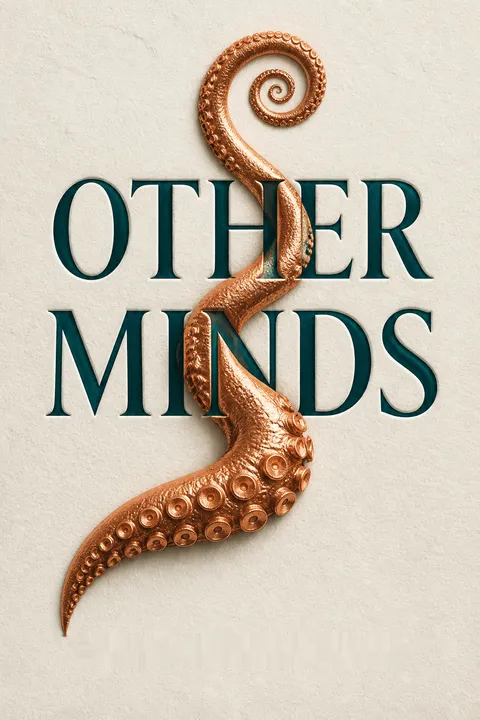
Other Minds works across several scales at once: the slow branching of evolutionary history, the organization of a nervous system, the moment-to-moment loop between sensing and action, and the uncertain character of experience. Its central method is comparison. Octopuses are neither miniature humans nor blank biological mechanisms; their distance from us makes them a test of which features of mind are shared solutions and which are peculiar to our lineage.
The book’s most consequential move is to treat the evolution of mind as plural. Large nervous systems arose independently in vertebrates and cephalopods, and perhaps complex experience emerged along multiple branches too. This weakens any account that treats human cognition as the universal template. It also encourages a layered vocabulary: basic sentience need not entail reflective consciousness, while advanced reasoning need not require language. The framework is intellectually generous without claiming that every organism has an inner life.
The evidence is uneven by nature. Fossils reveal bodies more readily than behavior; laboratory tasks can make unusual animals look dull when the test is poorly matched to their motivations; field anecdotes are vivid but difficult to control. Godfrey-Smith acknowledges these limits and uses them productively, though the account of early subjective experience remains more conjectural than its anatomical and behavioral examples. That gap is not a flaw unique to this book. Experience is not directly observable from outside, so claims must combine behavioral flexibility, nervous organization, and evolutionary plausibility without treating any one as decisive.
The broader implication is methodological as well as ethical. Studying minds requires attention to the animal’s whole way of living, including its body, habitat, and lifespan. The short-lived octopus is not an unfinished human; its intelligence is fitted to a different set of demands. That perspective makes curiosity more disciplined: resemblance invites comparison, difference prevents projection, and uncertainty becomes a reason for careful study and humane treatment.
Review Summary
Other Minds explores the intelligence and consciousness of cephalopods, particularly octopuses and cuttlefish. Godfrey-Smith combines scientific observations with philosophical inquiries to examine the evolution of consciousness. While many readers found the book fascinating, some felt it meandered or lacked focus at times. The author's personal experiences with octopuses and cuttlefish provide engaging anecdotes. The book challenges readers to consider the nature of intelligence and consciousness in creatures vastly different from humans. Overall, it offers thought-provoking insights into the minds of these remarkable sea creatures.
People Also Read



Glossary
action-shaping view
Nervous systems coordinate movementA view of nervous system function that emphasizes organizing the many small actions of an animal’s parts into coherent whole-body movements. It complements the sensory-motor view, which emphasizes using sensory information to select actions. The distinction is especially useful when considering early animals whose nervous systems may have coordinated movement before complex environmental tracking became central.
sensory-motor view
Perception guides actionAn account of nervous system function in which sensory systems gather information about the environment and the nervous system uses that information to guide behavior. It treats the connection between perception and action as a central role of nervous systems. The book sets it alongside the action-shaping view, which emphasizes coordination within the moving body.
sentience
Capacity for felt experienceThe capacity for there to be something it feels like to be an organism. In the book, sentience is broader and more basic than consciousness understood as an organized, unified, or reflective form of awareness. The distinction allows the possibility that an animal can feel pain or other states without possessing humanlike thought or a sophisticated inner model of the world.
transformation view
Experience changes with cognitionThe view that subjective experience began in relatively simple forms before capacities such as integrated perception, sophisticated memory, and working memory evolved. These later capacities transformed experience rather than creating it from nothing. The view contrasts with latecomer accounts that associate subjective experience itself with cognitive machinery found mainly in more complex animals.
latecomer views
Experience arose relatively lateTheories that place the emergence of subjective experience relatively late in animal evolution, linking it to capacities such as an integrated model of the world, working memory, or a global workspace. These accounts do not require a sudden appearance, but they distinguish animals with the relevant complex machinery from simpler animals whose sensing and behavior may occur without experience.
efference copy
Internal signal of an actionAn internal signal associated with a movement command that helps an animal account for the sensory consequences of its own actions. For example, moving the eyes changes the image on the retina, but the world is not normally experienced as shifting with every eye movement. An efference copy can help distinguish changes caused by self-movement from changes caused by outside events.
reafference
Sensation caused by self-actionSensory input produced by an organism’s own actions, as distinguished from input caused by events outside it. A moving animal must account for reafference because its movements alter what it senses. This input can confuse perception, but it can also be useful, as when an organism deliberately changes its surroundings so that it can later sense the result.
quorum sensing
Chemical sensing of nearby numbersA communication process in which bacteria release and detect chemical signals that indicate how many similar bacteria are nearby. When the signal reaches a sufficient level, the bacteria can coordinate an activity that is useful only when many participate. In the book’s example, bacteria living inside a Hawaiian squid produce light collectively, benefiting the squid’s camouflage while receiving shelter in return.
ecosystem engineering
Animals reshape their habitatThe alteration of an environment by organisms in ways that change the conditions experienced by other organisms. At Octopolis, octopuses brought scallops to a favored den and left the shells behind. The growing shell bed provided material for additional dens and attracted other species, turning the octopuses’ foraging behavior into a lasting change to their local habitat.
semelparous
Reproduces in one episodeDescribes an organism that reproduces once, or within one short reproductive period, rather than repeatedly over an extended life. Female octopuses usually lay a single clutch of eggs, tend it until hatching, and die soon afterward. The term helps explain how reproduction, external risks, and evolutionary trade-offs can be associated with a short lifespan.
episodic-like memory
Memory of what, where, whenA form of memory tested in animals by examining whether they remember what occurred, where it occurred, and when. The label is cautious because researchers cannot establish that the memory has the same subjective quality as human episodic memory. In a cuttlefish study, animals learned when different foods would become available again and chose feeding locations accordingly.
FAQ
What's Other Minds about?
- Exploration of consciousness: Other Minds by Peter Godfrey-Smith explores the evolution of consciousness, focusing on cephalopods like octopuses and cuttlefish. It examines their complex behaviors and intelligence despite different evolutionary paths.
- Evolutionary perspective: The book traces the history of animals to their common ancestors, exploring how consciousness evolved over millions of years. This narrative provides a framework for understanding the development of minds in various species.
- Philosophical inquiry: Godfrey-Smith combines philosophy with biology, asking profound questions about the nature of mind and experience. He seeks to understand how sentience arises from biological processes.
Why should I read Other Minds?
- Unique insights into intelligence: The book offers a fresh perspective on intelligence by examining cephalopods, challenging the view that intelligence is exclusive to mammals and birds.
- Engaging narrative style: Godfrey-Smith writes in an accessible manner, making complex scientific concepts understandable. His personal experiences with cephalopods add a captivating element.
- Philosophical depth: Readers interested in consciousness will find thought-provoking discussions. It encourages reflection on what it means to be sentient and how different life forms experience the world.
What are the key takeaways of Other Minds?
- Consciousness is evolutionary: The book emphasizes that consciousness evolved gradually through complex biological processes, highlighting the continuity of life and shared experiences across species.
- Cephalopods as intelligent beings: Godfrey-Smith argues that cephalopods showcase complex behaviors and problem-solving abilities, suggesting a form of sentience distinct from mammals.
- Mind-body connection: The author explores how an organism's body influences its mind, raising questions about how different bodies shape consciousness.
How does Other Minds relate to the philosophy of mind?
- Philosophical exploration: Godfrey-Smith engages with classic philosophical questions about consciousness and subjective experience, bridging philosophical inquiry and scientific understanding.
- Evolutionary approach: The book suggests that understanding the development of minds in different species can inform philosophical discussions about sentience, challenging views focused solely on human consciousness.
- Mind-body relationship: The author examines how cephalopods' physical structure influences their mental experiences, contributing to the discourse on the connection between mind and body.
What role do cephalopods play in understanding consciousness in Other Minds?
- Independent evolution of intelligence: Cephalopods have evolved complex nervous systems and behaviors independently from mammals, making them crucial for studying alternative forms of intelligence.
- Unique sensory experiences: The book highlights how cephalopods perceive and interact with their environment, offering insights into different modes of consciousness.
- Comparative analysis: By comparing cephalopods to other intelligent species, Godfrey-Smith provides a broader context for understanding consciousness.
What are the best quotes from Other Minds and what do they mean?
- “If we can make contact with cephalopods as sentient beings...” This quote underscores the idea that intelligence can arise independently in different evolutionary paths, highlighting cephalopods' uniqueness.
- “The octopus is not a survivor but a second expression...” Godfrey-Smith suggests octopuses represent a parallel evolution of intelligence, emphasizing life's diversity.
- “The history of animals has the shape of a tree.” This metaphor illustrates the branching evolution of species, indicating how different life forms emerged from common ancestors.
How does Peter Godfrey-Smith connect cephalopods to consciousness?
- Evolutionary insights: Godfrey-Smith argues that studying cephalopods provides insights into the evolution of consciousness, reflecting parallel evolutionary paths to those in vertebrates.
- Comparative analysis: He compares cephalopod intelligence to mammals and birds, highlighting similarities and differences in cognitive abilities.
- Philosophical framework: By integrating philosophical discussions, Godfrey-Smith enriches the scientific analysis of cephalopod behavior, emphasizing inner speech and self-awareness.
How does Other Minds challenge traditional views of intelligence?
- Intelligence beyond mammals: Godfrey-Smith argues that intelligence is not limited to mammals and birds, as evidenced by cephalopods' complex behaviors.
- Diverse expressions of intelligence: The book highlights various ways intelligence can manifest, broadening the definition beyond traditional metrics.
- Evolutionary context: By placing cephalopods within an evolutionary framework, Godfrey-Smith illustrates how intelligence can arise independently in different lineages.
What scientific methods does Godfrey-Smith use in Other Minds?
- Comparative analysis: The author examines the evolutionary history of cephalopods alongside other intelligent species, deepening the understanding of consciousness development.
- Philosophical inquiry: Godfrey-Smith integrates philosophical questions with scientific research, exploring cephalopod intelligence's implications for understanding consciousness.
- Field observations: His fieldwork and observations of cephalopod behavior provide empirical evidence to support his arguments.
What evolutionary theories does Other Minds discuss?
- Medawar-Williams Theory: Godfrey-Smith explores this theory of aging, suggesting aging is a byproduct of natural selection, with late-acting mutations leading to age-related decline.
- Convergence and divergence: The book discusses convergent evolution, where different species develop similar traits independently, using cephalopods and vertebrates as examples.
- Cognitive evolution: Understanding cognition's evolution requires examining diverse pathways taken by different species, with cephalopods offering a unique perspective.
How does Godfrey-Smith describe the social behavior of octopuses in Other Minds?
- Complex interactions: Octopuses exhibit complex social behaviors, including aggression, cooperation, and communication, particularly in environments like Octopolis.
- Color change as communication: They use color change to communicate during social interactions, conveying information about intentions and emotional states.
- Ecosystem engineering: Octopuses modify their environment, creating shelters and dens that facilitate social interactions, illustrating their role as ecosystem engineers.
What is the significance of Octopolis in Other Minds?
- Unique habitat: Octopolis is a unique environment where octopuses exhibit social behaviors rarely observed in the wild, allowing for controlled study.
- Ecosystem engineering: The presence of a metal object has led to a shell bed, which octopuses use to create dens, enhancing social interactions and survival.
- Research opportunities: Octopolis provides valuable opportunities for researchers to observe and document octopus behavior, contributing to understanding cephalopod intelligence.
Download PDF
Download EPUB
.epub digital book format is ideal for reading ebooks on phones, tablets, and e-readers.








