

Key Takeaways
Share a room with animals and you share almost no world at all.
One room, many worlds. A robin, a bat, a rattlesnake, and a human may occupy the same gym, yet each detects different parts of it. The robin can sense Earth’s magnetic field. The rattlesnake detects the mouse’s body heat. The bat hears echoes beyond human hearing. The flower’s ultraviolet markings stand out to a bee but not to a person. Ed Yong uses the term Umwelt for the part of an animal’s surroundings that it can sense and experience. It is not the whole environment, but the creature’s lived world within it.
Limits shape experience. Human perception feels complete because it is all we directly know. But every species, including ours, filters reality. The book’s challenge is to study animals on their own terms, rather than treating human senses as the standard.
What's striking is that this idea makes humility a practical scientific tool, not just a virtue. If an animal does not respond to a cue, that may reveal the limits of the experimenter's model, not the animal's abilities. The same caution applies to human judgments of other people: behavior that appears inattentive or irrational may make sense within a different set of available signals. The idea does have a boundary. A sensory world can be inferred from receptors and behavior, but those clues cannot provide direct access to another creature's subjective experience.
Judge senses by the job they solve, not by human standards.
Every sense has a price. Sensory organs and the nervous systems that interpret their signals require energy, even when an animal is not actively using them. More input is not automatically better: an animal flooded with irrelevant signals could struggle to act. Evolution instead favors sensory abilities that help with particular needs, such as locating food, avoiding predators, or finding mates.
Fit beats rank. A starfish’s simple eyes help it detect a large shape and move toward a reef, which is enough for its slow life. An eagle’s sharp vision helps it spot prey at great distances, while a nocturnal hunter may sacrifice detail for sensitivity in dim light. The book also considers the hypothesis that the longer sight available to early land animals helped support planning. The key point is not that one sense is superior, but that each is suited to a life.
This is an ecological version of engineering: a design is judged against its operating conditions, not an abstract ideal. The same principle helps explain why technological solutions often fail when they optimize one metric while ignoring context. A high-resolution sensor is useless if it cannot function in darkness or if its energy cost is prohibitive. The comparison also guards against an easy evolutionary story in which every trait is assumed to be perfectly adapted. The evidence can show how a sense works and what it supports, while the full path that produced it may remain uncertain.
Let a dog's nose lead sometimes; scent carries maps, memory, and mood.
Smell unfolds over time. A dog exploring a room is not simply inspecting objects with its nose. Odor travels around corners, lingers after its source has gone, and can arrive before the source itself. Alexandra Horowitz describes scent as information about who passed through, where they went, and what may be nearby. Dogs can follow trails, identify people, and detect substances ranging from explosives to disease markers.
Sniffing is a need. In a small study, dogs given two weeks of scent-finding activities became more likely to approach an ambiguous food bowl, a result interpreted as a more positive judgment bias. Dogs doing obedience exercises did not show the same change. The finding suggests that sniffing and independent exploration may support canine well-being. A slow walk led by a dog’s nose can therefore offer something beyond exercise: access to the animal’s primary way of exploring its surroundings.
This example turns a routine human judgment into a question about whose purpose governs an activity. A walk can be exercise and transportation for a person, while serving as exploration for a dog. That distinction matters whenever one species controls another's environment. The reported optimism effect is suggestive, not proof that scent work reliably improves every dog's mood; the study was small and short. Still, the broader lesson is sturdy: allowing an animal to use a central ability may improve its agency, even when the activity looks inefficient from a human perspective.
Never assume an animal sees the colors or details you do.
Eyes solve different problems. Most humans have three kinds of color-sensitive cone cells. Dogs have two and perceive a narrower range, while many birds have four, including sensitivity to ultraviolet light. This changes what signals are visible: flowers can display ultraviolet patterns to bees, and birds can distinguish markings that appear identical to people.
Human visibility misleads. Zebra stripes look vivid to us, but lions can distinguish the bands only at much shorter distances than people can. The stripes are therefore unlikely to camouflage zebras from predators at a distance. Research described in the book instead supports a role in deterring biting flies. Color itself is also constructed by the nervous system, not simply delivered by the eye. More photoreceptor types do not guarantee better color discrimination: mantis shrimp have many classes of receptors yet performed poorly in tests distinguishing similar colors.
The important correction is not merely that other species see extra colors. Their visual systems divide attention, motion, and detail differently, so a human-style image may be the wrong model altogether. This has consequences for design: signs, barriers, and displays that are obvious to people can disappear into an animal's visual background. The mantis shrimp also offers a useful warning against equating biological complexity with performance. A large number of sensory channels may support a different task rather than a richer version of human perception.
Touch can reach beyond skin, through webs, water, sand, and air.
Contact is only one form. A star-nosed mole explores its dark tunnels by pressing a ring of touch-sensitive rays against nearby surfaces. Its smallest pair acts like a tactile focus point, and it can identify prey and begin eating in as little as 120 milliseconds. A harbor seal uses its whiskers differently: it can follow the lingering water wake of a swimming object, even while blindfolded.
The environment can become an organ. A spider’s web carries vibrations to the spider and extends its ability to detect struggling prey. The spider can adjust the web’s tension, changing which vibrations reach it. Other animals feel pressure waves in sand or currents in water. These examples make touch less like a passive sense limited to the skin and more like active exploration of nearby physical changes.
These cases broaden the usual boundary between an organism and its surroundings. A web can function as part of a spider's sensing system, while moving whiskers or a probing nose make perception an action rather than a stream of incoming data. This resembles a general principle of embodied cognition: information is gathered through movement, posture, and contact with the environment. The analogy should not erase differences between species. A seal's wake-tracking, a mole's touch, and a spider's web vibrations are distinct abilities, even when all are casually called touch.
Echolocation is active sensing, not simply hearing in the dark.
The animal sends the question. Echolocation is the use of emitted sounds and returning echoes to locate objects. A bat adjusts its calls as it hunts: broad, spaced pulses help it search, while faster, shorter calls provide more detail as it closes in. Its final rapid burst helps track a target's last movements. The bat is not just listening to a finished soundscape; it is changing its calls to shape the information it receives.
Sound can explore. Dolphins use sonar to distinguish objects by shape, material, and size, and can detect some buried targets. Blind human echolocator Daniel Kish uses mouth clicks to map obstacles and spaces while walking. His experience shows that human sonar can support independent navigation, though its resolution differs from that of bats and dolphins. In each case, the returning echo is useful because the animal has produced a signal and interpreted its response.
Echolocation reveals perception as a feedback loop: act, receive a response, revise the next act. That model connects sensing with inquiry, because the organism actively probes uncertain surroundings rather than waiting for information to arrive. It also clarifies why the same stimulus can be both communication and exploration in some species. Claims about what an echo feels like to a bat remain necessarily indirect, however. Researchers can measure calls, responses, and neural processing, but those measurements do not settle the nature of the animal's conscious experience.
Treat electrical and magnetic cues as real landscapes, not magic.
Electric fields make nearby objects legible. Some fish generate an electric field and detect how objects distort it. This ability, called active electrolocation, helps a black ghost knifefish navigate and find prey in dark or murky water, but works only at close range. Sharks use a different strategy: their electroreceptors detect the faint fields produced by living animals, helping them locate prey near the final moment of a hunt.
Magnetism guides journeys. Magnetoreception is the ability to detect Earth’s magnetic field. Loggerhead turtle hatchlings can use its intensity and angle as map-like cues during migration. The sensory receptors responsible remain unknown, and research has produced disputed findings. Several mechanisms may be possible, but the evidence does not yet identify a complete explanation. These are physical senses with measurable effects, not supernatural powers, even when their mechanisms are difficult to understand.
These examples show how unfamiliarity can distort judgment in two directions: a genuine ability may be dismissed as impossible, or an intriguing hypothesis may be treated as established fact. Magnetoreception is especially instructive because the behavior is well supported while its biological sensor remains unresolved. Keeping those claims separate is not timid science; it is what makes later discoveries trustworthy. The broader implication is that a landscape is not only terrain. For different animals, it can also be a pattern of conductivity, magnetic coordinates, or other physical features that human perception does not register.
Separate damage detection from suffering, then choose precaution.
Detection is not the whole experience. Nociception is the nervous system’s detection of potentially harmful stimuli. Pain is the distressing experience that may follow. The two often occur together, but they can come apart: a reflex can withdraw a limb before conscious pain is felt, and pain can persist without an immediate injury signal. Naked mole-rats, for example, are unusually insensitive to acids that would hurt people, yet they still respond to other harmful stimuli.
Animal pain is difficult to assess. Fish injured with acid or venom changed their behavior for hours, and some behavior shifted after painkillers. Octopuses also showed responses consistent with pain, including avoiding places associated with injury. The evidence for insects and crustaceans is less conclusive. Because behavior and nervous systems vary across species, the book argues for careful, species-specific judgments and humane caution where suffering remains plausible.
This distinction helps avoid two symmetrical errors: treating every injury response as proof of human-like suffering, or treating the absence of human-like anatomy as proof that suffering is impossible. The ethical stakes make uncertainty different from ordinary scientific uncertainty. Waiting for definitive access to another animal's subjective experience may mean waiting forever, while the animal bears the risk in the meantime. Precaution need not mean claiming certainty. It means making welfare decisions that account for credible evidence and the consequences of being wrong.
An animal's world is assembled by interacting senses and a moving body.
Senses work together. A mosquito seeking a person responds to several cues, including carbon dioxide, skin odor, visual contrast, heat, and taste. Heat can repel it when carbon dioxide is absent, then attract it once the smell of a potential host is detected. Removing one cue may not stop the search because the insect can combine others.
Movement changes what sensation means. When an animal moves, its nervous system must separate signals caused by its own actions from signals caused by the outside world. A corollary discharge is a copy of a motor command that helps the sensory system predict the effects of movement. The octopus complicates the picture: much of its nervous system is in its arms, whose suckers combine touch and taste. Its perception is shaped not only by its senses, but by how its body is organized.
This view replaces the familiar picture of a central brain receiving neatly separated channels with a more distributed account of perception. It is especially useful for interpreting animals whose body plans differ radically from ours. A behavior that looks centrally planned might emerge from local sensing and control, as octopus arms suggest. Conversely, an animal's senses cannot be understood by listing organs alone; movement, internal feedback, and context change the information those organs provide. Researchers should therefore study whole animals in realistic settings, not just isolated receptors.
Protect the cues animals depend on, not just their visible habitats.
Pollution can be sensory. Artificial light and noise alter the signals animals use to navigate, forage, communicate, and avoid danger. By 2016, more than 80 percent of people lived under light-polluted skies. Researchers also found that human activity had doubled background noise in many protected areas. Bright lights can disorient migrating birds and turtles, while noise can mask animal calls and reduce the distance over which natural sounds travel.
Restoration can work through perception. At damaged Great Barrier Reef sites, researchers played recordings of healthy reefs over coral rubble. After 40 days, the acoustically enriched sites held twice as many young fish and 50 percent more species than silent sites. That is not a substitute for addressing climate change, but it shows that sensory conditions are part of habitat. Dimming lights, reducing noise, and preserving natural signals can directly improve the environments animals experience.
Conservation often maps habitat by visible features, but a place can look intact while its sensory conditions have been radically altered. The reef experiment makes this measurable: sound helped shape which animals settled and stayed. The practical advantage is that light and noise can often be reduced quickly, unlike persistent chemical pollution. Still, sensory repair should not be confused with ecological repair as a whole. Recreating one useful cue cannot compensate for warming oceans, damaged food webs, or lost shelter. It is a targeted intervention, valuable precisely because it complements broader protection.
Analysis
The book’s central achievement is to make sensory diversity more than a catalogue of animal oddities. Each example revises the reader’s default assumption that perception means constructing a human-like picture of the world. A star-nosed mole can locate food through rapid touch, a seal can follow a fading wake, and an electric fish can register an object through the disturbance it creates in a field. These are not inferior versions of sight. They are different ways of turning physical conditions into useful information.
The structure moves from individual sensory channels toward integration and consequence. That progression matters. Isolated chapters make unfamiliar systems legible, while the treatment of mosquitoes, octopuses, and animal movement shows why no sense can be fully understood alone. The final discussion of sensory pollution converts wonder into responsibility: human infrastructure can change not only where animals live, but what information remains available to them.
The book is strongest when it distinguishes observable ability from subjective experience. Researchers can establish that a turtle orients to magnetic cues without knowing what those cues feel like. They can find evidence consistent with pain without settling exactly how another species suffers. This disciplined uncertainty supports, rather than weakens, the ethical argument. It also prevents the tempting but mistaken leap from biological complexity to human equivalence.
A limitation follows from the method. Vivid descriptions can make an animal’s perceptual world feel almost accessible, even though the text repeatedly acknowledges that direct access is impossible. The reader must resist mistaking an informed analogy, such as sonar as touch at a distance, for a literal account of experience. Yet analogy is also how understanding begins. The book’s most durable lesson is not that people can become animals in imagination, but that careful science can expose the boundaries of human perception and give reasons to treat those boundaries as incomplete. Curiosity here is both an intellectual discipline and a conservation practice.
Review Summary
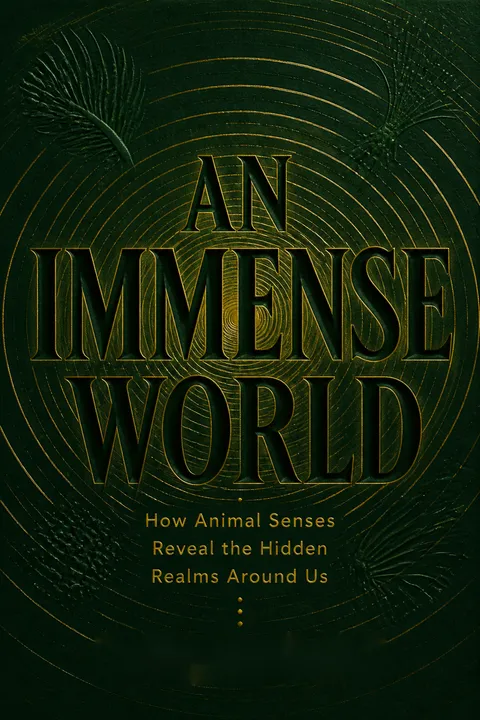
An Immense World explores animal senses, revealing fascinating insights into how different species perceive reality. Yong introduces the concept of Umwelt, each creature's unique sensory bubble. Readers are taken on a journey through various senses, from familiar ones to electric and magnetic fields. The book is praised for its engaging writing, thorough research, and thought-provoking content. While some found it overwhelming, most reviewers were captivated by the diverse sensory abilities of animals. The final chapter addresses human impact on animal sensescapes, adding depth to an already enlightening read.
People Also Read








Glossary
Umwelt
An animal's perceptual worldA term popularized by zoologist Jakob von Uexküll for the part of an animal’s surroundings that it can sense and experience. Two species can share the same physical environment while inhabiting different Umwelten, because their sensory systems detect different cues and assign them different importance.
matched filters
Sensors tuned to relevant cuesSensory systems are not designed to capture every possible stimulus. They are tuned to information that matters for an animal’s life, such as food, threats, shelter, or mates. Rüdiger Wehner used the term for sensory features calibrated to the signals an animal is most likely to need.
active electrolocation
Finding objects through self-made fieldsA sensing ability used by weakly electric fish. The fish generates an electric field around its body, then detects changes in that field caused by objects with different electrical properties. Those distortions help it estimate the location and shape of nearby objects, even in darkness or murky water.
magnetoreception
Sensing Earth's magnetic fieldThe ability of an animal to detect Earth’s magnetic field and use it for orientation or navigation. Some animals rely on the field as a compass, while others can use variations in its intensity and angle as map-like information. The sensory receptors and mechanisms involved remain incompletely understood.
nociception
Detecting potentially harmful stimuliThe nervous system’s detection of stimuli that may damage the body, such as extreme heat, pressure, acids, or injury-related chemicals. Nociception can trigger protective responses without necessarily producing conscious suffering. The book distinguishes this sensory process from pain, the distressing experience that may accompany it.
sensory exploitation
Using an existing sensory preferenceAn evolutionary process in which a signal or trait takes advantage of a preference already present in another animal’s sensory system. In túngara frogs, females were predisposed to respond to particular sound frequencies before males evolved calls that emphasized those frequencies. The preexisting bias helped shape the signal.
corollary discharge
A movement prediction for the sensesA copy of a motor command sent to sensory systems when an animal moves. It helps the nervous system predict the sensations that the movement itself will produce, making it easier to distinguish self-generated signals from changes caused by the outside world. The process supports stable perception during action.
sensory pollution
Human disruption of animal signalsArtificial light, noise, or other human-made stimuli that interfere with the cues animals use to navigate, forage, communicate, or avoid danger. Sensory pollution can shrink an animal’s usable environment even when the physical habitat remains present, by masking important signals or creating misleading ones.
FAQ
What's An Immense World about?
- Exploration of Animal Senses: An Immense World by Ed Yong explores how various animals perceive their environments through unique sensory adaptations, revealing the hidden realms these senses uncover.
- Concept of Umwelt: The book introduces "Umwelt," a term that describes the unique sensory world each species inhabits, emphasizing how different animals experience reality based on their sensory capabilities.
- Interconnectedness of Senses: Yong discusses how animals use multiple senses simultaneously, creating a rich tapestry of perception crucial for survival and interaction within ecosystems.
Why should I read An Immense World?
- Broadens Understanding of Nature: The book expands appreciation for the complexity of animal life and the various ways creatures interact with their environments, encouraging perspectives beyond human experience.
- Engaging Storytelling: Ed Yong combines scientific research with captivating narratives, making complex topics accessible and enjoyable, inviting readers to explore the wonders of the natural world.
- Awareness of Sensory Pollution: It raises awareness about the impact of human activity on animal senses, such as light and noise pollution, inspiring readers to advocate for conservation efforts.
What are the key takeaways of An Immense World?
- Diversity of Sensory Experiences: Animals perceive the world in ways vastly different from humans, with unique adaptations like echolocation in bats and electric fields in fish.
- Impact of Environment on Senses: Environmental factors shape sensory adaptations, such as electric catfish evolving to detect electric fields crucial for survival in murky waters.
- Human Influence on Animal Senses: Human-induced changes, like light and noise pollution, disrupt sensory landscapes, highlighting the urgent need for conservation efforts.
What are the best quotes from An Immense World and what do they mean?
- “Earth teems with sights and textures...”: This quote encapsulates the richness of the natural world and the myriad ways animals interact with it, urging recognition of life's complexity beyond human senses.
- “Each is enclosed within its own unique sensory bubble...”: Highlights the concept of Umwelt, illustrating that every species has a limited perception of reality, shaped by its sensory abilities.
- “We have to save the quiet, and preserve the dark.”: Reflects the call to action for preserving natural soundscapes and darkness for wildlife, emphasizing the detrimental effects of sensory pollution.
How does Ed Yong define the concept of Umwelt in An Immense World?
- Specific Perceptual World: Umwelt refers to the part of the environment that an animal can sense and experience, unique to each species, shaping their interaction with surroundings.
- Comparison to a House: Yong likens an animal's body to a house with many windows, each representing a different sense, illustrating limited perception of the larger world.
- Radical Notion: Challenges traditional views of animals as mere machines, recognizing them as sentient beings with their own inner worlds worth contemplating.
How does An Immense World address the impact of human activity on animal senses?
- Threatened Sensescapes: Human activities, such as pollution and habitat destruction, threaten the sensory environments animals rely on, disrupting communication, navigation, and survival.
- Misunderstanding Animal Needs: Lack of understanding of animal senses can lead to poor conservation practices, with urban environments overwhelming animals adapted to quieter habitats.
- Call for Conservation: Yong advocates for protecting diverse ecosystems, highlighting that preserving sensory landscapes is crucial for animal survival and well-being.
What unique sensory adaptations are discussed in An Immense World?
- Echolocation in Bats and Dolphins: Bats and dolphins use echolocation to navigate and hunt, emitting sounds that bounce off objects, creating a mental map of surroundings.
- Electric Senses in Fish: Certain fish, like electric eels, generate and detect electric fields to navigate and communicate, essential for survival in murky waters.
- Magnetoreception in Migratory Animals: Animals like birds and turtles use Earth's magnetic field to navigate during migrations, crucial for long-distance travel.
How does Ed Yong explain sensory exploitation in An Immense World?
- Definition of Sensory Exploitation: Occurs when one species evolves traits that exploit the sensory biases of another, shaping the evolution of communication signals.
- Example of Túngara Frogs: Male frogs produce calls that appeal to females' sensory biases, increasing mating success by tapping into pre-existing preferences.
- Evolutionary Implications: Sensory preferences can drive the evolution of traits in other species, illustrating dynamic interplay in communication systems.
How does An Immense World illustrate the interconnectedness of senses?
- Multisensory Integration: Animals often rely on multiple senses simultaneously, like mosquitoes using smell, heat, and taste to locate hosts, creating a comprehensive understanding of surroundings.
- Cross-Modal Recognition: Some animals recognize objects using different senses, such as electric fish identifying shapes through vision and electric fields, showcasing sensory system adaptability.
- Impact of Sensory Overload: Human activity can disrupt natural integration of senses, leading to confusion and maladaptive behaviors, highlighting the importance of balanced sensory environments.
What role does technology play in understanding animal senses in An Immense World?
- Innovative Research Methods: Scientists use advanced technologies, like high-speed cameras and acoustic sensors, to study animal senses, capturing behaviors previously impossible to analyze.
- Visualizing the Invisible: Technology helps make invisible sensory phenomena, like electric fields and sound waves, visible, aiding in understanding animal-environment interactions.
- Bridging Gaps in Knowledge: Enables data collection that bridges gaps in understanding animal senses, uncovering new insights into sensory worlds of various species.
How does An Immense World address the concept of pain in animals?
- Complexity of Pain Perception: Pain is not uniform across species; different animals perceive and respond to pain based on ecological needs and evolutionary history.
- Behavioral Responses: Some animals, like insects, may tolerate pain differently than mammals, raising questions about pain's nature and adaptive significance.
- Ethical Implications: Understanding pain perception has important implications for animal welfare and ethics, influencing treatment of other species.
What insights does An Immense World provide about the evolution of sensory systems?
- Adaptive Significance: Sensory systems evolve in response to environmental pressures, enhancing species' ability to detect and respond to stimuli, crucial for survival.
- Convergence of Sensory Traits: Instances of convergent evolution show unrelated species developing similar sensory adaptations, underscoring sensory systems' importance across taxa.
- Interplay Between Senses: Different sensory modalities work together to shape perception, reflecting evolution's dynamic nature and ongoing species adaptations.
About the Author
Other books by Ed Yong

Download PDF
Download EPUB
.epub digital book format is ideal for reading ebooks on phones, tablets, and e-readers.








