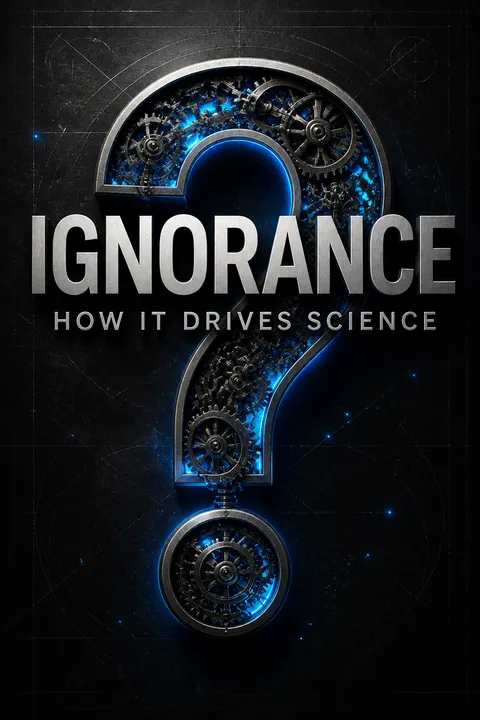


Key Takeaways
Treat ignorance as science's engine, not as a defect to hide
The unknown is the work. Firestein noticed that his neuroscience lectures made the field look like a finished catalogue of facts. In the laboratory, scientists spoke instead about unresolved problems, missing evidence, and what might change their minds. He built a Columbia course around researchers describing what they did not yet understand and how they might find out more.
Not all ignorance is equal. Willful disregard rejects evidence; the productive kind is a communal gap in knowledge, where information is missing or existing findings do not yet make sense. Firestein calls this informed ignorance. Facts remain essential, but they serve as starting material for sharper questions. Each discovery expands the boundary of what can be investigated rather than completing a fixed puzzle.
The distinction matters because uncertainty is not automatically wise. Productive ignorance is disciplined: it acknowledges what evidence can support, identifies what is missing, and invites correction. This resembles intellectual humility in philosophy, but it also has practical consequences for research culture. When scientists can discuss unresolved questions without treating them as personal failures, disagreement becomes a tool for locating weak assumptions. The approach does not excuse indifference to established evidence. It asks for the opposite: enough knowledge to recognize precisely where explanation breaks down.
Use every fact as a foothold, never as a final resting place
Facts can harden into myths. The familiar tongue map, assigning sweet to the tip and bitter to the back, grew from a study reporting only slight differences in sensitivity. A translation overstated the result, and repetition helped turn it into textbook truth. In another example, neuroscience textbooks long repeated an estimate of 100 billion neurons and ten times as many glial cells. Later counting found about 86 billion neurons and roughly as many glial cells.
Tools shape what gets seen. Early electrical recordings made neural spikes highly visible, so researchers built theories around them while other signals remained harder to detect. A fact is therefore not immune to revision just because it is precise, widely taught, or useful. New instruments and better measurements can change what appears settled.
These examples expose a quiet weakness in how knowledge travels: repetition can look like verification. A textbook may preserve a claim long after its evidential origins have faded from view. The remedy is not blanket distrust, but traceability. Researchers and educators can distinguish direct measurement, interpretation, and inherited convention, then make the evidence behind each visible. This is especially important when one measurement technology makes some phenomena easy to notice and others nearly invisible.
Let limits expose new questions instead of ending inquiry
Some boundaries are real. Heisenberg's uncertainty principle describes a limit on simultaneously knowing certain properties of subatomic particles, not merely a flaw in measuring equipment. Gödel showed that sufficiently powerful mathematical systems cannot establish every truth using only their own rules. These results challenge the hope that science or mathematics can become complete inventories of certainty.
A limit can become useful knowledge. The square root of two cannot be written as a ratio of whole numbers, a discovery that unsettled early Greek mathematicians. Mathematicians eventually treated such values as irrational numbers and developed ways to work with them. Likewise, physical uncertainty and mathematical incompleteness have generated new investigations. Firestein invokes Copernican cognitivism, the idea that human thought may not occupy a privileged position from which reality is fully graspable.
The distinction between a practical obstacle and an in-principle limit is crucial. Better instruments can overcome the first, but not necessarily the second. Recognizing that difference prevents wasted effort while also revealing new kinds of inquiry, such as studying probabilities rather than seeking impossible certainty. Still, a formal limit in physics or mathematics should not be casually applied to everyday problems. The useful lesson is narrower: knowing why a question cannot be answered in its original form can help researchers ask a more productive one.
Forecast the questions that matter, not discoveries on a schedule
Questions age better than predictions. In 1900, mathematician David Hilbert presented 23 problems he considered important for the coming century. About 10 were later regarded as solved by consensus; others remained partial, open, or impossible to settle. Hilbert did not promise dates or outcomes. He mapped areas of ignorance and helped shape mathematical work.
Basic research can travel unexpectedly. In 1928, Paul Dirac's equations implied the existence of the positron, then unobserved. Carl Anderson detected it in 1932. Decades later, positrons became central to PET medical imaging. Neither scientist could have planned that application. The example complicates the division between basic and applied science: pursuing a fundamental question can create tools and uses that no forecast could specify.
A question-led research agenda is more honest than a timetable of promised breakthroughs, especially where outcomes depend on discoveries that cannot yet be imagined. Yet public investment still needs scrutiny. The strongest alternative is not to abandon priorities, but to evaluate a varied portfolio: some work can target urgent needs, while other work develops explanations and methods whose uses remain unknown. Dirac's story illustrates possibility, not a guarantee that every basic project will produce a practical payoff.
Turn cosmic impossibility into a laboratory of evidence
The universe supplies unusual experiments. Astronomers cannot travel to distant stars, manipulate them, or repeat a cosmic event on demand. David Helfand treats a supernova remnant like a forensic scene: its traces help reconstruct what happened, while historical records can help date the explosion. Because light takes time to arrive, observing faraway space also means looking into the past.
A nuisance became a clue. Two radio astronomers investigating a persistent signal in their equipment found that it came from the cosmic microwave background, a remnant of the early universe. Tiny variations in that background now help test ideas about cosmic inflation, an early period of rapid expansion. The evidence is difficult to collect and interpret, but limits on direct experimentation have not made cosmology scientifically empty.
Cosmology shows that experimental control is not the only route to strong evidence. Researchers can compare independent traces, test whether a model explains multiple observations, and improve instruments to distinguish competing accounts. The tradeoff is that a unique universe offers no second sample for comparison, and interpretations can depend on assumptions about distant conditions. That makes calibration, transparency, and converging evidence especially important. Constraints do not erase rigor, but they make the shape of rigor field-specific.
Choose questions that connect widely and can still be tested
Good questions have room to grow. Mathematician Maria Chudnovsky describes an interesting problem as one that connects to other questions and leads somewhere. A question can also be tractable: Peter Medawar's Art of the Soluble values showing that a problem can, in principle, be solved. Neither quality is an absolute rule. Research on an obscure organism may look isolated until it suddenly connects to a larger problem.
The small can unlock the large. Microbiologist Thomas Brock and student Hudson Freeze studied heat-loving microbes in hot springs. Their heat-resistant enzymes later proved useful in PCR, a laboratory technique that repeatedly heats and cools genetic material. A model system is a simpler organism or setup used to investigate mechanisms relevant to a more complex one. Its value depends on choosing a question the model can genuinely illuminate.
This is a practical theory of research choice, not a recipe for certainty. Connected questions offer intellectual leverage, while tractability gives a project a plausible route to evidence. Curiosity-led work can also pay off through links nobody could predict, as the microbial enzymes demonstrate. But relevance must be established, not assumed: a model organism can reveal a mechanism without standing in for every feature of a human system. The strongest projects make that bridge explicit and test its limits.
Protect anomalies from the hypotheses that would explain them away
Unexpected results deserve attention. A hypothesis can guide an experiment, but it can also make researchers favor supporting evidence and dismiss inconvenient observations. Neuroscientist Alan Hodgkin reportedly gave little attention to expected results, but sat down with students when an observation did not fit. Such anomalies can expose a faulty assumption or point toward a better question.
Curiosity still needs direction. Firestein favors curiosity-driven research, not aimless data collection. Researchers need enough background to choose promising places to investigate, while remaining willing to revise their expectations. The story of serendipity is not simply that discoveries happen by luck. A prepared researcher notices an unexpected result, checks it carefully, and follows its implications instead of forcing it back into the original theory.
Anomaly-seeking is a valuable counterweight to confirmation bias, but it can create its own trap: unusual results are also more likely to arise from noise or chance. Modern safeguards such as preregistered predictions and independent replication can protect against both selective interpretation and overenthusiasm. The point is not to choose curiosity over rigor. It is to preserve a place for exploration alongside confirmatory testing, so that research can notice surprises without mistaking every surprise for a discovery.
Let animals reveal capacities before defining what their minds must be
Human cues can fool researchers. Clever Hans, a horse said to solve arithmetic, was actually responding to subtle changes in questioners' posture when they knew the answer. This helped motivate double-blind procedures, in which relevant people do not know which result is expected. Such controls are difficult in animal cognition, since removing social cues can also remove part of the behavior being studied.
Create an opportunity, then observe. Psychologist Diana Reiss used mirrors to study whether dolphins could recognize themselves. Dolphins showed behavior associated with self-directed mirror use, as did elephants in later work. These findings challenged the assumption that such abilities belonged only to primates. They do not settle what an animal subjectively experiences, but they make better questions possible about how self-recognition and other cognitive capacities develop.
Animal cognition sits at the intersection of experimental design and moral judgment. If researchers demand human-like performance before accepting evidence of animal thought, their standards may prejudge the result. Yet interpreting behavior as proof of an inner experience can project human expectations onto other species. The productive middle ground is careful operational testing: specify what a behavior demonstrates, control for alternative explanations, and avoid claiming more than the evidence supports. That discipline keeps the question open without making it vague.
Study ordinary memory to test the brain's most confident theories
Everyday recall hides a hard problem. People have recognized more than 90 percent of as many as 10,000 briefly shown images. Neuroscientists Larry Abbott and Stefano Fusi compared this capacity with models in which memories are stored by changing the strength of synapses. Their calculations suggested that, in a warm biological brain, memory capacity in those models grows roughly with the logarithm of the number of synapses, not in direct proportion to it.
The mismatch opens a question. If new memories overwrite old ones, ongoing brain activity may contribute to forgetting, rather than time alone. The researchers treated the discrepancy as a problem demanding new mechanisms, not as a minor adjustment to existing theory. Their result did not solve memory. It showed that familiar accounts might not explain the ordinary, rapid formation of memories we take for granted.
The power of this case lies in a mismatch between a measurable capability and a theory that seems intuitive. A large supply of neural connections sounds as though it should guarantee vast storage, but biological systems do not necessarily scale like computers. The theoretical result is a challenge to existing models, not a direct census of memories in a living brain. That distinction matters: calculations can reveal a hidden problem, while experiments must determine how much the proposed account matches actual memory.
Treat movement as a decision shaped by reward, not mere muscle
Slow action need not mean weak action. People with Parkinson's disease often move slowly, yet early-stage patients can move rapidly when circumstances demand it. Research discussed by Firestein points toward a faulty calculation of movement's cost, rather than simple inability to execute it. A person may be capable of a faster movement but not sufficiently motivated to choose it.
Dopamine links action and value. Parkinson's involves the loss of a small group of dopamine-producing neurons, with effects across brain systems. Dopamine's role in movement and reward suggests these functions are connected: the brain evaluates actions as well as issuing motor commands. This reframes rehabilitation questions. Improving movement may require understanding what makes an action seem worth the effort, not only strengthening the muscles or repairing their control.
This account makes a useful bridge between motor neuroscience and decision-making. Everyday movement appears automatic, but the brain constantly balances speed, effort, accuracy, and risk. A reward-based explanation can help make sense of why a movement is possible yet not selected at its usual pace. It should not be treated as a complete explanation of Parkinson's or a substitute for clinical evidence. Its value is that it changes what researchers measure and which treatment mechanisms they consider.
Build a career by following curiosity and using mentors well
A scientific path can begin sideways. Firestein spent more than 15 years working in theater before taking an animal behavior course at age 30. A generous teacher, Hal Markowitz, helped turn a casual interest into serious study. Firestein discovered that skills from theater, including memorizing scripts, helped him through organic chemistry. He later entered graduate school, completed his PhD around age 40, and built a research career studying smell.
Preparation makes accidents useful. His route depended on chance encounters and mentors, but also on the willingness to act when an opening appeared. A mentor in a retina laboratory helped him move toward olfaction when the data and his interest pointed that way. Firestein's story suggests that scientific careers are often less like a fixed plan than a sequence of experiments on one's own interests.
The story is a persuasive reminder that useful abilities often come from outside the field where they are applied. It also highlights how mentorship can supply both opportunity and standards, especially for someone entering a discipline by an unconventional route. A single successful biography cannot show that chance works equally well for everyone; access to supportive mentors is uneven. The broader lesson is institutional as much as personal: talent benefits when education leaves room for late starts, transferable skills, and exploratory turns.
Teach science through its live questions, not a mountain of facts
Facts without context alienate. Firestein argues that public accounts of science often report a result but omit the uncertainty, false starts, and unresolved questions behind it. The result is an intimidating impression of science as a secret storehouse of information. His alternative is to invite scientists to explain what they are trying to learn, what remains uncertain, and why the question matters.
Education should expose boundaries. Students need facts, but also practice seeing where those facts stop explaining. That shift would make science less like memorizing a large textbook and more like learning how evidence generates questions. Public understanding matters because scientific decisions involve shared resources and ethical debates, from medical research to climate and energy. Citizens need not become specialists to understand what a field is asking or what its evidence can and cannot establish.
Question-centered science communication can make expertise more accessible without pretending that technical knowledge is unnecessary. It gives audiences a way to follow the stakes even when they cannot reproduce an experiment or parse its mathematics. The challenge is that unresolved questions can be misrepresented as evidence that all claims are equally uncertain. Good public explanation must pair open questions with clear accounts of what is already well supported. Intellectual access depends on conveying both the frontier and the ground beneath it.
Analysis
Firestein's central move is to change the unit by which scientific progress is recognized. The popular story treats knowledge as a growing pile; his account treats it as a widening boundary. That is more than a metaphor. A useful discovery changes the map of what can be asked, measured, or explained. The history of the neuron count and the tongue map shows the other side: established claims can persist through prestige and repetition, even when their evidential foundations are weak. Science therefore needs both confidence in well-supported findings and procedures that keep those findings revisable.
The argument is strongest when it describes research practice and weakest if taken to imply that uncertainty is inherently virtuous. A field can be uncertain because its questions are profound, but also because measurements are poor, incentives are distorted, or evidence is simply insufficient. The distinction between productive and careless ignorance depends on methods: clear definitions, reproducible observations, criticism, and willingness to abandon a favored explanation. The book's emphasis on questions complements rather than replaces these safeguards.
Its public lesson is especially timely. Citizens rarely need to master every technical detail to evaluate whether scientists are asking a coherent question, what evidence bears on it, or where reasonable disagreement remains. But question-centered communication must not create false balance between robust conclusions and fringe objections. The most trustworthy account distinguishes settled evidence, active uncertainty, and speculation. That three-part distinction preserves the adventure of inquiry without making science sound like guesswork.
The deeper implication is institutional. Schools, grant systems, and media often reward polished answers because they are easy to grade, fund, and publish. Yet the work that creates durable understanding often begins with an awkward observation or a question that has no immediate application. Supporting that work requires room for exploratory research and honest failure, alongside targeted projects with near-term goals. Ignorance is not a substitute for a research plan. It is the reason a good plan must remain open to revision.
Review Summary
Ignorance: How It Drives Science receives mostly positive reviews for its thought-provoking take on the role of ignorance in scientific progress. Readers appreciate Firestein's accessible writing style and engaging anecdotes. Many find the book's central idea compelling: that focusing on what we don't know is more valuable for scientific advancement than accumulating facts. Some reviewers note that the book becomes repetitive, but overall, it's praised for challenging conventional views of science and education. The book's brevity and readability make it appealing to both scientists and general readers interested in understanding scientific thinking.
People Also Read






Glossary
Agnotology
Study of ignoranceA term coined by historian of science Robert Proctor for the systematic study of ignorance. In Firestein's account, ignorance can be examined as a social and scientific condition: what is unknown, how gaps in knowledge arise, and how they shape inquiry. It is distinct from simply lacking information as an individual.
Copernican cognitivism
No privileged human viewpointA term associated with philosopher Nicholas Rescher. It extends the Copernican shift away from treating Earth as the center of the cosmos to the possibility that human cognition is not privileged either. Human senses and thought may be unable to represent some features of reality, just as two-dimensional beings cannot conceive a third dimension.
The Art of the Soluble
Find what can be solvedPeter Medawar's phrase for the strategy of identifying questions that appear capable of solution. Demonstrating that a problem is soluble can motivate further work, even if the full answer is not yet known. The idea favors tractable questions without implying that all valuable research must be easy or immediately conclusive.
model system
Simpler system for broader insightAn organism, object, or experimental setup used to investigate mechanisms that may also operate in more complex systems. Scientists might study a worm's small nervous system to learn about basic neural processes relevant to larger brains. A model is useful only when its features genuinely apply to the question being asked.
Clever Hans effects
Unintentional cues alter resultsSubtle, often unconscious signals from an experimenter that influence a subject's behavior or the interpretation of results. The term comes from a horse that appeared to solve arithmetic by responding to changes in human posture. Double-blind methods help control such effects by concealing expected outcomes from relevant people.
Negative Capability
Remain open in uncertaintyJohn Keats's term for the ability to remain with uncertainty, mystery, and doubt without rushing toward premature explanations. Firestein applies it to scientific work: researchers need to tolerate not knowing long enough to imagine better questions and avoid letting certainty predetermine what an experiment can show.
horizon problem
Puzzle of cosmic uniformityA cosmological puzzle concerning why widely separated regions of the observable universe have such similar properties if they could not have interacted under the standard account of cosmic expansion. The inflationary model proposes a very early period of rapid expansion as a possible explanation, though the evidence remains a subject of scientific investigation.
FAQ
What is "Ignorance: How it Drives Science" by Stuart Firestein about?
- Central Thesis: The book argues that ignorance, rather than knowledge, is the true driving force behind scientific progress.
- Redefining Ignorance: Firestein distinguishes between willful ignorance and the productive, insightful ignorance that motivates scientific inquiry.
- Science as Question-Driven: The narrative emphasizes that science is propelled by questions and the unknown, not just by the accumulation of facts.
- Case Studies and Anecdotes: The book uses real-life examples and case histories from various scientific fields to illustrate how embracing ignorance leads to discovery.
Why should I read "Ignorance: How it Drives Science" by Stuart Firestein?
- Fresh Perspective on Science: The book challenges the common perception of science as a collection of facts, offering a more dynamic, question-driven view.
- Accessible to Non-Scientists: Written for a general audience, it demystifies scientific thinking and makes the process relatable and engaging.
- Practical Insights: Readers gain tools for thinking about knowledge, questions, and learning in any field, not just science.
- Encourages Curiosity: The book inspires readers to value questions and uncertainty, fostering a mindset that is open to exploration and innovation.
What are the key takeaways from "Ignorance: How it Drives Science" by Stuart Firestein?
- Ignorance Fuels Progress: Productive ignorance is essential for scientific advancement; it frames the questions that lead to new discoveries.
- Questions Over Answers: Good questions are more valuable than answers, as they open up new avenues for exploration.
- Limits and Uncertainty: Recognizing the limits of knowledge (e.g., Heisenberg’s Uncertainty Principle, Gödel’s Incompleteness Theorem) is not a barrier but a catalyst for further inquiry.
- Science is Messy and Human: The process is nonlinear, full of false starts, serendipity, and personal stories, rather than a neat accumulation of facts.
How does Stuart Firestein define "ignorance" in "Ignorance: How it Drives Science"?
- Not Willful Stupidity: Firestein distinguishes productive ignorance from willful ignorance or indifference to facts.
- Communal Knowledge Gaps: He defines it as the absence of understanding or clarity about something, often at the communal rather than individual level.
- Resource for Scientists: Ignorance is seen as a resource that helps frame better questions and guides research priorities.
- Prelude to Discovery: Quoting Maxwell, Firestein asserts that “thoroughly conscious ignorance is the prelude to every real advance in science.”
What is the main method or advice for scientists in "Ignorance: How it Drives Science"?
- Cultivate High-Quality Ignorance: Scientists should become connoisseurs of ignorance, focusing on questions that are tractable, interesting, and connected to broader issues.
- Ask Better Questions: The book encourages framing research around what is not known, rather than what is already established.
- Embrace Uncertainty: Scientists are advised to be comfortable with uncertainty and to see failed experiments or unexpected results as opportunities for discovery.
- Use Model Systems and Curiosity: Firestein highlights the value of model systems, curiosity-driven research, and revisiting old questions with new tools.
How does "Ignorance: How it Drives Science" by Stuart Firestein challenge traditional views of science education?
- Critique of Fact-Based Teaching: Firestein criticizes the overemphasis on facts in science education, arguing it gives students a false sense that everything is already known.
- Advocates Teaching Ignorance: He suggests that teaching should focus more on what is unknown and the open questions in a field.
- Encourages Question-Based Learning: The book promotes an educational model where students learn to think in questions and manage ignorance.
- Prepares for Lifelong Learning: By focusing on ignorance, education becomes about preparing students for the unknowns they will face in their careers.
What are some specific concepts or case studies discussed in "Ignorance: How it Drives Science" by Stuart Firestein?
- Case Histories: The book includes case studies on animal cognition (mirror self-recognition in dolphins and elephants), the quest for a unified theory in physics, and the complexities of brain research.
- Limits of Knowledge: It discusses concepts like Heisenberg’s Uncertainty Principle and Gödel’s Incompleteness Theorem as examples of productive limits.
- Dark Side of Knowledge: Firestein explores how entrenched “facts” (e.g., tongue maps, neuron counts) can hinder progress.
- Model Systems: The use of model organisms (e.g., nematode worms, salamanders) is highlighted as a strategy for tackling big questions through manageable systems.
How does "Ignorance: How it Drives Science" by Stuart Firestein address the relationship between knowledge and ignorance?
- Ignorance Follows Knowledge: The book posits that as knowledge grows, so does ignorance, because new discoveries open up more questions.
- Expanding Frontier: Science is likened to a widening circle, where the circumference (ignorance) grows as the area (knowledge) increases.
- Not a Zero-Sum Game: Gaining knowledge does not eliminate ignorance; instead, it refines and expands it.
- Ignorance as Opportunity: The ever-increasing unknowns are seen as opportunities for further research and innovation.
What practical advice does "Ignorance: How it Drives Science" by Stuart Firestein offer to non-scientists or the general public?
- Ask Scientists About Questions: When engaging with scientists, ask them what they don’t know or what questions they are working on, rather than for explanations of what they do.
- Read for Questions: Approach scientific articles and news by looking for the open questions and areas of uncertainty.
- Embrace Not Knowing: Don’t be intimidated by technical details; focus on understanding the puzzles and mysteries that drive research.
- Participate in Citizen Science: The book encourages public engagement with science through curiosity and critical questioning.
What are the best quotes from "Ignorance: How it Drives Science" by Stuart Firestein and what do they mean?
- “Thoroughly conscious ignorance is the prelude to every real advance in science.” (James Clerk Maxwell) – Emphasizes that recognizing what we don’t know is essential for progress.
- “It is very difficult to find a black cat in a dark room, especially when there is no cat.” – Illustrates the uncertainty and challenge inherent in scientific discovery.
- “Science is always wrong. It never solves a problem without creating 10 more.” (George Bernard Shaw) – Highlights the generative nature of science, where answers lead to more questions.
- “Education is not the filling of a pail, but the lighting of a fire.” (W. B. Yeats, quoted) – Advocates for inspiring curiosity and inquiry rather than rote memorization.
How does "Ignorance: How it Drives Science" by Stuart Firestein discuss the management and quality of ignorance in scientific research?
- High-Quality vs. Low-Quality Ignorance: The book distinguishes between ignorance that leads to fruitful questions and that which is unproductive or poorly defined.
- Strategies for Managing Ignorance: Scientists use grant proposals, model systems, and careful question selection to focus on the most promising unknowns.
- Marketplace of Ignorance: Grant funding is described as a system that rewards the best-articulated ignorance, not just knowledge.
- Intuition and Taste: Choosing the right questions often relies on a scientist’s intuition, experience, and sense of what is interesting or connected.
What is the broader impact of "Ignorance: How it Drives Science" by Stuart Firestein on public understanding and the future of science?
- Democratizing Science: The book argues for making science more accessible by focusing on questions and ignorance, not just technical details.
- Public Engagement: Firestein calls for scientists to communicate their ignorance and open questions to the public, fostering a more informed citizenry.
- Educational Reform: He advocates for educational systems that prepare students to navigate and enjoy the unknown, rather than just memorize facts.
- Science as a Human Endeavor: By highlighting the messy, uncertain, and creative aspects of science, the book encourages a more realistic and inspiring view of scientific work.
Download PDF
Download EPUB
.epub digital book format is ideal for reading ebooks on phones, tablets, and e-readers.








