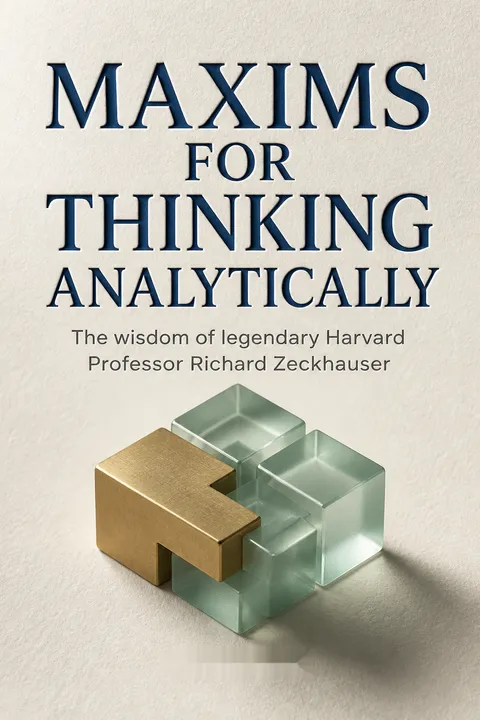


Key Takeaways
When reasoning stalls, test an extreme before building a bigger model.
Reduce the problem. Mary can paint a room in two hours and Jim in three. Averaging their times gives a tempting but wrong answer of two and a half hours. Imagine Jim simply watching: Mary still finishes in two hours, so his help must make the job faster. Calculating their combined work rates gives one hour and twelve minutes. Extreme cases expose faulty intuition and provide a quick check on a model. Zeckhauser's mentor Howard Raiffa used the same discipline, urging him to simplify a problem with three kinds of decision makers even further, to two.
Then return to reality. For a complex negotiation, policy, or model, start with a stripped-down version or a familiar everyday comparison. The goal is not to pretend the real situation is simple. It is to find its working parts, then add important complexity back in.
The method resembles a controlled experiment: vary one feature, observe what changes, and learn which parts of the problem matter. It also makes reasoning easier to challenge, because assumptions are visible rather than buried in a complicated model. The danger is mistaking a useful simplification for a complete explanation. Extreme cases can reveal a boundary or contradiction, but they do not establish how a messy real case behaves. The strongest use is iterative: simplify, derive an insight, and test whether it survives when realistic features return.
Treat forecasts as probabilities, not promises, and update them with evidence.
Uncertainty is ordinary. Before the 2016 U.S. election, FiveThirtyEight gave Donald Trump a 29 percent chance of winning. That made Hillary Clinton the favorite, not the certain winner. A 29 percent chance means that an outcome like Trump's would occur in roughly 29 of 100 comparable simulations. Yet many people who saw the forecast were shocked when it happened. In Zeckhauser's estimation exercise, students expected only 2 percent of their answers to fall outside their stated 1-to-99 percent ranges. In a typical year, about 30 percent did, a sign of overconfidence.
Revise your beliefs. A subjective probability is a reasoned estimate when no objective frequency is available. Bayesian updating means revising that estimate as relevant evidence arrives. The book distinguishes risk, where outcomes and probabilities are known, from uncertainty, where probabilities are not known, and ignorance, where even possible outcomes may be unimagined.
Putting a number on uncertainty makes disagreement more precise: two people can debate whether an estimate should be 20 or 40 percent instead of trading vague labels such as likely. Repeated forecasts also create a chance to learn whether confidence matches reality. This is especially useful when decisions must be made before certainty is possible. Still, numerical precision can create an illusion of rigor. A probability is only as trustworthy as its assumptions, and rare events often provide too little feedback to calibrate confidently. Good forecasting therefore includes both a number and an honest account of what could make it wrong.
Uncertainty protects the default, even when the default is failing.
Defaults feel safer. Status quo bias is the tendency to stick with a current or previous choice, even when another option may be better. Uncertainty about alternatives can make this seem sensible: why spend effort testing a new toothpaste if the old one is good enough? But the same reluctance can preserve a costly or harmful arrangement. During early COVID-19, waiting for definitive randomized trial results meant relying longer on a status quo that was already producing deaths. The book argues that faster, less definitive observational evidence could help guide treatment while stronger evidence accumulated.
Defaults steer behavior. Retirement plans and organ donation systems can use defaults to encourage beneficial choices, while automatic playback can keep a viewer watching. The key question is not simply whether to preserve or change a default, but whether the current arrangement deserves its advantage.
A default is never merely neutral when people tend to stay with it. This makes choice design powerful, but also ethically loaded: whoever selects the default can shape outcomes without requiring an explicit decision. The insight applies to organizations as well as consumers. A familiar procedure can persist because nobody wants to own the risk of changing it. Yet uncertainty cuts both ways: a new policy can be dangerous, too. The useful response is not automatic rebellion against the status quo, but a deliberate comparison between its known costs and the uncertain costs of alternatives.
Grade decisions by what was knowable then, not by luck afterward.
Separate process from outcome. The term resulting describes judging a decision mainly by what happened afterward. If a sober partner drives home after the other person has been drinking, and a drunk driver hits their car, the crash is a bad outcome, but asking the sober partner to drive was still the better decision with the information available. Decision trees help by laying out choices, possible events, probabilities, and consequences before the result is known.
Some choices remain painful. Richard and Sally Zeckhauser faced stage 3 breast cancer and uncertain treatment options. They investigated the evidence and chose a bone marrow transplant trial despite serious risks. Sally survived, but survival does not prove that the choice was right. The sounder test is whether the decision was defensible given the evidence and alternatives at the time.
This distinction reflects the philosophical problem of moral luck: people often receive praise or blame for consequences partly beyond their control. Separating process from outcome makes evaluation fairer and can prevent leaders from learning the wrong lesson from a lucky success or an unlucky failure. It does not mean outcomes are irrelevant. A result can reveal that the original probabilities were poorly estimated or that an important factor was missed. Good review therefore asks two questions: was the reasoning sensible beforehand, and what does the outcome teach about the assumptions?
Judge every path, including inaction and options not offered.
Inaction has a price. Errors of commission come from taking an action that turns out badly; errors of omission come from failing to act when action would have helped. The book's Amazon example gives both forms equal financial consequences. One investor sold shares worth about $20,000 in 1998, while another chose not to invest that amount. By 2021, either sum would have been worth more than $3 million if invested and held. The seller may feel more regret, but the missed gain is comparable.
Expand the menu. A doctor asks a patient with sweaty palms from one cholesterol drug whether the side effect is tolerable. A better question is whether another statin could work without it. Decisions are not limited to the options first presented. Compare action, inaction, and reasonable alternatives rather than giving the status quo an unearned pass.
People notice losses caused by visible action more readily than losses from paths never taken. That asymmetry can make organizations cautious in a lopsided way: a failed intervention is documented, while a missed opportunity remains hypothetical. The Amazon comparison makes the cost of omission legible, but its hindsight is unusually vivid because the winning investment is known. Most real alternatives cannot be observed so cleanly. The practical discipline is to record plausible options and expected consequences before acting, rather than treating a memorable success story as evidence that every neglected opportunity was valuable.
Ask whether information could change the action before paying to get it.
Information has a job. New facts are useful for a decision when they could alter what someone chooses, or improve the choice enough to justify their cost. A government official requesting more program statistics should be asked what might change if the numbers came back one way rather than another. If no action would change, collecting the data may waste time and money.
Do not wait by reflex. Richard's mother had severe abdominal pain, and doctors suspected either appendicitis or a tumor. They proposed waiting overnight for more information, but Richard asked whether surgery would be needed in either case. The surgeon operated that evening and found a leaking appendix. Waiting would have been dangerous. The relevant test was not whether more information could be learned, but whether it could change the treatment decision.
This is a practical form of value-of-information analysis: compare the expected improvement in a decision with the cost of gathering evidence. It guards against analysis that feels productive while postponing responsibility. The principle also has a limit. Information may matter beyond the immediate choice, by improving future decisions, reducing legal uncertainty, or helping others learn. And when evidence has a chance to change an irreversible, high-stakes choice, extra investigation may be worth substantial effort. The question should be whether information has decision value, not whether it is interesting in the abstract.
Compare policy options by marginal benefit per scarce resource, not slogans.
Divide benefit by cost. Long division is the book's plain-language version of comparing what an intervention achieves with what it consumes. A vaccination site costing $50,000 a day and delivering 1,000 vaccinations costs $50 per dose. But the meaningful output is not doses alone: it is illness and death prevented. A policy analyst must choose a measure that reflects the actual goal.
Think at the margin. An elasticity measures how much one quantity changes when another changes, often expressed as the percentage response to a 1 percent change. The related habit is to ask what the next unit of time or money adds. An extra work hour may bring little income while taking valuable family time. In a clinic, funds should move toward the activity producing the greatest additional health benefit per dollar.
Ratios make competing uses of limited resources visible and can puncture proposals that sound compelling but deliver little per dollar. Marginal analysis is especially useful because the value of the next unit often differs from the value of the first. But the arithmetic cannot choose society's goals. A policy that maximizes total benefit might neglect people with greater need, and some important values resist easy measurement. Strong analysis makes the denominator and outcome explicit, then states what the ratio leaves out, including fairness, rights, and who bears the costs.
Segment populations before trusting their averages.
Averages can conceal structure. Heterogeneity means that people in a population differ in relevant ways. During the COVID-19 pandemic, Singapore's overall reproduction rate stayed below one, but transmission in migrant worker dormitories was estimated at two to three. The overall figure concealed a high-risk setting. The population's relatively low death rate also reflected that many infected workers were young and healthy, so the same outbreak in nursing homes could have had a different toll.
Look inside the total. Health spending varies sharply across people and conditions. The book notes that chronic disease accounts for 86 percent of U.S. health care costs, making policies focused on chronic illness more promising than uniform measures. Breaking a total into meaningful subgroups can explain patterns that a single average obscures and can help target resources where needs and outcomes differ.
This is a defense against ecological error, the mistake of assuming that a group-level pattern describes every person within the group. It also helps explain why an overall trend can change as the mix of people at risk changes. Segmentation is not automatically wise, however. Groups must be chosen for a relevant reason, not because a convenient category is available. Poorly chosen categories can hide variation within groups or turn statistical patterns into stereotypes. The strongest analysis asks which differences plausibly drive the outcome and checks whether the explanation survives alternative ways of dividing the population.
Pair complementary skills instead of assembling more of the same.
Some inputs multiply value. Complementary inputs are resources whose usefulness rises when the other is available. At a tennis camp, a second instructor is less valuable when there is only one court. Add another court, and that instructor can serve more players. The same logic applies to collaborators: another person with the same strength may add less than someone who supplies a missing skill.
Design for fit. Zeckhauser describes collaborating with people from different disciplines and with abilities that fill his own gaps. Someone strong at generating ideas can gain from a partner who excels at execution; a researcher may benefit from an expert in a different field. Complementarity also matters in everyday relationships, where different approaches to speed, caution, or expertise can improve joint decisions.
The idea connects team design to production: performance depends not just on how much talent is present, but on whether the talents work together. This explains why adding a specialist, editor, or implementer can outperform hiring another person who excels at the same task. Difference alone is not a guarantee of synergy. Complementary roles require communication, trust, and a shared objective; otherwise, distinct expertise can produce friction instead of added value. A useful question when forming a team is not simply who is impressive, but what capability the group is currently missing.
Treat a friend's success as evidence of possibility, not a threat.
Comparison can sour good news. Envy turns another person's achievement into evidence of one's own inferiority. When a student told Richard Zeckhauser that a peer had made progress on a dissertation while he was stuck, Richard urged him to celebrate the peer and trust that his own progress would come. The student says this helped him stop treating colleagues as rivals and become more supportive in both work and personal life.
Make success social. A friend's breakthrough can offer encouragement, useful knowledge, or a reason to strengthen the relationship. The maxim is not a claim that every comparison is harmless. Rather, it directs attention away from ranking personal worth and toward appreciating what another person has achieved.
Social comparison can provide useful information: another person's progress may reveal a method, opportunity, or skill worth learning. The damage begins when comparison becomes a verdict on personal worth. Reframing success as possibility preserves the informational benefit while reducing the urge to resent the person who achieved it. This is particularly powerful in collaborative environments, where a colleague's success can improve shared work. The advice should not be used to dismiss genuine unfairness or unequal access. Celebrating another person's gain and examining structural barriers are compatible responses.
Learn from regret without letting it price your next decision.
Review, then release. Regret is not proof that a choice was bad. A well-reasoned choice can lead to an unlucky result, while a careless choice can get lucky. After a poor outcome, examine what was knowable and whether the reasoning can improve. Then move on rather than replaying the mistake as punishment.
Do not let past effort dictate future effort. The sunk-cost fallacy occurs when time, money, or work already spent is used to justify continuing an activity that no longer looks worthwhile. The book's examples include attending a poorly reviewed play because tickets are paid for, or staying in a failing investment or relationship because it has lasted for years. Past costs are gone; the relevant question is what future choice makes sense now.
Regret can serve as a signal that a goal mattered or that a decision deserves review, so eliminating it entirely is neither realistic nor necessary. The useful distinction is between learning and rumination. A structured review asks what assumptions failed and what would change next time; rumination repeatedly revisits the pain without improving the next choice. The sunk-cost principle helps because it separates historical expenditure from prospective value. Still, obligations and relationships can create genuine future costs, so persistence is not automatically irrational. The test is whether continuing has value from this point forward.
Schedule anticipation and savoring, not just the event itself.
Pleasure has a timeline. Anticipation utility is the enjoyment gained from expecting a future experience. A family can enjoy a vacation before it begins by planning hikes, meals, and places to visit. Remembering a good experience can extend its value after it ends, too. This suggests that pleasure is not limited to the moment of consumption.
Improve what you have chosen. After selecting a college, job, or place to live, seek out the features that make it a good fit and make choices that help it work well. Zeckhauser's advice is to make a sound choice, then actively increase its value. The caution is not to use positive thinking to deny real problems, or to keep investing in a bad option merely because it has already been chosen.
This connects decision-making to how people experience time: expectation and memory can shape satisfaction as much as the event itself. Planning can turn a future reward into a source of present enjoyment, while savoring helps attention stay with a worthwhile experience. The approach also counters the tendency to fixate on flaws after a choice is made. Its limit is important: anticipation can become worry, and deliberate savoring cannot redeem every bad situation. It works best when the expected event is genuinely appealing and when appreciation does not replace necessary change.
Analysis
The book's central contribution is less a single decision formula than a disciplined way to move between intuition and analysis. Simplify a problem until its structure becomes visible, represent uncertainty rather than disguising it, and compare choices by their expected consequences. Then carry that discipline into evaluation: do not confuse a lucky result with sound reasoning, or a quiet omission with harmlessness. The memorable stories make these ideas portable, from a painting-rate puzzle to a family confronting cancer treatment.
The approach is strongest when decisions are consequential, alternatives can be named, and outcomes can be evaluated against some shared objective. It is also a corrective to two common institutional habits: demanding impossible certainty before acting, and mistaking technical complexity for understanding. Yet analytic tools do not settle every dispute. A benefit-cost ratio depends on which benefits count, whose costs matter, and how unequal impacts are treated. Expected value can also understate concern about irreversible harms or low-probability disasters when the underlying probabilities are poorly understood. In such cases, the book's emphasis on uncertainty and ignorance is vital, but it cannot manufacture reliable numbers from thin evidence.
The maxims are best treated as prompts for better questions, not commandments. Extreme cases test a claim but do not substitute for evidence. A default can be harmful, but changing it is not automatically wise. More information can be wasteful, yet it may create value beyond the immediate decision. The method therefore asks for intellectual humility as much as calculation: make assumptions visible, seek information that can alter action, and notice who is hidden by an average. Its humane thread is equally important. Decision-makers deserve judgment by what they could reasonably know, while people living with outcomes deserve compassion. Clear analysis and human concern are not rivals. Each helps prevent the other from becoming narrow or cruel.
Review Summary
Reviews of Maxims for Thinking Analytically are mixed. Many praise its concise presentation of useful decision-making frameworks, particularly for those new to analytical thinking. Readers appreciate the real-world examples and practical applications. However, some critics find the content basic or overly simplistic for those already familiar with mental models. The book's heavy focus on Richard Zeckhauser receives both admiration and criticism, with some viewing it as excessive praise. Overall, readers find value in the maxims but opinions vary on the depth and novelty of the content.
People Also Read









Glossary
Status quo bias
Preference for the current choiceThe tendency to retain an existing or previous choice more often than an objective comparison of alternatives would warrant. Uncertainty about alternatives can reinforce it, because the current option feels familiar. The bias can preserve an inferior arrangement, but defaults can also be deliberately designed to make beneficial choices easier.
Subjective probability
A reasoned chance estimateAn estimate of how likely an event is when its probability cannot be calculated from a known random process. It can apply to one-time events, personal choices, or future conditions. Subjective does not mean arbitrary: estimates can be informed by evidence, compared with outcomes, and assessed for calibration over many predictions.
Bayesian updating
Revising beliefs with evidenceA process for changing a probability estimate when relevant new information arrives. The initial estimate is a prior, and the revised estimate is a posterior. For example, a basketball fan might raise the estimated chance of victory after learning that the opposing team's star player is injured.
Risk, uncertainty, and ignorance
Three kinds of unknownsRisk describes situations where possible outcomes and their probabilities are known. Uncertainty describes situations where outcomes can be identified but their probabilities are not known. Ignorance goes further: some possible outcomes or states of the world are themselves unknown. The distinctions matter because familiar probability calculations cannot fully address every kind of unknown.
Resulting
Judging choices by outcomesThe error of evaluating a decision mainly by what happened afterward, rather than by whether the reasoning was sound with the information available at the time. A sensible choice can produce a bad result through chance, and a poor choice can succeed by luck. Outcomes can inform review, but do not alone establish decision quality.
Omission bias
Overweighting mistakes from actionThe tendency to judge harmful actions more harshly than harmful inactions, even when their consequences are comparable. Selling an investment that later rises can provoke more regret than declining to buy it, despite similar missed gains. The bias can encourage excessive caution and obscure the costs of failing to act.
Elasticity of trust
Trust's response to changed incentivesA measure of how much willingness to trust changes when the likelihood or cost of betrayal changes. The concept reflects the finding that people may care not only about the financial size of a possible loss, but also about whether another person caused it. Institutions that compensate losses may therefore fail to restore trust fully.
Quality-adjusted life year (QALY)
A measure of health benefitA measure combining the length and quality of life associated with a health outcome. One QALY represents one year in perfect health; states of poorer health count as fractions of a QALY, and death is assigned zero. Policy analysts use QALYs to compare health benefits with the resources required by different interventions.
Consequential Amazing Developments
Important unforeseen outcomesOutcomes that matter greatly but could not be envisioned by the decision-maker at the time of choice. The term highlights a limit of ordinary risk analysis: people can estimate probabilities only for possibilities they can conceive. A consequential development may reshape a life or decision in a way that no prior scenario captured.
Positive cross-partial derivatives
Inputs that increase each other's valueAn economic relationship in which adding more of one input raises the marginal productivity of another input. More tennis courts can make an additional instructor more useful, because the instructor can serve more players. The idea also describes collaborators whose different skills create greater value together than similar skills would.
Anticipation utility
Pleasure from expecting rewardsThe enjoyment people receive from looking forward to a future experience, in addition to the pleasure of experiencing it. Planning a vacation, imagining its activities, and discussing it with family can make the period before departure enjoyable. Remembering a good experience can also extend its value after the event.
FAQ
1. What’s "Maxims for Thinking Analytically" by Dan Levy about?
- Analytical Thinking Framework: The book distills the wisdom of Harvard Professor Richard Zeckhauser into a set of maxims—short, memorable principles—to help readers think more analytically about the world.
- Decision-Making Under Uncertainty: It focuses on improving decision-making, especially in situations involving uncertainty, risk, and complexity, drawing from Zeckhauser’s decades of teaching and research.
- Practical Applications: Through real-life anecdotes, policy examples, and personal stories, the book demonstrates how these maxims can be applied in professional, policy, and personal contexts.
- Accessible Wisdom: The content is designed to be accessible to readers from all backgrounds, avoiding technical jargon and emphasizing clear, actionable advice.
2. Why should I read "Maxims for Thinking Analytically" by Dan Levy?
- Improve Decision-Making: The book provides practical tools to make smarter, more rational decisions in both personal and professional life.
- Learn from a Renowned Expert: It encapsulates the teachings of Richard Zeckhauser, a legendary Harvard professor known for his insights on risk, uncertainty, and policy analysis.
- Broad Applicability: The maxims are relevant for anyone—students, professionals, policymakers, or anyone seeking to think more clearly and effectively.
- Engaging and Relatable: The book uses stories, analogies, and real-world examples to make complex concepts understandable and memorable.
3. What are the key takeaways from "Maxims for Thinking Analytically"?
- Simplify to Understand: When stuck, simplify problems by considering extreme or simple cases, and avoid unnecessary complexity.
- Embrace Uncertainty: Recognize that the world is more uncertain than we think, and learn to think probabilistically about outcomes.
- Separate Decisions from Outcomes: Good decisions can have bad outcomes, and vice versa; focus on the quality of the decision process, not just results.
- Policy and Life Lessons: Use tools like long division (cost-benefit analysis), understand population heterogeneity, and capitalize on complementarities in collaborations and life.
4. Who is Richard Zeckhauser, and why is his wisdom central to "Maxims for Thinking Analytically"?
- Harvard Professor: Richard Zeckhauser is a long-time professor at the Harvard Kennedy School, renowned for his work in decision theory, behavioral economics, and public policy.
- Pioneer in the Field: He introduced influential concepts such as status quo bias, betrayal aversion, and the importance of recognizing ignorance in decision-making.
- Mentor and Polymath: Zeckhauser is celebrated for his intellectual breadth, generosity, and ability to distill complex ideas into practical wisdom.
- Real-World Impact: His teachings have influenced leaders, policymakers, and students worldwide, including notable figures like Singapore’s Prime Minister Lee Hsien Loong.
5. How does "Maxims for Thinking Analytically" by Dan Levy help readers think more analytically?
- Maxims as Tools: The book presents maxims—concise, actionable principles—that guide readers to approach problems logically and systematically.
- Practical Examples: Each maxim is illustrated with stories and real-life scenarios, showing how to apply analytical thinking in diverse situations.
- Encourages Probabilistic Thinking: Readers learn to assess uncertainty, assign subjective probabilities, and update beliefs as new information arises.
- Promotes Simplicity and Clarity: The book emphasizes simplifying complex issues and using analogies to make abstract concepts concrete.
6. What are some of the most important maxims in "Maxims for Thinking Analytically," and what do they mean?
- Go to an Extreme or Simple Case: When stuck, consider the most extreme or simplest version of a problem to gain insight.
- Don’t Take Refuge in Complexity: Avoid hiding behind complicated models; strive for clear, intuitive understanding.
- Think Probabilistically: Assign and update probabilities to uncertain events, rather than relying on certainty or gut feeling alone.
- Errors of Commission vs. Omission: Treat mistakes of action and inaction equally when evaluating decisions.
- Information Value: Only seek information if it could change your decision; avoid unnecessary data gathering.
7. How does "Maxims for Thinking Analytically" by Dan Levy address uncertainty and risk?
- Uncertainty is Ubiquitous: The book stresses that the world is far more uncertain than most people realize, and certainty is often an illusion.
- Risk vs. Uncertainty vs. Ignorance: It distinguishes between risk (known probabilities), uncertainty (unknown probabilities), and ignorance (unknown unknowns).
- Probabilistic Reasoning: Readers are encouraged to assign subjective probabilities to outcomes and update them as new information becomes available.
- Practical Exercises: The book includes estimation exercises and real-world examples (e.g., COVID-19, elections) to illustrate how to handle uncertainty.
8. What practical decision-making advice does "Maxims for Thinking Analytically" offer?
- Focus on Process, Not Just Outcomes: Judge decisions by the quality of the process and information available at the time, not just by results.
- Decision Trees and Expected Value: Use tools like decision trees to map out choices, uncertainties, and expected outcomes.
- Don’t Be Limited by Presented Options: Look beyond the immediate choices; consider creating new alternatives.
- Avoid Regret and Status Quo Bias: Don’t let fear of regret or comfort with the status quo prevent you from making optimal decisions.
9. How does "Maxims for Thinking Analytically" by Dan Levy apply to policy analysis and public decision-making?
- Long Division Principle: Use simple ratios (output per input) to compare policy options and maximize impact per resource spent.
- Elasticities and Marginal Thinking: Understand how changes in one variable affect another, and focus on marginal (incremental) effects.
- Heterogeneity Matters: Recognize differences within populations to design more effective and equitable policies.
- Complementarities: Seek synergies by combining resources or collaborating with people who have different strengths.
10. What are some key concepts unique to "Maxims for Thinking Analytically," and how are they explained?
- Status Quo Bias: The tendency to stick with current choices, especially under uncertainty, even when better options exist.
- Betrayal Aversion: People are more averse to losses caused by others’ actions than by bad luck, affecting trust and institutional design.
- Ignorance: Beyond risk and uncertainty, ignorance refers to situations where even the possible outcomes are unknown.
- Anticipation Utility: The idea that planning and looking forward to positive events can enhance happiness, not just the events themselves.
11. What are the best quotes from "Maxims for Thinking Analytically" by Dan Levy, and what do they mean?
- “When you are having trouble getting your thinking straight, go to an extreme case.” – Simplifying a problem by considering its limits can reveal hidden insights.
- “Good decisions sometimes have poor outcomes.” – Focus on making sound decisions, not just on whether things turn out well.
- “Uncertainty is the friend of the status quo.” – People often avoid change when outcomes are unclear, even if change could be beneficial.
- “Strive hard not to be envious – see your friend’s success as your gain.” – Avoiding envy leads to greater happiness and stronger relationships.
12. How can readers implement the advice from "Maxims for Thinking Analytically" by Dan Levy in their own lives?
- Adopt and Practice Maxims: Select a few maxims to focus on, reflect on past and future situations where they apply, and review progress regularly.
- Apply to Everyday Decisions: Use the principles in personal choices, professional dilemmas, and policy evaluations to improve outcomes.
- Share and Discuss: Engage with others by sharing experiences, submitting stories, or discussing the maxims to reinforce learning.
- Continuous Improvement: Treat analytical thinking as a skill to be developed over time, using the book’s exercises and reminders to build better habits.
Download PDF
Download EPUB
.epub digital book format is ideal for reading ebooks on phones, tablets, and e-readers.








